UV Protection for Cyclists Eyes: The Complete 2026 Guide
Contents18 min read
It is the third week of August. The Vuelta peloton is grinding up the Alto de l'Angliru under a Spanish sky that looks benign from below but delivers UV radiation at altitude with an intensity most riders never account for. Down at sea level, at the Saturday sportive you have been training toward for three months, the conditions feel softer but the maths are nearly identical: four to six hours of uninterrupted UV exposure, eyes wide open, no windscreen between you and the sun.
Eye protection for cyclists is discussed far less seriously than, say, sunscreen or hydration. Yet the eye is one of the few tissues in the human body that accumulates UV damage without any meaningful regenerative response. The retina does not tan. The lens of the eye does not shed and renew like skin. Every unprotected hour in the saddle adds to a biological total that ophthalmologists have been tracking for decades, and the data is not reassuring for anyone who rides regularly outdoors.
This guide covers the physiology of UV eye damage in plain terms, explains why cyclists sit in a genuinely elevated risk category, and gives you the information you need to evaluate whether your current glasses are actually doing the job or just making you feel like they are.
01 · The scienceWhat UV radiation actually does to the eye
Ultraviolet radiation sits just below visible light on the electromagnetic spectrum. The two bands relevant to eye health are UVB (280 to 315 nanometres) and UVA (315 to 400 nanometres). Both reach the eye on every outdoor ride. Both cause damage through different mechanisms, and both are blocked completely by any lens certified to UV400 standard.
UVB is the higher-energy band. It is absorbed primarily by the cornea and the anterior lens. In acute doses it causes photokeratitis, the eye equivalent of sunburn: intense pain, temporary blurred vision, and a gritty sensation that can last 24 to 48 hours. Cyclists rarely experience full photokeratitis because the threshold dose is high, but subclinical corneal stress from repeated UVB exposure accumulates in ways that are harder to feel and easier to ignore. Research has linked chronic UVB exposure to accelerated development of pterygium, a growth of tissue over the cornea that is more common in outdoor workers and athletes than in the general population.
UVA is the more insidious of the two. It penetrates deeper into the eye, passing through the cornea and reaching the crystalline lens and, in part, the retina itself. The primary long-term concern with UVA is cataract formation. The lens of the eye absorbs UVA and over time the proteins within it begin to yellow and aggregate, reducing optical clarity. Cataracts are the leading cause of preventable blindness globally, and outdoor occupation is a documented risk factor. For cyclists who log serious mileage across a career spanning decades, this is not a distant abstraction.
Beyond the lens, cumulative UVA exposure reaching the retina contributes to oxidative stress in the macula, the region responsible for central, high-resolution vision. The link between UV exposure and age-related macular degeneration is not as direct as the cataract connection, but epidemiological data consistently shows higher incidence in populations with prolonged outdoor UV exposure.
The eye does not tan. The lens does not shed and renew. Every hour of unprotected UV exposure adds to a biological total the eye cannot clear.Velluto Eye Health Guide, 2026
02 · Risk factorsWhy cyclists are a genuinely high-risk group
UV risk is not distributed evenly across outdoor activities. Cyclists sit near the top of the exposure hierarchy for reasons that are structural to the sport itself, not merely a function of time outdoors.
First, duration. A typical road cyclist completing a sportive or a serious training ride spends four to seven hours in direct sunlight in a single session. Compare that to a golfer taking four hours on a course with tree cover and regular turns away from the sun, or a runner who might manage 90 minutes. Cyclists sustain forward-facing head positions with eyes tracking a consistent horizon for the entirety of a long ride. The cumulative dose in a single session is high.
Second, timing. Most recreational cyclists ride between 07:00 and 14:00, which overlaps almost entirely with the peak UV index window. UV radiation is not uniform across the day. It peaks between 10:00 and 14:00 in summer months across central and southern Europe, and riders who are mid-ride during this window are receiving exposure at its most intense. A Vuelta stage starting at 13:00 in late August is beginning precisely when UV radiation peaks.
Third, there is no windscreen. Car drivers benefit from a glass windscreen that blocks the majority of UVB radiation naturally. The windscreen of a road bike is the cyclist's face. There is no filter between the sun and the eye except whatever is sitting on the rider's nose.
Fourth, reflection. Road surfaces, particularly pale asphalt and concrete, reflect UV radiation upward toward the face. This is the same mechanism that makes snow so dangerous for eye exposure at altitude. On a bright summer day, a cyclist receives UV from above (direct solar) and from below (road reflection), creating a bilateral exposure that no hat brim can address.
Fifth, altitude. This factor is worth examining in detail, because it is both significant and widely underestimated.

03 · AltitudeThe 10 percent rule every climber should know
UV intensity increases by approximately 10 to 12 percent for every 1000 metres of altitude gain. The mechanism is straightforward: at higher altitude, there is less atmosphere between the rider and the sun, and the atmosphere is what absorbs and scatters a portion of incoming UV. Thinner atmosphere means less filtration, more radiation reaching the surface.
To put this in concrete terms: a rider summiting a 2000 metre pass such as the Col du Tourmalet or the Sierra Nevada climbs that feature in late Vuelta stages is receiving roughly 20 to 24 percent more UV radiation at the top than they were at the valley floor, without any change in visible conditions. The sky may look the same colour. The air may feel similarly warm. But the UV intensity is categorically different.
This matters more for cyclists than for most outdoor users because climbers spend sustained time at altitude, not just a few minutes. A mountain stage of four hours includes potentially two or three hours at elevations above 1500 metres. That is a substantially elevated UV dose that accumulates ride by ride, season by season.
Reflection compounds the altitude effect. Snow and ice reflect up to 80 percent of incoming UV radiation. Even on summer climbs without snow, pale rock, bright road surfaces and any standing water create reflective conditions that add to the direct solar dose. For Vuelta riders, late August stages in Spain combine high UV index, significant altitude, dry reflective terrain, and peak-hour starts. From an eye health perspective, this is about as demanding an environment as recreational cycling produces.
The practical implication is simple but worth stating directly: if you ride mountain terrain, your UV exposure per hour of riding is meaningfully higher than flat-road riding at the same time of day. Glasses that provide UV400 protection at sea level provide the same certified protection at 2000 metres. That consistency is exactly why UV400 certification matters more than any other single specification on a cycling lens.
04 · Common mistakesThe lens colour misunderstanding that costs cyclists their eye health
There is a persistent belief among cyclists that darker lenses offer more UV protection. It is understandable. Dark lenses reduce visible glare, and glare is associated with bright conditions, which are associated with UV. But the logic is incorrect, and the error matters.
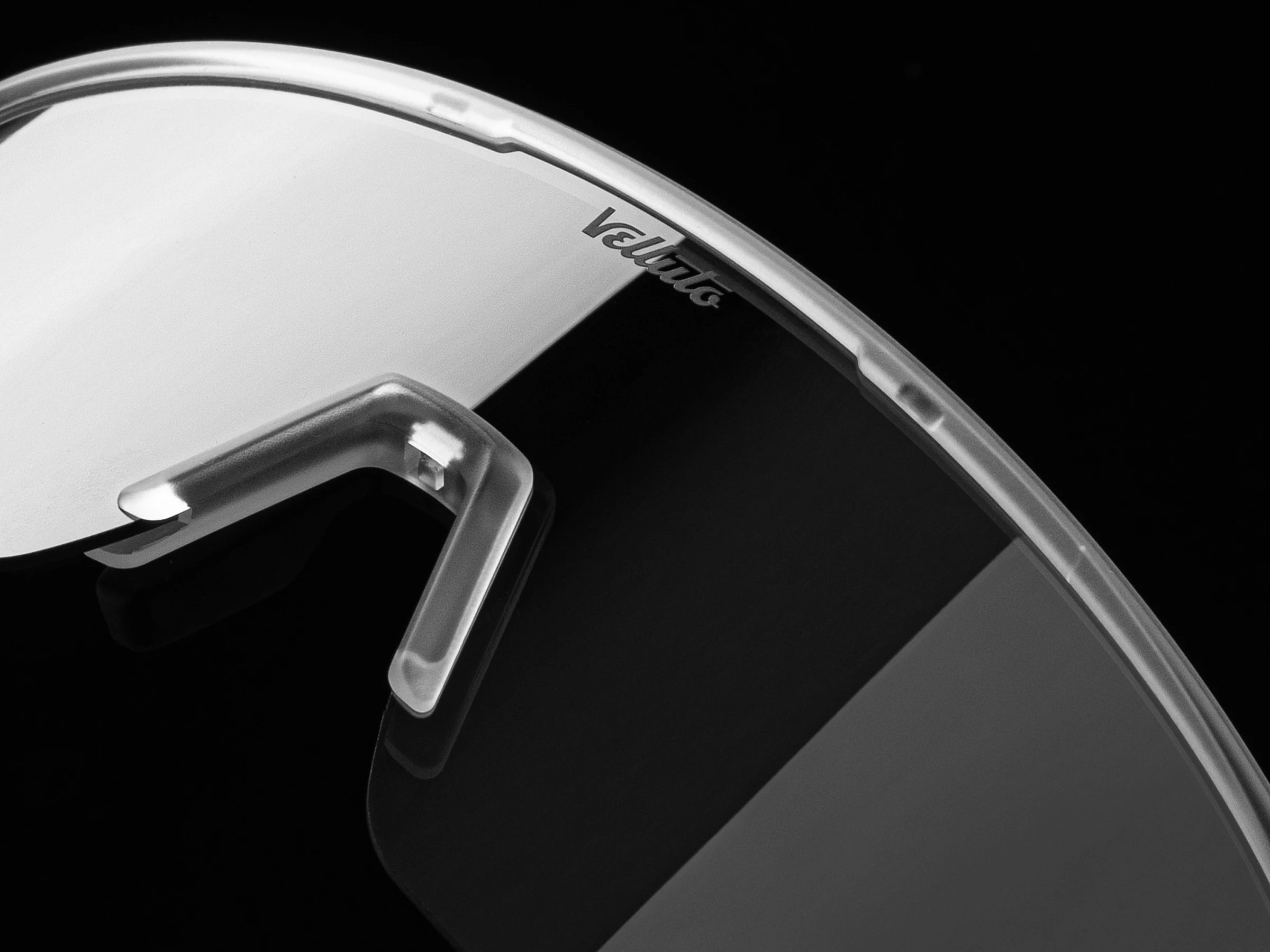
UV blocking and lens tint are entirely independent properties. A lens can be deeply tinted without any UV-blocking coating, and a clear lens can carry full UV400 certification. The UV400 standard describes the wavelength at which the lens blocks radiation, not the density of its visible tint. A dark brown lens with no UV coating will pass UV freely while appearing protective. A clear VellutoPuro lens with UV400 certification blocks 100 percent of UVA and UVB while transmitting full visible light.
This is not a theoretical concern. In the early 2000s, consumer testing in several European markets found a meaningful proportion of inexpensive sunglasses, including some marketed to sports users, claiming UV protection without meeting UV400 standards. The EU's CE mark for eyewear covers optical quality and physical safety but does not by itself guarantee UV400 performance. Explicit UV400 or "100% UVA/UVB protection" certification on the lens or documentation is the relevant standard, not CE alone.
A second common mistake is assuming that old glasses still perform as they did when new. UV-blocking coatings in lower-quality lenses can degrade over time, particularly with repeated cleaning using abrasive materials or inappropriate cleaning products. If your cycling glasses are three or four seasons old, have been cleaned with rough cloths, or have visible scratching, the UV performance they were sold with may no longer be what they deliver.
05 · Overcast daysThe grey-sky trap: why cloud cover is not UV cover
Overcast days feel safer. The glare is gone, temperatures often drop, and squinting is unnecessary. For many cyclists, this translates instinctively into leaving the glasses at home or reaching for an unprotected pair.
UV radiation does not behave like visible light in this respect. Cloud cover reduces UV intensity, but not to safe levels. On a uniformly overcast day, UV radiation typically remains at 70 to 80 percent of clear-sky intensity. On a day with thin or partial cloud, intensity can match or exceed clear-sky conditions because clouds scatter UV in multiple directions rather than simply blocking it.
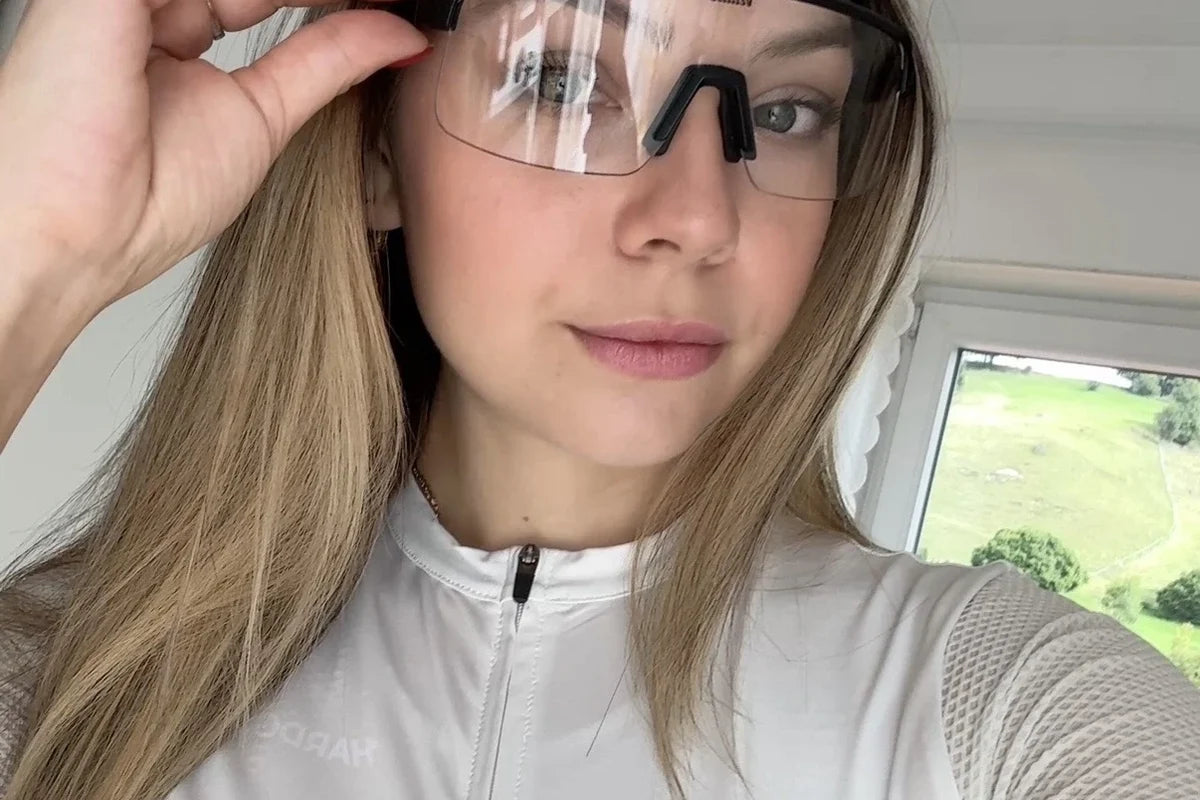
The practical implication for cyclists is that UV protection is required on every ride with any outdoor daylight, not only on days when you are reaching for sunglasses instinctively. This is where a UV400 certified clear lens becomes genuinely valuable. A VellutoPuro lens in the StradaPro frame provides full UV400 protection, shields the eye from wind and insects on open roads, and adds no tint that would impair vision in low light. It is the solution for the overcast sportive, the early morning training ride, and the late-season event where the sky is white and the UV is still present.

06 · What UV400 meansReading the certification and understanding what it actually guarantees
UV400 is a specific technical standard. A lens meeting UV400 blocks all ultraviolet radiation with wavelengths up to 400 nanometres. Since the UV spectrum runs from approximately 100 to 400 nanometres, and the biologically relevant bands for eye damage (UVA and UVB) sit between 280 and 400 nanometres, UV400 means complete protection against all solar UV that reaches the earth's surface.
The standard is expressed as a wavelength threshold rather than a percentage, which can cause confusion. "UV400" and "100 percent UVA/UVB protection" mean the same thing when the lens genuinely meets the standard. Both statements appear on verified Velluto lenses. Either phrasing confirms that no UVA or UVB passes through the lens under normal conditions.
What UV400 does not cover is infrared radiation (which generates heat but is not a documented cause of the UV-linked eye conditions discussed here) and visible blue light, which is a separate topic with its own ongoing research. For the purposes of what cyclists need to understand about UV eye damage, UV400 is the relevant and sufficient standard.
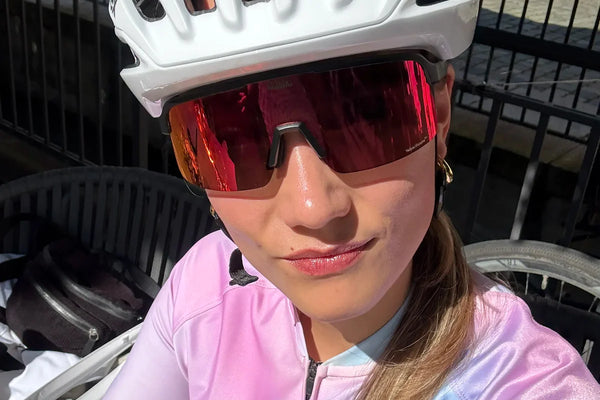
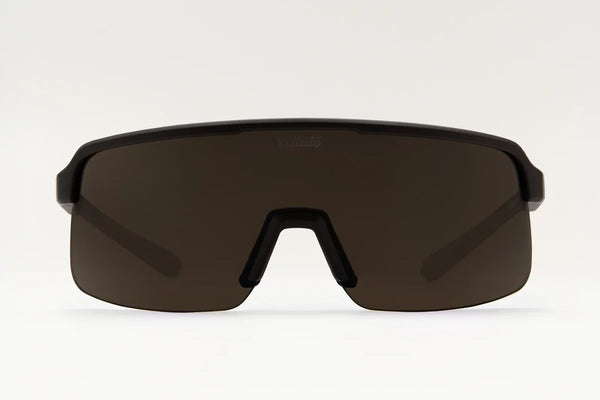
Both lenses available for the Velluto StradaPro carry UV400 certification. The VellutoPuro (clear) lens is UV400 certified for use in low light, overcast conditions, and all-day rides where variable weather makes a dark lens impractical. The VellutoVisione high-contrast lens is UV400 certified for bright conditions where enhancing visual definition across road surfaces, terrain changes, and distance is the priority. Swapping between them with the StradaPro's click-in system takes seconds and does not alter the UV protection delivered by either lens.

07 · Fit and coverageWhy the frame matters as much as the lens
UV400 certification tells you what the lens blocks. It does not tell you how much UV reaches the eye around the lens. Frame design is the other half of real-world UV protection for cyclists, and it is rarely discussed with the same rigour.
UV radiation does not travel only along the line of sight. It scatters from the sky, reflects from surfaces, and enters the eye from the sides, top, and below the frame. A lens that blocks UV400 across its surface area is only as protective as the coverage it provides. A small lens, an open frame design, or a frame that sits far from the face creates gaps through which UV passes freely.
Road cycling frames are generally well-designed for coverage by category standards. The aerodynamic wrap geometry that makes cycling glasses look the way they do also serves an eye health function: it places a continuous lens surface close to the face across a wide arc, reducing the pathways for UV scatter. The StradaPro's frame geometry follows this convention.
Fit compounds coverage. A frame that does not sit correctly on the face, that slides down the nose under sweat or that sits too far from the face due to an incompatible nose pad, creates gaps between the lens edge and the face that admit UV from below and the sides. This is one of the underappreciated arguments for adjustable nose pads on cycling glasses. When the frame sits at the correct distance and angle for the rider's face shape, coverage is consistent across the entire lens area. When it does not fit properly, coverage is intermittent regardless of UV400 certification.
The StradaPro's adjustable nose pads allow the frame to be positioned correctly for a wide range of face geometries, keeping the lens close to the face for consistent coverage without pressure that causes discomfort on long rides. This is not primarily a comfort feature. For UV protection purposes, it is a functional requirement.

08 · Practical guideChoosing the right lens for UV protection across different riding conditions
UV400 protection is not a variable. Either a lens has it or it does not. What varies across different riding conditions is which lens serves the rider's visual needs while maintaining full UV protection. For cyclists riding across a typical late-summer season that includes bright sportives, early morning training rides, mountain climbs, and overcast autumn days, no single tinted lens is the correct answer for every situation.
This is the practical argument for an interchangeable lens system. A click-in system that allows a rider to swap between a clear UV400 lens and a high-contrast UV400 lens in seconds, without tools, means UV protection is constant while visual optimisation adapts to conditions. There is no compromise between eye health and performance vision.
The VellutoPuro clear lens is the choice for:
- Early morning rides before full daylight, where a tinted lens reduces useful vision
- Overcast and grey-sky days where UV is still present but visible light is limited
- Mixed-conditions rides that transition from pre-dawn to full daylight
- Tunnel sections on mountain routes where a tinted lens creates dangerous vision reduction
- Late-season rides in northern Europe where low light is the primary constraint
The VellutoVisione high-contrast lens is the choice for:
- Bright summer rides where distinguishing road surface texture, shadows, and gradient changes is the visual priority
- High-altitude stages where UV intensity is elevated and brightness is consistent
- Afternoon sportives in full sun where the high-contrast enhancement improves reading of the road ahead
- Rides in variable terrain where rapid visual definition of obstacles and surface changes matters for safety
In both cases, UV400 protection is identical. The choice between the two lenses is a performance and comfort decision, not an eye health decision. That distinction is worth understanding clearly: no riding condition removes the need for UV400 protection, but different conditions call for different levels of visible light transmission and contrast enhancement.

One practical note on lens maintenance: UV-blocking coatings in quality cycling lenses are durable, but lens surfaces should be cleaned properly to avoid micro-scratching that degrades optical quality over time. The Velluto Cleaning Spray uses a formula safe for coated cycling lenses and is refillable, which means the cleaning tool you use on your UV400 lenses is not introducing abrasive residue that compromises them gradually.


Compare the full lineup in the Velluto StradaPro cycling glasses collection.
09 · FAQFrequently Asked Questions
What does UV400 protection actually mean?
Is UV damage to eyes cumulative, like skin damage?
Do darker lenses always block more UV?
Does altitude increase UV exposure for cyclists?
Why are cyclists at higher UV risk than walkers or drivers?
Can cycling glasses with interchangeable lenses still provide UV400 protection?
What is the difference between UVA and UVB, and why do both matter for cyclists?
Is a clear lens worth wearing for UV protection on overcast days?
How do I know if my existing cycling glasses actually block UV400?
If the rides you are planning for the rest of this season include any combination of long hours, mountain terrain, and late-summer sun, the case for certified UV400 eye protection is straightforward. The Velluto StradaPro, with both VellutoPuro and VellutoVisione lenses UV400 certified, adjustable nose pads for consistent coverage, and a 30-day risk-free trial so you can verify the fit on actual rides, is built for exactly this kind of use. You can explore the full range and find the right lens combination for your riding at velluto-shop.com.