Burning Eyes When Cycling: Causes and Fixes
Contents23 min read
Burning eyes when cycling are caused by wind stripping your tear film faster than your body can replace it: at 30 km/h, moving air accelerates corneal drying within minutes, and the watery eyes that follow are a reflex that makes the dryness worse, not better. The fix is not eye drops at the finish line but a frame that reduces the column of air reaching your eye surface in the first place.
Updated: August 2026. If you have spent any time on summer roads this season, you already know the sensation. You roll out of a climb into a descent, the speed climbs toward 50 km/h, and within a minute your vision blurs, your eyes are streaming, and by the time you reach the valley you are blinking constantly just to see the road markings. It feels dramatic. The physiology behind it is actually quite straightforward, and once you understand it, the solution becomes obvious.
This guide works through the full picture: the corneal mechanics, why your tear reflex backfires, how frame geometry interacts with airflow, what ventilation design actually means for dry eyes, and which lens properties matter for summer riding in high UV conditions. By the end, you will know exactly what to look for and why.
- Why wind dries the cornea at speed
- The watery eye paradox
- Summer conditions that amplify the problem
- Frame geometry: coverage, wrap and airflow
- Ventilation that helps versus ventilation that hurts
- Lens properties for bright summer riding
- Fit details that matter more than you think
- The StradaPro: how the design addresses each factor
- Frequently Asked Questions
01 · Corneal MechanicsWhy wind dries the cornea at speed
The cornea, the transparent front surface of your eye, is kept moist by a tear film that is only about seven micrometres thick. That film has three layers: a mucin layer that anchors the tears to the corneal surface, a watery aqueous layer that makes up the bulk of the volume, and a thin lipid layer on top that slows evaporation and stabilises the whole structure. Under normal conditions, blinking every four to six seconds re-spreads the film and keeps the surface hydrated.
When wind moves across the exposed eye surface, it accelerates evaporation of the aqueous layer. The physics here are the same as blowing across a wet surface to dry it faster: convection removes water vapour from the boundary layer above the surface and replaces it with drier ambient air, which in turn pulls more moisture out. The rate of evaporation scales with wind speed. At walking pace the effect is negligible. At 20 km/h it is mild. At 30 km/h and above, tear evaporation can outpace tear secretion from the lacrimal glands, meaning the film begins to thin and destabilise between blinks.
When the tear film thins below a critical threshold, the exposed corneal nerve endings register the dryness. Those nerves are among the most densely innervated in the human body, which is why even mild dryness produces a burning, stinging sensation out of proportion to what is actually happening. You are not damaging your eye at this point, but the sensation is real and, over a long ride, genuinely fatiguing.
At 30 km/h, moving air accelerates corneal drying faster than your tear glands can compensate. The burning you feel is the nervous system's early warning, not a sign of damage.Velluto Eye Health Guide, August 2026
The problem compounds on descents and in headwinds, where the effective wind speed across the face can reach 60 to 80 km/h even on a moderate gradient. Open roads with no tree cover or buildings to break the airflow, the kind of roads the Vuelta a España peloton crosses in August through Castile and Extremadura, are particularly aggressive environments for unprotected eyes.
02 · PhysiologyThe watery eye paradox: why reflex tearing makes it worse
Here is the part that frustrates a lot of riders: you stop, your eyes stop streaming, and within a few minutes they feel fine. Surely the watering means your eyes are self-correcting? In the short term, perhaps. Over the course of a long ride, the reflex tear response is actively counterproductive.
When the corneal nerve endings detect dryness, the trigeminal nerve sends a signal to the lacrimal glands to produce more tears. Those reflex tears are predominantly watery: they have a very different composition to the resting tear film. They contain far less of the lipid-producing secretions from the meibomian glands in the eyelids, which means the reflex tears lack the lipid layer that slows evaporation. In other words, the tears your body sends to fix the dryness are less stable than the tears they are replacing.
The result is a cycle. Wind evaporates the tear film. The cornea detects dryness. Reflex tears flood the eye. The reflex tears evaporate faster than the original film because they lack the lipid stabiliser. The cornea detects more dryness. The lacrimal glands produce more reflex tears. On a two-hour summer ride with no eye protection, this cycle runs continuously, and by the end your eyes are irritated not from the wind itself but from an afternoon of hyperstimulated lacrimal gland activity and repeated tear film instability.
The practical implication is important. You cannot solve burning eyes by training your body to produce more tears, or by using eye drops at the café stop. You solve it by reducing the rate of wind-driven tear evaporation at the source. That means putting something between the moving air and your cornea.
03 · Summer ConditionsHow late summer riding amplifies the problem
August is the peak month for burning eye symptoms among cyclists for several overlapping reasons, and if you are targeting a late-summer sportive or watching the Vuelta stages and planning your own riding around them, it is worth understanding exactly what you are up against.
First, temperature. Higher ambient temperatures increase evaporation rates independent of wind. When the air temperature is 35 degrees Celsius rather than 15 degrees, the same wind speed causes significantly faster tear film thinning. Riders who have no problem on cool spring mornings are often surprised when the same training route becomes uncomfortable in August. The route has not changed; the thermal environment has.
Second, humidity. Late summer in southern Europe, and during dry spells further north, brings low relative humidity. Dry air has a much higher capacity to absorb water vapour than saturated air, which further accelerates corneal evaporation. This is why mountain stages can be particularly uncomfortable: the air at altitude is both faster moving and drier.
Third, UV radiation. UV exposure peaks in late summer, particularly at altitude and in the late morning hours before clouds build. UV does not directly cause the burning sensation associated with wind-driven dryness, but cumulative UV exposure without adequate protection contributes to chronic corneal inflammation over time. A lens rated UV400 blocks 100 percent of UVA and UVB radiation, which is the correct protection threshold for summer road riding.

Fourth, blink rate suppression. Riding in bright conditions triggers a natural squinting response that reduces blink frequency. Since each blink re-spreads the tear film across the cornea, a reduced blink rate extends the interval between restorations of the lipid layer. In squinting conditions with low blink rate and high wind speed, the tear film can thin to its critical threshold in well under the four-to-six-second normal inter-blink interval.
Fifth, effort and breathing. Hard riding increases respiratory rate, and mouth-breathing in itself slightly elevates the evaporation environment around the face. This is a minor contributor compared to wind and temperature, but it stacks with the others during climbs and threshold intervals.
04 · Frame GeometryCoverage, wrap angle, and managing the airflow column
Now we get to the part that is directly actionable. If burning eyes when cycling are caused by wind reaching the cornea, the frame's primary job is to reduce the volume and velocity of air that makes contact with the eye surface. Three geometric properties determine how well a frame does this: lens height, wrap angle, and the gap between the frame and the face.
Lens height determines vertical coverage. A lens that extends from the brow line to below the lower orbital rim creates a physical barrier that forces wind to travel further around the face before it can approach the eye. Lenses that sit high on the face and leave the lower orbital area exposed allow a consistent column of upward-moving air, disturbed by your velocity, to reach the cornea from below. On a road bike in the drops, this upward airflow is significant because your face is tilted forward and the air hits the lower face first.
Wrap angle is the degree to which the lens curves around the side of the face. A lens with a generous wrap angle reduces lateral airflow ingress: the wind that would otherwise enter from the side of the frame is blocked before it can travel across the eye. Many fashion-adjacent cycling frames sacrifice wrap angle for a flatter, more stylistic profile. This is a direct trade-off that costs you eye comfort at speed.
Frame-to-face gap is the distance between the inner surface of the lens and the eye. A closer fit creates a smaller enclosed air volume in front of the eye, which is harder to flush with moving ambient air. A frame that sits far from the face creates a larger cavity that ventilates easily, which sounds beneficial but in practice means ambient air (including the dry, fast-moving air from your forward velocity) circulates freely across the cornea. This is why the fit of the nose pads matters: they determine how close and how consistently the frame sits relative to the face across the full ride.
Covers from brow to below the orbital rim. Blocks upward airflow in the dropped riding position.
Curves around the side of the face. Reduces lateral airflow ingress that reaches the cornea from the temple side.
Adjustable pads that sit flush reduce the lower air gap and keep the frame-to-face distance consistent throughout the ride.
Airflow routed behind the lens rather than across the cornea. Manages fogging without accelerating tear evaporation.
It is worth being specific about what wrap angle means in practice. A frame described as "sport wrap" typically has a lens that curves roughly 8 to 10 degrees beyond flat on each side. A frame with a more aggressive road cycling geometry may wrap to 15 degrees or beyond. The difference is visible when you hold the glasses and look at them from above: a flatter lens has a shallower arc, a wrapped lens forms a deeper curve. The wrapped lens sits closer to the temples and creates a more consistent seal between frame and face at the sides.
05 · VentilationAnti-fog ventilation that helps versus ventilation that hurts
This is the most misunderstood aspect of cycling eyewear, and it is the point where a lot of riders get confused. They hear "ventilation" and think any ventilation is good, or they hear "anti-fog" and assume that means more airflow across the lens. Neither is accurate.
Fogging occurs when warm, humid air from your breath or skin contacts the cooler inner surface of the lens and condenses. The solution is to manage the temperature and humidity differential between the air behind the lens and the air in front of it. There are two ways to do this: ventilation (letting air circulate behind the lens) and coating (applying a hydrophilic or hydrophobic coating to the inner lens surface that prevents droplets forming).
The problem with poorly designed ventilation is that vents positioned at the top and bottom of the lens create a convection current that draws air across the inner face of the lens, which also means drawing air across the eye surface. If you have ever worn a lens with large open vents on a descent and felt the wind directly on your eyes despite wearing glasses, this is why. The vents are doing exactly what they were designed to do: moving air. The issue is the direction and path of that airflow.
A well-designed anti-fog system routes air circulation to manage temperature without directing the airflow column across the cornea. The vents are positioned so that air circulates in the space between the lens and the brow, or is managed via the coating on the lens surface, rather than flushing across the eye. The distinction sounds subtle but the experiential difference on a long descent is significant.
The key question to ask about any cycling frame is not "does it have ventilation?" but "where does the airflow go?" A frame with a built-in anti-fog system and thoughtful vent placement manages lens clarity without trading it for corneal dryness. This is not a universal feature: it requires deliberate engineering choices about vent geometry and lens coating.
06 · Lens PropertiesWhat lens properties actually matter for summer riding
Once you have addressed the frame geometry and ventilation questions, lens selection is the next variable. For summer road riding in August conditions, there are two properties that directly affect how your eyes feel across a long ride: UV protection and contrast optimisation.
UV400 certification is the baseline that every summer riding lens should meet. UV400 means the lens blocks 100 percent of ultraviolet radiation up to 400 nanometres wavelength, which covers the entire UVA and UVB spectrum. Exposure to UVA and UVB without protection causes photokeratitis (effectively a sunburn of the cornea), cumulative lens damage over years, and short-term irritation that adds to the burning sensation already caused by wind-driven dryness. UV400 certification is not a premium feature: it is a minimum standard for any lens worn in full summer sun.
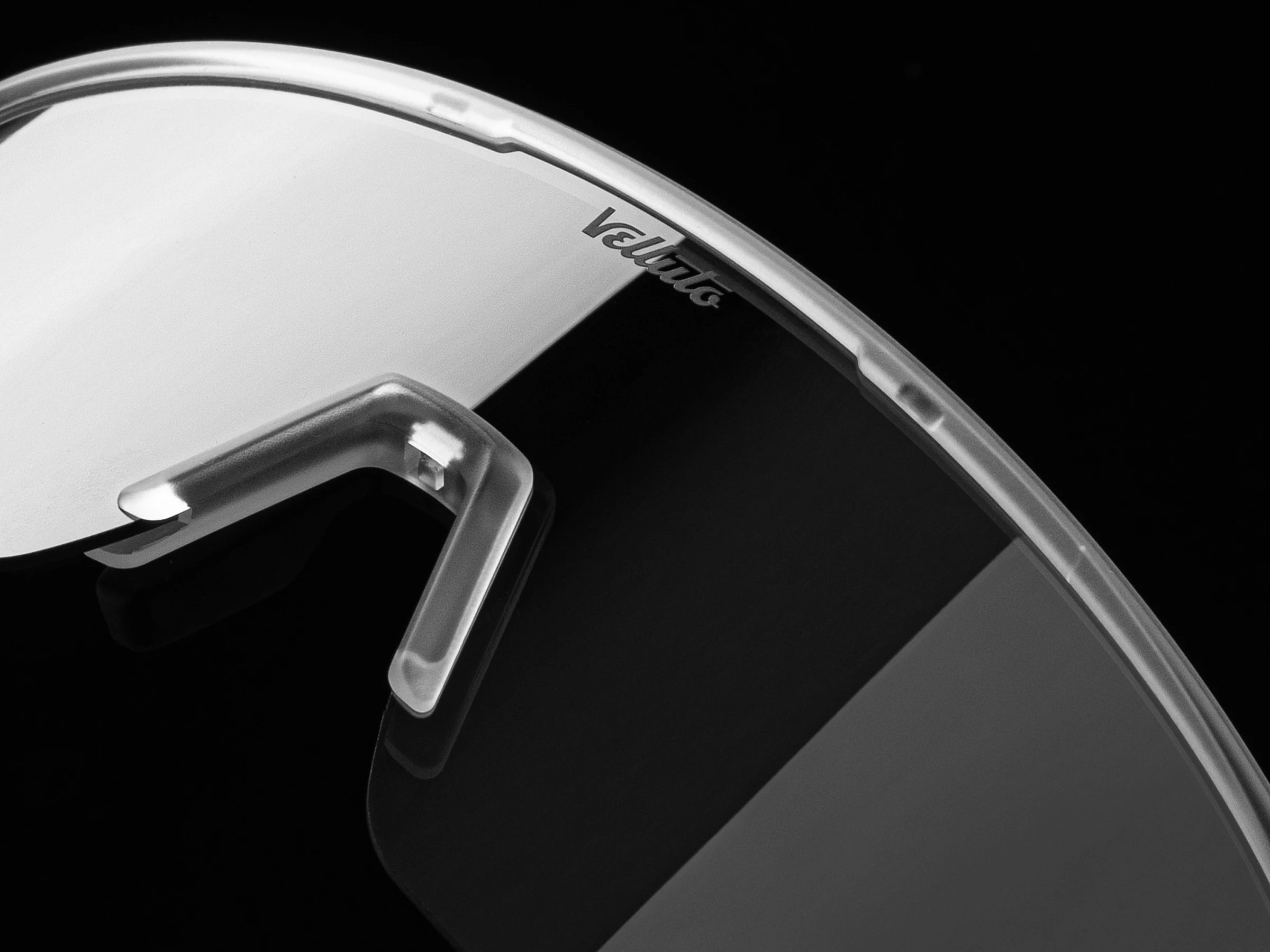
A clear lens, like the VellutoPuro, is UV400 certified and serves a different purpose: wind and insect protection with maximum light transmission. In the mixed conditions of a long sportive that starts at dawn or finishes in lower light, a clear lens allows full vision without compromising on protection. The anti-fog coating on the VellutoPuro is relevant here too: morning rides often involve temperature differentials that cause fogging, and a clear lens without anti-fog coating is not useful in those conditions even if the UV and wind protection is excellent.
A high-contrast lens, like the VellutoVisione, applies a tint that selectively filters specific wavelengths to sharpen the definition between road surfaces, shadows, and horizon lines. On a ride with significant tarmac variation, uneven surfaces, or broken road edges, this reduces the visual effort required to track the road. Over three or four hours at high intensity, the reduction in visual processing effort translates into reduced eye fatigue, which manifests as less burning and irritation by the end of the ride.

The interchangeable lens system matters here practically. A single fixed-lens frame commits you to one optical environment regardless of conditions. On a sportive that starts at 6am in low light and peaks at noon in full sun, or a training ride that encounters unexpected cloud cover, the ability to swap lenses quickly without tools means you can match the optics to the actual light. Click-in systems that require no tools and take under 10 seconds to change are genuinely useful in this context, not just a feature bullet point.
What cycling glasses do not need for the burning eye problem specifically: polarisation and photochromic response. Polarisation reduces glare from horizontal surfaces like wet roads and water but does not affect tear film stability or corneal dryness. It is a useful comfort feature for some environments but does not address the wind-driven dryness mechanism. Photochromic lenses that darken in UV are similarly useful for light management but irrelevant to the airflow problem. The lens properties that matter for burning eyes are coverage geometry (which is a frame property) and UV certification (which is a lens property).
07 · FitFit details that matter more than most riders realise
Frame geometry and lens technology only perform if the frame actually fits your face. A frame with perfect wrap angle that slides down your nose every 20 minutes loses its lateral sealing effect and allows lateral airflow in from the gap that opens at the temple. A frame that sits too tight across the nose creates pressure points that cause you to adjust it constantly, and each adjustment resets the position and disrupts the airflow management you started the ride with.
Adjustable nose pads are the most important fit feature for this reason. A fixed nose bridge creates a single geometry that fits some face shapes well and others poorly. An adjustable nose pad system allows the frame to be positioned at the correct height and angle for your specific nasal bridge geometry, which means the frame-to-face distance at the sides (where the wrap does its work) is consistent regardless of your face shape.
The weight of the frame affects fit stability over time. A heavier frame requires the nose bridge and temples to exert more holding force to stay in position. On a long ride, that holding force becomes noticeable as pressure on the nose and behind the ears, and the frame becomes something you want to take off rather than leave on. A lighter frame, 25 grams in the case of the StradaPro, exerts minimal holding force and can be worn for hours without the cognitive load of frame discomfort.
Sweat is also a factor on summer rides. As sweat accumulates on the nose bridge and around the ears, the friction coefficient between the frame and the skin decreases and frames tend to migrate forward. This is relevant for both fit stability (the frame moves away from the ideal position) and comfort (a migrating frame requires repeated manual adjustment). Silicone nose pad materials provide better grip on wet skin than rigid plastic, which is another reason adjustable pad systems with soft-touch materials outperform fixed rigid bridges on summer rides.

Temple arm length and temple tip design also contribute. An arm that is too short does not provide enough contact pressure at the ear to hold the frame at the correct forward position. An arm that terminates in a curved tip that grips behind the ear provides more stable retention than a straight arm that simply rests on the ear. On descents, where the combination of head-down position and high wind loading creates the most challenging retention conditions, this detail matters.
08 · The StradaProHow the Velluto StradaPro addresses each factor
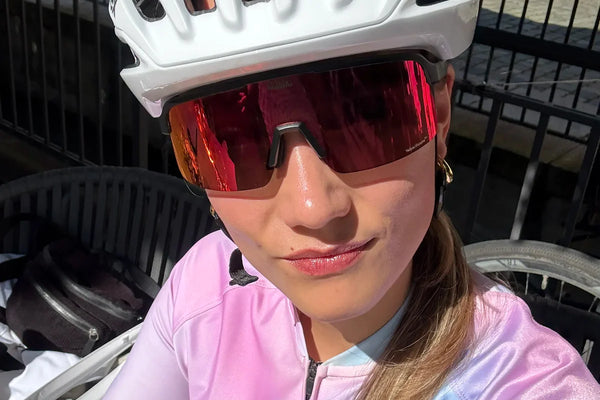
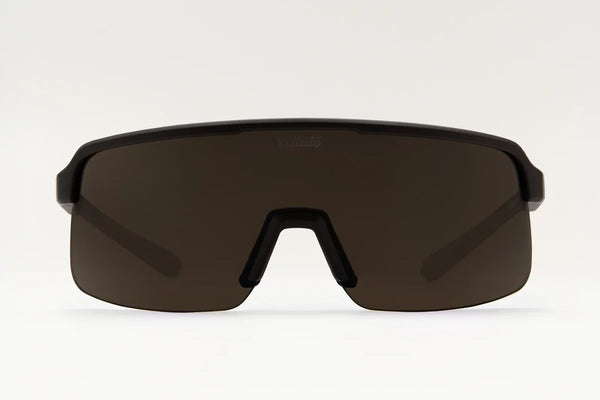
The StradaPro is Velluto's road cycling frame, designed in Italy and built around exactly the performance criteria this article has covered. It is not the right frame for everyone, but if the specific problem you are solving is burning eyes caused by wind at speed, the design decisions map directly to the problem.
The lens geometry provides full coverage in the road cycling position. In the drops, where your head is tilted forward and the lower face is the leading surface into the wind, the vertical height of the lens creates a barrier across the full eye area including the lower orbital region where upward airflow would otherwise reach the cornea. The wrap angle positions the lens close to the temples, reducing the lateral airflow ingress that causes the side-entry dryness many riders experience.
The built-in anti-fog system manages the temperature differential between the inside and outside of the lens without routing airflow across the cornea. The ventilation geometry is a deliberate engineering choice: the system prevents condensation on climbs and in variable weather, where the temperature differential between effort-generated heat and ambient air is at its highest, without the aggressive lens-flushing airflow that would defeat the wind protection purpose of the frame.
The adjustable nose pads allow the frame to be positioned correctly for a wide range of face geometries. For riders with a lower nasal bridge, a narrower bridge, or a face shape where standard fixed bridges consistently produce a poor seal at the sides, the adjustable system means the wrap angle actually delivers its intended protection rather than sitting too far from the face to block lateral airflow effectively.
Weight is 25 grams. This is relevant not as a specification to compare against a number but for the practical reason described in the fit section: a lighter frame creates less holding-force fatigue over a long ride and is more likely to stay in position on the face across four or five hours of a late summer sportive than a heavier frame that creates nose and ear pressure. At 25 grams, the frame is light enough that most riders stop being aware of it within the first few minutes of a ride, which is the correct outcome.

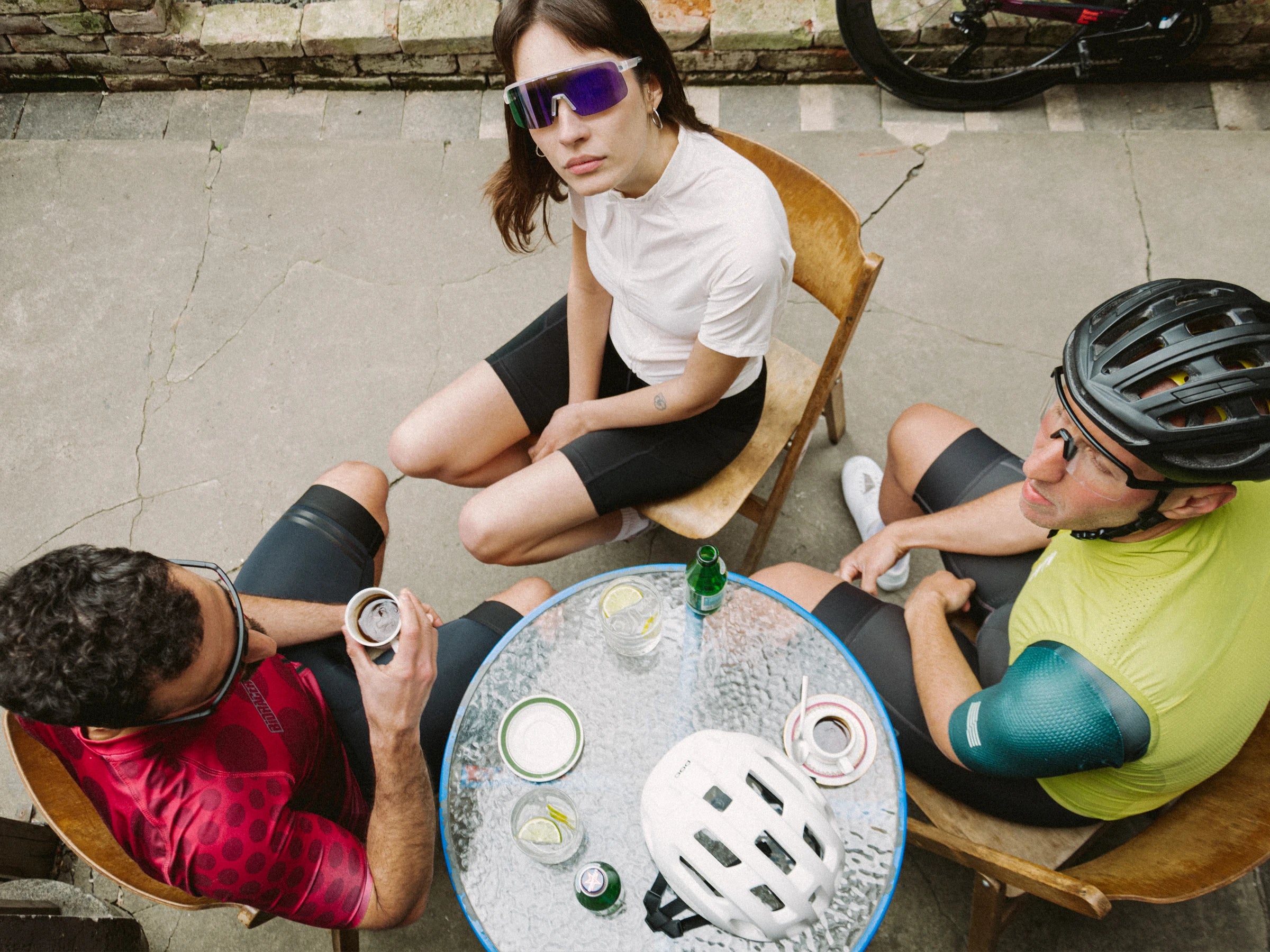
The lens system gives you two options for summer riding: the VellutoPuro clear lens for variable and low-light conditions, and the VellutoVisione high-contrast lens for full summer sun. Both are UV400 certified. The click-in system changes lenses in seconds without tools, which is the practical version of having the right lens for the actual conditions rather than the conditions you planned for. Both lenses are compatible with the same StradaPro frame, which means the investment in the frame covers two optical environments without requiring a second pair of glasses.
The 30-day risk-free trial exists because fit and comfort are genuinely personal. The frame geometry works for a wide range of face shapes, and the adjustable nose pads extend that range further, but the only reliable test of whether a frame solves your specific burning eye problem is to ride with it in your actual conditions. The 30-day period covers enough rides to include varied conditions: headwind days, descents, summer heat, and the long four-hour sportive efforts where the problem typically manifests most clearly.
One accessory worth noting in the context of lens care on summer rides: the Velluto cleaning spray is a 50ml, apple-scented, refillable spray made in Germany, designed specifically for optical surfaces. During summer rides, sunscreen, sweat, and insect debris accumulate on the outer lens surface and degrade optical clarity, which in turn increases eye strain. A microfibre cloth and appropriate spray used before and after rides maintains the lens surface and extends its anti-fog performance.


Compare the full lineup in the Velluto StradaPro cycling glasses collection.
09 · FAQFrequently Asked Questions
Why do my eyes burn when cycling?
Wind moving across the eye surface at 30 km/h or faster accelerates tear evaporation faster than your tear glands can replenish it. The result is corneal dryness, which your nervous system registers as a burning sensation. The reflex response, watery eyes, makes the dryness worse because the reflex tears wash away the lipid layer that stabilises your tear film. The fix is to reduce the volume of wind reaching the cornea, which requires the right frame geometry rather than eye drops.
Do cycling glasses actually stop burning eyes?
Yes, but only if the frame geometry is right. A lens with sufficient vertical height and a close wrap angle reduces the column of moving air that reaches the eye surface. Ventilation matters too: a system that allows air to circulate behind the lens without channelling it directly across the cornea manages temperature and humidity without triggering tear evaporation. Not all cycling glasses are designed with this distinction in mind.
What is the difference between burning eyes and watering eyes on the bike?
They are two phases of the same process. Burning is the sensation of corneal dryness caused by tear film disruption. Watering is the reflex response: your lacrimal glands flood the eye to compensate. The reflex tears are thinner than the resting tear film and do not contain the same lipid stabilisers, so they evaporate quickly and leave the eye drier than before. Understanding this cycle explains why watery eyes on a ride do not mean your eyes are comfortable.
Does riding faster make burning eyes worse?
Yes, in a direct relationship. Wind speed across the eye surface scales with your riding speed plus any headwind. At 20 km/h the effect is mild. At 30 to 40 km/h, tear evaporation accelerates significantly. Descents, open roads, and headwinds all amplify the problem, which is why many riders first notice symptoms on faster training rides or sportives rather than on easy recovery spins.
Can hot summer weather make the problem worse?
It can. High ambient temperatures increase evaporation rates independent of wind speed. Low humidity, common in late summer conditions, reduces moisture in the air and accelerates tear film thinning. Riding in full sun also triggers squinting, which reduces blink rate and shortens the time the eyelid has to re-spread the tear film across the cornea. All of these factors stack, which is why August rides are often when the problem first becomes noticeable.
What frame properties should I look for to prevent eye burning?
Look for three things: lens height that covers the eye from the brow to below the cheekbone, a wrap angle that positions the lens close to the face to block lateral airflow, and an anti-fog ventilation system that circulates air behind the lens without directing it across the cornea. Adjustable nose pads that sit flush against the face without gaps also reduce air ingress from below, which is the main airflow problem in the dropped riding position.
Are anti-fog vents bad for dry eyes?
Badly designed vents can draw air across the eye and worsen dryness. A well-engineered anti-fog system routes airflow behind the lens to manage temperature and prevent fogging, but the vents are positioned so air circulates between lens and face rather than flushing directly over the corneal surface. The distinction is in the direction of airflow, not the presence of ventilation. Ask where the air goes, not whether ventilation exists.
What lens colour is best for reducing eye strain in bright summer sun?
UV400 certification is the non-negotiable baseline: it blocks 100 percent of UVA and UVB radiation regardless of lens tint. For bright summer riding, a high-contrast lens like the VellutoVisione sharpens road surface definition and reduces the visual effort of tracking uneven tarmac, which lowers cumulative eye fatigue over long rides. For variable light or dawn starts, a clear UV400 lens like the VellutoPuro provides wind and UV protection with full light transmission.
How do I clean cycling glasses without scratching the lens?
Use a microfibre cloth and a lens cleaning spray specifically formulated for optical surfaces. Avoid paper products, jersey fabric, and dry rubbing. Apply spray first to soften any grit before wiping. Store glasses in a hard case when not in use to prevent lens contact with abrasive surfaces inside a jersey pocket or bag. On summer rides, sunscreen and sweat accumulate quickly on the outer lens surface, so a post-ride clean with appropriate products maintains both optical clarity and anti-fog coating performance.
Burning eyes on the bike are solvable. The physiology is consistent, the cause is clear, and the frame properties that address it are specific and verifiable. If you want to understand how the StradaPro approaches each of these design requirements in detail, the full specification and lens options are at velluto-shop.com, including the 30-day risk-free trial that lets you test the frame across your actual summer rides before committing.