Cycling Glasses UV Protection: UV400 vs UV380 Explained
Contents25 min read
It is the third hour of a Pyrenean stage and the sun is directly overhead at 1,800 metres. The air is thin, the sky is a deeper blue than it ever looks at sea level, and your eyes are taking in ultraviolet radiation at a rate roughly 20 percent higher than it would be on a flat coastal road. Most cyclists checking their sunglasses think about lens tint and frame weight. Very few think about whether the UV rating on the label actually means what it claims to mean. After this guide, you will be one of the ones who know.
UV protection in cycling glasses is one of those specifications that appears on almost every product page yet is almost never explained. You see "UV400" printed on a frame arm, or "100% UV protection" in a product description, and you reasonably assume that means something concrete and regulated. Sometimes it does. Sometimes it is a marketing label without certification to a defined standard. The difference matters, particularly if you are logging five or six hours a week in the saddle through a European summer, riding camps in the Alps, or following the Tour de France route through the high cols.
This guide breaks down exactly what UV400, UV380, and CE EN 1836 mean in plain terms. It explains why altitude raises the UV stakes for cyclists specifically, how long-ride exposure accumulates over a season, and how to verify the rating on any pair of glasses before you buy. No jargon, no inflated claims: just the information you need to make a genuinely well-informed decision the next time you are standing in front of a product page wondering whether the protection is real.
01 · The StandardWhat UV400 Actually Means
Ultraviolet radiation sits just below the visible light spectrum, in the wavelength range of approximately 100 to 400 nanometres (nm). For practical purposes, the portion that reaches the earth's surface and affects human tissue falls into two bands: UVB (roughly 280 to 315 nm) and UVA (roughly 315 to 400 nm). UVC (100 to 280 nm) is almost entirely absorbed by the atmosphere before it reaches ground level and is not a meaningful concern for everyday outdoor activity.
The "UV400" designation means a lens blocks 100 percent of ultraviolet radiation up to 400 nm, which covers the entire UVA and UVB range that actually reaches you on a ride. The number 400 refers to the upper wavelength boundary, not a quality score or an index. A lens rated UV400 stops all the UV that matters. It is the highest standard you will routinely encounter in sport eyewear.
UV380 means the same principle applies but the blocking cutoff is at 380 nm rather than 400 nm. This covers the full UVB band and most of UVA. The portion of the UVA spectrum between 380 and 400 nm passes through. At sea level in moderate conditions, the practical difference between UV380 and UV400 is small. Over a season of long rides at altitude, or in high-UV environments like snow or reflective water surfaces, that small unblocked slice of the spectrum adds up.
The critical thing to understand: neither "UV400" nor "UV380" is a regulated label on its own. Any brand can print either term on a frame without certification to a defined standard. The label tells you the claim. The certification tells you the claim has been verified. That distinction is where many cyclists get misled.
02 · The CertificationCE EN 1836 Explained
CE EN 1836 is the European standard that governs sunglasses and sun glare filters for general use, including sport eyewear. When you see both a CE mark and an EN 1836 reference on a pair of cycling glasses, it means the lenses meet defined criteria covering UV transmittance, luminous transmittance, optical quality, and in the case of sport glasses, impact resistance, verified by an accredited laboratory. The result is a documented, auditable outcome from a standardised test.
The standard includes a filter category system from 0 to 4, with each category defining the percentage of visible light transmitted through the lens. Category 0 (80 to 100% transmission) covers clear and very lightly tinted lenses used in low or variable light. Category 1 covers lightly tinted lenses for overcast days. Category 2 covers general-purpose lenses. Category 3 covers strong solar protection for bright conditions. Category 4, the darkest category, is for extreme solar environments like high-altitude mountaineering or glacier travel, and is explicitly not suitable for driving or cycling on public roads because transmission is too low for safe hazard detection.
The UV requirement embedded in EN 1836 mandates that the average solar UVA transmittance must be lower than the average luminous transmittance divided by a specific factor, and that UVB transmittance must meet even stricter limits. In practical terms, a lens that passes EN 1836 UV requirements will block essentially all UVB and the vast majority of UVA. A UV400-certified lens that also carries the EN 1836 mark has met both the defined standard and the full-spectrum blocking requirement. That combination is the most complete protection you can verify.
When you are evaluating cycling glasses, the question to ask is not just "does it say UV400?" but "does it carry CE EN 1836 certification?" If the product page shows only the marketing claim without a standard reference, check the frame arm and inner frame for the CE mark and standard number. If neither appears, ask the brand for the certification documentation. A reputable brand will provide it readily.
A UV400 label tells you the claim. CE EN 1836 certification tells you the claim has been verified to a defined standard. In five hours of high-altitude riding, that difference matters.Velluto Cycling Eyewear
03 · AltitudeWhy UV Intensity Increases the Higher You Ride
At sea level, the atmosphere above you acts as a natural filter, scattering and absorbing a portion of the UV radiation arriving from the sun. As you gain altitude, the depth of atmosphere between you and the sun decreases. The relationship is reasonably consistent: UV intensity increases by approximately 10 to 12 percent for every 1,000 metres of elevation gained.
To put that in practical terms: a col at 2,000 metres in the Pyrenees exposes you to roughly 20 to 24 percent more UV than the same sun angle at sea level. A summit at 2,500 metres, common in the Alps and on several Tour de France stage finishes, means 25 to 30 percent more UV. If you are riding a week-long cycling camp through July, the cumulative exposure across six or seven days of mountain stages is substantially higher than it would be on flat roads in the same weather.
The geometry of the cycling position makes this worse than it might be for a pedestrian or a driver. You are outdoors for extended periods with no shelter. Your eyes face partially upward on descents, catching direct sky UV rather than reflected ground UV. On long climbs, the pace is slow and the duration is long, meaning total exposure per ride is much higher than even an equal-distance flat effort. Reflective tarmac on sunlit road surfaces adds reflected UV to the direct solar component. Snow on the verges in early season alpine camps amplifies this further: snow can reflect 80 percent or more of incident UV, effectively doubling the intensity hitting your face.
The cumulative nature of UV exposure is worth emphasising. Your eyes do not reset between rides. Cumulative UV exposure over a season contributes to long-term risks including photokeratitis (temporary but genuinely painful inflammation of the cornea, essentially sunburn of the eye), accelerated lens changes, and other conditions that develop over years rather than days. None of this requires medical alarmism to take seriously: it simply means that lens certification is not a nice-to-have specification. On a programme of regular long rides through a European summer, it is a meaningful health consideration.

04 · Long RidesHow Exposure Accumulates Over a Season
Think about the hours. A committed amateur cyclist in Europe might ride five to eight hours per week outdoors from April through September, a roughly 26-week season. At five hours per week that is 130 hours of outdoor UV exposure. At eight hours per week, 208 hours. Every one of those hours without adequate lens protection is additive. Unlike sunscreen applied to skin, you cannot reapply UV filtering to your eyes mid-ride: the protection is entirely determined by the optics of the lens you chose that morning.
There is also a temporal dimension specific to road cycling that is easy to overlook. Cyclists are typically out in the hours of peak UV intensity: 10am to 3pm, when the sun is highest and the atmospheric path length is shortest. Most social and club rides, Gran Fondos, sportives, and training blocks hit this window. Evening rides avoid the worst of it, but the majority of long summer rides do not.
The Tour de France context is useful here not because most of us are racing, but because the riding conditions it represents are real conditions that thousands of European cyclists seek out in their own summer camps. The mountain stages through the Alps and Pyrenees during July and August are exactly the environment where UV intensity is at its seasonal peak, combined with high elevation, long daily duration, and reflective road surfaces. If you are riding in those conditions for a week or two this summer, you are in the highest-exposure category for amateur cyclists. Your lenses matter more in that context than on a Tuesday morning ride through flat country in cloudy weather.
None of this is meant to be alarming. It is meant to be honest about why the UV specification on your cycling glasses is worth understanding properly rather than taking on trust from a label. You would not buy a cycling helmet without checking it had passed a recognised impact standard. Your lenses deserve the same scrutiny.
05 · VerificationHow to Check the UV Rating on Any Pair of Glasses
Knowing what to look for turns a vague spec into a verifiable fact. Here is a practical checklist you can apply to any pair of cycling glasses before buying, whether in a shop or from a product page.
Check the frame markings
Look on the inner temple arm, the nose bridge area, or the lens edge. A compliant pair will show a CE mark, the standard reference (EN 1836 or EN ISO 12312-1 for occupational eyewear), and ideally the filter category number. If these markings are absent, that is a signal worth noting.
Read the product page carefully
A trustworthy brand distinguishes between "UV400 certified" (tested to a standard) and bare "UV400" (a claim). Look for explicit mention of EN 1836 or CE certification alongside the UV number. If only a marketing phrase appears with no standard reference, ask the brand directly.
Ask for the test documentation
Reputable brands can provide the CE conformity declaration or the EN 1836 test report. This is not an unusual request. If a brand is unable or unwilling to share it, that tells you something about the robustness of the claim.
Understand that tint is not protection
A dark or mirrored lens reduces glare and visible light, but provides no UV protection unless a UV-blocking treatment or substrate is present. A completely clear lens with the correct coating can be UV400 certified. Always verify the UV spec independently of the visual darkness of the lens.
One practical note on purchasing online: the CE mark and EN 1836 reference should appear in the product listing or the accompanying technical documentation, not just in a marketing description. If you are comparing several pairs and one prominently cites the standard while others give only a bare UV claim, weight that accordingly. The one with the verifiable reference is the one whose protection you can trust.
It is also worth knowing that optical quality and UV protection are related but distinct. A lens can be UV400 certified but still have distortion that makes it uncomfortable or unsafe to ride with for extended periods. EN 1836 includes optical quality requirements (prismatic deviation, refractive power tolerances) precisely because a lens that protects your eyes but blurs your vision is not a good cycling lens. The standard covers both dimensions, which is another reason why certification matters beyond the UV number alone.
06 · The Velluto ApproachUV400 Certification in the StradaPro
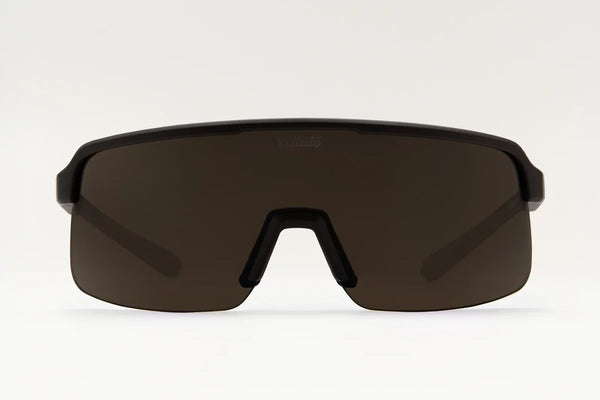
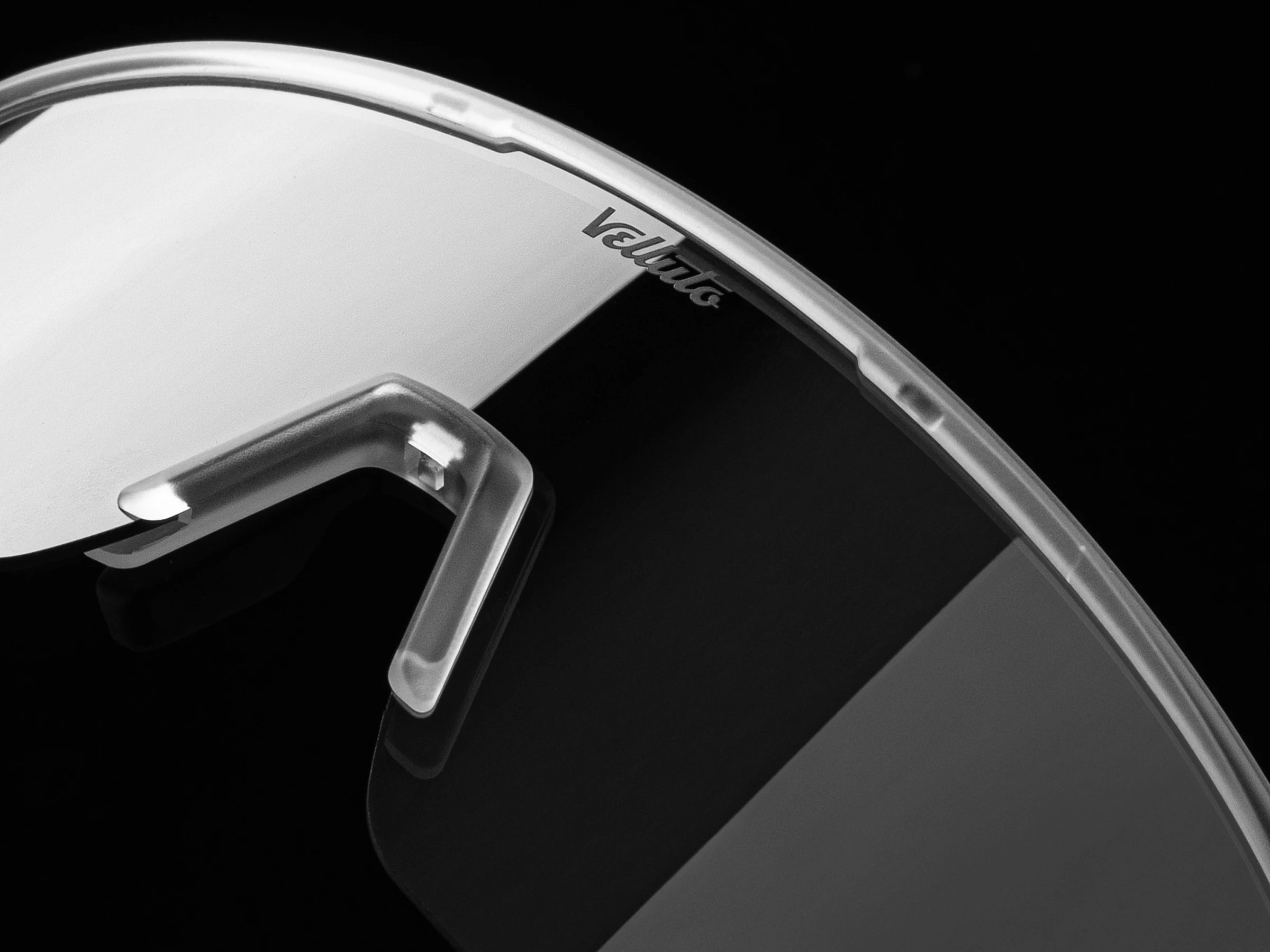
The Velluto StradaPro carries UV400 certified lenses, meaning 100 percent of UVA and UVB radiation up to 400 nm is blocked. This applies to both interchangeable lens options: the VellutoPuro clear lens and the VellutoVisione high-contrast lens. Both carry UV400 certification, verified to the EN 1836 standard.
The VellutoPuro is the clear option, designed for low-light and variable conditions: dawn starts, shaded woodland roads, late-evening rides, or high-altitude sections where the sun goes behind cloud unpredictably. Clear does not mean unprotected. UV400 certification applies equally to the VellutoPuro, because UV radiation and visible light are independent phenomena. A clear lens with the correct treatment blocks UV just as effectively as a dark tinted lens with the same treatment.
The VellutoVisione is the high-contrast lens, using VellutoVisione technology to sharpen visual definition on bright roads and in the variable light conditions common on mountain stages, where you move from direct sun into shade on north-facing descents and back into full exposure on south-facing climbs. The lens enhances contrast and edge definition, making surface texture, road debris, and gradient changes easier to read at speed. UV400 certified protection is built in.
Both lenses use the click-in system, allowing a tool-free swap in seconds. This matters specifically for cycling in mountain conditions, where light can change dramatically between a long exposed climb and a fast, tree-lined descent. You can swap lenses at the top of a col without tools, without stopping for more than twenty seconds, and without carrying both frames. The case for interchangeable lenses on long mountain rides is not primarily about style: it is about having the right optics for the conditions you are actually in, not the conditions you started the day in.

The StradaPro frame weighs 25 grams. On a three-hour alpine climb, 25 grams with adjustable nose pads and no pressure points delivers a stable fit. Heavier frames may shift position or create temple fatigue over extended wear, which is why weight and fit work together to support compliance with protection. Weight is not vanity in this context: it is the difference between glasses you stop noticing after five minutes and glasses you adjust every twenty minutes. The adjustable nose pads allow you to dial the fit once at the start of a ride and forget about it for the rest of the day, regardless of whether your nose bridge is narrow or broad.
The built-in anti-fog system addresses the specific challenge of mountain cycling: the temperature differential between a hard climb and a fast descent. On a steep climb at 8 percent gradient, your core temperature and breath rate are both elevated. Drop over the summit and start descending at 60 km/h into cooler air, and cheaper lenses will fog. The StradaPro's anti-fog system is designed to address the temperature differential between climbs and descents, maintaining clear vision through the conditions where visibility is most critical: high speed, low temperature, high humidity.

07 · Lens ColourTint, Contrast, and UV: Understanding the Relationship
The most common misconception about UV protection in cycling glasses is the assumption that a darker tint means better UV protection. It does not. Lens tint determines how much visible light passes through the lens, affecting glare reduction and eye comfort in bright conditions. UV protection is determined by a separate property of the lens material or coating, which filters radiation in the non-visible UV spectrum. The two properties are entirely independent.
A completely clear lens with a UV-blocking substrate or coating can offer UV400 protection. A very dark lens without any UV treatment can transmit almost all UV radiation while reducing visible light to a comfortable level, which is actually counterproductive: the reduced visible light causes your pupil to dilate, potentially allowing more UV to enter the eye than it would in bright unprotected conditions. This is the risk of darkly tinted sunglasses without UV certification: reduced visible light causes pupil dilation, potentially allowing more UV to enter the eye than it would under bright unprotected conditions.
Lens category and filter darkness matter separately. For road cycling specifically, Category 2 and Category 3 lenses cover the vast majority of conditions. Category 3 is appropriate for full sun on exposed roads. Category 2 suits variable cloud cover and wooded routes. Category 0 (essentially clear) suits low-light conditions. Category 4 is too dark for safe cycling on public roads: reaction time to hazards is compromised at very high optical density.
High-contrast lenses like the VellutoVisione operate by selectively filtering certain wavelengths of visible light to increase the perceptual difference between adjacent tones, making it easier to distinguish road surface texture, shadows, and edges. This is a transmission tuning property, not a UV filtering property. The UV400 certification on VellutoVisione is provided by the blocking treatment, separately from the contrast-enhancement properties of the lens. Both work simultaneously: you get enhanced contrast AND full UV protection, not a trade-off between them.
The practical implication for building a lens kit for varied riding is straightforward. Two certified lenses covering the low-light and bright-sun ends of the spectrum, both UV400 certified, give you complete flexibility without any gap in protection. You are never in a situation where swapping to a clearer lens for overcast conditions means sacrificing UV protection, because both lenses in the StradaPro system carry the same UV400 certification.
08 · Buying GuideWhat to Prioritise When Choosing Cycling Glasses for UV
If you are evaluating cycling glasses specifically for UV protection, the buying decision comes down to a short list of genuinely important criteria. Here is how to weight them.
Certification first. UV400 with CE EN 1836 certification is the baseline. If a pair of glasses cannot show you the standard reference, move on. There are enough certified options at every price point that there is no reason to accept an unverifiable UV claim when you are going to spend five or six hours a week in direct sun.
Coverage geometry matters. A lens that wraps around the orbital area provides better protection than a flat lens with gaps at the sides or bottom. UV radiation does not only come from directly in front of you: on a bike, sky UV bounces off road surfaces and enters from below and the side. Wraparound frames minimise these pathways. Look at the frame geometry alongside the lens certification.
Fit determines actual protection. A certified lens that sits too far from your face, or that moves around during riding, creates gaps that let UV in around the edges. Adjustable nose pads allow you to bring the lens close to your face without pressure, which is both more comfortable and more protective. The StradaPro's adjustable nose pads are a functional specification, not a cosmetic one.
Weight affects long-ride compliance. A heavier frame can accumulate pressure points over extended wear. At 25 grams, the StradaPro minimises frame pressure, and the adjustable nose pads allow you to dial the fit precisely so the glasses remain comfortable and stable across a full day of riding. Compliance with protection depends on comfort, which depends on weight and fit working together.
Interchangeable lenses for all-day coverage. Mountain riding involves lighting conditions that change dramatically over a single day. A fixed, single-lens frame forces a compromise: either it is too dark for the shaded valley roads at the start or too light for the full-sun summit. Interchangeable click-in lenses mean you can carry both options and swap in twenty seconds, maintaining the right optical density for the conditions at any point in the ride without ever removing UV protection.
Anti-fog for sustained clear vision. UV protection is only useful if you can see clearly. On mountain rides, the combination of elevated effort on climbs and rapid cooling on descents creates fogging conditions. The StradaPro's anti-fog system is designed to maintain optical clarity through temperature differentials, supporting stable positioning across the temperature range typical of mountain riding.

09 · Tour ContextHigh-UV Riding in July: What the Mountain Stages Teach Us
The Tour de France is relevant here not as a marketing angle but as an accurate description of conditions. The high mountain stages in the Alps and Pyrenees during July represent some of the highest UV-exposure cycling environments in Europe: elevation above 2,000 metres, full midday sun, extended duration, and in many cases, reflective dry limestone road surfaces. The professionals riding those stages are protected by eyewear that is specifically chosen for performance in those conditions. The amateur riding a cycling camp on the same roads in the same month is in the same environment.
Cycling camps in the Alps and Pyrenees have become a major part of the summer calendar for European amateur cyclists, particularly from Central and Western Europe. These camps typically run one to two weeks of daily riding, with stages that include major cols. The participants are serious cyclists who care about equipment: they train on high-end bikes, count grams on components, and plan their nutrition meticulously. Eyewear is often the last piece of kit that gets the same attention as the rest of the setup.
Altitude riding in summer is also when the anti-fog specification matters most. The temperature at the base of a col on a July morning in the Pyrenees might be 22 degrees. At the summit it might be 10 to 12 degrees with wind. The transition from a 90-minute climb, during which your body temperature and ventilation rate are elevated, to a fast descent into cool air creates temperature differentials where anti-fog performance becomes critical to maintaining clear vision at the moment when you need it most: the top of a steep descent at speed.
The combination of UV protection, anti-fog performance, and lightweight fit is not three separate specifications for three separate problems. On a mountain stage they are three aspects of the same problem: maintaining clear, protected vision across a full day of highly variable riding conditions. The StradaPro combines all three, UV400 certification, anti-fog performance, and 25 g weight, so you have complete protection and optical stability whether you are riding at altitude or on flat terrain.


10 · Care and MaintenanceKeeping Your UV Protection Intact Over Time
UV protection on cycling lenses can degrade if the lens is not maintained correctly. Understanding what affects the UV-blocking treatment helps you protect your investment and ensures the protection spec you paid for continues to perform at season five as it did at season one.
The UV-blocking property of a lens is typically provided either by the lens substrate itself (built into the material during manufacture) or by a surface coating applied after moulding. Substrate UV protection is generally more durable across extended use. Coating-based UV protection can be affected by abrasion, harsh cleaning chemicals, and environmental exposure that degrades the coating surface over time. The practical implication: how you clean your lenses matters.
Use a microfiber cleaning cloth and a lens-specific cleaning solution rather than dry fabric, tissues, or shirt material. Dry abrasive cleaning causes micro-scratches that degrade optical clarity and, on coated lenses, can affect the UV treatment layer over time. A purpose-made cleaning spray removes road grime, insect residue, and sweat salt effectively without the pH extremes that damage lens coatings. Velluto's cleaning spray is a 50 ml, apple-fragrance, refillable solution designed specifically for cycling optics.
Store your glasses in a hard case when not on your face or on the bike. Road and gravel cycling involves carrying kit in jersey pockets, drop bags, and saddle packs, all of which create compression and abrasion risks for unprotected lenses. The Velluto hard case carries an anti-crash guarantee and a velvet interior lining that protects the lens surface from the scratches that accumulate in a season of casual storage. Consistent case storage is one of the highest-value things you can do to extend the optical life of a pair of certified cycling glasses.
Inspect your lenses at the start of each season. Deep scratches in the centre of the optical zone are a reason to replace the lens, not just because they affect visual clarity but because significant surface damage on coated lenses can compromise the UV treatment. The interchangeable lens system on the StradaPro allows you to replace the affected lens independently of the frame, extending the lifespan of your eyewear. The click-in, tool-free system means the replacement takes about twenty seconds and the frame continues performing for seasons beyond that.
Compare the full lineup in the Velluto StradaPro cycling glasses collection.
11 · FAQFrequently Asked Questions
What does UV400 mean on cycling glasses?
What is the difference between UV400 and UV380?
What is CE EN 1836 certification and why does it matter for cyclists?
Does UV intensity really increase at altitude?
How can I verify the UV rating on a pair of cycling glasses?
Do tinted lenses automatically provide UV protection?
Can I try Velluto StradaPro glasses before committing to them?
What lens options does Velluto offer for varying light conditions?
Are lightweight cycling glasses better for long climbs?
UV protection in cycling glasses is a straightforward specification when you know what to look for: UV400 certification backed by CE EN 1836, wraparound coverage geometry, and a fit system that keeps the lens close to your face across five or six hours of varied terrain. The Velluto StradaPro brings all three together in a 25 g frame with Italian design, with the VellutoPuro and VellutoVisione interchangeable lenses both certified to UV400, and a 30-day risk-free trial so you can verify that on real rides before you commit. Find the full specification and all four colourways at velluto-shop.com.