Buy Lightweight Cycling Glasses: What to Check Beyond Weight

Contents27 min read
Three hours into a November road ride, the kind where the light sits low and grey all morning, you notice the glasses before you notice anything else. The frame that felt fine in the shop is pressing into your nose bridge. You push it up for the fourth time on the same climb. The weight is not dramatic, but the interruption is real, and by the final hour it has moved from minor to genuinely irritating.
That is the practical argument for paying attention to frame weight when you buy lightweight cycling glasses. It is not about grams on a scale for their own sake. It is about contact pressure accumulating across two, three, four hours on the bike, and about a frame that simply disappears on your face instead of announcing itself every twenty minutes. November is a good moment to think about this clearly, because cyclocross season and winter training rides are the conditions that expose exactly these weaknesses: rough terrain, repeated intensity changes, fogged lenses on punchy climbs, cold descents where fit matters more than ever.
This guide works through what to check when you are ready to buy lightweight cycling glasses in 2026. Weight comes first, because it is the most direct and measurable factor. But it is not the only one, and buying the lightest frame you can find without checking nose-pad adjustment, lens coverage, fit security and lens system will often leave you disappointed. We cover all of it, with Velluto's own specifications stated as the manufacturer supplies them, and with enough structural detail that you can compare any glasses you are considering against the same criteria.
01 · WeightWhat weight should cycling glasses be?
The honest answer is: as light as possible, without compromising fit or optical quality. Performance road cycling glasses typically fall between 25 g and 35 g. That 10 g spread sounds small, but on a four-hour ride with your head in an aerodynamic position, it represents a meaningful difference in cumulative nose-bridge pressure.
The physics are simple. A frame resting on your nose applies a small downward force. The lighter the frame, the lower that force. Over a short ride, neither a 25 g frame nor a 35 g frame will cause discomfort in isolation. The variable is time, repetition and terrain. Cobbles, gravel sectors and cyclocross courses transmit vibration upward through the fork and into the frame of the glasses. That vibration adds micro-impacts to the nose-bridge contact point. A heavier frame compounds this; a lighter one reduces it.
There is a second, less discussed effect: frame bounce. On rough surfaces, heavier frames tend to move more visibly in the rider's field of vision, particularly at the lower edge of the lens. This is a minor but measurable distraction during technical cyclocross sections or on descents where you need clean visual information from the road surface ahead.
The StradaPro is specified by the manufacturer at 25 g. That is at the lower end of what performance road cycling glasses typically weigh. It is worth asking any glasses manufacturer for the frame weight as a confirmed specification, not an approximation, before you buy. Some published weights exclude lens weight; always ask whether the figure includes the lens or covers the frame alone.
One important clarification: weight alone does not guarantee comfort. A 25 g frame that sits on a fixed, poorly positioned nose pad can feel worse than a 32 g frame with well-positioned adjustable pads. Weight is the starting point for the conversation; nose-pad fit is what determines whether the glasses actually stay comfortable across the full duration of a long ride.

02 · Nose-Pad FitWhy adjustable nose pads matter more than most buyers expect
Nose-pad fit is the single biggest predictor of long-ride comfort in cycling glasses, and it is consistently underweighted in buying decisions. Most cyclists try glasses in a shop, squeeze the frame to check temple grip and move on. The nose pad is an afterthought. After three hours on the road, it becomes the main character.
The core problem with fixed nose pads is that they are designed for one nose geometry. That geometry is usually an averaged approximation based on the brand's target market. If your nose bridge is narrower, wider, flatter or higher than the design assumption, the pad contacts your skin at a suboptimal angle. This creates pressure concentration rather than pressure distribution, and the discomfort that results has nothing to do with how light the frame is.
Adjustable nose pads solve this by allowing the contact angle, the pad separation and the bridge height to be tuned to your face. You slide the pads to match your nose width. The result is that pressure spreads across a larger surface area, the frame sits higher or lower on your face depending on your preference, and the glasses stop moving under effort because they are genuinely in contact with your face rather than perched on a single contact point.
For cyclocross and autumn road riding specifically, there is an additional factor: sweat. When your heart rate spikes on a climb or in a race effort, the skin on the nose bridge becomes damp. A fixed nose pad on a frame that was already slightly misaligned will start to slide at this point. An adjustable pad that is correctly set stays in position because the contact geometry is correct from the start, and because the pad material can be chosen for grip rather than purely aesthetics.
The StradaPro uses adjustable nose pads as a standard feature. This is not universal in road cycling glasses at this price level. When comparing options, check whether nose-pad adjustment is offered, and whether the adjustment range is wide enough to cover your face geometry. A narrow adjustment range on an adjustable pad system is better than no adjustment at all, but it may still not reach the extremes of very narrow or very wide nose bridges.
The glasses that disappear on your face are the ones you will reach for every single ride. The ones you notice are the ones that stay in the cupboard by February.A principle most experienced long-distance cyclists agree on
03 · UV400Do cycling glasses need UV400 certification?
Yes, without exception. UV400 is the certification that confirms lenses block 100 percent of UVA and UVB radiation up to 400 nanometres of wavelength. That coverage is relevant every time you ride outdoors, including grey November days when the sun is low and partially obscured.
The November sun angle is actually the detail most cyclists miss. In northern Europe in autumn and winter, the sun sits low on the horizon for a longer part of the day. You are riding directly into it on certain compass bearings, and the UV exposure at that angle can be intense even when the air temperature suggests otherwise. Combined with reflections off wet road surfaces, UV exposure during winter riding is not trivially lower than in summer.
There is a second, counter-intuitive risk with tinted lenses that do not carry UV400 certification. A dark lens without UV filtration causes the pupil to dilate, because the visual system perceives reduced brightness. The dilated pupil then admits more UV radiation than it would under normal daylight conditions. The lens has made the exposure worse, not better, by combining cosmetic darkening with inadequate filtration. This is why the certification matters: it separates lenses that genuinely protect from lenses that look protective but are not.
When you check a product listing or packaging for UV400, look for the specific label rather than general phrases like "UV protection" or "filters UV rays." Those descriptions can be applied to lenses with partial filtration. UV400 is the specific, complete standard. Both the VellutoPuro clear lens and the VellutoVisione high-contrast lens carry UV400 certification.
One additional point: UV400 certification should be verified on each lens in a system, not just the frame or the base lens. If you use interchangeable lenses, confirm the certification on both the clear and tinted variants. A frame with certified lenses does not automatically mean every lens in the system is certified to the same standard.

04 · Anti-FogWhy anti-fog matters in autumn and cyclocross conditions
Anti-fog performance is the feature that separates cycling-specific glasses from general sports eyewear, and it becomes the most relevant feature of all in November. The mechanism of fogging is straightforward: when warm, moisture-laden air from your breathing or from exertion meets the cooler inner lens surface, water vapour condenses into tiny droplets that scatter light and reduce optical clarity. In cycling, this happens most reliably at the worst possible moment, which is the top of a climb when you have been working hard for ten minutes and you then need to descend safely.
The cyclocross context makes this even more acute. Cross races involve repeated short, intense efforts followed by brief recoveries. Heart rate and respiration spike repeatedly. The rider is also closer to the ground, in a more varied position, and subject to mud spray that can compromise lens surfaces. A lens that fogs on the first big effort of a race is a lens that becomes a liability.
Built-in anti-fog systems work through a combination of ventilation geometry, which channels airflow between the lens and the face to prevent moisture build-up, and in some cases hydrophilic lens coatings that cause water to spread in a thin film rather than forming vision-disrupting droplets. The most effective systems combine both: the frame geometry keeps airflow moving across the lens inner surface even when the rider slows, and the coating handles condensation that forms faster than ventilation can remove it.
When evaluating anti-fog claims, look for systems that describe the mechanism rather than just the outcome. "Anti-fog lens" and "built-in anti-fog system" are meaningfully different: one describes a coating applied to the lens surface, the other describes a frame-level design decision that addresses the root cause. The StradaPro includes a built-in anti-fog system designed to maintain clear vision on climbs and in variable weather, which is the specific use case where anti-fog performance matters most for road and cyclocross cyclists.
It is also worth checking whether a brand's anti-fog system extends to both lenses in an interchangeable system. Some brands treat the base tinted lens as the primary product and design the frame geometry around it, with the clear lens offered as an accessory. If you plan to ride in winter primarily on the clear lens, check that the anti-fog geometry is effective with both configurations, not just one.
05 · Lens SizeHow important is lens coverage for road cycling?
Lens size in cycling glasses is a balance between three competing factors: coverage, weight and ventilation. Getting that balance right for your type of riding requires understanding what each axis actually delivers.
Coverage means the total area of the visual field that the lens protects. A larger lens shields more of the eye and surrounding area from wind, insects, road spray and UV exposure. For road cyclists at speed, the wind protection effect is real: eyes watering in crosswinds affect vision and comfort significantly over a long ride, and a larger wrap-around lens reduces this considerably. For cyclocross, where mud and debris are part of the environment and the face is often low to the ground, more coverage is a genuine safety consideration as well as a comfort one.
Weight is the trade-off. Polycarbonate lens material is denser than the frame materials, and a larger lens adds grams directly to the total frame weight. Manufacturers making genuinely lightweight glasses have to choose lens geometry carefully. A very large lens on a 25 g frame is architecturally difficult; the two demands push against each other.
Ventilation interacts with coverage in a less obvious way. A large lens that sits very close to the face creates a sealed environment between the lens and the eye, which is efficient for wind protection but accelerating for fogging. This is why large-lens designs in performance cycling glasses almost always pair coverage with an engineered ventilation system: ports, channels or frame geometry that keeps air moving across the inner lens surface despite the close fit. If you are evaluating a large-lens option, check whether the ventilation design has been specifically thought through, or whether the frame relies on the lens simply being far enough from the face for air to circulate naturally.
For autumn and winter riding, the balance shifts slightly toward more coverage. Cold air on the eyes is uncomfortable and causes tearing. Low sun angles create peripheral glare that a smaller lens does not intercept. And the visual conditions on a November ride, where light levels are lower and contrast is reduced, mean that more of the visual field being optically protected is a benefit rather than just an aesthetic choice.

06 · Secure FitWhat makes cycling glasses stay in place?
Frame security is not a single spec; it is the result of three contact points working together. The nose pad is one. The temple tips, the parts of the frame arms that rest on or behind the ears, are the second. The overall frame curve and how it positions the lens relative to the face is the third. When all three are correct for your anatomy, the glasses are genuinely stable: they do not bounce, slide or need adjustment during the ride.
Temple tips on road cycling glasses are typically made from rubber or a soft thermoplastic elastomer. The design question is how much grip the tip provides against the skin or hair around the ear, and whether the tip is angled to create downward pressure or simply rests behind the ear passively. For road cycling with a standard helmet, the arms run under the helmet straps, which provide additional stabilisation. For cyclocross, where the head position changes more and the terrain generates vibration, the temple grip becomes more critical on its own.
The overall frame curve is the least discussed but arguably the most important factor for initial fit. A frame designed for a medium facial width will sit correctly on a medium facial width and incorrectly on a narrower or wider face regardless of nose-pad adjustment or temple grip. This is why it is worth reading manufacturer fit guides or using a 30-day trial period to test the frame on actual rides, rather than relying on a brief in-store try-on that cannot replicate three hours in the saddle.
The interaction between all three contact points is what experienced cyclists mean when they describe a frame as "dialled in." Each point provides one axis of stability: the nose pad controls vertical position and prevents downward slide; the temple tips prevent rearward slide and lateral movement; the frame curve determines whether the whole assembly is under slight compression (which provides grip) or is loose against the face (which allows movement). Getting all three right simultaneously is the goal, and it is one reason why adjustable nose pads are so valuable: they give you one axis of control that you can tune without returning the frame or choosing a different model.
07 · Lens SystemInterchangeable lenses vs photochromic: which suits your riding?
This is the question that most buying guides collapse into a single preference, but it deserves a more careful treatment because the two systems genuinely suit different rider profiles. Neither is universally superior; the right choice depends on how you ride, where you ride, and how much variability you encounter in a single session versus across different sessions.
An interchangeable lens system gives you two or more lenses that you swap manually, depending on the conditions. The core advantage is optical precision: you choose exactly which lens characteristic you want for a given ride, and that characteristic does not change during the ride unless you decide to swap the lens. For a rider doing a consistent road ride in a known light condition, this is ideal. The limitation is that swapping lenses mid-ride, while fast on a well-designed system, is still a stop. If conditions change rapidly during the same session, as they can in autumn when heavy cloud cover moves in mid-morning, you either swap or ride with the wrong lens for a while.
A photochromic lens adapts its tint automatically as the available light changes. The rider does not need to stop, and the lens transition is continuous. The trade-off is that you have one lens handling all conditions rather than two purpose-designed lenses. For many riders and especially for autumn and winter cycling where light levels change frequently within a single ride, this is a compelling convenience argument.
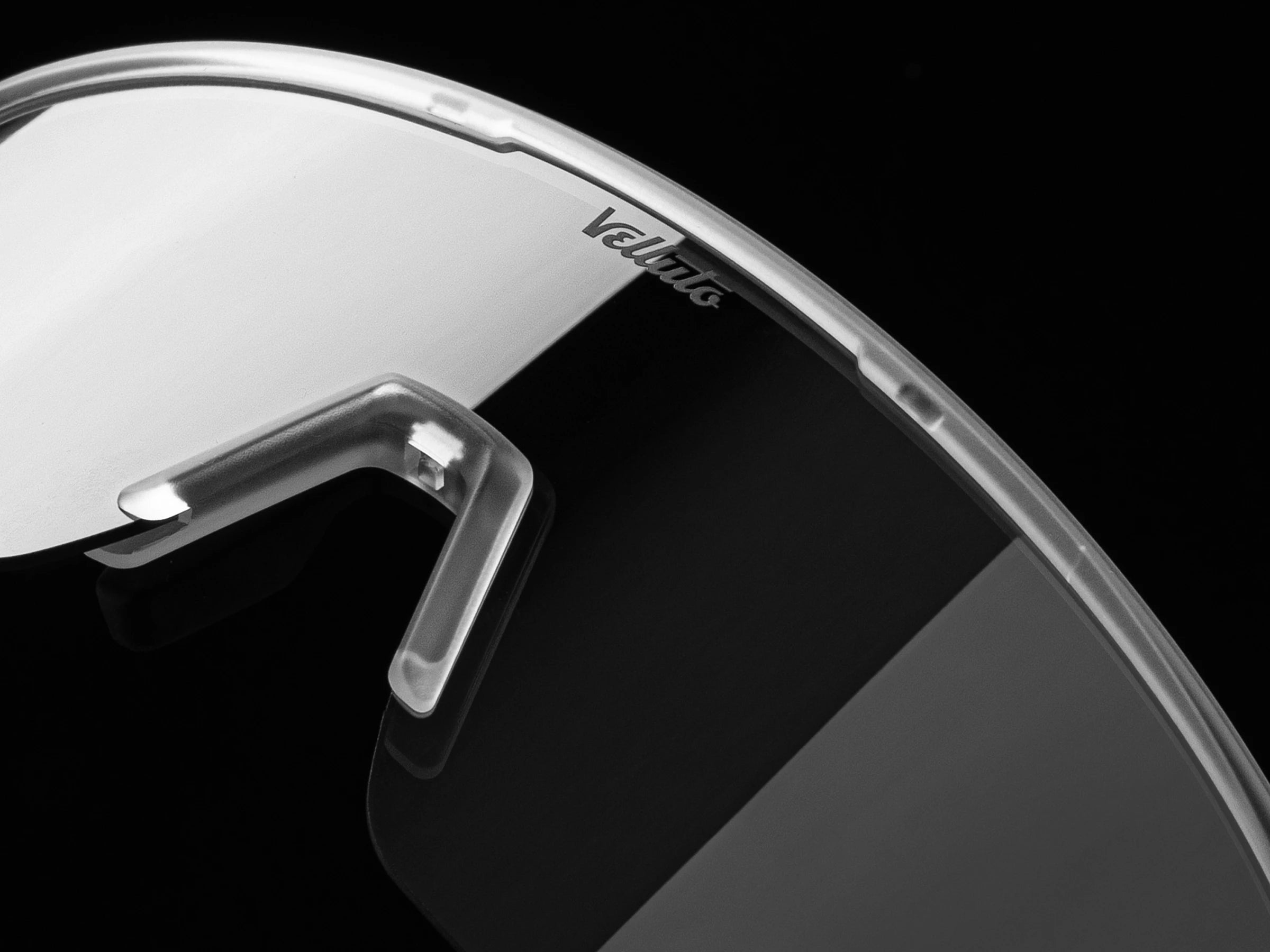
Velluto offers both. The StradaPro uses a click-in interchangeable system: the VellutoPuro clear lens is designed for road wind and insect protection with UV400 certification and clear optics, while the VellutoVisione high-contrast lens uses VellutoVisione technology to sharpen contrast and visual definition in variable light. Both lenses click in and out without tools, completing a lens change in seconds at a feed stop or café break.
The Velluto Chromo is a separate, dedicated photochromic model launching in October 2026. Its lens self-tints: clear in low light, darkening with a mirrored finish in bright sun. The Chromo is built specifically for the light variability of autumn and winter riding. If you are drawn to the one-lens convenience and the automatic adaptation, the Chromo is the right product to look at. You can find the full details at velluto-shop.com/pages/chromo.
The StradaPro and the Chromo solve the same underlying challenge, changing light conditions on a bike, by different means. The StradaPro gives you two precision lenses you control actively. The Chromo gives you one lens that adapts without input from you. Both carry UV400 certification. Which suits you better is a genuine question of personal preference and riding style, not a question with a universal correct answer.

08 · The StradaProHow the Velluto StradaPro addresses each of these criteria
It is worth working through the StradaPro specifically against the framework above, using only the specifications that Velluto publishes for the product. This is not a review or a test result; it is a specification summary that lets you match the product to the criteria in this guide.
Weight: the manufacturer specifies 25 g. This places the StradaPro at the lower end of performance road cycling glass weights. That specification should be confirmed against the product listing when you check it, as published specs can be updated.
Nose-pad fit: the StradaPro has adjustable nose pads as a standard feature. The adjustment allows the rider to dial in the nose-bridge contact for their face geometry, reducing pressure concentration across extended rides. This is the feature that translates the low frame weight into genuine long-ride comfort, because it means the 25 g rests correctly on the bridge rather than concentrating on a fixed contact point.
UV protection: both compatible lenses, the VellutoPuro clear lens and the VellutoVisione high-contrast lens, carry UV400 certification. This means 100 percent filtration of UVA and UVB radiation in both the light-condition-specific configurations.
Anti-fog: the StradaPro includes a built-in anti-fog system. This is a frame-level design feature rather than purely a lens coating, relevant for the climbing and intensity-change scenarios that characterise cyclocross and autumn road riding.
Lens system: the StradaPro is compatible with two click-in lenses, VellutoPuro (clear, optimised for wind and insect protection) and VellutoVisione (high-contrast, for sharpened visual definition in variable light). Both lenses swap without tools. The system is not photochromic; it is an interchangeable lens system where the rider selects the appropriate lens before or during the ride.
Trial period: Velluto offers a 30-day risk-free trial. This is the practical solution to the limitation of buying glasses online: you test the frame on real rides, in the conditions you actually ride in, over enough sessions to assess fit, comfort and optical performance properly.
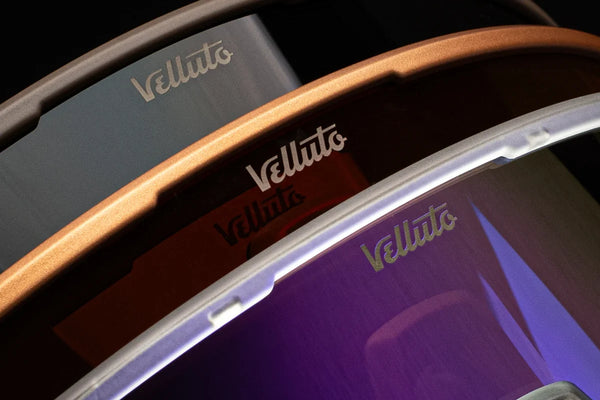
The StradaPro is available in four colourways: Nero (black), Espresso (brown), Arancia (orange) and Viola (purple). Italian design, German brand. Free shipping applies on orders over 89 EUR.


09 · Keeping Lenses ClearMaintenance that protects the optics you invested in
Frame weight and fit are pre-purchase decisions. Lens maintenance is the ongoing decision that determines whether the optics you chose continue to perform across the full life of the glasses. Cycling lenses are exposed to road grit, mud, insect impact, skin oils from handling and salt from sweat. Each of these degrades optical clarity in a different way, and each requires a slightly different approach to remove without damaging the lens surface or any coatings applied to it.
The most common mistake is wiping a dry lens with a jersey or glove on the ride. Dry wiping drags road grit across the lens surface; under magnification you would see micro-scratches forming with each wipe. Those scratches do not impair UV filtration, but they scatter light and reduce the crispness of the optics over time, particularly visible when riding into low sun. A lens that looked optically excellent at purchase starts to feel slightly hazy after a season of dry-wiping. The solution is to wet the lens before wiping: a few drops of cleaning solution or even water loosens particulate matter and allows it to lift away from the surface rather than being dragged across it.
Microfibre cloths are the correct tool for lens cleaning. The fibre structure physically traps particles between the fibres rather than dragging them across the surface, which is why they are effective where other fabrics are not. The Velluto Microfibre Cleaning Cloth (25 x 25 cm, 80 percent polyester and 20 percent polyamide) is designed for this purpose. The key maintenance habit with any microfibre cloth is to launder it regularly: a cloth that has accumulated road grit in its fibres becomes abrasive rather than protective, so washing it out of the cloth before it accumulates is the step most riders skip.
Lens cleaning spray is worth using at the end of every ride rather than waiting until the lens is visibly dirty. The Velluto Cleaning Spray (50 ml, apple fragrance, refillable, made in Germany) is formulated for optical surfaces and removes skin oils and road film without leaving residue. Applying it to a damp lens and then wiping gently with a clean microfibre cloth takes thirty seconds and keeps the optics in the condition they were in when you first put them on. Maintaining a lens is considerably easier than repairing one.
When you are not riding, storing the glasses in a hard case removes the most common source of damage: being placed lens-down on a surface, or being loose in a kit bag where they can contact keys, links or other abrasive objects. The Velluto Hard Case has an anti-crash guarantee and a velvet interior finish that holds the frame securely. This is the simplest possible protection for an investment in quality optics, and it extends the useful life of the glasses considerably.

10 · Buying DecisionHow to structure the decision when you are ready to buy
When you are ready to buy lightweight cycling glasses, the temptation is to go directly to the lightest available weight specification. That is a reasonable starting point, but it is not a complete decision framework. The following process gives you a structured way to work through the considerations in the right order.
Start with the riding you actually do in the next three months, not the riding you aspire to do. If you are heading into a cyclocross season and regular November road training rides, the relevant variables are anti-fog performance, secure fit on rough terrain, UV protection for low-angled winter sun and lens coverage for cold descents. If you are primarily a summer road rider buying ahead, the balance shifts: weight optimisation and ventilation are relatively more important, anti-fog is relatively less critical. Matching the glasses to the season you are in gives you a better outcome than buying the most impressive specification sheet.
Second, assess your face geometry honestly. If you have a narrow nose bridge, fixed nose pads are a risk. If you have a wide face, check frame width before assuming a standard frame will wrap correctly. If you have experienced glasses sliding on climbs before, that is diagnostic of a nose-pad fit problem, not a weight problem. Getting the right fit for your face is more important than getting the lightest frame on the market.
Third, decide between the interchangeable lens system and a photochromic model. This comes down to ride variability and personal preference more than objective performance. If you want to match the lens precisely to known conditions, interchangeable is the right system. If you want one lens that handles whatever the weather does during the ride, photochromic is the right system. Both approaches are valid; the wrong answer is buying an interchangeable system when you know you will never carry the second lens.
Fourth, check the trial policy. Performance cycling glasses are difficult to evaluate in a shop. The conditions that reveal fit problems, anti-fog weaknesses and lens performance are real rides, not brief indoor try-ons. A 30-day risk-free trial period is a meaningful differentiator precisely because it moves the evaluation to where it belongs: on the road, in the conditions you actually ride in.
Finally, check the total cost of the system you are buying. A frame at one price point combined with separately purchased lenses can add up differently than a frame sold with lenses included. Understand what is in the box before comparing prices. The StradaPro is sold as a complete system with the frame and lens included; the VellutoPuro and VellutoVisione lenses are additionally available separately for riders who want both options.

Compare the full lineup in the Velluto StradaPro cycling glasses collection.
11 · FAQFrequently Asked Questions
What weight should cycling glasses be?
Most performance road cycling glasses fall between 25 g and 35 g. At 25 g, the frame disappears on your face during long rides; above 35 g, pressure on the nose and temples builds noticeably on climbs and rough descents. The StradaPro is specified by the manufacturer at 25 g. When comparing specifications across brands, ask whether the published weight includes the lens or covers the frame alone, as this affects comparability.
Do cycling glasses need UV400 certification?
Yes. UV400 means the lenses block 100 percent of UVA and UVB radiation up to 400 nanometres. Without that certification, dark tinted lenses can actually increase UV exposure by causing the pupil to dilate while letting unfiltered radiation through. Check the product spec sheet or packaging for the UV400 mark specifically, not just "UV protection" language. If you use an interchangeable lens system, verify the certification on both lenses individually.
What is the difference between adjustable and fixed nose pads on cycling glasses?
Fixed nose pads are moulded into one position designed around an averaged nose geometry. Adjustable nose pads let you move the bridge contact point to match your nose width and bridge height. For road cycling, where you are in an aerodynamic position for hours, adjustable pads reduce pressure hotspots and stop the frame from riding down during hard efforts or sweaty climbs. The difference is most noticeable on rides over two hours and on rough terrain.
Are interchangeable lenses worth it on cycling glasses?
For riders who train across seasons or in variable weather, yes. A single frame with two click-in lenses covers bright days and grey November mornings without buying a second pair. The key factor is how fast and tool-free the swap is. A system that completes a lens change in seconds with no tools is genuinely practical at a café stop or in a car park before a sportive start. The StradaPro uses a click-in system that works without tools for both the VellutoPuro clear and VellutoVisione high-contrast lenses.
What is the difference between photochromic and interchangeable cycling lenses?
A photochromic lens is a single lens that adapts its tint automatically as light changes. An interchangeable lens system gives you two or more separate lenses you swap manually. Photochromic lenses are convenient for one-step simplicity and suit rides where conditions change frequently within the same session. Interchangeable systems let you choose precisely which optical characteristic suits a given ride. Velluto offers both: the Chromo uses a photochromic self-tinting lens, while the StradaPro uses a click-in interchangeable system. Full details on the Chromo are at velluto-shop.com/pages/chromo.
How important is lens size for road cycling glasses?
Lens coverage matters for protection and comfort. A larger lens shields more of the visual field from wind, road debris and insects, which is especially relevant at speed. For cyclocross and winter riding, more coverage also keeps cold air away from the eyes on descents and intercepts low-angle sun from wider field positions. The balance against weight means that larger lenses add grams; evaluate coverage and weight together rather than optimising one independently.
Can I use cycling glasses for cyclocross in autumn and winter?
Yes, and it is recommended. Cold air, mud spray, low November sun and sudden climbs that cause fogging are all conditions where purpose-built cycling glasses outperform standard sunglasses. Look for a built-in anti-fog system, UV400 lenses for the low winter sun angle, and a secure fit that stays in place over rough terrain. The StradaPro's adjustable nose pads and built-in anti-fog system address the specific demands of this riding context.
What does the Velluto 30-day trial cover?
Velluto offers a 30-day risk-free trial period on the StradaPro. You can test the glasses on real rides during that window and return them if they do not suit you. This matters specifically for cycling glasses because the conditions that reveal fit problems, anti-fog weaknesses and lens performance are real rides in real weather, not brief indoor try-ons. The 30-day window gives you enough sessions to assess the frame properly across different conditions.
Do heavier cycling glasses perform worse than lighter ones?
Not automatically. A heavier frame with excellent nose-pad fit and temple grip can feel more secure than a lightweight frame that slips. Weight matters most on long climbs, where cumulative pressure on the nose bridge becomes noticeable, and on road surfaces that transmit vibration upward through the frame. A 25 g frame with a stable, correctly adjusted fit addresses both: the low weight reduces base pressure, and the adjustable pads ensure that pressure is distributed correctly across the bridge contact area.
If you are ready to buy lightweight cycling glasses that balance all of these criteria, the StradaPro's 30-day risk-free trial means the decision carries no risk you cannot reverse. Test it on the rides you actually do, in the conditions that matter to you, and assess it against the framework in this guide. Full details, all four colourways and the complete lens system are at velluto-shop.com.