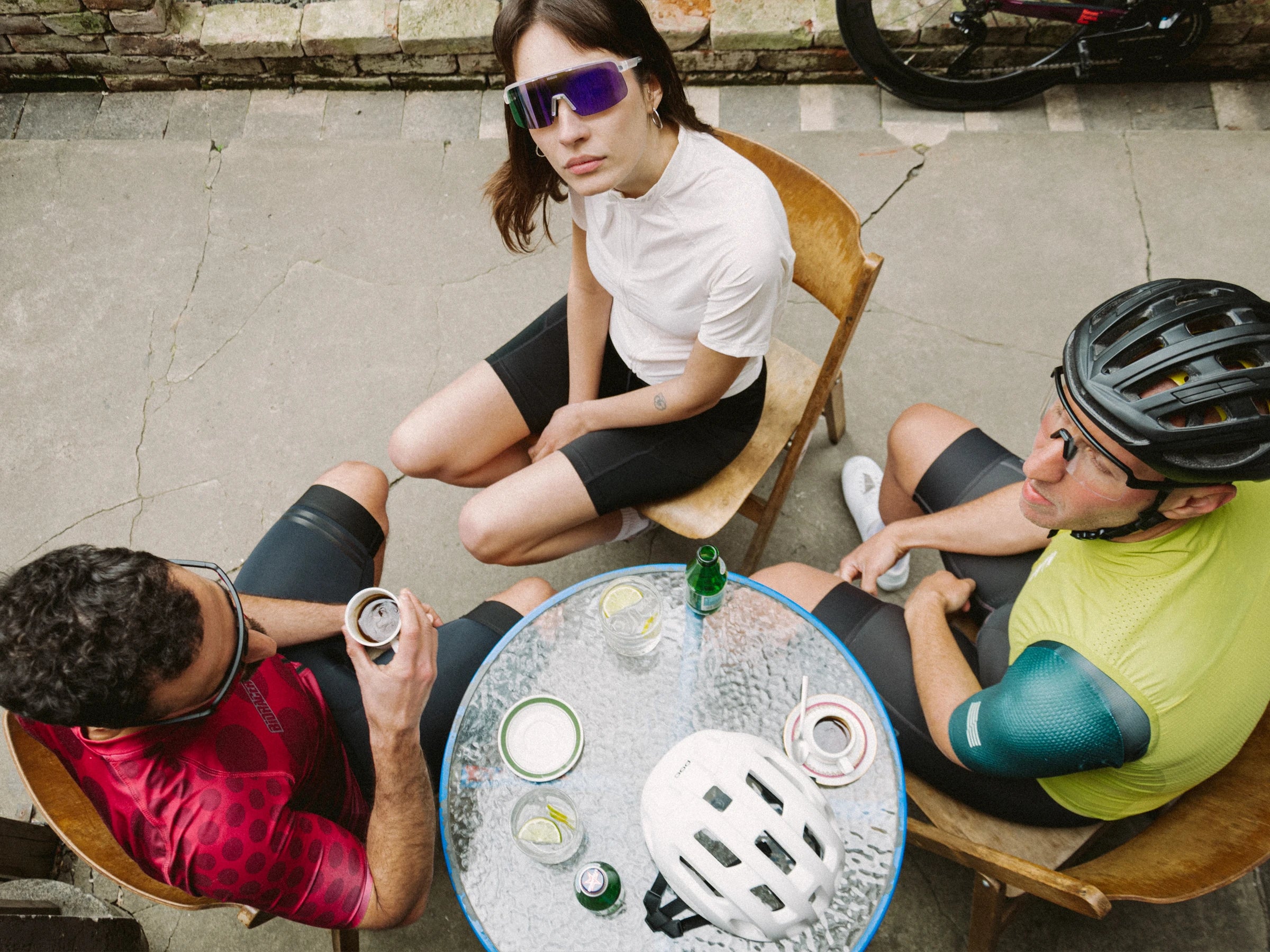
Cycling Glasses Buying Guide 2027: Performance Meets Style
Contents23 min read
You are forty minutes into a wet November ride, the kind where the light shifts from grey to amber to near-dark inside a single descent. Your lenses have fogged on the climb, your nose pad has migrated south, and you are squinting at road surface texture that your glasses are doing nothing to sharpen. This is not a niche problem. It is the standard experience of cycling glasses bought on aesthetics alone, and it is entirely avoidable.
This guide exists for the rider who is tired of that compromise. Not the rider who wants the most expensive glasses, or the most recognisable logo, or the frame that looks best hanging from a coffee shop table. The rider who wants to know what genuinely matters in road cycling eyewear, what the marketing language around optics actually means, and how to choose a pair that works in the conditions they actually ride in, which, in November, means variable light, cold climbs, and the kind of road grit that gets everywhere.
What follows is a structured buyer's guide. We cover the technical criteria first, explain what the specifications mean in practice, and work through real riding scenarios so you can match the spec list to your specific situation. The Velluto StradaPro features throughout because it is the product we know best and can speak to with accuracy, but the framework applies to any serious road cycling glasses purchase.
01 · Short answerThe TL;DR for cyclists who want the answer fast
If you are scanning this guide for a quick verdict before the detail, here it is.
The minimum specification you should accept in road cycling glasses is UV400 certified lenses (not UV400-claimed, certified), a frame weight under 35 g, an anti-fog system of some kind, and a secure nose fit that holds position on descents. If your budget allows, an interchangeable lens system gives you significantly more versatility than a single fixed tint across seasons.
What you do not need to pay extra for: excessive branding, inflated retail positioning, or lens technology described in proprietary language that obscures whether it is simply a standard tint or something that meaningfully affects optical performance.
The Velluto StradaPro weighs 25 g, carries UV400 certification, has a built-in anti-fog system, adjustable nose pads, and ships with a tool-free interchangeable lens system compatible with both a clear VellutoPuro lens and a high-contrast VellutoVisione lens. It is available from 69 EUR, with free shipping on orders over 89 EUR. There is a 30-day risk-free trial. That is the short version. The rest of this guide explains what those specs mean, and how to decide whether they match what you need.
02 · CriteriaWhat actually matters when buying cycling glasses
The marketing language around cycling eyewear is dense. Terms like "enhanced clarity", "precision optics", and "performance lens technology" appear across almost every product at every price point, without reference to any verifiable standard. Before you can evaluate a pair of cycling glasses sensibly, you need a framework built around documented, testable criteria. These are the ones that make a material difference on the road.
03 · UV protectionUV400 certification: the one spec you cannot skip
UV400 is not a marketing label. It is a measurable, certifiable standard: a lens designated UV400 blocks 100% of ultraviolet radiation up to 400 nanometres, covering both UVA and UVB wavelengths. The certification matters because it distinguishes tested, documented protection from a tint that simply makes light look darker without filtering the radiation that causes cumulative corneal and lens damage.
Cyclists face higher UV exposure than most outdoor athletes because they spend hours at a time outdoors, often at altitude or on reflective road surfaces, in an aerodynamic position that holds the face forward into the light. Cloudcover is not protective: UV penetrates overcast sky and reflects off tarmac and water. This is as relevant on a grey November cyclocross day as it is in July.
The standard to reference is CEN EN ISO 12312-1, which defines the test conditions for ocular protection against solar radiation. Any glasses claiming UV400 should be traceable to a certification under this or an equivalent standard. The Velluto StradaPro carries UV400 certification across both its VellutoPuro and VellutoVisione lenses.
04 · Lens systemsTint, contrast and the interchangeable lens argument
The simplest version of a cycling lens is a tint: the material absorbs a portion of incoming light, reducing glare and overall brightness. This works well in the specific conditions the tint was designed for and poorly in everything else. A dark tint optimised for summer sun is a liability in a November tunnel or under heavy cloud cover. A light tint adequate for autumn riding offers inadequate glare management on a low-sun winter morning.
High-contrast lenses work differently. Rather than simply reducing total light transmission, they filter specific wavelengths to increase the visual differentiation between road surface types, shadow edges, obstacles, and terrain changes. For road cyclists, this means potholes, gravel patches, and surface transitions become more legible at speed. The VellutoVisione lens applies this principle: it sharpens contrast and visual definition, which is a different functional claim from general light reduction, and one that is relevant on descents and technical sections regardless of ambient brightness.
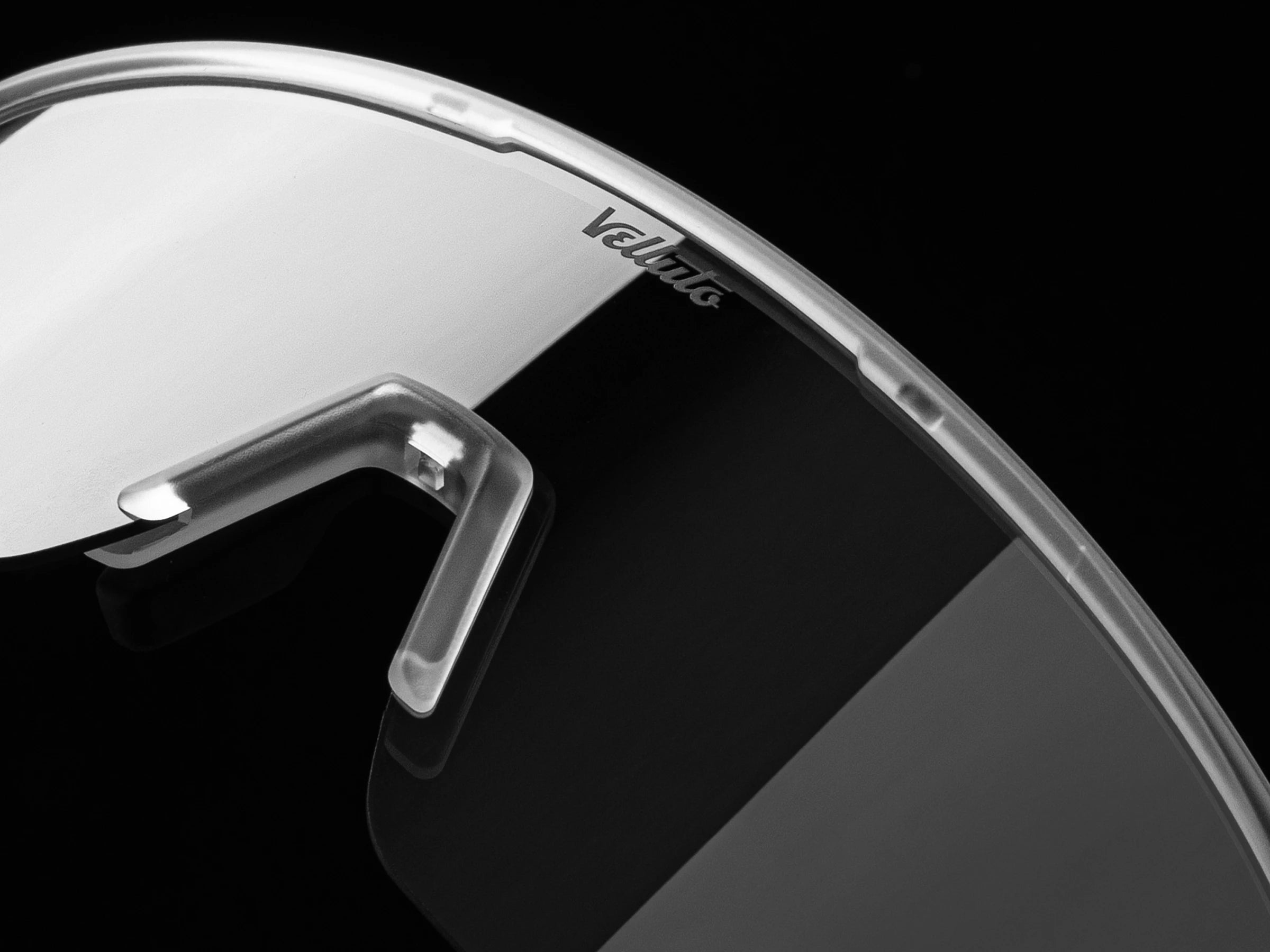
The interchangeable lens argument follows from this. If no single tint is optimal for all conditions, and if you ride across seasons and time frames, then a system that lets you swap lenses is more practically useful than a fixed lens at any tint level. The StradaPro's click-in system is tool-free and covers two distinct optical needs: the VellutoPuro (clear) lens for low light, dawn, dusk, and tunnel sections; and the VellutoVisione high-contrast lens for road riding in variable conditions. The swap takes seconds and requires no tools or accessories.

A note on what the interchangeable system does not include: photochromic lenses, which self-tint in response to light intensity, are not a feature of the StradaPro. That technology belongs to the Velluto Chromo, a separate model launched for exactly the conditions where a single self-adapting lens is preferable to a manual swap. If your preference is a one-lens solution that adapts without intervention, the Chromo is worth reading about. If you prefer the control and optical specificity of choosing your lens for the conditions ahead, the StradaPro's two-lens system is the more precise tool.
05 · Fit and anti-fogWhy fit is a performance variable, not just a comfort one
Frame fit in cycling glasses is more mechanically significant than it is for everyday eyewear. The glasses operate in an environment of vibration, airflow, sweat, and changing head angles, across periods of two to six or more hours. A frame that fits well in a shop mirror can migrate, bounce, slip, or create pressure points under these conditions. That is not a minor annoyance; it is a distraction at precisely the moments when attention to the road matters most.
Adjustable nose pads are the primary variable in achieving a stable, pressure-free fit across different face shapes. The StradaPro's nose pads can be positioned to hold the frame at the correct distance from the face without digging into the nose on longer rides. This is a functional adjustment rather than a cosmetic one: the right nose pad position also affects the ventilation gap between frame and face, which directly influences fogging behaviour on climbs.
Anti-fog performance deserves more precise language than it usually receives in cycling eyewear marketing. Fogging is a thermodynamic event: when warm, humid air from exertion contacts a lens surface that is cooler than the dew point of that air, condensation forms. Ventilation gaps in the frame help by increasing airflow across the lens, but they are passive and dependent on riding speed. On long climbs at low pace, airflow slows, exertion increases, and the conditions for fogging are at their most severe. A built-in anti-fog system in the lens material itself addresses the problem at the surface level, reducing the temperature differential needed for condensation to form. The StradaPro includes a built-in anti-fog system designed for exactly these conditions.
What we will not claim: fog-free performance is not absolute in all conditions. In extreme temperature differentials between a cold exterior and high exertion, no current coating system eliminates fogging entirely. The built-in system significantly reduces its occurrence and severity under typical road cycling conditions, which is the accurate and honest framing of what the technology does.
The frame that fits in a shop mirror is not always the frame that fits at hour four on a wet November ride. Test under actual conditions before you decide.Velluto Buying Guide
06 · Velluto positioningPerformance and aesthetics: separating the two, then combining them
There is a tension in road cycling eyewear that the category has never fully resolved. Performance-led brands produce glasses that are technically rigorous and visually assertive to the point of conspicuousness. Lifestyle and fashion-adjacent brands produce glasses that look refined and understated but often compromise on the specs that matter on a four-hour ride. The rider who wants both, genuine UV400 performance, anti-fog function, and a frame that does not look industrial, has historically had to choose one or the other.
Velluto's position in this space is deliberate. The brand is German in origin, with Italian design informing the aesthetic direction of the frame and colourways. These are separate dimensions and it is worth being explicit about that separation: Italian design heritage in this context means attention to proportion, material finish, and colour palette, the choices that make a frame look considered rather than functional-at-all-costs. It does not, in itself, determine optical performance. The optical performance comes from the UV400 certification, the VellutoVisione lens technology, the anti-fog system, and the 25 g frame weight. These are documented, verifiable specifications independent of where the design language originates.
The practical result of combining both dimensions is a glasses that can sit comfortably in a range of contexts: the road training ride, the cyclocross course, the coffee stop, and the commute. This matters to riders who do not want to manage multiple pairs and who find that the visual aggression of some performance eyewear conflicts with how they present themselves off the bike.

On pricing: the cycling eyewear market spans from under 30 EUR for unbranded options to well over 200 EUR for established sport eyewear names. The StradaPro starts from 69 EUR. The question of whether that represents value is answered by what you get at that price point: UV400 certified lenses, 25 g frame, built-in anti-fog, adjustable nose pads, two-lens interchangeable system, and a 30-day risk-free trial. These are documented specs. The 30-day trial is particularly relevant because it removes the risk of discovering on ride three that the frame does not fit as expected.
07 · ComparisonHow the StradaPro compares: a spec-based overview
Comparison tables in cycling eyewear guides frequently rely on inferred or estimated competitor data, which makes them unreliable for purchasing decisions. The table below takes a different approach: it presents only the Velluto StradaPro's documented specifications in full, and uses publicly known category facts for the market context column. No competitor specs are stated that cannot be independently verified from official sources. Where a competitor's specific detail is not publicly confirmed, the cell is left neutral.
| Specification | Velluto StradaPro | Typical premium road glasses | Typical mid-range road glasses |
|---|---|---|---|
| Frame weight | 25 g | 28 to 35 g (varies by model) | 30 to 40 g (varies by model) |
| UV protection | UV400 certified | UV400 (most leading brands) | UV400 (check certification documentation) |
| Lens system | Interchangeable: clear + high-contrast | Varies: single tint or interchangeable | Typically single fixed tint |
| Anti-fog | Built-in anti-fog system | Ventilation-based or coated (varies) | Ventilation-based (typically) |
| Nose pad | Adjustable | Adjustable on most models | Fixed on most models |
| Trial period | 30-day risk-free trial | Standard retail return policy | Standard retail return policy |
| Starting price | from 69 EUR | 150 to 300 EUR (approximate range) | 50 to 100 EUR (approximate range) |
The comparison illustrates the StradaPro's position clearly: it carries the documented specifications of the premium road cycling category (UV400 certification, interchangeable lenses, anti-fog, adjustable fit, low weight) at a price point that sits below the typical premium range. The 30-day trial is not standard in this category and is worth weighting significantly in a purchase decision, because it converts a commitment into a test.
08 · Rider scenariosReal-world riding conditions and which glasses approach suits each
Specification lists are most useful when mapped to actual riding situations. The following scenarios cover the conditions most likely to be relevant to a serious road cyclist buying in autumn and winter 2026 into 2027.
08a · The road racerTraining rides and competitive road cycling
For structured training rides and road races, the priorities are optical clarity at speed, aerodynamic stability, and reliable performance across the duration of an effort. At pace, peripheral vision coverage matters: the lens should extend far enough laterally to pick up approaching traffic, riders and road hazards without requiring head rotation. The StradaPro's lens profile is designed for a road cycling position, with coverage shaped for a forward-leaning head angle rather than an upright walking posture.
Anti-fog performance is critical on training rides that include sustained climbs. At threshold effort on a cold day, the exertion-to-airspeed ratio tips sharply toward fogging conditions. A frame that relies solely on ventilation to manage this will fog on the steeper climbs where you need vision most. The StradaPro's built-in anti-fog system provides a more consistent baseline here.
Lens choice for road training: the VellutoVisione high-contrast lens for daylight riding on varying road surfaces, and the VellutoPuro clear lens for pre-dawn or post-dusk sessions where total light transmission is the priority. The two-lens system covers both without requiring a second frame.

08b · The cyclocross riderMixed terrain, variable light and weather exposure
Cyclocross is currently at the height of its season in November, and it creates specific eyewear demands that standard road glasses are not always designed for. The light changes rapidly on a cyclocross course: a morning event in Northern Europe will begin in near-dark conditions, move through oblique low sun as the race progresses, and potentially deal with rain, mud spray, and tunnel-effect shade under tree canopy in a single race. No single fixed tint manages all of these well.
The interchangeable lens argument is strongest here. Arriving at a cyclocross venue with a clear VellutoPuro lens for the warm-up and a VellutoVisione high-contrast lens ready to click in for the race itself, depending on how the light develops, is a practical advantage. The tool-free swap takes seconds in a team tent or car park. This is not a marginal benefit: a lens that is too dark on a grey morning genuinely reduces road visibility on technical sections.
Weight matters on a cyclocross course too. Remounts, dismounts, and carrying sections subject the frame to forces that road-only cycling does not. A lighter frame with a secure nose pad fit is more stable under these dynamic loads than a heavier frame that relies on inertia to stay in place.
Riders considering the cyclocross scenario might also want to consider the Velluto Chromo, which takes a different approach to variable light: its photochromic lens adapts as conditions change, darkening in bright sun and remaining clear in low light, without requiring a manual swap. This is a genuine trade-off rather than a hierarchy: the Chromo is a one-lens adaptive solution; the StradaPro is a two-lens system where you choose the optic for the conditions. Neither is universally superior; the right choice depends on how your race unfolds and whether you have the opportunity to swap before the start.
08c · The sportive riderLong distance, endurance focus and comfort over hours
On a six-hour sportive, the criteria for cycling glasses shift from moment-to-moment optical performance toward accumulated comfort. A pair that creates a 1 mm pressure point on the nose bridge is a minor irritant at hour one and a significant distraction at hour five. This is where frame weight and adjustable nose pad quality become the dominant variables.
At 25 g, the StradaPro is at the lighter end of the road cycling glasses market. That 10 to 15 g difference between it and a mid-range frame sounds trivial but is felt over long rides in the cumulative pressure it places on the nose and ears. The adjustable nose pads allow personalised positioning so that the frame rests on the nose without digging in, and distributes load more evenly across the bridge.
Anti-fog relevance on a sportive: sportive routes frequently include long climbs at sustained but sub-maximal effort, exactly the conditions where fogging is most likely. The pace is high enough to generate significant heat and humidity but sometimes slow enough that frame ventilation alone cannot manage it. The built-in anti-fog system provides a consistent baseline through these sections.

08d · The winter commuterLow light, cold mornings and daily use across variable conditions
The cycling commuter faces a different set of demands from the sportive or racing rider. The rides are typically shorter, the conditions less predictable, and the range of light environments within a single commute potentially wider: a dark pre-dawn start, artificial lit tunnels or underpasses, reflected morning sun on wet tarmac, and grey mid-morning overcast can all occur within forty minutes. The fixed-tint single-lens approach is at its most limiting here.
For the commuter, the VellutoPuro clear lens is the base option: it provides UV400 protection and wind and debris protection without reducing light transmission, making it appropriate for dawn, dusk, and low-light conditions. The VellutoVisione high-contrast lens can be swapped in on brighter mornings or when road surface conditions make contrast enhancement useful.
The 25 g weight is more relevant for the commuter than might first appear. Daily use across a year means the frame is on your face a significant number of hours annually. A lighter frame with a genuinely secure fit is less likely to become something you stop wearing because it is uncomfortable, which is the most common reason commuters abandon eyewear that otherwise meets their optical needs.
Durability and storage: the Velluto hard case is worth considering alongside the glasses themselves. Its anti-crash guarantee and velvet interior protect the frame and lenses during transport in a bag or commuter pack, where unprotected glasses are routinely scratched or deformed by contact with other items. The cleaning kit, a 25 by 25 cm microfibre cloth and a 50 ml apple-fragrance cleaning spray made in Germany, covers daily lens maintenance without the residue that household cleaners leave.

09 · ColourwaysThe StradaPro colour range: four options, one lens system
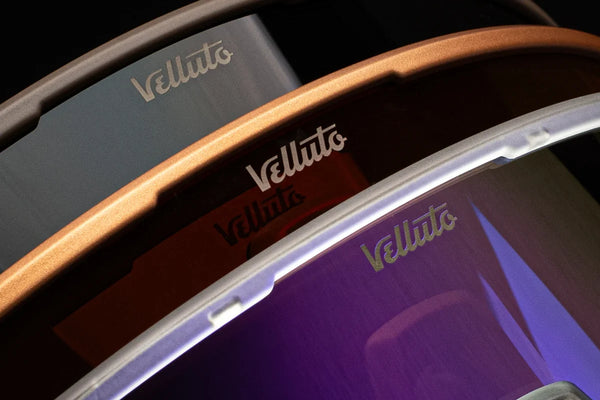
The StradaPro is available in four colourways: Nero (black), Espresso (brown), Arancia (orange) and Viola (purple). The lens system, VellutoPuro and VellutoVisione interchangeable click-in lenses, is consistent across all four. Colourway is an aesthetic choice, not a performance variable. The practical question is simply which frame colour suits your kit and your preference for visibility on the bike.


10 · What to avoidCommon mistakes when buying cycling glasses
A buying guide is only complete if it also covers the wrong moves. These are the most common errors cyclists make when purchasing road eyewear, based on the criteria explored above.
Buying on lens tint alone. Tint is the most visible feature of a cycling lens and consequently the one that receives the most marketing attention. It is also the least useful single metric for evaluating road performance. UV400 certification, contrast enhancement and anti-fog properties are more practically significant for the conditions you actually ride in.
Assuming a heavier frame is more durable. Frame durability and frame weight are independent variables. A well-engineered lightweight frame is not fragile; it is simply more precisely constructed. The StradaPro at 25 g is not a compromised frame; it is one that has been designed to meet road cycling demands without carrying unnecessary mass.
Purchasing without a trial period. Cycling glasses are performance tools. Their fit, anti-fog behaviour, and lens clarity only reveal themselves under real riding conditions. A shop fitting tells you almost nothing about how a frame performs at hour four of a wet November ride. If a retailer does not offer a trial period, factor that risk into the purchase decision.
Conflating aesthetic choice with optical performance. This was addressed in the positioning section but deserves repetition as a purchasing error: a frame's visual design and colour palette are legitimate criteria, but they do not substitute for documented optical specs. A refined-looking frame with uncertified UV lenses is worse for your eyes than a less elegant frame with UV400 certification. Evaluate both dimensions; do not let one substitute for the other.
Buying a photochromic solution when you need a contrast-optimised one, or vice versa. Photochromic lenses, like those in the Velluto Chromo, are designed for riders who want one adaptive lens that handles changing light without manual intervention. High-contrast lenses, like the VellutoVisione, are designed for riders who want to maximise road surface legibility in a specific light range. These are different tools for different rider preferences. Knowing which you need before purchasing saves a return.

11 · AccessoriesWhat else to consider alongside the glasses
The glasses themselves are the primary purchase, but a few accessories materially affect the experience of owning and maintaining them.
Hard case. The Velluto hard case carries an anti-crash guarantee and a velvet interior finish that holds the frame and lenses securely during transport. This is relevant for cyclists who carry glasses in a jersey pocket, a backpack, or a kit bag where unprotected eyewear is routinely scratched or deformed. The case fits all road cycling glasses in the Velluto range.
Cleaning kit. Lens maintenance is not a trivial consideration. Cleaning with the wrong materials, shirt fabric, rough cloths, general household sprays, introduces fine scratches that progressively degrade optical clarity. The Velluto cleaning cloth is 25 by 25 cm, in an 80% polyester and 20% polyamide composition designed for optical surfaces. The cleaning spray is a 50 ml refillable apple-fragrance formulation made in Germany, without the solvents or residues that household alternatives leave on coated lenses.

Compare the full lineup in the Velluto StradaPro cycling glasses collection.
12 · FAQFrequently Asked Questions
What UV protection do cycling glasses need?
How much should I spend on cycling glasses?
What is the difference between a tinted lens and a high-contrast lens?
Do I need anti-fog cycling glasses?
What makes cycling glasses different from regular sunglasses?
Are interchangeable lenses worth it?
How do I stop my cycling glasses from fogging up on climbs?
What weight should cycling glasses be?
Can I try cycling glasses before committing?
13 · SourcesFurther reading and references
The following sources inform the technical standards and cycling context referenced in this guide. They are linked for further reading, not as endorsements of any specific product.
- ISO 12312-1: Eye and face protection, sunglasses and related eyewear (ISO official page). The international standard governing UV400 certification testing for ocular protection against solar radiation.
- British Cycling: Eye protection advice for cyclists. Practical guidance on why UV protection and lens choice matter across riding conditions and seasons.
- VeloNews eyewear coverage. Category-level journalism on road cycling eyewear developments, useful for staying current on market options.
The full StradaPro specification and 30-day trial are available at Velluto cycling eyewear. Free shipping applies on orders over 89 EUR.