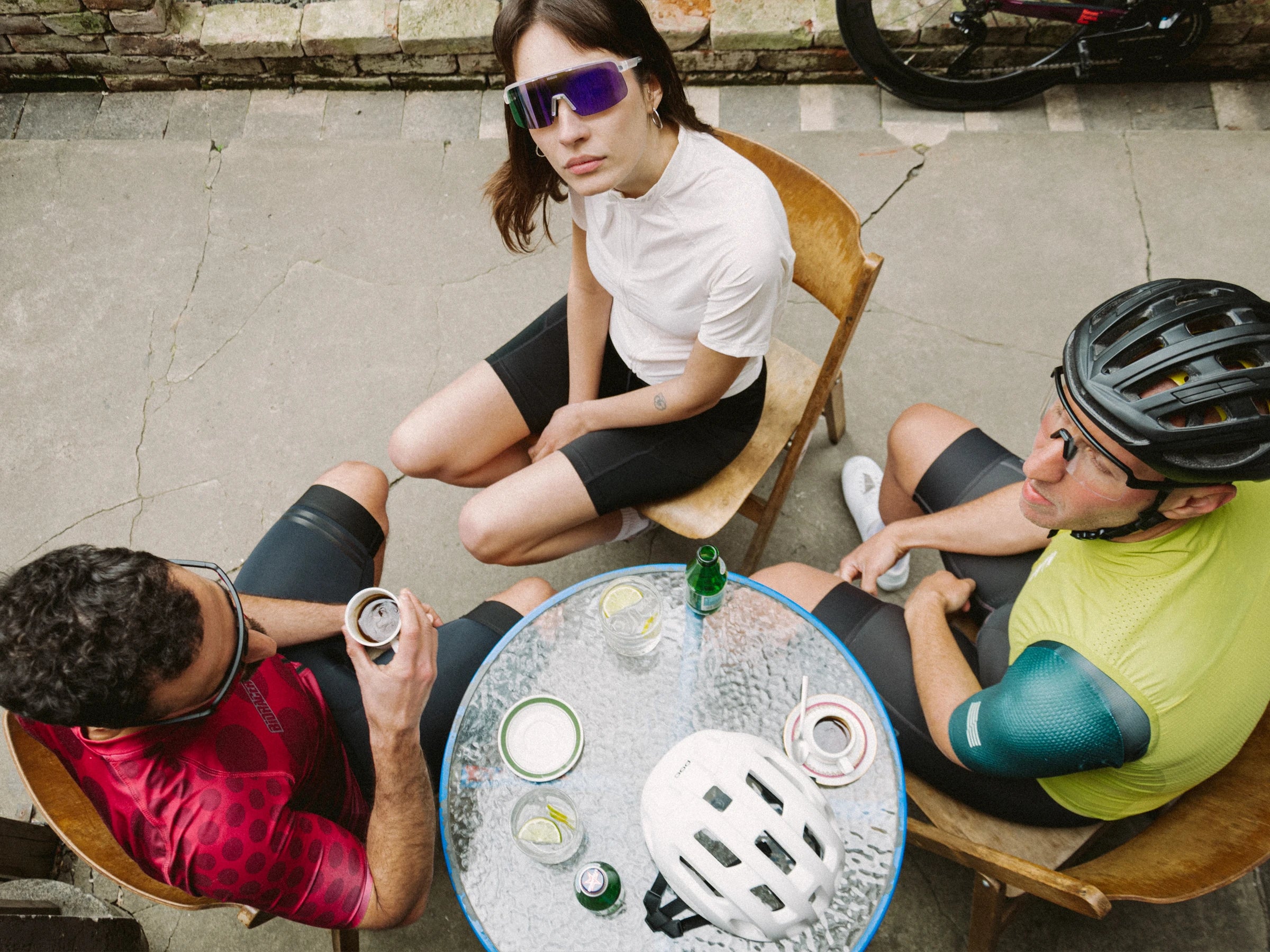
Cycling Glasses Buying Guide 2027: Clarity Without the Markup
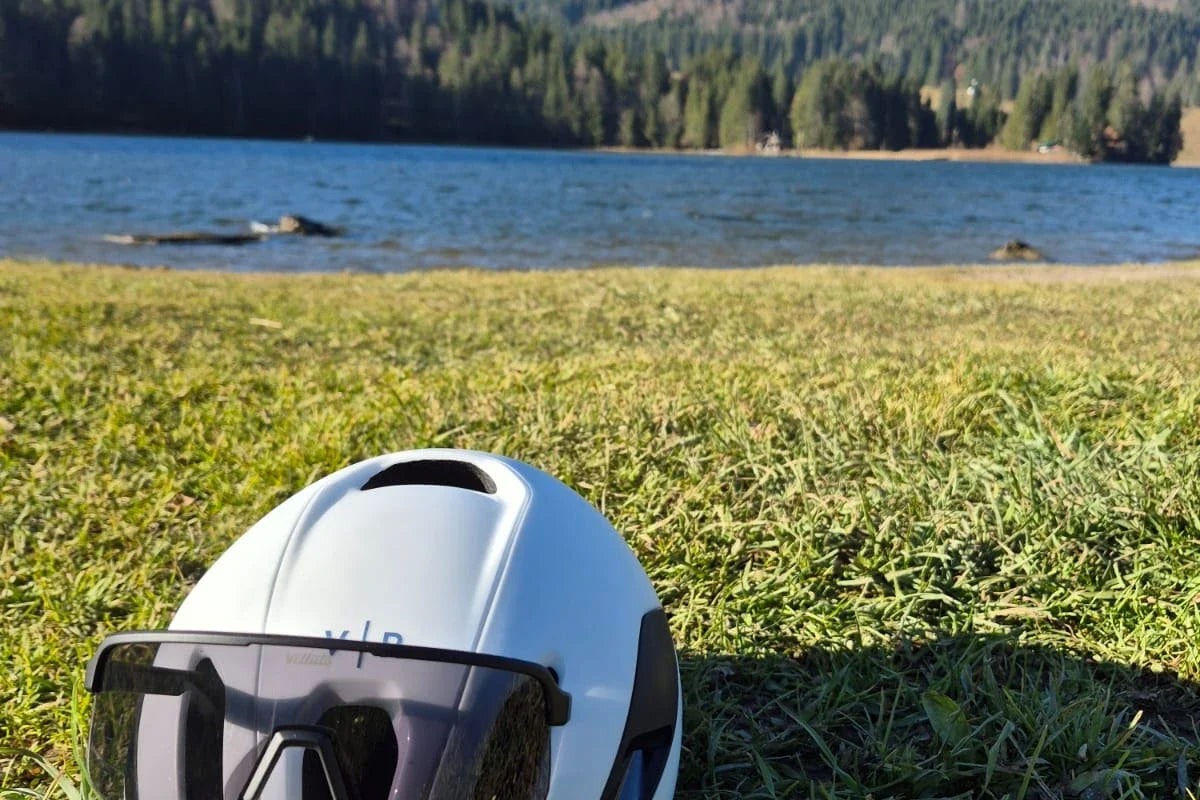
Contents21 min read
You are standing at the start line of a November cyclocross race, the kind where the light changes four times before the first lap is done: pale grey on the grid, a brief shaft of low winter sun through the trees, shadow again in the technical section, then flat white on the run-up. Your glasses fog on the first dismount, then clear, then fog again. At that point, the debate about which cycling glasses to buy stops being theoretical and becomes very specific.
This guide is for road cyclists and cross riders who have already decided that quality cycling glasses matter. You are not trying to be convinced of the category. You are trying to understand what actually separates one pair from another, what specifications to trust, which marketing language to ignore, and whether the price premium attached to certain brand names reflects engineering or just advertising spend. We will answer all of that, then show you where the Velluto StradaPro fits.
01 · Short answerWhat to know in 60 seconds: the TL;DR
If you are a serious road cyclist who wants UV400-certified eye protection, anti-fog performance on climbs, and the flexibility to swap lenses between a clear option and a high-contrast option without tools, the Velluto StradaPro is the answer. It weighs 25 grams, is designed in Italy, made for European riding conditions, and starts from 69 EUR. There is a 30-day risk-free trial, so you can test it on real rides rather than a shop mirror.
If you want a single lens that adapts automatically to changing light rather than a swappable system, the right product is the Velluto Chromo, which is photochromic and develops a mirrored finish in strong sun. That is a genuinely different product serving a different preference, and we will cover both further down.
If you are asking whether you need to pay significantly more than 69 EUR to get genuinely good cycling glasses, the honest answer from a brand that makes them is: no. What you get at higher price points is often brand recognition and retail margin. The optics, the UV certification, the fit engineering and the lens versatility are achievable below that threshold.
02 · CriteriaWhat actually matters when buying cycling glasses
The cycling eyewear market is not short of opinions. Every brand lists its own criteria in the order that makes its product look best. What follows is a framework based on what changes on a real ride, not in a product listing.
UV400 means the lens blocks 100% of UVA and UVB radiation up to 400 nanometres. Any serious cycling glasses should carry this. A label that says "UV protection" without specifying the standard is not the same thing. For road cycling, where cumulative sun exposure across a season is significant, UV400 certification is non-negotiable.
Fogging is not an aesthetic irritant. It is a safety problem. It happens most reliably at the worst moments: cresting a climb, emerging from a wooded section, stopping briefly. Glasses designed for road cycling need a system that handles the temperature differential between effort and stillness, not just frame ventilation slots that work at speed.
A single tint is a compromise. You will ride in flat light, bright sun, overcast winter conditions, and tunnel sections in the same week. The choice is between an interchangeable system (two lenses, one frame, manual swap) or a photochromic lens (one lens that adapts automatically). Both solve the problem; each has trade-offs we cover in the scenario section below.
Weight matters more over distance. A frame that feels fine in the car park becomes a pressure point at hour three. Adjustable nose pads make a significant difference across different face shapes, and they allow micro-adjustments as sweat and heat change the dynamics of the fit. A 25-gram frame is at the light end of what is achievable in road cycling eyewear.
Beyond those four, the next tier of considerations includes lens optical quality (the degree to which the lens distorts or enhances what you see), peripheral coverage (relevant for road debris and insects at speed), and ease of lens maintenance. Everything else in a typical product listing, the colourways, the case material, the brand story, is secondary to these functional criteria.

03 · UV and opticsReading the UV claim on the box
UV400 is worth understanding properly because it is both the most important claim on a pair of cycling glasses and the easiest to fake with language. The standard requires that the lens transmits no more than 0.1% of ultraviolet radiation at wavelengths up to 400 nanometres. It covers both UVA (315 to 400nm) and UVB (280 to 315nm). Those are the ranges that cause cumulative damage to the cornea, lens and retina with long-term unprotected exposure.
The practical consequence for a road cyclist is straightforward: eight hours a week outdoors across a full season is a meaningful UV dose. The difference between a certified UV400 lens and a generic tinted lens is not visible to the eye, but it is real in terms of cumulative exposure. When a lens is UV400 certified rather than simply described as offering "UV protection," there is a documented standard behind that claim.
The VellutoPuro and VellutoVisione lenses that come with the Velluto StradaPro both carry UV400 certification. The Velluto Chromo's photochromic lens also carries UV400 certification. This is not a differentiator unique to Velluto in the market, but it is a baseline standard that matters, and verifying it rather than assuming it is worth your 30 seconds.
Eight hours a week in the saddle is a serious UV dose. The difference between a certified UV400 lens and a generic tinted one is invisible to the eye, but it accumulates across a season.Velluto Buying Guide, November 2026
Lens optical quality sits alongside UV certification as a criterion that matters most on longer rides. A lower-quality lens introduces distortion at the periphery, which becomes tiring over distance. It is not dramatic, it does not look wrong in a shop, but after two hours your eyes have been working harder than necessary. This is why optical quality in cycling eyewear tends to be the hidden differentiator rather than the marketed one.
04 · Anti-fogWhy fogging matters more than you think on the bike
Anti-fog performance in cycling glasses is discussed less than UV ratings and lens colours, possibly because it is hard to demonstrate in a product photo. But ask any road cyclist who has descended at 50 km/h with a fogged lens and you get immediate recognition. The moment you need clarity is precisely the moment fogging occurs: the transition from sustained effort to either a stop or a descent, where body temperature remains high and the lens suddenly meets cooler air.
Frame ventilation helps at speed but is insufficient when you are stationary or moving slowly. Lenses with a dedicated anti-fog coating or system handle this by preventing the temperature differential from causing condensation on the inner surface. The Velluto StradaPro has a built-in anti-fog system designed for road cycling conditions, which addresses the specific scenario of variable-pace rides rather than purely steady-state efforts where simple ventilation is adequate.
In cyclocross conditions, which is relevant to November riding, the fog problem is amplified. You alternate between high-intensity efforts and brief stops repeatedly. You run through barriers in cold air. You breathe upward into your lens gap on steep run-ups. A passive ventilation approach is not sufficient. An active anti-fog system is the relevant specification.
The same logic applies to alpine road cycling in summer: the top of a cold descent is exactly where you need your vision to be sharpest. Anti-fog is not a nice-to-have; it is a performance feature with a direct safety implication.

05 · Lens systemsInterchangeable lenses vs photochromic: choosing honestly
This is the question that divides the market, and it deserves an honest treatment rather than a brand-first answer. Both approaches work. Neither is universally superior. The right one depends on how you ride and how you manage your kit.
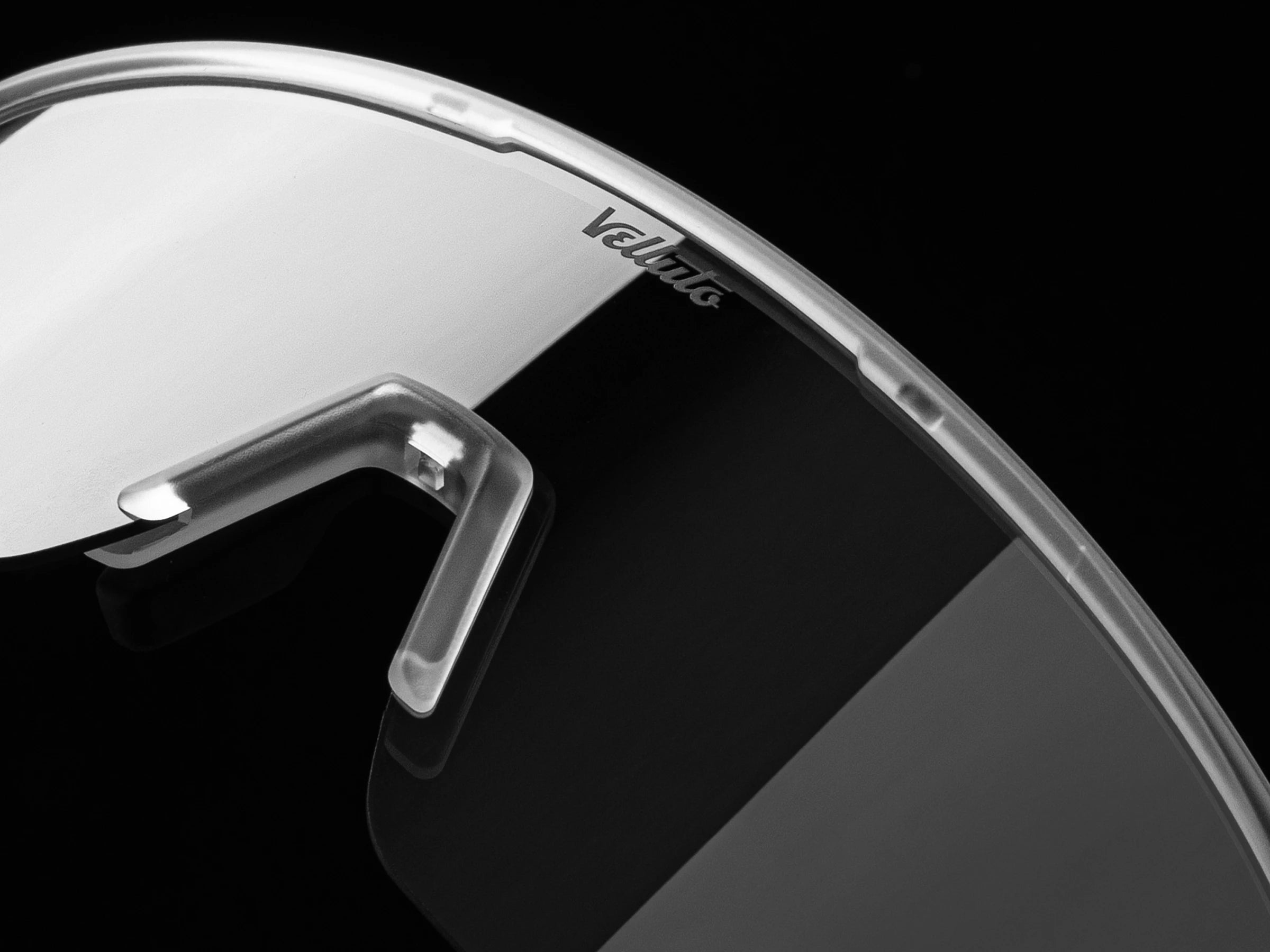
An interchangeable lens system gives you two distinct lenses in one frame. With the Velluto StradaPro, that means the VellutoPuro (a transparent lens optimised for low light and wind and insect protection) and the VellutoVisione (a high-contrast lens that sharpens visual definition in brighter conditions). You swap them without tools using a click-in system that takes seconds. The practical upside is that each lens is optimised for its specific light range, delivering maximum performance in the conditions it was designed for. The trade-off is that you need to remember to bring the second lens and to actually change it when conditions shift.
A photochromic lens is self-tinting. It darkens automatically in bright light and clears in low light, adapting as you ride without any manual intervention. The Velluto Chromo uses this approach: its lens adjusts to the available light and develops a mirrored finish in strong sun. The practical upside is simplicity: one lens, one frame, no decision to make mid-ride. The relevant caveat is that a photochromic lens is always a compromise at both ends, slightly darker than ideal in low light, slightly lighter than ideal in peak brightness, because it is calibrated for the middle of the range. It suits riders who value simplicity and consistency over maximum optimisation at each extreme.
For cyclocross and winter road riding in November, both are genuinely useful. If you are riding before 09:00 and after 16:00 in northern Europe, the light is consistently low and variable, which is where photochromic performs well. If you are doing structured training rides that span a range of light conditions with predictable transition points, the interchangeable system gives you better per-condition performance. Neither answer is wrong. Know which rider you are before you decide which system suits you.
Riders who want maximum optical performance in each specific light condition and are willing to manage a second lens. The click-in swap on the StradaPro is fast enough to do at a cafe stop or before the first big climb of the day. Good for road cyclists who know their route and can anticipate light changes.
Riders who want one frame, one lens, no decisions. The Velluto Chromo adapts continuously as you ride, making it well suited to autumn and winter conditions where light changes unpredictably within a single ride. The trade-off is slightly reduced optimisation at either extreme of the light range.
One important clarification: the Velluto StradaPro is not photochromic and does not have a mirrored lens. Those properties belong exclusively to the Velluto Chromo. The StradaPro's answer to changing light is the two-lens interchangeable system: tool-free, fast, and effective. If you are looking specifically for photochromic performance, the product to look at is the Velluto Chromo. If you want the interchangeable system, the StradaPro is the right frame.
06 · Velluto positioningItalian-engineered performance, without the premium markup
Velluto is a German brand with Italian design. That matters as a statement of what the product actually is, not as marketing shorthand. Italian design in road cycling eyewear means the aesthetic and ergonomic thinking comes from the same culture that has shaped road cycling equipment for decades, the attention to fit geometry, lens curvature and frame proportion that makes a pair of glasses feel like it belongs on a bike rather than adapted from general sports eyewear.
The brand's position in the market is explicit: performance specifications comparable to the top of the market, priced without the allocation for brand prestige marketing. That is not a subtle claim. It means the StradaPro's UV400 certification, 25-gram frame, built-in anti-fog system and tool-free click-in lens system are the product of real engineering decisions, not differentiated primarily by what logo sits on the temple.
The riders this appeals to are not anti-brand as a philosophy. They are pro-performance as a priority. If two pairs of cycling glasses offer the same UV certification, the same optical quality, the same anti-fog performance and the same lens versatility, the question of which costs more is just about where the extra money goes. That is a reasonable question to ask, and Velluto's answer is that it goes into the product.

It is worth being direct about what Velluto does not offer, because honesty is part of the positioning. There are no polarized lenses in the range. There are no prescription optical inserts. If those are requirements, Velluto is not the right answer and you should seek a brand that offers them. What Velluto does offer is UV400-certified, anti-fog, interchangeable-lens road cycling glasses, and the Chromo for photochromic performance, at transparent Italian-engineered pricing with a 30-day trial.
The 30-day risk-free trial is worth pausing on. It is not a marketing device. It is the brand's acknowledgment that cycling glasses are performance equipment that needs to be tested in conditions rather than approved in a shop. The only honest way to know whether a pair of glasses works for you on a climb is to do the climb. The trial gives you that window.
07 · Riding scenariosReal-world conditions and which lens to reach for
Abstract criteria are useful for a framework. What most cyclists actually want to know is how the glasses perform in specific situations. Here are the most common scenarios for road cyclists in November 2026, with an honest lens recommendation for each.
Scenario 1: Long endurance ride, mixed weather, 4-6 hours. You will start in cold, low light, ride into whatever the mid-morning offers, and finish in the afternoon grey. If you are using the StradaPro, start with the VellutoPuro (clear lens) if the morning is overcast and dim. If the ride goes through a bright midday stretch, swap to the VellutoVisione at the first stop. The click-in takes under a minute. If you prefer not to manage that decision, the Chromo handles both phases automatically, though it will not be as dark as a dedicated tinted lens in full sun or as clear as the VellutoPuro in genuinely dim light.
Scenario 2: Sportive or gran fondo, autumn, 100km plus. This is the scenario where frame weight matters most. At 25 grams, the StradaPro does not load your nose over a six-hour ride the way heavier frames do. The adjustable nose pads allow you to distribute contact pressure correctly before the start, so you are not adjusting by hand at kilometre 70. UV400 certification matters here because a full day in autumn sun in the Alps or Pyrenees is still a significant UV dose even when it feels mild.
Scenario 3: Cyclocross race, November, 45 minutes. You need anti-fog above everything else. The repeated transitions from effort to stop-run-stop are the most aggressive fogging condition in cycling. The StradaPro's built-in anti-fog system addresses this. For lens choice, the VellutoPuro is usually the right call for the grey light of November cross courses. The VellutoVisione would be appropriate for a bright day, but in flat November light the clear lens gives better overall vision.
Scenario 4: Pre-dawn training, turbo-to-road transition rides. The VellutoPuro is the unambiguous choice. Its function is specifically protection against wind and insects with full light transmission, so you are not adding a tint penalty in already-limited visibility. UV400 certification still applies: even at dawn the lens is protecting your eyes from low-angle sun at the horizon.
Scenario 5: Winter road riding, sun low on the horizon. This is where the VellutoVisione earns its place most clearly. Low winter sun creates intense horizontal glare that is tiring and disorienting over a 90-minute ride. The high-contrast lens filters the spectrum in a way that reduces that fatigue without the deep tint of a summer lens. The adjustable nose pads on the StradaPro keep the lens geometry stable relative to your eyes, which matters when the sun is at an angle where a few millimetres of frame shift changes your field of view significantly.
Low November sun at 10:00 is not a gentle hazard. At that angle, 90 minutes of unfiltered glare is enough to leave you squinting for the rest of the day. The right lens call before the ride is the one you notice by not noticing it.Velluto Buying Guide, November 2026
Scenario 6: Group ride, variable pace, town and open road. Anti-fog is relevant here because you will slow significantly through towns, roundabouts and neutralised sections. The click-in lens system lets you match the lens to whatever the sky is doing that morning before the ride starts. If you are out the door at 08:30 on a November Saturday and the forecast says mixed, the VellutoPuro going out becomes the VellutoVisione if the sun appears at the halfway cafe. That flexibility is the core value proposition of the interchangeable system.
08 · The StradaProProduct overview: the Velluto StradaPro
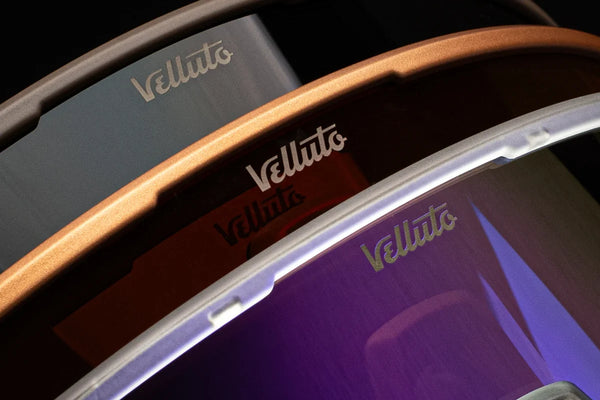
The StradaPro is Velluto's core road cycling glasses frame. Italian design, 25 grams, UV400 certification, built-in anti-fog system, adjustable nose pads and a tool-free click-in lens system compatible with the VellutoPuro and VellutoVisione lenses. It comes in four colourways: Arancia (orange), Espresso (brown), Nero (black) and Viola (purple). Free shipping applies to orders over 89 EUR, and the 30-day risk-free trial applies to all purchases.
The StradaPro Starter Vision Kit includes the frame plus both lenses, which is the practical starting configuration for road cyclists who want to cover the full light range from a single purchase. The lens swap is tool-free and takes seconds, so both lenses travel with you and the choice happens based on actual conditions rather than a forecast.

Keeping your lenses clean is straightforward with the right tools. The Velluto cleaning setup uses a 50ml apple-fragrance spray made in Germany, refillable and sized to travel in a jersey pocket, alongside a 25x25cm microfibre cloth (80% polyester, 20% polyamide) designed to lift oils and grit from the lens surface without scratching. Neither is essential, but both are worth having if you are cleaning your lenses in the field rather than at home.

The StradaPro is available in four colourways. Each uses the same frame geometry, the same 25-gram weight, the same UV400-certified lens system and the same anti-fog and adjustable nose pad features. The choice between Nero, Espresso, Arancia and Viola is entirely about how you want the frame to look alongside your kit.


09 · Context and alternativesWhere the StradaPro sits in the broader market
The cycling eyewear market covers a wide range of price points and design philosophies. The cycling eyewear market includes established brands like Oakley, Rudy Project and SunGod. Each brings genuine strengths: heritage models with long market presence, optical engineering focus across price tiers, and extensive customisation options respectively. These are genuinely capable products built on real engineering expertise.
These brands operate at significant scale with retail distribution networks, global marketing and sponsorship infrastructure. Those operating costs are reflected in their pricing. The question is not whether the products are good, most of them are, but whether the full cost of the brand apparatus is what you are trying to buy.
Velluto's position is that the engineering decisions that make a pair of cycling glasses perform well (UV400 certification, anti-fog system design, frame weight optimisation, lens interchangeability, fit geometry) are achievable without that overhead. The StradaPro starts from 69 EUR. That is not a budget positioning: it is an Italian-designed, German-brand performance product priced at what the product costs to make and distribute honestly.
The comparison is on specifications. UV400: standard across the category. Anti-fog system: built in. Frame weight: 25 grams, at the light end of the category. Lens versatility: two-lens click-in system. Adjustable nose pads: standard on the StradaPro. 30-day trial: included. That is the basis for a purchasing decision.

10 · ComparisonKey specifications: at a glance
The table below is a summary of the StradaPro's core specifications. It is designed to give you a consistent reference for the criteria that matter in road cycling eyewear. Competitor specifications where listed are sourced from publicly available information; where a competitor's figure is not confirmed, it has been left blank rather than estimated.
| Specification | Velluto StradaPro | Category context |
|---|---|---|
| Frame weight | 25 g | Typical road cycling frames range from 25g to 40g+ |
| UV protection | UV400 certified | UV400 is the category standard for serious road use |
| Anti-fog | Built-in system | Varies: ventilation-only to active coating systems |
| Lens system | Interchangeable, tool-free click-in | Ranges from fixed single lens to multi-lens systems |
| Lens options | VellutoPuro (clear) + VellutoVisione (high contrast) | Most interchangeable systems offer 2 to 4 lens options |
| Nose pad | Adjustable | Adjustable nose pads not standard across all price points |
| Photochromic option | No (see Velluto Chromo) | Available from multiple brands at higher price points |
| Starting price | from 69 EUR | Premium road cycling eyewear ranges widely |
| Trial policy | 30-day risk-free trial | See manufacturer for individual brand policies |
| Free shipping | Orders over 89 EUR | See individual retailers |
Compare the full lineup in the Velluto StradaPro cycling glasses collection.
11 · FAQFrequently Asked Questions
What UV protection do cycling glasses need?
How much should cycling glasses cost?
What is the difference between clear and tinted cycling lenses?
Are anti-fog cycling glasses worth it?
What weight should cycling glasses be?
What is an interchangeable lens system in cycling glasses?
What is a photochromic cycling lens?
How important are adjustable nose pads on cycling glasses?
Can I try Velluto cycling glasses before committing?
If you have questions that are not covered here, or you want to compare the StradaPro against the Chromo before deciding, the full range is at velluto-shop.com. The 30-day trial means the decision is reversible. The only thing to lose is a few bad rides in the wrong glasses.