Cycling Glasses for Big Head: Fit Guide 2026
Contents25 min read
You are three kilometres into a Category 1 climb in the Pyrenees, your cycling camp is already a speck below, and the glasses you bought in March are sliding down your nose for the fifth time in twenty minutes. The problem is not sweat. The problem was always the fit. Finding cycling glasses for a big head is one of the most overlooked problems in cycling kit, and getting it right changes every ride that follows.
This guide is for riders who have bought glasses that looked fine in the mirror and felt wrong by kilometre ten. It covers the actual measurements that determine whether a frame works on a wider, larger head, the adjustable features worth paying attention to, and how to test fit properly before you commit. No guesswork, no generic advice about "one size fits most."
Last updated: 31 July 2026.
01 · The ProblemWhy Standard Cycling Glasses Often Fail on Larger Heads
The road cycling eyewear industry designs to a statistical median. That median is approximately a 55 cm head circumference and a face width of around 13 to 13.5 cm, measured temple to temple at the cheekbones. If you sit at or above one standard deviation above that, which roughly corresponds to a 58 cm or larger circumference and a 14.5 cm or wider face, standard frames create predictable problems.
The first and most common complaint is lateral pressure. The frame is physically narrower than your face, so the temple arms push inward at the sides of your skull. On a short ride this reads as mild discomfort. Over three hours in the saddle, particularly on a hot day in the Alps when your helmet padding is compressed and your temples are already warm, it becomes a headache that has nothing to do with the climb gradient.
The second problem is nose-bridge mismatch. A wider face often comes with a broader nose bridge, and frames sized for narrower faces place their nose pads too close together, forcing the lens to sit too high or causing the whole frame to tip forward. The result is that the glasses perch at an angle, the upper edge catches in your line of sight, and on descents you end up looking under the frame rather than through it.
The third issue is temple arm length. Head size is not just about width. A larger skull is usually deeper front to back, meaning standard-length temple arms that are long enough to sit behind the ear on a median-sized head can finish too short on a larger one, creating a cantilever effect where the glasses are always fighting to slide forward.
None of these are unfixable. They are solvable with the right measurements, the right frame geometry, and two or three adjustable features that are now standard in quality cycling eyewear but are absent from budget options that prioritise aesthetics over engineering.
02 · MeasurementsHead Circumference vs Face Width: Which Number Actually Matters
Walk into any hat shop and they will measure your head circumference. Walk into an eyewear fitting and they will measure your pupillary distance and face width. These are different things, and understanding which one governs cycling glasses fit is the first step to buying correctly.
Head circumference is the distance around your skull at its widest point, typically measured just above the ears and across the forehead. It is useful for helmets, headbands, and caps. For cycling glasses, it is a secondary number. The primary measurement is face width.
Face width, measured at the widest point across your cheekbones, determines whether the frame's lens edges will sit comfortably at your temples or dig into them. A standard cycling frame has a total front width (lens width plus bridge) of somewhere between 130 and 145 mm. If your face width is 150 mm or more, you will feel standard frames pulling inward.
The second measurement that matters for cycling glasses specifically is temple arm length, sometimes called the arm reach. This is the distance from the hinge to the bend that goes over the ear. Standard arms run between 115 and 135 mm. If you have a larger skull that is also deeper front to back, shorter arms sit too high behind your ear rather than curving naturally into the groove above the earflap.
The third measurement, which almost no buyer thinks about until they have had the problem once, is nose bridge width. This is the gap between the two nose pads, measured in millimetres. Standard frames offer a bridge of 16 to 22 mm. A broader face often comes with a broader nose, and a 16 mm bridge on a face that needs 22 mm will push the frame outward and upward, angling the lenses away from your eyes rather than wrapping them.
To summarise the hierarchy: face width governs lateral comfort, temple arm length governs rear stability, and nose bridge width governs lens angle and height. Head circumference is the rough indicator that tells you to check all three, not the measurement that solves the problem.
03 · Self-MeasurementHow to Measure Your Own Head at Home
You do not need a fitting appointment to get accurate measurements. You need a flexible tape measure (the kind used in tailoring, not a metal builder's tape), a mirror, and roughly five minutes.
Start with head circumference. Wrap the tape around your skull at the widest point, typically about 2 cm above your eyebrows at the front and across the widest part of the back of your skull. Pull the tape until it is snug but not tight enough to indent your skin. Note the number in centimetres.
For face width, stand facing the mirror and place the tape at the outermost point of your left cheekbone. Stretch it horizontally across to the same point on your right cheekbone. This measurement tells you the maximum width your cycling frame needs to accommodate without its edges pressing against your temples.
For temple-to-ear distance, measure from the hinge point where your cheekbone ends (roughly where a glasses temple arm would begin) to the point just above your ear where the arm would bend. This approximates the temple arm length you need.
Finally, measure your nose bridge width by placing the tape across the top of your nose at the point where glasses pads would rest, measuring the natural width at that point. This tells you the minimum nose pad gap your frame needs to avoid pushing the frame outward.
Write these four numbers down before you start looking at any specific frame. They are your fit specification, and they will immediately eliminate perhaps half the options on the market, which is actually useful information before you spend money.

04 · Adjustable FeaturesWhat to Look for in Cycling Glasses for a Big Head
Once you know your measurements, you can assess any frame against three adjustable features that do the real work of fit customisation. A frame can score well on all three, two, one, or none. Budget glasses often score zero. Quality performance eyewear should offer at minimum two of the three.
The single most impactful feature for wider faces. Pads that move inward and outward change the effective bridge width. Pads that move up and down change lens height. Both axes matter for a larger head.
Rubber or silicone tips that bend slightly let you customise the angle at which the arm curves over the ear. On a wider skull, a rigid tip can lever the lens away from the face; a flexible tip conforms instead.
A frame built with a wider front arc gives more lateral coverage for a broader face. The lens edges do not finish too close to the temples, and peripheral vision is not cut off on the sides.
Weight becomes critical on a larger head because the downward force of a heavy frame is distributed across a wider nose bridge, accelerating slippage. A 25 g frame stays where you put it; a 40 g frame fights gravity with every descent vibration.
The most common mistake cyclists make when shopping for glasses to fit a big head is to focus only on the lens size, assuming that a larger lens means a better fit for a larger face. That logic is partially correct, but a wide lens on a narrow frame still pinches. It is the total front width and the adjustability of the nose pads that determine real-world comfort, not the vertical height of the lens alone.
A secondary mistake is dismissing nose pad adjustability as a minor detail. On a standard-sized face it might be. On a face that is 5 or 6 mm wider than the frame was designed for, being able to push the nose pads 3 mm further apart on each side is the difference between a frame that sits level on your nose and one that is constantly tipping forward.
05 · The Velluto StradaProHow the StradaPro Addresses Wider Face Fit
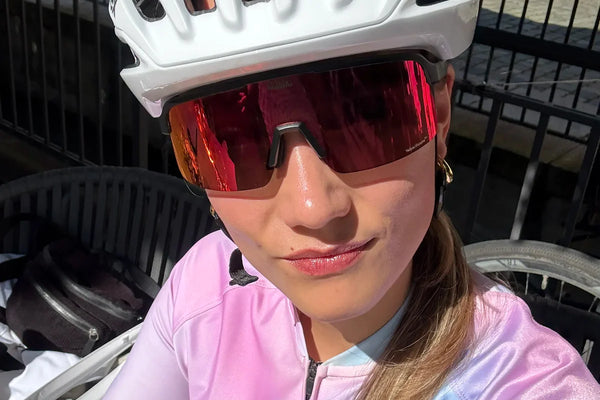
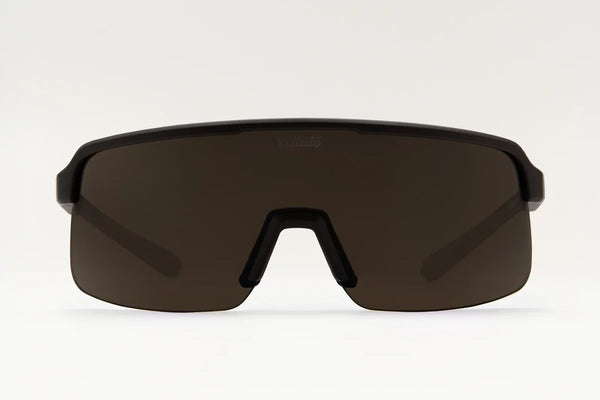
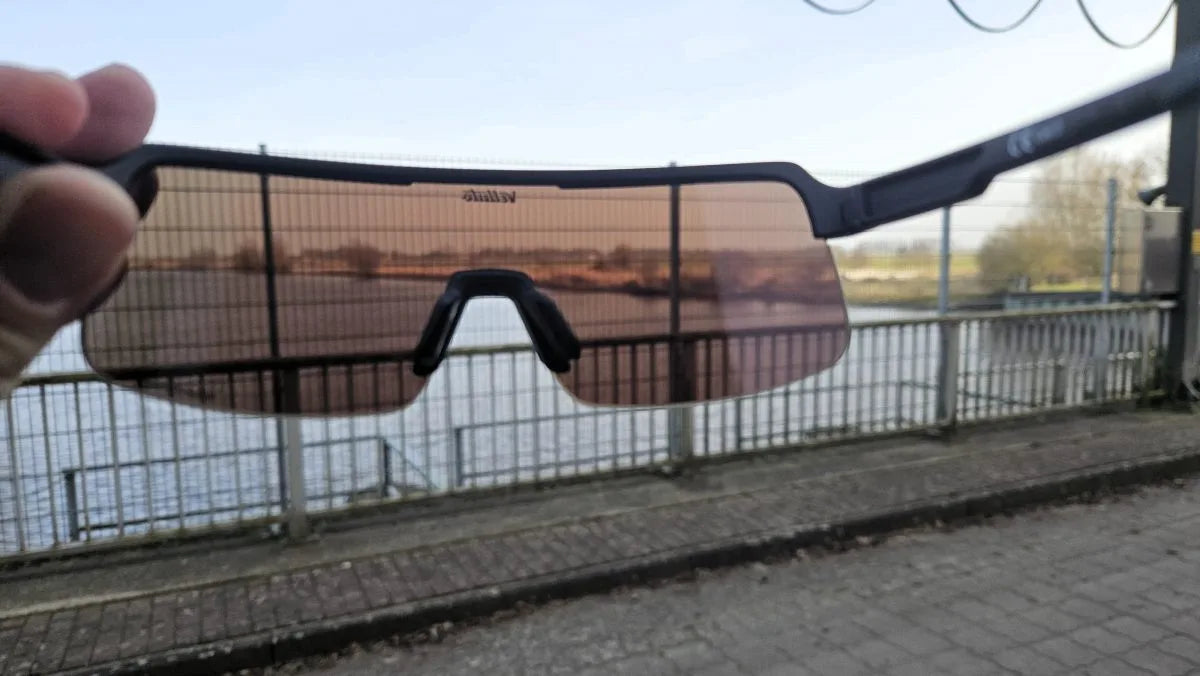
The Velluto StradaPro was designed in Italy and engineered for road cycling performance. Two of its core features are directly relevant to cyclists dealing with wider face fits: adjustable nose pads and a 25 gram frame weight.
The adjustable nose pads are not a cosmetic addition. They move along two axes, allowing you to widen the bridge gap for a broader nose and to raise or lower the lens height for a longer or shorter nose. Combined with the frame's wrap geometry, this means the StradaPro can genuinely serve a wider range of face widths than a fixed-pad frame in a similar price bracket.
At 25 grams, the frame sits at the lighter end of the road cycling glasses market. This matters for larger-headed cyclists for the reason mentioned above: less weight means less downward pressure on the nose bridge, which means less tendency to slip on long climbs. If you have spent a ride pushing glasses back up your nose every few kilometres, you will appreciate this immediately.
The built-in anti-fog system is relevant here as well. A common workaround cyclists use when glasses fit poorly, particularly when they are too narrow, is to let them sit slightly further from the face to create an airflow gap. This solves the fogging problem but creates a wind and debris gap. The StradaPro's ventilation system is designed to manage airflow through the frame itself, so you do not need to compromise fit to manage condensation on climbs.
UV400 certification means 100% UVA and UVB protection. This is not a feature specific to fit, but it is worth noting for cyclists heading to Alpine or Pyrenean camps in summer 2026: UV intensity at altitude is significantly higher than at sea level, and a certified UV400 lens is not optional at 2,000 metres in July.

06 · Lens SystemInterchangeable Lenses and Why They Matter Beyond Fit
If you are buying cycling glasses for a big head, you are already solving one problem: the frame has to fit. Once you have that solved, the next question is whether the glasses you have committed to can do every job you need them to do. This is where the StradaPro's interchangeable lens system becomes relevant.
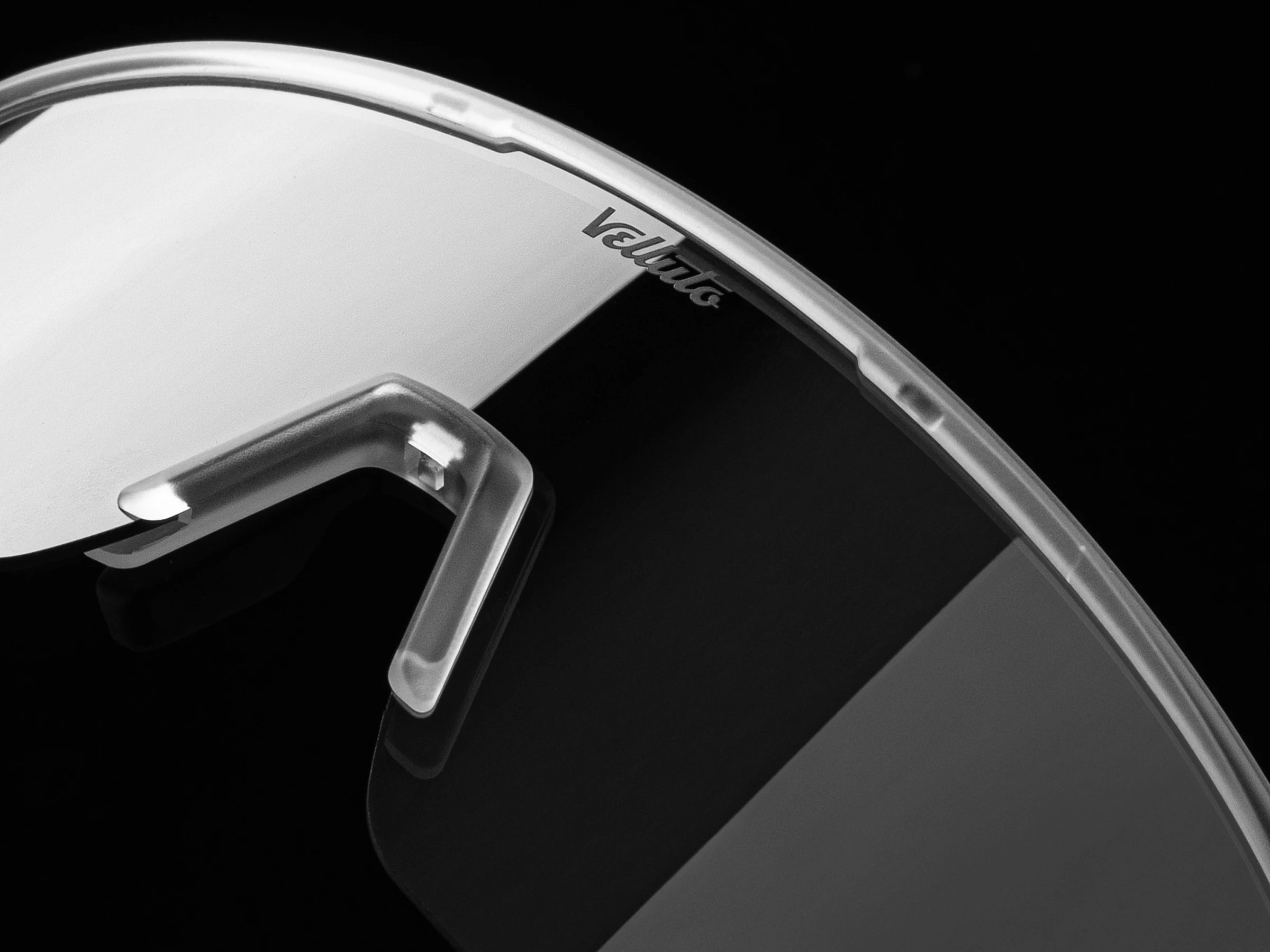
The VellutoPuro clear lens is optimised for low-light conditions: early morning starts before the peloton sets off, tunnel sections on Alpine descents, overcast days in the mountains when flat light makes road surface reading harder. It carries UV400 certification and the same anti-fog system as the tinted lens. The click-in mechanism means the swap takes seconds, with no tools and no risk of bending the frame in the process.
The VellutoVisione high-contrast lens sharpens visual definition in variable light, which is the dominant condition on a mountain stage: you ride from bright open cols into shaded valley sections and back into full sun within the same hour. A high-contrast lens that enhances depth and edge definition helps you read road surfaces more accurately, spot gravel patches mid-descent, and judge distances in the broken light that comes through a forest canopy.
For a rider who has already invested the time in finding glasses that genuinely fit a wider face, having two lens types that click in and out without tools is a meaningful quality-of-life improvement. The alternative is carrying a second pair of glasses sized to the same fit specification, which is a real inconvenience for any rider who has spent months finding frames that work.

07 · Fit TestHow to Test Cycling Glasses Fit Without Buying Blind
The single most useful piece of advice in this entire guide is this: never assess cycling glasses fit from a 30-second try-on in a shop or from a product photo online. Fit reveals itself on a ride, not standing still in air conditioning.
When you put cycling glasses on and stand still, several fit problems are invisible. Temple pressure, for example, is a cumulative complaint. The frame may feel neutral for the first few minutes and become uncomfortable after 45 minutes because the initial tension is sustained throughout. Nose-pad slippage accelerates under sweat and downward vibration from rough roads. Anti-fog performance only becomes relevant when your body is generating heat on a climb. None of these are assessable from a mirror in a shop.
The practical way to test fit properly is to wear the glasses on a real ride of at minimum one hour, including at least one section where you are producing significant effort. This is exactly what the StradaPro's 30-day risk-free trial is designed for. You ride with them. If the fit does not work for your head, you return them. This removes the primary barrier for a cyclist with a wider-than-average head who has been burned before by glasses that looked promising and disappointed in practice.
Fit reveals itself on a ride, not in a mirror. The 30-day trial exists precisely because no fitting room can replicate three hours on a col.Velluto Fit Guide
When you are evaluating fit during your test ride, pay attention to four specific things in order of importance:
First, temple pressure. Do you feel the arms pressing inward at the sides of your skull after 20 to 30 minutes? If yes, the frame is too narrow for your face width, and no amount of nose pad adjustment will fix that. This is a frame geometry issue.
Second, nose-pad stability. Are the glasses staying level on your nose through a moderate climb, or are they tipping forward as you produce power? If they tip, adjust the nose pads first: widen them slightly and lower them to distribute the contact over a larger area. If they still tip after adjustment, the frame may be too light at the front relative to the arm length, which is a different fit issue.
Third, lens position. Are you looking through the centre of the lens or have the glasses shifted so you are looking near the edge? The lens should wrap your field of view, not cut it off. If the lens is drifting out of your central vision, the nose pads need to move up (to raise the lens) or the frame is slightly too narrow.
Fourth, fogging. Do the lenses fog on the first climb and stay fogged, or do they clear quickly? Persistent fogging is partly a ventilation design issue and partly a fit issue: if the frame sits too close to your face because the nose pads are bringing it flush with your skin, the anti-fog vents cannot work. Try bringing the nose pads very slightly outward to increase the gap between lens and face.
08 · Market ContextCycling Glasses Fit Standards: What Other Brands Offer
Several well-known brands address the wider-face fit problem in different ways. Understanding the general approaches helps you evaluate options systematically rather than trial and error.
Oakley's Sutro and Sutro Lite frames use a broad, shield-style front geometry with a single-piece lens design. The Sutro Lite offers a lighter-weight variant within Oakley's range.
POC's Devour and Aspire frames feature a wider front geometry. Their frames tend toward a more structured, sportier aesthetic.
Julbo's Reactor and Aerospeed lines feature adjustable nose pad systems and are built for mountain and endurance riding. Their Reactiv lens technology offers self-tinting, which is a different approach to lens adaptation than Velluto's tool-free interchangeable system.
Smith's Optics Shift MAG line uses a magnetic lens swap system. Their shield-style frames are designed to accommodate wider face geometries.
Tifosi's Rail and Rail XL offer different sizing options. The Rail XL is designed to accommodate a wider fit. Tifosi operates in the value segment of the performance eyewear market.
Roka's San Remo Air is built with a lightweight construction philosophy. Their frames are designed with a wide range of face geometries in mind.
The common thread across all quality options in this category is that adjustable nose pads and some form of temple arm flexibility are now the minimum specification for a performance cycling frame that claims to serve a range of head sizes. A frame without either is essentially telling you that if you do not happen to match its fixed geometry, you are not its customer.

09 · Colour & StyleChoosing the Right StradaPro Colour for Your Face Shape
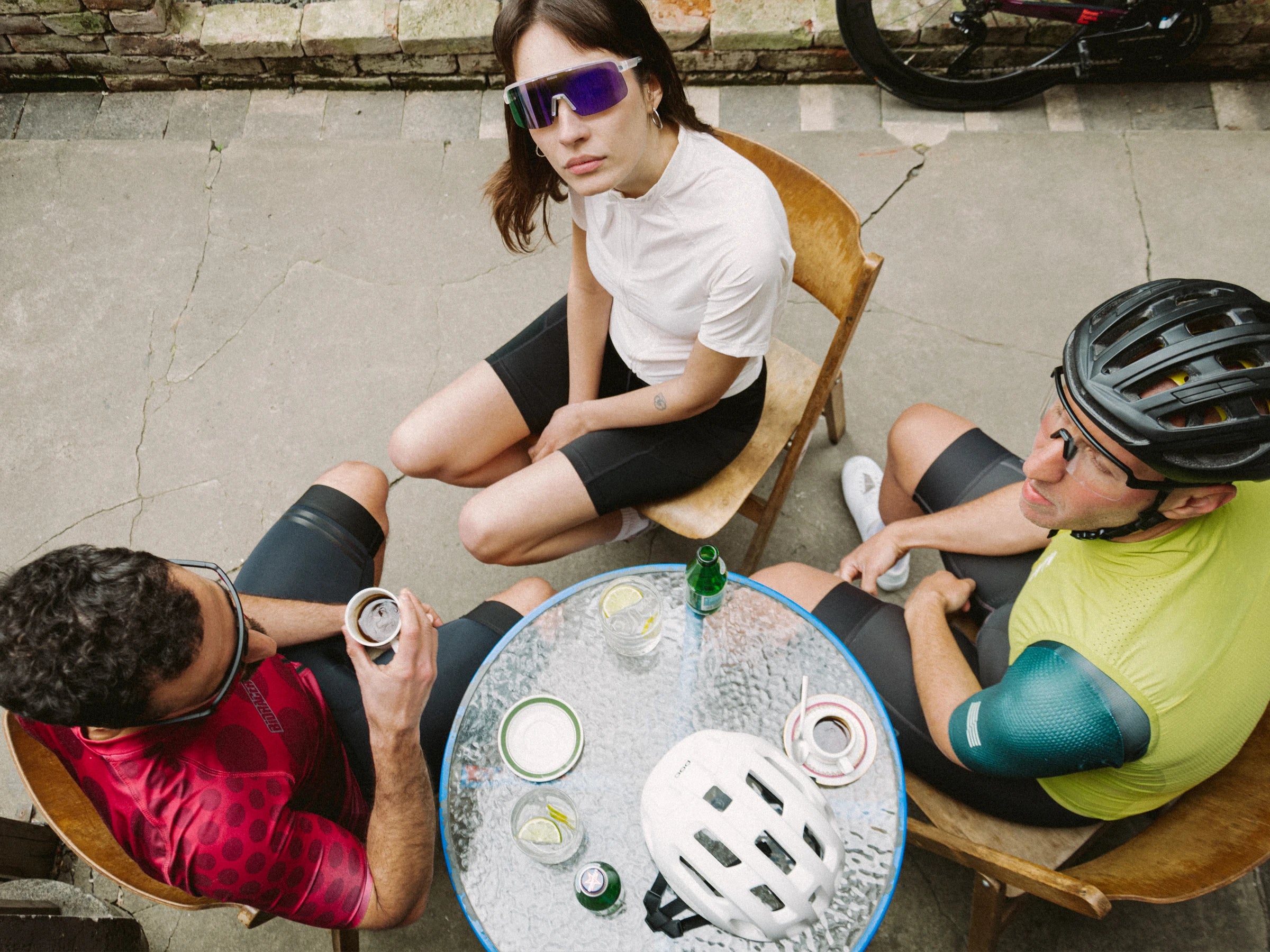
All four StradaPro colours share exactly the same frame geometry, dimensions, and adjustable features. There is no fit difference between Arancia, Espresso, Nero, and Viola. The choice is entirely aesthetic, though there are a few practical considerations worth mentioning for riders with wider faces.
Frame colour affects perceived face width in the same way it does in any wearable. Darker frames (Nero and Espresso) tend to create less visual contrast against the skin and helmet, which some riders with broader faces prefer because the frame reads as less prominent. Arancia and Viola are more visible against a range of helmet colours, which has a practical road safety benefit in mixed traffic.
If you are spending time in the Alps or Pyrenees this summer, Viola and Arancia are also easier to spot from a distance, which is useful in a group where wheel overlap and bunch dynamics require riders behind you to read your head position quickly. This is a small point but worth knowing.


10 · Complete KitProtecting Your Investment: Case, Lens Care, and Long-Term Fit
Once you have found cycling glasses that genuinely fit a larger head, protecting that investment is straightforward but worth addressing. A frame that fits well can still be damaged by poor storage or lens care habits, and replacing a well-fitting frame that you have dialled in is frustrating.
The Velluto Hard Case carries an anti-crash guarantee and fits all road cycling glasses in the range. If you are travelling to a cycling camp, the hard case is the only sensible storage option: jersey pockets are fine for a solo club ride, but in a suitcase or kit bag where the glasses are exposed to other items, a semi-rigid or soft case is a risk. The velvet interior finish also prevents micro-scratches on the lens surface during transport.
For lens cleaning, the Velluto Microfiber Cleaning Cloth (25 by 25 cm, 80% polyester and 20% polyamide) and the 50 ml Cleaning Spray with apple fragrance handle routine maintenance. The spray is refillable and made in Germany, which matters for riders who prefer to minimise single-use packaging on multi-week camps. A clean lens is also a functionally relevant safety item on descents: a smeared VellutoVisione high-contrast lens loses contrast clarity, defeating the purpose of carrying it.
For riders doing significant Alpine or Pyrenean riding this summer, carrying the VellutoPuro clear lens as a backup to the VellutoVisione makes practical sense. The click-in swap takes seconds and gives you appropriate protection in any light condition without needing a second pair of well-fitting glasses.

11 · Fit ChecklistA Quick Reference Before You Buy
Before ordering any cycling glasses for a wider or larger head, work through this checklist. It takes three minutes and saves the frustration of a return, or worse, keeping glasses that do not really fit because the return process feels like too much effort.
Measure your face width at the widest point across your cheekbones. Note the number. Compare it against the frame's stated total front width (lens width plus bridge). The frame front should be at minimum equal to your face width, ideally 2 to 5 mm wider, to ensure the lens edges do not press into your temples.
Check whether the frame has adjustable nose pads. If it does not, and your face width is at the upper end of what the frame was designed for, you have no adjustment mechanism available. This is a significant limitation.
Measure your nose bridge width at the natural resting point of glasses on your nose. Check that the frame's bridge measurement (almost always listed in the sizing, formatted as lens width, bridge width, arm length, for example 70-16-120) accommodates your nose without pushing the frame outward.
Check the temple arm length. If you have a deeper skull front to back, look for arms of 130 mm or longer. Most performance road cycling glasses fall in this range, but some more compact race-profile frames use shorter arms that can cause problems.
Confirm the frame weight. Below 30 grams is the threshold where downward slippage becomes noticeably less of a concern for most riders. The StradaPro at 25 grams sits comfortably below that threshold.
Finally, confirm whether the brand offers a trial period. For riders with non-standard head sizes, a trial period is not a luxury, it is the only honest way to know whether a frame works for you before you are past the point of return.

12 · Tour de France ContextWhat the 2026 Tour Season Tells Us About Eyewear Fit at Altitude
The 2026 Tour de France has, like its predecessors, put eyewear fit under a practical microscope. Watch any mountain stage closely and you will notice that virtually every professional on a serious climb has glasses that sit flush and level without slipping, regardless of effort level, sweat, and the vibration of rough tarmac. This is not coincidence. Professional teams invest significant time in equipment fitting, and eyewear is part of that process.
What the peloton demonstrates consistently is that a well-fitted lightweight frame stays put through the worst conditions a road presents. Frames that are adjusted to the individual rider's face, including nose pad position and temple arm angle, do not need to be pushed back up during efforts. This is not a performance gain in watts. It is a concentration and safety gain, which at 70 km/h on a descent is far more meaningful.
cycling camps in the Alps and Pyrenees in summer 2026 put amateur riders in exactly these conditions: high UV exposure, variable light from open mountain cols to shaded switchback descents, long climbs generating significant perspiration, and the occasional tunnel section where a clear lens is preferable to a tinted one. The equipment decisions that matter in this context are identical to the ones professional teams make: light frame, adjustable fit, verified UV400 protection, and a lens system that can adapt to changing light.
The amateur rider's advantage over the professional context is the 30-day trial period. Professionals test kit under controlled conditions over weeks before a major event. Amateur riders can approximate this by riding their chosen glasses for a month before committing, returning them if the fit is wrong, and trying again. This is essentially a professional fitting process available to any rider who uses it.
Compare the full lineup in the Velluto StradaPro cycling glasses collection.
13 · FAQFrequently Asked Questions
What is considered a big head for cycling glasses?
Does head circumference or face width matter more for cycling glasses?
How do I measure my face width for cycling glasses without a fitting appointment?
What adjustable features should I look for in cycling glasses for a big head?
Can A cyclist with a larger head tests cycling glasses for fit before committing to a purchase?
Will a heavier frame cause more pressure on a large head?
Do anti-fog features matter more for cyclists with larger heads?
What lens options are available for the Velluto StradaPro?
Are there specific colours of the Velluto StradaPro that suit larger frames better?
Finding cycling glasses that genuinely fit a larger head is a solvable problem once you know what to measure and what features to prioritise. If you are ready to ride with a frame built around adjustable nose pads, a 25 gram construction, and a 30-day trial so you can test fit on real roads, explore the full range at velluto-shop.com.