Cycling Glasses Don't Fit With Helmet? Here's Why
Contents26 min read
You are twenty kilometres into a Vuelta-week club ride, the pace is honest, and your helmet strap has been pressing against your glasses arm since the first roundabout. By the time the road tilts uphill and you lean forward onto the drops, the nose pad is digging in and the lens has crept two millimetres south. You know the feeling. Most road cyclists do.
The good news is that this is not a random discomfort that you have to accept. Cycling glasses that do not fit with a helmet have a specific, diagnosable cause, usually one of three mechanical conflicts, and each of those conflicts has a concrete fix. This guide walks through the geometry of why it happens, how to test your current setup in thirty seconds, and which frame features to look for when you are choosing glasses that will actually work with the helmet already sitting on your hook at home.
No brand loyalty is assumed. The principles below apply to any glasses purchase. Where the Velluto StradaPro is mentioned, it is because its published specifications directly map to the criteria described.
01 · The core problemWhy Cycling Glasses Don't Fit With Your Helmet
A road cycling helmet and a pair of cycling glasses are both precision-fitted objects. The helmet is shaped to your skull with a retention dial; the glasses are shaped to your face with nose pads and arm curvature. The problem is that nobody designs these two objects together. Each manufacturer optimises for their own fit geometry, and when you put both on at the same time, you are stacking two independent systems that were never tested in combination.
The result is three recurring conflict points: arm contact, strap pressure, and nose-pad displacement. Understanding which of the three you are experiencing is the first step to solving it, because the fix for each is different.
Arm contact is the most common. The retention strap on most road helmets runs diagonally from the ear cup forward and down, crossing the side of the head at roughly the point where the glasses arm sits. If the arm is thick enough, the strap rides over it rather than beside it. Every time you tighten the retention dial or buckle the chin strap, you compress that contact point and drive the arm laterally into your skull.
Strap pressure is subtler. Even when the strap does not sit directly on the arm, the downward pressure of the helmet's inner cradle on the arms can tilt the front of the frame. When the front tilts, the nose pads shift from a flat load across both sides of the bridge to a concentrated point on one side. Over four hours of riding, that point becomes painful in proportion to your frame's total weight.
Nose-pad displacement usually follows from the first two. The helmet changes the equilibrium position of the glasses, and if your nose pads are fixed rather than adjustable, you have no way to rebalance the frame. The glasses slide, you push them back up, they slide again.

02 · The geometryHow Arm Design Decides Everything
If you ask most cyclists why their glasses do not fit with their helmet, they will say the glasses are "too big" or the helmet is "too tight." Both answers miss the actual variable: arm geometry at the crossing point.
The arm of a cycling glasses frame has three relevant measurements. Total arm length determines how far back along the skull the arm reaches, but this rarely causes conflict. Arm curvature at the rear determines how the tip wraps around the ear, this matters for stability but again rarely causes helmet conflict. The measurement that almost always determines compatibility is arm thickness at the mid-section, specifically at the point where the helmet's side strap crosses the head.
On a typical road helmet, that crossing point sits roughly 35 to 45 mm behind the hinge of the glasses. On a standard adult head, it falls somewhere between the outer corner of the eye and the midpoint of the temple. An arm that is 4 to 5 mm thick through that zone will almost always pass under the strap cleanly. An arm that is 7 to 9 mm thick in that zone, which is common in lifestyle-oriented or oversized-shield frames, will conflict with a tightly buckled helmet strap on most helmet models.
Hinge height is the second factor. Hinges that sit high and proud above the arm plane create a raised contact point. When the helmet pushes down even slightly, the hinge acts as a fulcrum and the nose end of the frame tilts up, rotating the nose pad out of its correct position. Road cycling glasses with a low-profile, integrated hinge solve this because there is no raised pivot point for the helmet to lever against.
Arm angle at the front is the third variable. Arms that run nearly horizontal from hinge to ear can conflict with the helmet's inner foam padding along the entire arm length. Arms with a slight downward angle through the first third of the arm tend to drop below the foam band and avoid the contact zone entirely.
03 · The testA 30-Second Fit Check You Can Do Right Now
Before you buy new glasses, or before you decide that the pair you own is genuinely incompatible with your helmet, run this test. It takes less than a minute and it will tell you exactly which conflict type you are dealing with.
Step 1: Glasses first, then helmet. This sounds obvious, but many cyclists put the helmet on first and then try to thread the glasses underneath the strap. Always put the glasses on first. If the helmet cannot go on over the glasses without forceful repositioning of the strap, you have a severe arm conflict that will not improve on a ride.
Step 2: Buckle up and dial in. Buckle the chin strap to your normal riding tension and turn the retention dial to where you would normally set it for a hard effort. Not parade tension, actual riding tension. Most helmet-glasses conflicts only appear at real riding tension because the strap looseness hides the arm contact.
Step 3: Run the finger check. With one finger, trace along each arm from hinge to ear. You are feeling for whether the helmet strap is sitting on top of the arm or passing beside it. If the strap is on top of the arm, you have an arm contact conflict. If you feel the helmet's inner padding pressing down along the arm's length, you have a hinge-height or arm-angle conflict.
Step 4: Drop your chin 30 degrees. Tilt your head down as if you are reading your bike computer or looking at your front wheel. This is the riding position most road cyclists are in for at least half of a typical ride, and it changes the load distribution between nose pads and arms. If the glasses slide forward when you drop your chin, you have a nose-pad displacement problem. If they stay stable, your nose pads are doing their job correctly under helmet pressure.
Step 5: Shake test. Turn your head sharply left and right twice, as you would to check over your shoulder before a junction. The glasses should stay exactly in position. Any movement is a fit problem that will worsen at 40 km/h with wind added.
Once you have identified the conflict type, the solution becomes specific rather than generic. Arm contact conflicts require slimmer arms. Hinge-height conflicts require a lower-profile frame. Nose-pad displacement requires adjustable pads. If you are experiencing more than one conflict simultaneously, look for a frame that addresses all three, because patching one while ignoring the others simply moves the discomfort.

04 · Helmet typesHow Different Helmet Designs Change the Equation
Not all helmets create the same conflict. The internal geometry of the helmet, specifically the height of the retention cradle, the angle of the side straps, and the depth of the inner foam band, determines how much room the glasses arm has to pass without contact.
Standard road helmets with an open-vent design and a mid-height retention cradle are the most forgiving. The cradle sits slightly above the ear, the side straps have room to diverge from the glasses arm, and there is typically enough clearance that frames with arms up to 6 or 7 mm thick will fit without meaningful pressure. This is the category where the broadest range of cycling glasses will work.
Aero road helmets are significantly more demanding. Because the outer shell is tighter and the vent openings are smaller, the internal geometry leaves less tolerance for a thick arm. The retention cradle on many aero helmets sits lower and closer to the ear, which means the strap crossing point moves rearward along the arm, toward the thicker section near the hinge. On these helmets, slim-arm glasses are not a preference; they are essentially required for a pain-free fit.
Gravel and endurance helmets vary considerably. Some have a very open design similar to a standard road helmet; others have a more structured foam band around the perimeter that acts like a continuous contact ring. Glasses with any arm bulk will press against that foam band along the full length of the arm, creating distributed rather than point pressure. Distributed pressure feels softer initially but is actually more problematic over long rides because there is no comfortable position to escape to.
MTB helmets with a visor are a different problem entirely, because the visor itself can conflict with the top of the lens on full-coverage road glasses. If you ride both road and trail, you need a frame with a lens that does not extend above the eyebrow line, or you need to remove the visor when wearing road glasses, which defeats the purpose.
The practical implication is that the same glasses can behave completely differently depending on which helmet you wear them with. This is why buying advice that does not specify helmet type is only half useful. And it is why a trial period that lets you test on actual rides with your actual helmet matters much more than a showroom fit check with no helmet on.
The frame that fits a standard road helmet perfectly may press painfully under an aero lid. Arm thickness at the strap-crossing zone is the single variable that predicts compatibility across both.Velluto Fit Guide
05 · WeightWhy 25 Grams Matters More Than You Think Over Four Hours
When cyclists talk about lightweight glasses, they usually frame it as a performance question, grams saved on the bike. But for helmet compatibility, weight is a comfort question, and the physics are straightforward.
When a helmet compresses the glasses arm at the strap crossing point, it creates a lever. The nose pad is the fulcrum. The lens and front frame are on one side of the lever, the arm behind the crossing point is on the other. The heavier the front frame, the more downward force it exerts on the nose pad. Over a one-hour ride that force is manageable. Over a four-hour sportive in late August heat, when your nose is also warm and your nose pads are working harder to grip, cumulative pressure at the bridge becomes genuinely uncomfortable.
A 25 gram frame does not eliminate this lever effect, but it reduces the magnitude significantly compared to a 38 or 40 gram frame with the same geometry. The reduction is not psychological. The mathematics of moment arms and contact pressure are real, and they compound across time. This is one of the reasons that professional road cyclists, who wear glasses for five or six hours at a stretch, overwhelmingly use lightweight frames, not primarily for aerodynamics, but because comfort over duration is a performance variable on its own.
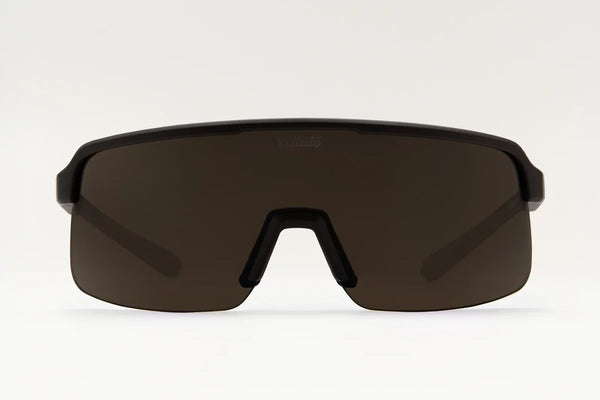
The Velluto StradaPro weighs 25 grams. That number is a published specification, not a marketing estimate. At that weight, the frame sits in the range used by professional road cycling glasses, and the practical effect on helmet pressure over a long ride is measurable rather than theoretical.
06 · Nose padsThe Component That Saves the Fit When the Helmet Changes It
Adjustable nose pads are the most underrated fit feature in road cycling glasses, and they become especially important when a helmet is involved.
Here is the mechanism. In a perfect static fit, glasses on, no helmet, your nose pads sit at the angle and height that distributes load evenly across both sides of the bridge. The lens is at the correct height relative to your eye. The arms are angled correctly for your ear position. Everything is in equilibrium.
When you put the helmet on and buckle it at riding tension, the helmet changes that equilibrium. The retention cradle applies a small downward force on the arms. Depending on your helmet and head shape, it may also apply a very slight lateral force. The result is that the glasses shift fractionally from their static equilibrium, usually the front of the frame tilts either up or down by one or two degrees, and the nose pads either dig in or float away from the bridge.
With fixed nose pads, you cannot compensate. The pads are moulded to a single position, and if the helmet has moved that position out of optimum, you ride with suboptimal contact until it becomes uncomfortable. With adjustable nose pads, you can set the angle and height to match the new equilibrium that the helmet creates. The adjustment takes thirty seconds and you do it once, then it is correct for that glasses-helmet combination.
There is a secondary benefit specific to summer riding. Heat causes the face to expand slightly, particularly across the nose bridge, and sweat reduces friction. Adjustable nose pads let you compensate for this by increasing the contact angle slightly, which maintains grip without increasing downward pressure on the bridge. Fixed pads cannot adapt to this change, which is why some cyclists find their glasses fit well in spring but slide by mid-summer.

07 · LensesInterchangeable Lenses and Helmet Venting on Hot August Climbs
Helmet compatibility is not only a structural fit question. It is also a ventilation question, and in the late summer heat of an August sportive, the interaction between your lens choice and your helmet's airflow becomes a practical concern.
Most road cyclists have experienced fogging on a climb. The body generates heat and moisture; the helmet's vents direct airflow over the head; the glasses trap warm air between the lens and the eye. The result is fog, which is both a safety issue and an annoyance. The standard advice is to choose glasses with good anti-fog properties. But the less obvious variable is how your helmet's airflow interacts with your lens choice on that specific climb in that specific temperature.
A tinted lens in an anti-fog frame will perform better on a cold morning descent than on a 35-degree August climb where the dominant airflow issue is not cold air striking a warm lens but warm saturated air building pressure behind the lens. For the latter condition, a clear or lightly tinted lens reduces the heat differential and slows the fogging mechanism even before any anti-fog coating does its work.
This is the core argument for an interchangeable lens system on a summer road helmet: you are not choosing one lens for all conditions; you are choosing the right lens for the temperature and light you will encounter in each segment of the ride. A high-contrast lens for the shaded valley roads at the start; a clear lens for the hot climb where fogging risk outweighs glare management; the high-contrast lens back in for the descent where road surface reading matters most.
The practical requirement is that the lens swap must be fast enough to do at a café stop or a regrouping point, without tools and without risk of dropping the lens. A click-in system that takes a few seconds and locks mechanically meets that threshold. A system that requires careful manipulation or a tool does not, because most cyclists will not use it in the field and will default to one lens for the whole ride.
The VellutoPuro clear lens and the VellutoVisione high-contrast lens are both compatible with the StradaPro via a tool-free click-in system. Both carry UV400 certification. The swap mechanism is designed to be done with cycling gloves on, which is the real-world test of whether a field-swap system is actually usable.

08 · Buying criteriaWhat to Check Before You Buy Cycling Glasses for Helmet Use
If you are buying new cycling glasses specifically because your current pair does not fit with your helmet, the following criteria will help you avoid buying the same problem in a different colour. These are in order of importance, based on the mechanics described above.
1. Arm thickness specification. Ask or look up the arm thickness at the mid-section. Many brands do not publish this, which is itself a data point: brands that engineer for helmet compatibility tend to publish frame dimensions because those dimensions are a genuine selling point. If the spec is not published, ask before buying or ensure you can return the glasses if the fit conflicts with your helmet.
2. Nose pad adjustability. Fixed nose pads are a deal-breaker if you are experiencing nose-pad displacement. The adjustment range does not need to be enormous, a few degrees of angle and 2 to 3 mm of height movement is enough to cover the shift introduced by most helmets. What matters is that the pads move at all, so you can set them once for your specific glasses-helmet combination.
3. Total frame weight. Below 30 grams is the threshold above which most cyclists do not notice weight-related pressure on a four-hour ride. Below 25 grams is the range used by performance road glasses. Above 35 grams, weight-related nose-pad pressure becomes a genuine discomfort factor over long sportives, particularly in summer heat.
4. Hinge profile. Try to assess the hinge height from a photograph taken from directly behind the glasses. If the hinge sits noticeably above the arm plane, it will create a raised contact point that the helmet can lever against. Integrated hinges that sit flush with the arm profile are significantly more helmet-compatible.
5. Lens system. For summer riding specifically, interchangeable lenses give you the option to swap to a clear or lightly tinted lens for climbing sections where fogging risk is higher. This is not directly a helmet-compatibility feature, but it is a rider-comfort feature that becomes relevant when you are generating the kind of exertion that also makes helmet-glasses pressure more noticeable.
6. Trial period. The only definitive test of helmet compatibility is riding with both at the same time, in your riding position, at your riding intensity, for a realistic ride duration. A 30-day risk-free trial allows you to do exactly that without financial risk. This is not a minor convenience, it is the difference between a guaranteed-fit purchase and a gamble.

09 · The StradaPro specsHow the StradaPro Maps to the Helmet-Fit Criteria
The following is a straightforward mapping of the StradaPro's published specifications to the buying criteria outlined in the previous section. This is not a verdict or a recommendation dressed as objective information, it is a spec check, the same one you should apply to any glasses you are considering.
Arm thickness: The StradaPro is built around a 25-gram total frame weight, which requires a slim construction throughout. The arm profile through the mid-section is kept low to achieve that weight target, which is the same geometry that reduces helmet-strap contact.
Nose pad adjustability: The StradaPro has adjustable nose pads. You can set angle and height independently for your specific face shape and then reset for the slight equilibrium shift that your helmet introduces.
Total weight: 25 grams. Published specification.
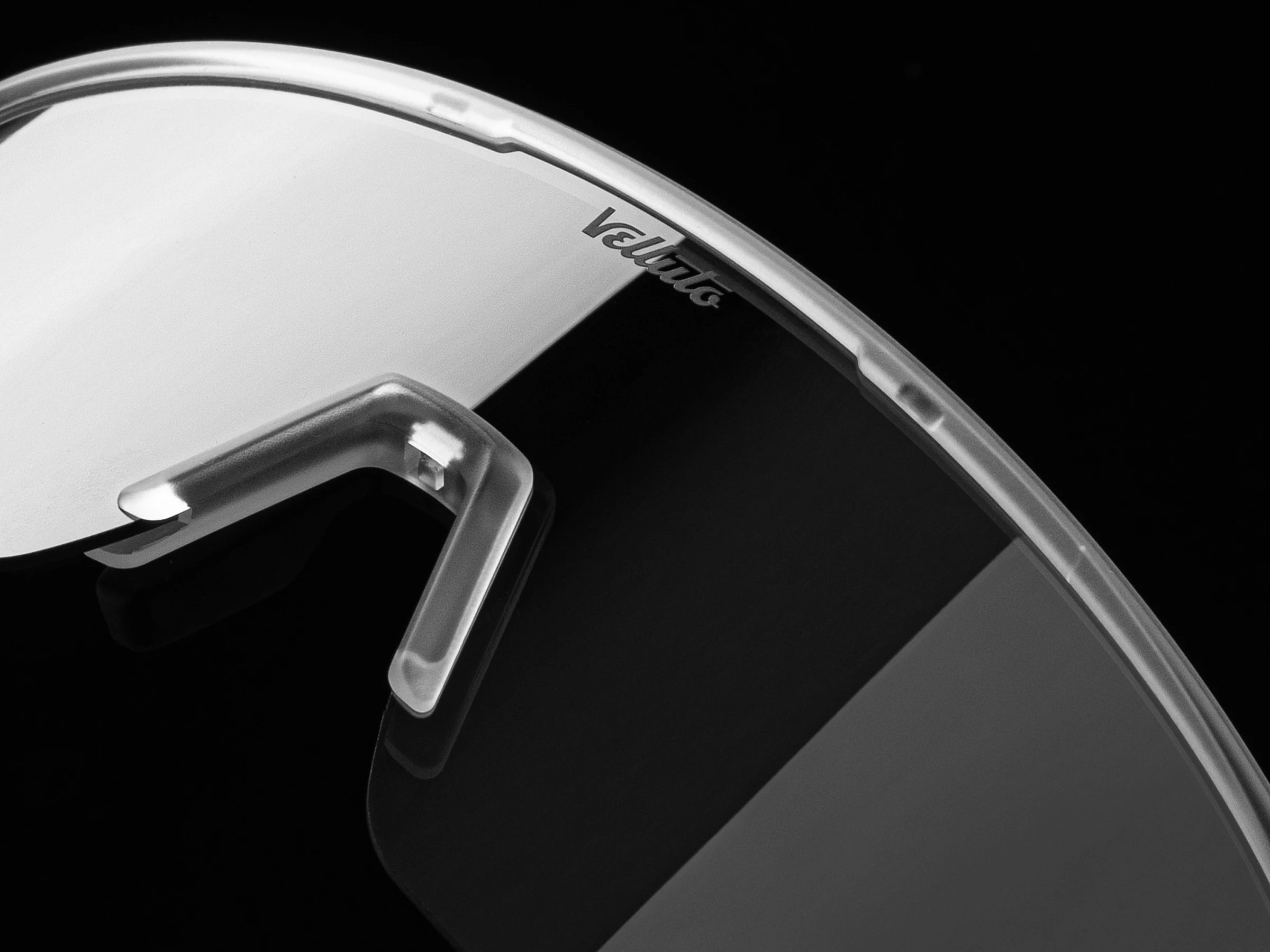
Hinge profile: The hinge is designed with a low profile consistent with the frame's weight target. There is no raised pivot assembly that would create a helmet-leveraging contact point.
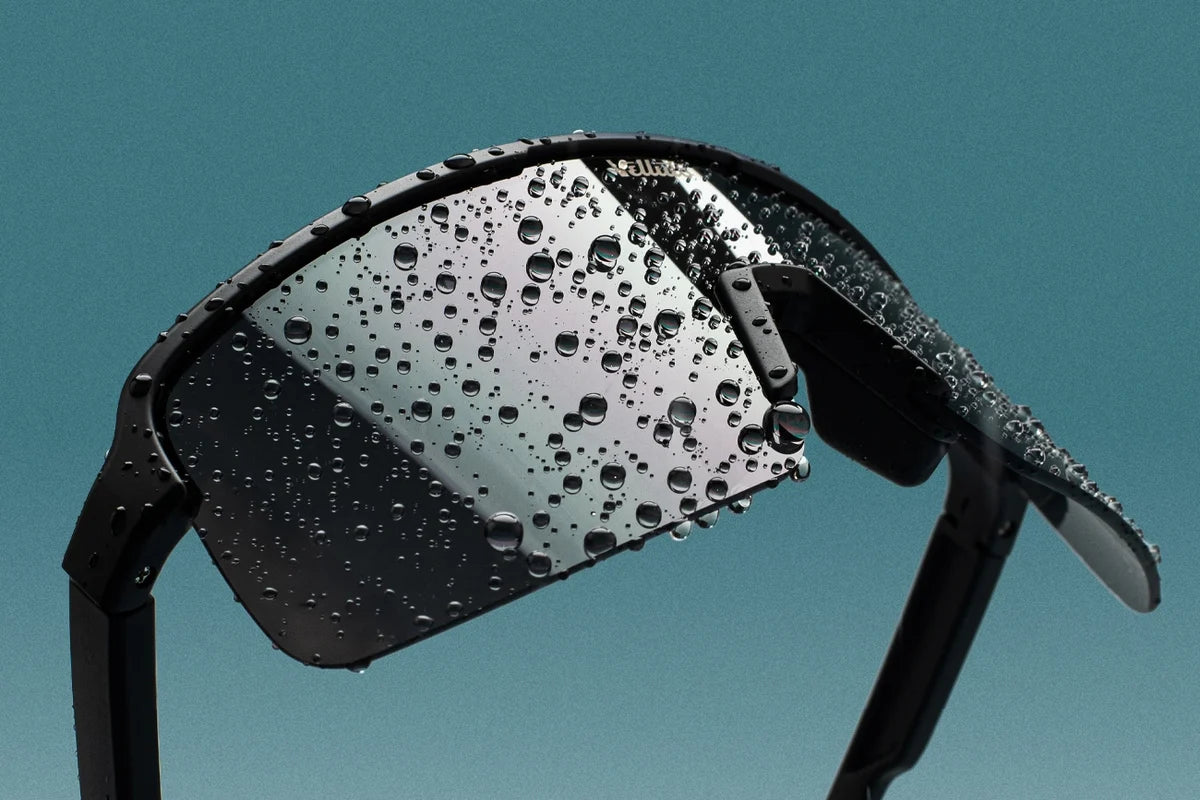
Lens system: The StradaPro is compatible with two interchangeable lenses: the VellutoPuro clear lens and the VellutoVisione high-contrast lens. Both use a tool-free click-in system and carry UV400 certification. The anti-fog system is built into the frame rather than relying entirely on a lens coating, which is relevant for summer climbs where the thermal gradient is reversed compared to cold-weather fogging.
Trial period: 30 days, risk-free. You can ride with your actual helmet in your actual conditions and return the glasses if the fit is not right.
The StradaPro does not guarantee compatibility with every helmet on the market, no glasses frame can make that claim. What the published specifications indicate is that it addresses the three mechanical conflict types described in this guide: slim arms for strap contact, adjustable nose pads for displacement, and low total weight for cumulative pressure over long rides.
If you want to explore the full StradaPro range and lens options, the Velluto StradaPro Arancia page has complete specification details and the 30-day trial terms.


10 · MaintenanceKeeping the Fit Stable Once You Have It Right
Once you have found the glasses-helmet combination that works, a few basic maintenance habits will keep it working consistently rather than drifting back toward discomfort over the season.
Clean the nose pads regularly. Sunscreen, salt from sweat, and skin oils accumulate on nose pads and reduce friction. When friction falls, the nose pads lose grip and the glasses slide under any pressure, including the small pressure the helmet introduces. A clean with a damp cloth every few rides takes thirty seconds and preserves the grip that makes your adjusted nose-pad position actually hold.
Check the nose-pad position after any crash or drop. If you drop your glasses on a hard surface, the nose-pad arms, the thin metal or plastic rods that hold the pads, can shift slightly. The movement may be too small to see but large enough to change the balance point. Run the 30-second fit test after any drop before your next long ride.
Use a proper lens cloth rather than a jersey hem. The micro-abrasions from fabric cleaning degrade anti-fog coatings and lens clarity over time. An 80% polyester, 20% polyamide microfibre cloth, the same composition as the Velluto cleaning cloth, is the standard for optical surfaces and will not abrade coatings the way synthetic jersey fabric does.
Store the glasses in a hard case when not riding. Arm deformation from being sat on, packed badly in a kit bag, or stored loose in a jersey pocket changes the arm geometry that you set when you adjusted the fit. A protective case prevents the small deformations that add up over a season and gradually worsen helmet compatibility.
The Velluto Cleaning Spray is a 50 ml apple-scented, refillable spray made in Germany that is designed for optical surfaces. Used with the microfibre cloth, it clears salt deposits and sunscreen residue from nose pads and lenses without degrading coatings. For late-summer sportives where sun cream and sweat are a constant, this kind of regular lens hygiene also preserves the anti-fog performance of the lens itself.

11 · SummaryThe Short Version for Cyclists in a Hurry
Cycling glasses that do not fit with a helmet are not a category of product to avoid. They are a fit problem with specific mechanical causes that can be identified in thirty seconds and solved with the right frame features. The three conflict types are arm contact at the strap-crossing zone, hinge-height leveraging, and nose-pad displacement. The four frame features that address them are slim arm construction, low hinge profile, adjustable nose pads, and low total weight.
The 30-second fit test, glasses first, helmet on, dial to riding tension, finger trace, chin drop 30 degrees, shake test, tells you which conflict you have and therefore which solution to apply. Running this test before committing to a long sportive will save you four hours of incremental discomfort that builds from manageable in the first hour to genuinely distracting in the last.
If you are in the market for glasses that address the helmet-compatibility criteria specifically, the Velluto StradaPro's published specifications, 25 grams, adjustable nose pads, slim arm build, built-in anti-fog, interchangeable VellutoPuro and VellutoVisione lenses, map directly to those criteria. The 30-day risk-free trial means you can test the actual glasses-helmet combination on real rides before committing. That is the right way to make this purchase, for any brand.
Compare the full lineup in the Velluto StradaPro cycling glasses collection.
12 · FAQFrequently Asked Questions
Why do my cycling glasses hurt when I wear a helmet?
Can the shape of my helmet affect whether glasses fit?
What is arm geometry and why does it matter for helmet fit?
How do I do the 30-second helmet fit test?
Do lightweight glasses fit better under a helmet?
Why do my glasses slide down when I put my helmet on?
Are there cycling glasses specifically designed for helmet compatibility?
Can I use any cycling glasses with an aero road helmet?
What should I check before buying cycling glasses for helmet use?
Ready to test a frame built around the criteria in this guide? The 30-day risk-free trial at velluto-shop.com means you ride with your actual helmet, in your actual conditions, before making the decision final.