Cycling Glasses Small Face: Fit Guide for 2026

Contents24 min read
You hit the first descent of a late-summer sportive, tuck into the drops, and your glasses are already halfway down your nose. You push them back up, ride another kilometre, and they slide again. The problem is not your riding. The problem is that most cycling glasses were not built for your face.
Finding cycling glasses for a small face is one of those problems the industry quietly ignores. Frame widths, nose pad spacing, and temple arm lengths are almost universally calibrated to a "standard" adult head that is measurably wider and flatter than a smaller or narrower face. The result is that millions of cyclists spend their rides nudging frames back into position, developing pressure points on the temples, or simply tolerating a fit that would be considered unacceptable in any other performance equipment.
This guide covers the specific mechanics of why standard glasses fail on small faces, what to look for in frame geometry, and how adjustable nose pads and frame weight interact to solve a problem that tinted lenses and marketing copy never mention.
01 · The core problemWhy Standard Cycling Frames Fail on a Small Face
The cycling eyewear industry designs to the mean. Frame widths in the performance road segment cluster around 140 to 148 mm measured across the front of the frame. Nose pad centres, where the two pads meet the nasal bridge, are typically spaced 18 to 22 mm apart. Temple arms run between 125 and 135 mm. These are reasonable averages for a population, but they leave a significant portion of riders, particularly those with narrower heads, smaller bone structure, or shorter skull depth, working against the geometry rather than with it.
On a face that is narrower than the design target, three failure modes compound each other. First, the frame sits further from the face in the bridge area, tilting the lens forward and moving the optical centre away from your eyes. Second, wide-spaced fixed nose pads land on the sides of the nasal bridge rather than flat across the top, creating a pivot point that encourages the frame to rock and slide. Third, temple arms that are correct in length for a wider skull extend past the ear on a narrower head, producing a rocking motion at the hinge rather than secure grip behind the ear.
None of these failures are catastrophic on a flat road at moderate pace. They become serious problems the moment you get into an aero position, descend at speed, begin to sweat, or try to glance over your shoulder at traffic. That is precisely when you need your eyewear to be invisible and reliable, and it is precisely when an ill-fitting pair becomes an active hazard.

02 · Frame widthThe Number That Matters Most Before You Buy
If you measure only one dimension before purchasing cycling glasses, measure frame width. This is the horizontal distance from the outer edge of one temple hinge to the other, measured across the front of the frame at the widest point. On a face that is narrower than the frame design target, every other fit adjustment is fighting an uphill battle.
As a practical starting point, riders who find standard frames consistently too wide often have head widths in the 130 to 138 mm range at temple level. A frame wider than that range will leave a gap between the temple arm and the side of the head near the hinge. That gap means the temples cannot apply consistent lateral grip, and the only thing keeping the glasses on is the nose pad contact and whatever tension exists in the arm where it curves behind the ear.
Frame width is rarely listed prominently in product specifications. Manufacturers tend to lead with lens width, which describes a single lens panel rather than the full frame. When comparing options, look for the total frame measurement (sometimes listed as "frame width" or "total width") rather than lens width alone. A lens width of 72 mm sounds large but in a wraparound road frame it tells you almost nothing about whether the full frame will sit flat on your face.
Some brands offer a "narrow" or "small" version of their popular frames. Others, including several European performance brands, build a single frame size and rely on adjustable components to accommodate a range of face widths. Which approach works better depends entirely on whether the adjustable components are genuinely effective or simply there for the spec sheet.
03 · Nose pad geometryAdjustable vs Fixed: Why This Is the Deciding Factor
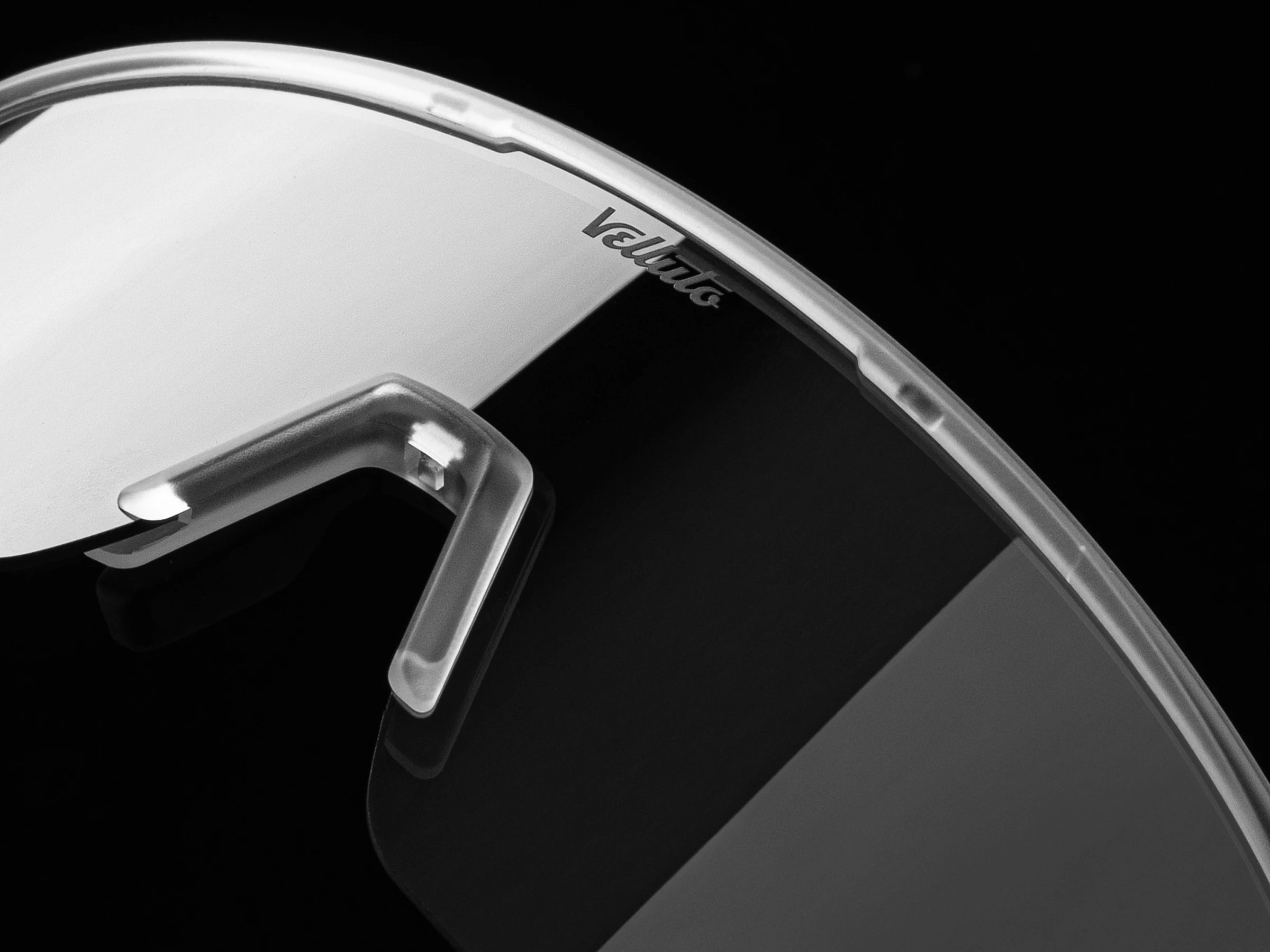
The nose pad is the most important single component for small-face fit, and it receives the least attention in cycling eyewear marketing. Most road cycling frames use one of three approaches: a moulded integral bridge (no separate nose pad at all, common in sport wraparounds), a fixed dual-pad design with pads set at a standard width, or an adjustable dual-pad design where each pad can be moved independently.
Moulded integral bridges are optimised for one bridge shape. They work well for riders who happen to match that shape, and they are a consistent irritant for everyone else. There is nothing to adjust, nothing to press inward, no way to narrow the contact zone. If the mould is too wide for your nose, you ride with a frame that pivots on the sides of your bridge every time the road gets rough.
Fixed dual pads are a step forward. At least the material is usually softer and more conforming than a moulded plastic bridge. But the spacing is still fixed. If your nasal bridge is narrower than the standard 18 to 20 mm spacing, the pads will sit on your nose at an angle rather than flat, creating a rocking fulcrum rather than stable two-point contact.
Adjustable nose pads are categorically more effective for riders with narrow or small faces. The ability to move each pad inward to match your actual nasal bridge width converts a pivot point into a stable platform. When the pads sit flat on the bridge, the frame stays parallel to your face rather than tilting forward. The optical centre of the lens stays where it should be. The frame stops sliding because the weight is distributed evenly rather than balanced on two angled contact points that want to let the frame tip.
The practical objection to adjustable nose pads is durability and stability. If the adjustment mechanism is a thin wire that bends and re-bends every time you adjust, it will fatigue and eventually snap. Look for adjustable pads that use a solid pivot or hinge rather than a simple wire loop. Once correctly set, you should not need to adjust them more than once or twice, so longevity of the mechanism matters less than getting the initial adjustment right.
The nose pad is the single most important component for small-face fit. Everything else compensates for what a mismatch there creates.Velluto Fit Guide, 2026
04 · Temple armsLength, Tension, and Where the Grip Actually Happens
Temple arms on road cycling glasses serve a specific mechanical function: they need to apply enough lateral pressure against the skull to counteract the downward pull of gravity on the frame, without creating a headache over a three-hour ride. On a small or narrow face, this balance is harder to achieve because the geometry of the skull is different in two relevant ways.
First, the distance from the front of the frame to the point where the temple arm should begin curving behind the ear is shorter. A standard arm length of 130 mm is calibrated for this distance on a larger head. On a smaller head, that extra length sits behind the ear rather than before it, which means the curve is in the wrong place. The arm either presses straight back along the skull without curving at all, or it curves before reaching the ear, pushing the entire frame slightly forward and down.
Second, the head circumference is smaller, which means the arms need to apply a tighter grip to achieve the same lateral force. Most road cycling temple arms are not particularly flexible and are designed to spring outward with a fixed amount of tension. On a narrower head, that tension may be insufficient to hold the frame securely without additional mechanisms.
Practical solutions for temple arm length problems come in several forms. Some frames are available in a shorter temple arm version. Some use a flexible, rubbery tip that you can heat-shape to curve more tightly behind your ear. Others use a textured or rubberised surface on the tip to increase friction with the skin. If you are evaluating glasses for a small face, pay attention to the material and flexibility of the temple tip, not just the overall arm length.
One practical test: put the glasses on, look straight ahead, then tuck into an aero position and shake your head gently side to side. If the glasses move more than 1 to 2 mm in any direction, the temple grip is insufficient for descending. On a well-fitted small-face frame, the glasses should feel attached to your face in this test, not balanced on it.

05 · Frame weight25 Grams: Why Light Frames Fit Better on Small Faces
Frame weight is often discussed as a comfort or performance benefit in isolation from fit. A lighter frame feels better over a long ride because the cumulative pressure on the nose bridge is lower. That is true and it matters. But weight also directly affects how well a marginally fitted frame stays in place, and for small-face riders this interaction is more significant than for riders with an average-width face.
Here is the mechanics of it. A heavier frame requires more grip force to stay in position against gravity. That grip force comes from two places: the nose pads pressing against the bridge, and the temple arms pressing against the skull. On a face where the nose pad spacing is even slightly wider than the bridge, or where the temple arms are a fraction too long, that grip is reduced. A heavier frame in that situation slides because the force of gravity exceeds the available friction.
A frame weighing 25 grams exerts roughly half the downward force of a frame weighing 45 to 50 grams. On a face where the fit is close but not perfect, that difference in gravitational load can be the margin between a frame that stays put and one that slides. This is not a theoretical argument. It is basic physics applied to a geometry problem that many small-face riders experience daily.
The practical implication is that when you are choosing cycling glasses for a small face, frame weight is not a luxury consideration. It is a fit consideration. A well-adjusted, lightweight frame on a small face will almost always outperform a heavier frame of the same geometry, and will definitely outperform a heavier frame on a sub-optimal geometry.
At 25 grams, the Velluto StradaPro is among the lightest road cycling frames available. That weight, combined with its adjustable nose pads, means that riders who have spent years accepting a sliding fit often find the combination of narrow-adjustable contact and reduced gravitational load genuinely transforms the experience. Not "marginally better." A different category of fit.

06 · Lens systemInterchangeable Lenses and What They Mean for Versatile Riders
For riders who have found a frame that fits their face well, the next practical consideration is lens versatility. Late-summer sportives and Vuelta-inspired club rides often start before full daylight, climb into bright exposed terrain, and return through shadowed valley roads in the late afternoon. No single tint handles all of these conditions equally well.
The traditional approach is to own multiple pairs of glasses, one per light condition. This works but it requires accepting multiple fit compromises: it is unlikely that two separate frames will both fit a small face as well as one carefully adjusted pair. The more practical solution is a single well-fitting frame with a fast lens swap system.
The StradaPro uses a click-in lens system that is compatible with two lens options. The VellutoPuro clear lens handles low-light riding, pre-dawn starts, and wind protection in tunnels or overcast conditions. It provides full UV400 protection and anti-fog performance without reducing light transmission. The VellutoVisione high-contrast lens sharpens road surface detail and visual depth in bright daylight, making it the choice for open climbs, exposed ridgelines, and high-summer conditions.
The lens swap takes seconds, requires no tools, and because the lenses are designed specifically for the StradaPro frame, there is no optical distortion at the lens edge that sometimes occurs with aftermarket systems. For a small-face rider who has already done the work of adjusting the nose pads and confirming the temple fit, carrying a second lens in a jersey pocket and swapping at a café stop is a more practical solution than carrying a second pair of glasses and hoping the fit is equally good.
Both lenses include built-in anti-fog performance, which is relevant to the fit discussion: a frame that sits closer to the face due to properly adjusted nose pads creates less gap for warm air to enter, reducing the raw material for fogging in the first place. The anti-fog system then handles the residual moisture load. The two effects are additive, not independent.

07 · Fit testingHow to Actually Test Glasses Fit Before You Commit
Testing cycling glasses fit in a shop or from a static position tells you very little. You need to know how the glasses behave when you are moving, sweating, looking down at your computer, and taking your hands off the bars. Here is a structured approach that takes about ten minutes and eliminates most bad purchases.
Start with the aero position test. Get into your lowest riding position, chin down, eyes up. In this position the nose bridge carries more of the frame weight because the tilt shifts the centre of gravity forward. If the glasses start to slide in this position before you have even moved, they will not survive a descent. A frame that feels secure standing upright can behave completely differently in position.
Next, test the nose pad pressure. Press gently on the lens and release. A well-adjusted nose pad should return the frame immediately to the same position without any sideways drift. If the frame rocks laterally after you press it, the nose pad contact is a pivot rather than a stable base. This almost always means the pads are too wide for your bridge and need to be moved inward, or replaced with an adjustable system.
Then check temple pressure over time. Put the glasses on and leave them for five minutes while you move your head normally. Small-face riders often report that a frame feels acceptable for the first few minutes and becomes progressively uncomfortable as the temple tension builds. This is the frame trying to spring open to its designed-for width and using your skull as the resistance point.
Finally, simulate a sweat condition. Most glasses slip not because they were poorly fitted initially but because sweat on the nose bridge reduces friction. You can replicate this crudely by wiping the nose pad area with a slightly damp finger. A frame that was borderline before will slide immediately under these conditions. A frame that fits correctly with adjustable nose pads properly positioned will hold significantly better because more of the contact is mechanical (pad position) rather than frictional.
Velluto's 30-day risk-free trial is directly relevant here. A proper fit test requires real riding, including climbs, descents, sweat, rain, and the specific movements of your own riding style. No static test fully replicates this. The trial period exists specifically to let you confirm fit on actual roads rather than in a living room.

08 · Colour and visibilityChoosing a Colourway That Also Works Optically
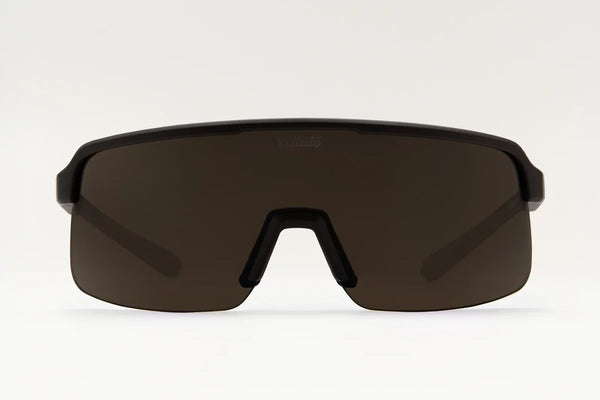
The StradaPro is available in four colours: Arancia (orange), Espresso (brown), Nero (black), and Viola (purple). The frame colour is a style choice, but for small-face riders there is one practical consideration worth noting.
Darker frame colours, including Nero and Espresso, create less visual mass on a smaller face. A large frame in a bright colour can visually dominate a smaller facial structure, which some riders prefer and others find distracting when they glance at their reflection in a window or vehicle. This is entirely subjective, but if you are undecided between colourways, it is worth considering frame-to-face proportion as part of the decision.
What is not subjective is the optical difference between the two available lenses. The VellutoPuro clear lens is the correct choice for variable light, dawn starts, and any conditions where light transmission needs to be at or near 100 percent. The VellutoVisione high-contrast lens is the correct choice for full daylight, where its contrast-enhancement technology improves road surface definition and depth perception. Neither choice affects fit. Both lenses are identical in weight and geometry, so swapping between them does not alter the nose pad position or temple tension you set initially.
For the Vuelta-season sportives that many European riders are targeting in August and September, the combination that sees most use is VellutoVisione for the main ride and VellutoPuro carried as a backup for the tunnel sections on mountain stages or the pre-dawn rollout. The click-in swap is fast enough that you can do it at a traffic stop without taking the glasses off the frame.

09 · ComparisonWhat to Look for When Comparing Road Cycling Glasses for Small Faces
The road cycling glasses market in 2026 covers a wide range of price points, frame geometries, and lens technologies. For small-face riders specifically, the comparison criteria that matter most are different from the criteria that dominate most buyer's guides. Here is a framework for evaluating any pair of road cycling glasses through a small-face lens.
The first filter is adjustability. Does the frame offer any mechanism for narrowing the nose bridge contact, shortening the effective temple arm length, or otherwise adapting the geometry to a narrower face? A beautiful frame with no adjustability is a lottery. A less visually striking frame with genuine adjustable nose pads is a known quantity.
The second filter is weight. Below 30 grams, frame weight becomes a meaningful fit advantage on a small or narrow face, for the mechanical reasons described earlier. Above 40 grams, the extra downward force on a marginally fitted nose pad becomes a sliding problem on descents. This threshold is not arbitrary; it reflects the point at which gravitational load starts to exceed the available friction from a correctly adjusted adjustable nose pad on a typical narrower nasal bridge.
The third filter is lens versatility. A frame that fits perfectly is worth protecting. Having two lenses, clear and high-contrast, for different light conditions means you never have to choose between optimal optics and your best-fitting frame. This is a convenience argument with a real performance benefit attached.
The fourth filter, for European riders in particular, is the trial policy. Fit cannot be fully confirmed without riding. A 30-day trial removes the purchase risk that otherwise makes buying a potentially poor-fitting frame a gamble.
Against these four criteria, the StradaPro performs well in every column. Adjustable nose pads, 25 gram frame, two-lens click-in system, and a 30-day risk-free trial. These are verifiable specifications, not marketing claims. You can measure 25 grams on a kitchen scale. You can adjust the nose pads yourself in under a minute. You can swap the lens in seconds. You can ride for 30 days and return the glasses if the fit does not work for your face.


10 · Practical checklistA Step-by-Step Approach to Getting the Fit Right
If you have been tolerating a sliding fit and are ready to solve it properly, here is a practical sequence that addresses each failure mode in the right order.
Start with nose pad adjustment. This is the highest-leverage change you can make. If your glasses have adjustable nose pads, move them inward incrementally until they sit flat on the widest part of your nasal bridge rather than on the sides. The test is simple: the pads should feel like even, comfortable pressure across the bridge, not like two small points pushing from the sides. Once set correctly, the frame should sit parallel to your face rather than tilted forward.
Once the nose pad is correct, check the lens-to-eye distance. The lens should sit close enough to your face that the top of the lens is approximately at eyebrow level and the bottom clears your cheekbone with roughly 8 to 12 mm of clearance. Too close and the lens fogs from skin contact. Too far and the frame tilts forward every time you look down.
With the nose pad set and the lens distance confirmed, check the temple arm fit. The arm should make contact with the skull from just in front of the ear and curve cleanly behind and slightly below the ear. If the arm is too long, the curve happens too far behind the ear and creates a rocking motion at the hinge. If the arm is too short, the glasses are pulled back against the face rather than resting naturally.
Finally, do the movement tests described in section 07. Aero position, head shake, sweat simulation. A correctly fitted frame on a small face passes all three without adjustment. If it fails any of them after you have correctly set the nose pads, the frame geometry is too large for your face and no amount of adjustment will fully compensate.
The good news is that for most riders who have always assumed "glasses just slide, that is how it is," the nose pad adjustment alone on a correctly sized, lightweight frame eliminates the problem. It does not require a specialist fitting service, expensive customisation, or a compromise on optical performance. It requires a frame that was designed with adjustability as a genuine engineering priority rather than a marketing checkbox.
Compare the full lineup in the Velluto StradaPro cycling glasses collection.
11 · FAQFrequently Asked Questions
What makes cycling glasses suitable for a small face?
Why do most cycling glasses slip on a narrow or small face?
Are adjustable nose pads actually useful, or are they a gimmick?
Can temple arm length affect fit on a small face?
Do lightweight glasses help with small-face fit?
What is the difference between VellutoPuro and VellutoVisione lenses for small-face riders?
How does anti-fog performance relate to small-face fit?
Is the Velluto StradaPro a good option for women with smaller faces?
Can I try the StradaPro before committing to the purchase?
If you have been riding with glasses that slide, tilt, or create pressure points on descents, the solution is almost always a fit problem rather than a budget problem. The right frame geometry, correctly adjusted nose pads, and a lightweight build make a measurable difference. Explore the full StradaPro range and the 30-day trial at velluto-shop.com.