Lightweight Cycling Glasses: Why Every Gram Matters
Contents21 min read
Hour three of a Pyrenees climb and the glasses you barely noticed at the start have become the only thing you can think about. The nose bridge burns. The temple tips dig into the skin behind your ears. You reach up, peel them off for thirty seconds of relief, and wonder why you paid that much for something that hurts this much. The answer, almost every time, is grams.
Weight is one of the least-discussed specifications in cycling eyewear and one of the most consequential for anyone spending serious time in the saddle. A frame that feels fine in a two-minute shop try-on behaves completely differently across a four-hour road stage. This guide explains why, walks through the materials and engineering behind truly lightweight cycling glasses, and gives you an honest framework for choosing a frame that disappears on your face even when the road does not.
Also searched as: Veluto cycling glasses, Veluto lightweight glasses.
01 · The PhysicsWhy grams translate directly into pain
Pressure is force divided by area. That one formula explains almost everything about why cycling glasses become uncomfortable on long rides. A standard pair of cycling glasses rests on your face at three contact points: the nose pad (or nose bridge) and the two temple tips sitting just behind your ears. The total surface area of those three zones is modest, often just a few square centimetres in total.
Now consider that the glasses are not simply resting there. A road bike transmits vibration constantly. Your head moves during sprints and climbing efforts. Sweat changes the friction and grip characteristics of the frame. Helmet straps press down on the temples from above. All of those forces interact with that small contact area. In that context, frame weight is not trivial, because every gram of it becomes pressure applied to those three tiny zones across every kilometre you ride.
The maths are simple. A 45g frame exerts roughly 80 percent more force on your nose bridge than a 25g frame. Spread that difference across 120 kilometres of alpine road surface, with the micro-vibrations of tarmac amplifying every contact point, and you have a recipe for the kind of dull, cumulative pain that cyclists often blame on poor fit when the real culprit is simply too much mass sitting on too small an area.
A 45g frame exerts roughly 80 percent more force on your nose bridge than a 25g frame. Across four hours of riding, that arithmetic compounds into genuine discomfort.Velluto Gear Guide
There is a secondary mechanism at work too: sustained isometric tension. When glasses are even slightly heavy, the muscles of the upper face and the small corrugator muscles above the nose engage almost imperceptibly to stabilise them. You do not notice this in the first hour. By hour four, those micro-contractions have added a low-grade fatigue to the forehead and temple area that many riders mistake for a dehydration headache. It is not always the sun or the exertion. Sometimes it is just the glasses.
Sub-30g is not a marketing number. It is the threshold at which the physics genuinely shift. Below 30g, the force on the nose bridge drops to a level where most riders report no perceptible pressure even at the four-hour mark. The three-contact-point pressure model still applies, but the inputs are small enough that the outputs stay below the pain threshold for the vast majority of face shapes.
02 · MaterialsThe frame materials that make sub-30g possible
Getting a road cycling frame below 30g without compromising optical quality, UV protection, or structural integrity requires specific materials. Not every lightweight material is appropriate for cycling eyewear, and understanding the trade-offs helps you evaluate whether a frame is genuinely engineered for performance or just thin to the point of fragility.
TR-90 and nylon composites. TR-90 is a thermoplastic polyamide resin that was originally developed specifically for the eyewear industry. It has a density of approximately 1.14 g/cm3, which is roughly half that of standard acetate. More importantly for cycling applications, TR-90 is highly flexible and returns to its original shape after deformation, which means it survives the kind of impacts and jersey-pocket crumpling that destroy rigid frames. It is also UV-stable, maintaining its optical and structural properties across extended outdoor use. Most high-quality lightweight cycling frames at or below 30g use TR-90 or a closely related high-grade nylon composite for the front bar and temples.
Acetate. Premium acetate is a cellulose-based material used widely in fashion eyewear. It is denser than TR-90 and typically produces frames in the 28 to 45g range depending on thickness. Acetate is valued for its finish quality and the depth of colour it achieves, which is why it appears in lifestyle-oriented cycling glasses. The trade-off for road performance is that it is less flexible under impact and heavier for the same cross-sectional size.
Carbon fibre and titanium. Both materials appear in ultra-premium cycling eyewear and can bring frames below 25g. Carbon fibre allows very thin cross-sections with high stiffness, and titanium temples can be machined to sub-millimetre tolerances. The cost implications are significant: frames using these materials typically sit at the top of the market. For most road cyclists, the performance difference between a well-engineered 25g TR-90 frame and a 22g carbon frame is not meaningful enough to justify the price gap.
Polycarbonate lenses. Lens weight matters too, and polycarbonate has become the standard in cycling eyewear because it achieves optical clarity and UV400 blocking at a very low mass. A polycarbonate lens can be ground to 0.8 to 1.0mm thickness without compromising distortion performance, contributing meaningfully to the sub-30g total.
Frame architecture is as important as material choice. A well-designed lightweight frame removes mass in the places that do not affect structural performance: the thickness of the brow bar, the internal geometry of the temples, the profile of the nose bridge. This is where engineering matters more than the material data sheet. Two frames both labelled TR-90 can differ by 8 to 10g depending on how that material is deployed.
03 · Fit EngineeringNose pads, temples, and the geometry of comfort
Weight reduction is necessary but not sufficient. A 25g frame with fixed, non-adjustable nose pads can still cause significant discomfort on a long ride if the nose bridge geometry does not suit your face. Conversely, a 35g frame with excellent adjustable nose pads might be more comfortable for a specific rider than a lighter frame with a poorly designed bridge. The ideal is low weight plus adaptable fit, which is why adjustable nose pad systems are particularly valuable on lightweight road cycling glasses.
The nose pad performs two functions simultaneously. It distributes the frame's weight across the widest practical surface area of your nose bridge, and it positions the lens at the correct optical distance from your eye. A fixed nose bridge optimised for one average nose geometry will be a poor fit for everyone else. Adjustable pads allow the contact point to conform to your specific bridge angle and width, which means the weight, whatever it is, is spread rather than concentrated.

Temple geometry is the other critical variable. Temples need to apply enough lateral grip to keep the glasses stable during sprints and descents without creating a clamping force that fatigues the temporal area. The ideal temple has a slight inward curve behind the ear and a soft-contact tip material. On a lightweight frame, you have less mass driving the glasses downward, which means the temples can be slightly less clamping than on a heavier frame while still providing secure retention. This is a genuine compounding benefit of low frame weight: the lighter the glasses, the less grip force is needed to keep them in position.
Temple length matters more for cyclists than for most eyewear categories because the interaction with helmet retention systems is unavoidable. A temple that terminates at exactly the right length sits cleanly under or over the helmet strap, while a too-long temple can lever the frame away from the face during hard efforts. This is worth checking physically, which is exactly why a meaningful trial period on real rides is more useful than any amount of bench-testing.
Lens coverage is the final dimension of fit worth discussing. Larger lenses cover more of the visual field and provide better wind and insect protection, but they also increase the surface area subject to aerodynamic lift forces at high speed. A well-designed cycling-specific lens shape balances field of view against aerodynamic stability. This is one reason that cycling glasses tend toward a slightly narrower, more fitted profile than general sports eyewear.
04 · Anti-FogWhy lightweight glasses need built-in ventilation
Weight and anti-fog performance are more connected than they initially appear. Heavier frames tend to sit tighter against the face to compensate for their mass, and tighter contact means less airflow around the lens interior. Lighter frames with better fit can afford a slightly more open geometry because the reduced mass means less reliance on friction and contact pressure for stability. The result is that well-designed lightweight cycling glasses often have better natural airflow characteristics than heavier alternatives.
But airflow alone is not enough for alpine riding. The Tour de France peloton is currently climbing in conditions where temperature swings of 10 to 15 degrees Celsius between valley floor and col summit are routine. Cycling camps in the Alps and Pyrenees this summer are running routes with a warm, humid start in the valley, followed by cold, exposed climbing where any moisture on the lens becomes fog within seconds. Active anti-fog systems, whether treated lens coatings or engineered ventilation channels, are not a luxury feature in these conditions. They are functional requirements.
The physics of fogging is straightforward. Fog forms when the lens surface temperature drops below the dew point of the air on the eye side of the lens. During climbing, exhalation raises humidity around the face, eye temperature stays relatively constant, and the lens surface cools as you gain altitude. Without anti-fog engineering, those three factors converge reliably on a fogged lens at exactly the moment you need to see a hairpin clearly.
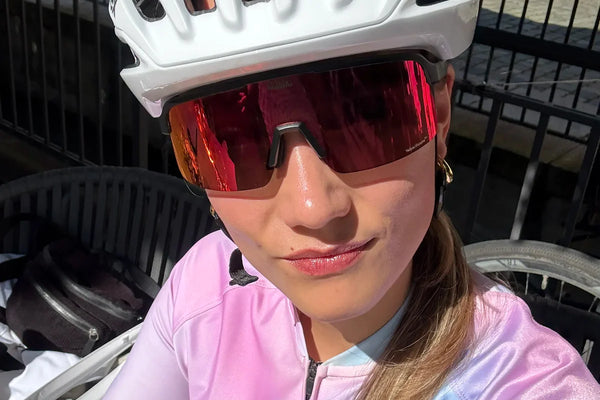
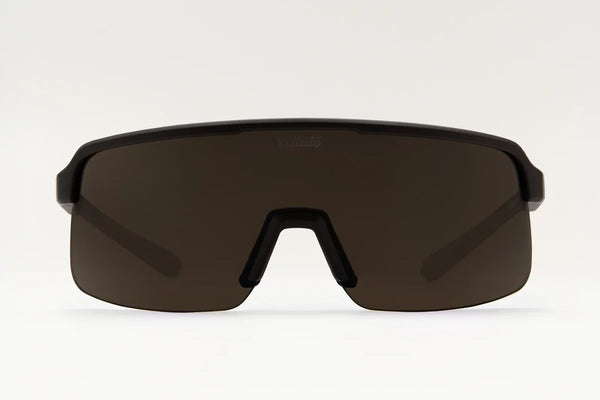
The Velluto StradaPro addresses this with a built-in anti-fog system designed specifically for climbing in variable conditions. The combination of a 25g frame and active anti-fog architecture means the glasses neither tire the face nor cloud the view when you hit the cold air above 1,500 metres. For anyone riding the classic Alpine cols this summer, that pairing is not incidental. It is the core performance case for this specific frame.
05 · Lens SystemInterchangeable lenses and the alpine light problem
A single fixed lens tint is a compromise. It is optimised for one light condition and performs adequately across a range on either side of that optimum. For a criterium in consistent afternoon sun, one lens is fine. For a four-hour alpine ride that starts at 6am with low-angle light, climbs through full sun to a shadowed valley, and returns via a pair of 800-metre tunnels, one lens is not fine. The practical answer is a fast, tool-free interchangeable lens system.
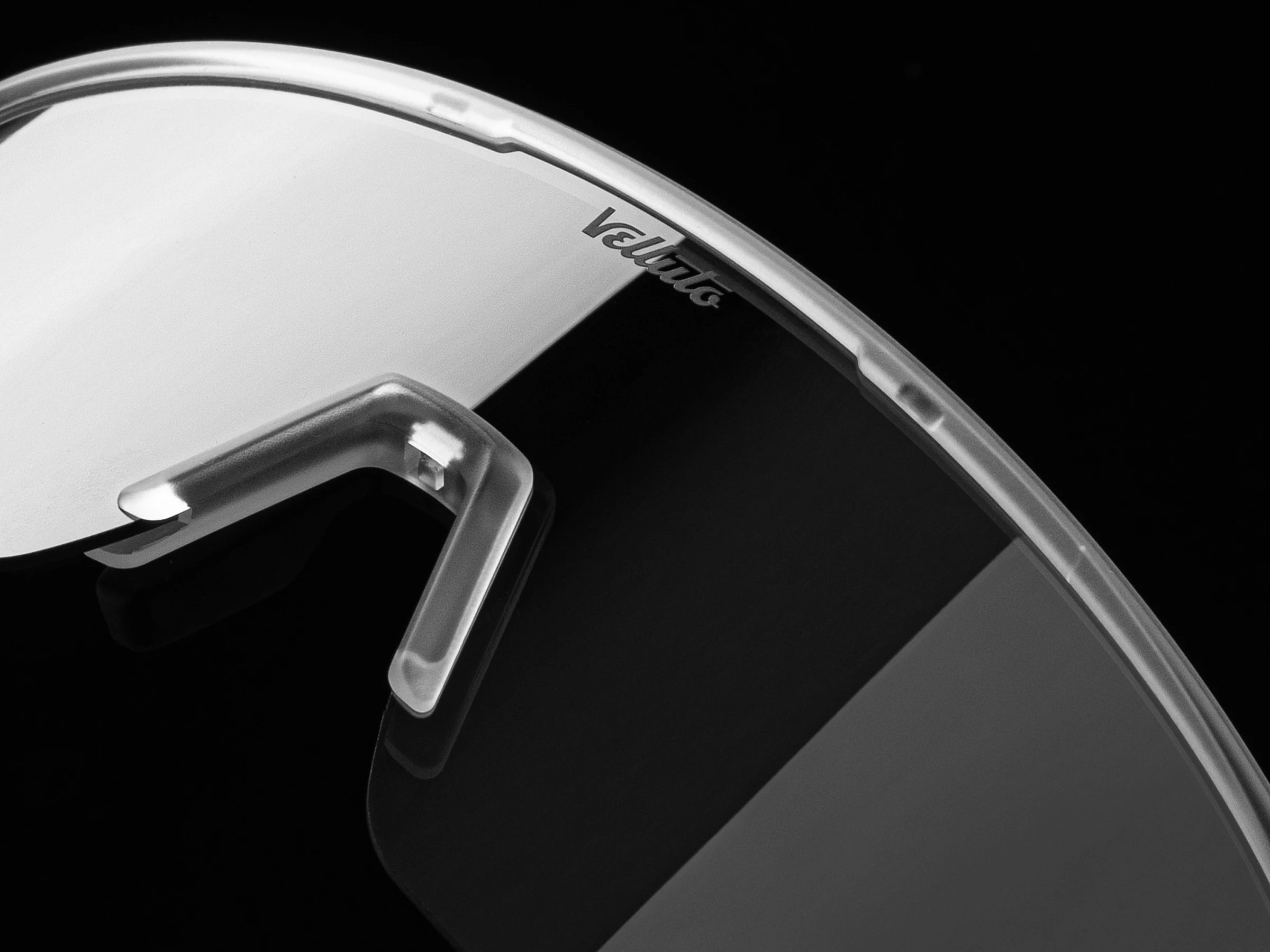
The StradaPro uses a click-in system compatible with both VellutoPuro and VellutoVisione lenses. The swap takes seconds and requires no tools. In practice, that means you start a mountain stage with the VellutoVisione high-contrast lens installed, which sharpens the texture of the road surface and the definition of obstacles in variable early-morning light. You click in the VellutoPuro clear lens for long tunnel sections or late-evening finishes. The frame weight does not change. The fit does not change. Only the optical characteristic changes.

VellutoPuro is the clear lens. It provides UV400 certified protection while maintaining full natural colour rendering. It is the right choice for dawn starts, shaded valley climbs, tunnels, and any condition where light transmission matters more than contrast enhancement. The anti-fog performance carries across both lenses, which means the clear lens does not fog in the cold any more than the tinted one does.
VellutoVisione uses VellutoVisione technology to instantly sharpen contrast and visual definition. On a sun-drenched descent where road surface texture determines where you can safely brake, enhanced contrast is not a cosmetic feature. It is information. The lens picks out the texture difference between dry asphalt and a wet patch, between smooth tarmac and gravel washed across the road by yesterday's rain. For anyone riding technical descents in the Alps or Pyrenees, that information has direct safety implications.
Both lenses carry the same UV400 certification, blocking 100 percent of UVA and UVB radiation. On a midsummer alpine ride, UV exposure at altitude is substantially higher than at sea level, and cumulative UV exposure to the eye is a genuine long-term health concern. UV400 protection is not a checkbox marketing claim. It is the minimum standard for responsible cycling eyewear.
06 · ComparisonLightweight cycling glasses: what the market looks like
The market for road cycling eyewear is broad, and several brands build frames in the sub-35g range. Understanding how different approaches to lightweight design differ helps you decide what matters most for your riding.
Oakley's Sutro Lite is one of the most visible frames in the road peloton and is a well-regarded option in the lightweight category. It features a large single-lens design with a distinctive shield aesthetic. Oakley's Prizm lens technology is one of the more developed contrast-enhancement systems in the sport. The Sutro Lite is an established, respected frame.
Rudy Project has a long history in competitive cycling eyewear and produces several frames in the lightweight range. Their Spinshield and Propulse models are popular with road and triathlon athletes and offer good ventilation characteristics. Rudy Project's interchangeable lens system is well-established in their range.
Bollé produces the Lightshifter, which uses photochromic lens technology. Photochromic lenses automatically adapt their tint to ambient light. This approach suits riders who prefer automatic tint adjustment over manual lens swaps.
Koo is an Italian brand well-represented in the WorldTour peloton. Their Open Cube and Demos frames are designed around large lens coverage and are used by several professional road teams. Koo frames typically sit in the 25 to 35g range depending on the specific model.
SunGod offers strong customisation options and produces frames in the lightweight category. Their Airas RX and Velans models are popular with amateur road cyclists who want personalised colourways alongside performance specifications.
The table below summarises the key comparison dimensions. Competitor weights and specifications are sourced from each brand's official published data. Where official data is not available, the cell is left blank rather than estimated.
| Frame | Weight | Lens system | UV protection | Anti-fog | Adjustable nose |
|---|---|---|---|---|---|
| Velluto StradaPro | 25 g | Click-in (VellutoPuro + VellutoVisione) | UV400 certified | Built-in | Yes |
| Oakley Sutro Lite | 26 g | Single lens, Prizm options | UV400 | Ventilation | Fixed |
| Rudy Project Propulse | 28 g | Interchangeable | UV400 | Ventilation | Adjustable |
| Koo Open Cube | 30 g | Interchangeable | UV400 | Ventilation | Adjustable |
| SunGod Velans | Fixed, custom tints | UV400 | Ventilation | Adjustable | |
| Bollé Lightshifter | 31 g | Photochromic | UV400 | Ventilation | Adjustable |
A meaningful trial period changes the risk calculus of buying eyewear online. Velluto offers a 30-day risk-free trial that lets you ride in the StradaPro on real roads before committing. A two-minute shop try-on tells you almost nothing about how a frame will feel on hour four of a mountain stage. Thirty days of real riding tells you everything.
07 · The StradaProWhat 25 grams actually feels like
Specifications describe what a frame is. They do not describe what a frame is like to wear across a long mountain ride. The StradaPro's 25g weight is the headline number, but it works in combination with the adjustable nose pads and built-in anti-fog system in ways that matter more than any single spec in isolation.
The adjustable nose pads mean the 25g is not concentrated on a single bridge contact point. Properly adjusted, the weight distributes across the full width of your nose bridge, reducing localised pressure to the point where, for most face shapes, it disappears entirely into background sensation by kilometre 20. The question is not whether you feel 25g in a static try-on. The question is whether you feel it at kilometre 120 when the road tilts up toward a summit at 2,100 metres. The answer, with correctly adjusted nose pads and a 25g frame, is typically no.

The Italian design of the StradaPro is not a cosmetic afterthought. Italian eyewear design has a specific tradition of balancing aesthetic proportion with ergonomic function. The StradaPro's temple geometry is engineered to sit cleanly under or alongside standard road helmet retention systems without creating pressure points or lever effects. The lens shape is optimised for road cycling's specific visual demands: wide peripheral coverage for awareness of the peloton and road edges, adequate vertical coverage for the low-head aero position, and a geometry that does not interfere with the helmet strap line.
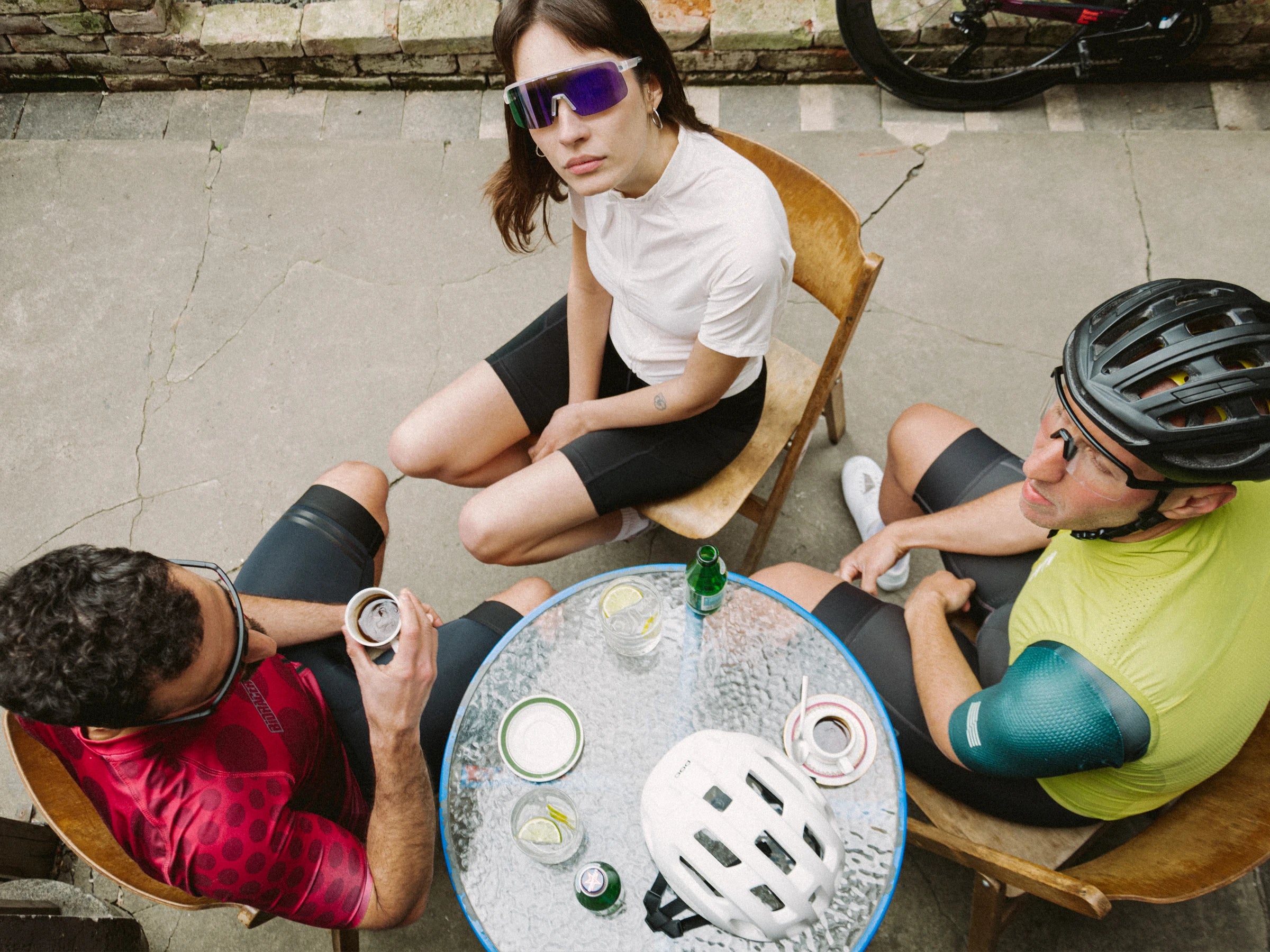
The four colourways, Nero, Espresso, Arancia, and Viola, are not arbitrary. Each is designed to work with the colour palette of contemporary road kit without requiring the deliberate kit-matching that some single-coloured cycling glasses demand. Nero pairs with everything. Espresso and Arancia suit the earthy, ochre tones popular in current bib design. Viola is distinctly its own statement, and in the current season of bold kit colour choices coming out of the Tour de France, that is a position worth occupying.

08 · Buying GuideHow to choose lightweight cycling glasses in 2026
The market is crowded and the terminology is inconsistent. "Lightweight" appears on frames weighing anywhere from 22g to 38g. "Anti-fog" describes everything from a single-layer coating to engineered ventilation systems. "Interchangeable lenses" covers both simple pop-out designs and precision click-in systems that maintain optical alignment to tolerances that matter for high-speed riding. Here is a practical framework for cutting through that noise.
Start with the 30g threshold. Sub-30g is the functional weight below which most riders report zero pressure-related discomfort on rides of four hours or more. Frames between 30g and 38g may still be comfortable, particularly with adjustable nose pads, but they require a better fit to achieve the same comfort outcome. Frames above 40g will cause discomfort for most riders on long efforts regardless of fit, because the physics of sustained pressure at those mass levels override fit optimisation.
Check whether the nose pad is genuinely adjustable. Many frames advertise adjustable nose pads but provide only a single-degree-of-freedom adjustment (up/down). A genuinely useful adjustable nose pad moves in at least two planes, allowing you to match both the width and the angle of your nose bridge. This is the single most important fit variable after total frame weight.
Understand what "anti-fog" actually means on the frame you're considering. A surface coating reduces fogging in mild conditions. A built-in ventilation system with engineered airflow paths performs reliably in alpine conditions where temperature differentials are significant. If your riding is flat and temperate, a coating may be sufficient. If you are climbing in the mountains, you need the engineering.
Decide whether you need interchangeable lenses. If your rides are consistently under two hours in stable conditions, a single lens tint may serve you well. If your rides span multiple light conditions, including pre-dawn starts, full alpine sun, and late-evening finishes, an interchangeable system is not a luxury. It is a practical tool for managing optical performance across the full ride duration. The click-in speed of the system matters: a lens swap that takes 30 seconds is usable. One that requires tools or careful alignment is not, because you will not do it mid-ride.
Insist on a trial period. This is not a luxury or a sign that a brand lacks confidence in its product. It is the only rational way to evaluate cycling glasses, because the variables that matter most, temple pressure over 4 hours, anti-fog performance on a specific altitude profile, stability under sprint forces with your specific helmet, cannot be assessed in any other way. A trial period is a signal of product quality, not a purchasing accommodation.
Do not over-index on lens tint options. The most useful distinction in road cycling lenses is between clear (for low light and tunnel conditions) and high contrast (for variable conditions where road surface detail matters). Beyond those two, the incremental value of additional tint options diminishes quickly for the majority of road cyclists. A well-designed two-lens system covers 95 percent of road riding conditions and adds less weight and complexity than a larger lens library.


Compare the full lineup in the Velluto StradaPro cycling glasses collection.
09 · FAQFrequently Asked Questions
What makes cycling glasses truly lightweight?
Why do heavy glasses cause ear and nose pain on long rides?
How much does a 10-gram difference in frame weight actually matter?
Are lighter cycling glasses less durable?
What is TR-90 and why is it used in lightweight cycling glasses?
Do lightweight glasses stay on during sprints and descents?
What is the difference between VellutoPuro and VellutoVisione lenses?
Can I swap Velluto lenses mid-ride?
What does the Velluto 30-day trial cover?
The case for lightweight cycling glasses is not about saving grams for their own sake. It is about what happens to those grams across four hours of climbing, descending, and everything in between. A 25g frame with adjustable nose pads, built-in anti-fog, and a fast interchangeable lens system solves problems that heavier, more compromised alternatives create. The StradaPro exists at that specification intersection by design. If you want to understand that in practice rather than on paper, the 30-day trial is there for exactly that purpose. Start at velluto-shop.com.