Cycling Eye Protection Importance: What Every Rider Must Know
Contents18 min read
You are 47 kilometres into a four-hour autumn road ride, descending into a valley where temperature drops five degrees in ninety seconds, when your lens fogs over completely. At 52 km/h, with a gravel patch ahead and a group of riders behind you, you are navigating blind for the two seconds it takes to react. Those two seconds are exactly where cycling eye injuries happen, and exactly what good eyewear is designed to prevent.
Eye protection on a bike is one of those topics that gets treated as a style consideration, a weight saving, or a nice-to-have upgrade. It is none of those things. It is a medical and mechanical safety issue that cyclists at every level underestimate until something goes wrong. This article looks at why cycling eye protection matters, what the real injury risks are, and what specific features in a pair of glasses actually reduce those risks on the road.
01 · The risk pictureWhy cycling eye protection importance is not a marketing phrase
Sports medicine research consistently identifies the eye socket and orbit as one of the most commonly injured regions in cycling accidents. The eye is exposed, unprotected by the skull's natural architecture, and positioned directly in the path of wind, insects, road debris, and UV radiation during every ride. Unlike a knee or a hip, it has no subcutaneous fat layer, no muscle padding, and no tolerance for repeated trauma.
The injury mechanisms fall into three broad categories: acute physical impact, chronic ultraviolet exposure, and impaired vision leading to secondary accidents. Each of these operates differently, presents differently, and requires a different protective response. Understanding all three is the starting point for choosing eyewear that actually does its job.
The eye is exposed, unprotected by the skull's natural architecture, and positioned directly in the path of wind, insects, road debris, and UV radiation during every ride.Velluto Eye Safety Guide, September 2026
What makes cycling a particularly high-risk environment for the eyes is the combination of sustained high speed, outdoor exposure over multiple hours, and the variety of conditions a single ride can pass through. A cyclist completing an autumn sportive in September 2026 might experience bright morning sun, cloud cover, a shaded forest section, a wet descent, and a foggy valley floor, all within four hours. Standard sunglasses designed for a beach or a ski slope are not built for that range of conditions. Purpose-built cycling eyewear is.
02 · Acute injuryDebris, insects, and the physics of speed
At 35 km/h, a small insect, a chip of road surface, or a fragment of grit thrown up by a wheel ahead arrives at your eye with enough kinetic energy to cause a corneal abrasion. At 50 km/h, the same object can cause a penetrating injury. These are not edge-case scenarios. Cyclists who ride regularly, particularly in groups or on roads with loose surfaces, encounter debris consistently. The question is not whether debris will reach your face, but whether it reaches your eye.
The autumn gravel season compounds this risk. Gravel routes by definition traverse unpaved or partially surfaced terrain, where loose stones, dry leaves, and organic debris are part of the riding surface. A rider in the middle of a group on a gravel descent is exposed to a continuous stream of material thrown up by the wheels ahead. During the Vuelta's mountain stages, the peloton generates enough road spray and debris cloud that even professional riders with team-supplied eyewear regularly clean their lenses at feed stations.

Insect strikes are their own category of risk. A bee, wasp, or large flying beetle at speed carries enough mass to cause immediate pain, reflex eye closure, and, if no lens is present, a foreign body that requires clinical removal. Beyond the injury itself, the reflex response of a rider who takes an insect strike to the eye at speed, involuntary tearing, flinching, and momentary blindness, creates a secondary accident risk to the rider and to anyone behind them.
The protective response here is simple: a well-fitted, wraparound frame with a full lens that covers from the brow to the cheek. Gaps at the temple or brow line allow debris to enter from angles. The frame geometry matters as much as the lens material.
03 · UV exposureThe slow damage cyclists rarely connect to cycling
Ultraviolet radiation from the sun causes cumulative damage to the cornea, crystalline lens, and retina. The conditions do not present immediately, which is precisely why UV-related eye damage is underestimated by athletes. A single four-hour ride in bright summer conditions delivers a UV dose comparable to a full day at the beach, but the skin-visible equivalent, sunburn, does not appear on the eye. The damage accumulates silently over years.
The clinical conditions associated with chronic UV eye exposure include photokeratitis (effectively sunburn of the cornea), cataracts (clouding of the eye's natural lens), and macular degeneration. Cyclists who train year-round, particularly at altitude where UV intensity increases by roughly 10 to 12 percent per 1,000 metres of elevation, accumulate significantly higher lifetime UV doses than the general population. This is not a concern for one weekend's sportive. It is a concern for a decade of regular riding.
UV400 certification is the minimum standard worth accepting in a cycling lens. The designation means the lens blocks all ultraviolet radiation up to 400 nanometres, covering both UVA and UVB bands completely. It is worth noting that UV protection in a lens does not require a dark tint. A clear lens can be UV400 certified, which is relevant for dawn rides, tunnel sections, and overcast autumn mornings when a dark lens would reduce visibility to a dangerous level.
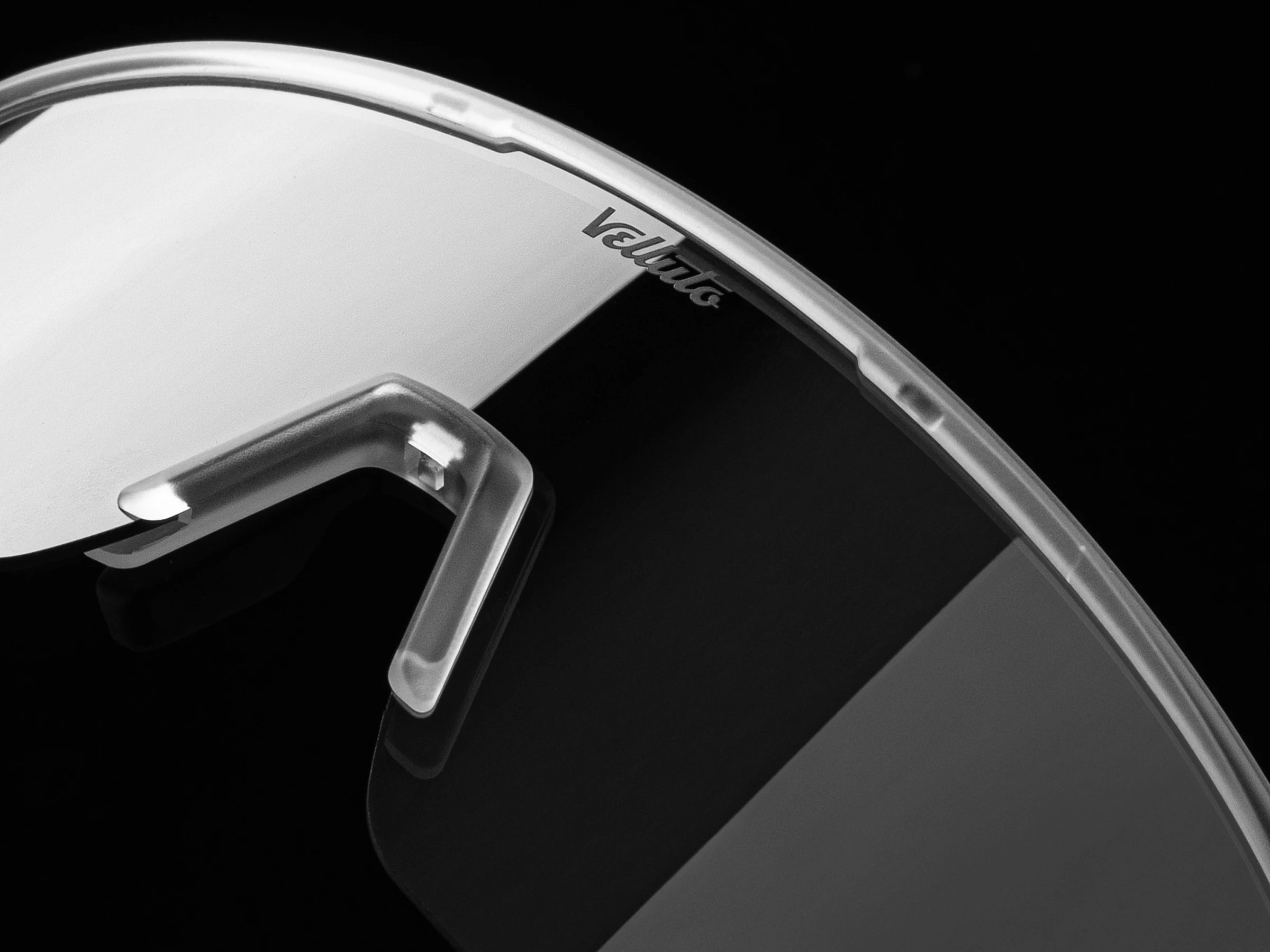
This is where the combination of UV400 certification and interchangeable lenses becomes a genuine safety feature rather than a convenience. The VellutoPuro clear lens offers UV400 protection with maximum light transmission, making it the correct choice for low-light conditions. The VellutoVisione high-contrast lens offers the same UV400 certification with added contrast enhancement for variable or bright conditions. Neither compromise on UV protection; they differ in optical function.
04 · Impaired visionWhen fogged or wet lenses create the hazard
The third injury category is less obvious but statistically significant: accidents caused by impaired vision through a compromised lens. A fogged lens, a lens running with water, or a lens misted by a temperature transition can reduce forward visibility to the point where a rider fails to identify a road hazard in time to respond. At cycling speeds, the gap between seeing an obstacle and being able to avoid it is measured in metres. A fogged lens removes those metres.
The scenario described at the start of this article, a rapid descent into cold air causing sudden fog, is not unusual. It happens on alpine descents, on rides into fog-filled valleys, and on any ride where the rider generates significant body heat while passing through cooler ambient air. Autumn sportives in Northern Europe, the Netherlands, Germany, and Scandinavia, are particularly prone to this because temperature and humidity variability across a single route can be dramatic.

The practical solution is a built-in anti-fog system, which addresses the issue through ventilation engineering and, where applicable, lens coating, rather than requiring the rider to stop and wipe the lens during a descent. The Velluto StradaPro integrates an anti-fog system designed to manage the temperature and humidity gradients a cyclist encounters across a full ride. The result is a lens that remains optically clear through the transitions that cause fogging in standard frames.
Rain is a related but distinct challenge. A lens that is optically clear but running with water droplets reduces contrast and makes it harder to distinguish surface texture, including the transition from tarmac to gravel, the shine of a wet cobblestone section, or the shadow of a pothole. High-contrast lens technology, such as VellutoVisione, helps by sharpening the definition between surface types even in wet light conditions.
05 · The autumn-specific riskWhy September and October riding demands proper eyewear
September 2026 sits at the peak of the gravel season, with the Vuelta running through its final stages and thousands of sportive riders completing their last long events of the year. It is also the period where riding conditions in Central and Northern Europe shift most rapidly. Morning temperatures in the Netherlands and Germany can sit at nine degrees before rising to nineteen by midday. Low sun angles in autumn produce glare conditions that differ from summer: the sun is lower in the sky, placing it directly at eye level for longer periods of the morning and evening ride.
Low-angle autumn glare is one of the most underappreciated visual hazards in cycling. It creates a horizontal glare band that makes it difficult to see through even at moderate intensities, and it is present even on days that are not technically bright. Overcast autumn skies still transmit UV. A 2019 review in the British Journal of Ophthalmology confirmed that UV exposure through cloud cover remains substantial, with some studies measuring 80 percent of clear-sky UV levels on overcast days.
The combination of UV risk, debris from fallen leaves and gravel surfaces, fog-prone descents, and low-angle glare makes autumn cycling the season where the importance of proper eye protection is most clearly demonstrated. Riders who managed through summer with cheaper or less functional eyewear often encounter their first serious issue in September or October, when the conditions demand more from the frame and lens than a basic pair can deliver.
06 · What to look forCycling eye protection features that actually reduce risk
Not all cycling-branded eyewear provides meaningful protection. The term is used broadly across products that range from genuine ophthalmic-grade cycling lenses to fashion frames with a wraparound shape. The difference lies in specific, verifiable features. When evaluating any pair of cycling glasses for their protective value, these are the criteria worth checking.
UV400 certification is the first and most important. This is a verifiable standard, not a marketing claim. A lens that is described as offering UV protection without a UV400 certification may block some UV radiation but not all, and there is no independent standard being applied. Only accept UV400 certified lenses for outdoor sport use.
Frame coverage and seal geometry determine how much of the eye's surface area is actually protected from debris and wind. A lens that sits flat against the face with minimal gap at the brow and temple is significantly more protective than a lens that sits away from the face. Wraparound curvature is the relevant design criterion: the greater the wrap angle, the smaller the exposed area at the periphery.
Anti-fog performance should be a specified design feature, not an incidental result of ventilation. Some frames achieve partial anti-fog through airflow channels above and below the lens. Others combine ventilation with a lens coating. The distinction matters in conditions where airflow alone is insufficient, such as the bottom of a cold descent or a slow climb where body heat is high and speed is low.
Interchangeable lenses are not just a convenience feature. A dark tinted lens that protects well in bright sun impairs visibility in low light. A cyclist who starts a ride in autumn darkness or ends one in evening shadow with a dark lens fitted is at increased risk of missing road hazards. An interchangeable system that takes seconds to swap means the rider always has the correct lens for the conditions.
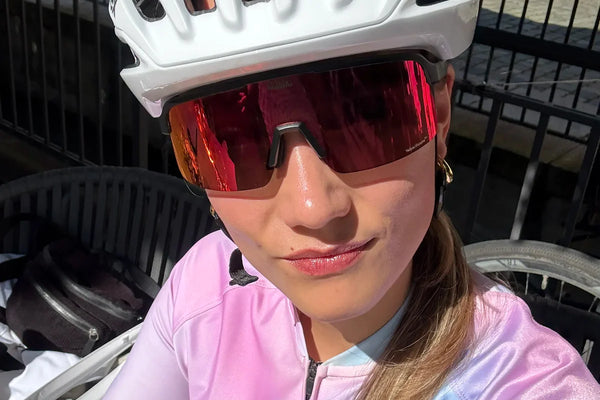
Weight and fit stability are safety-adjacent. A frame that is heavy enough to shift during effort, particularly out-of-saddle climbing or sprinting, becomes a distraction. A frame that slips down the nose in sweat creates a gap that allows debris and UV radiation to reach the eye. Adjustable nose pads and a genuinely lightweight frame, the StradaPro weighs 25 grams, address both failure modes.

07 · The StradaProHow Velluto's design addresses each risk category
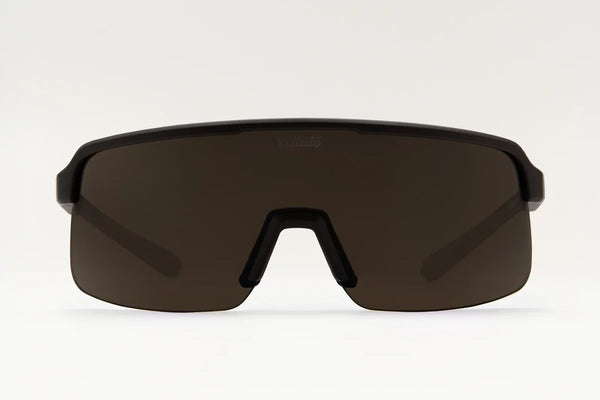
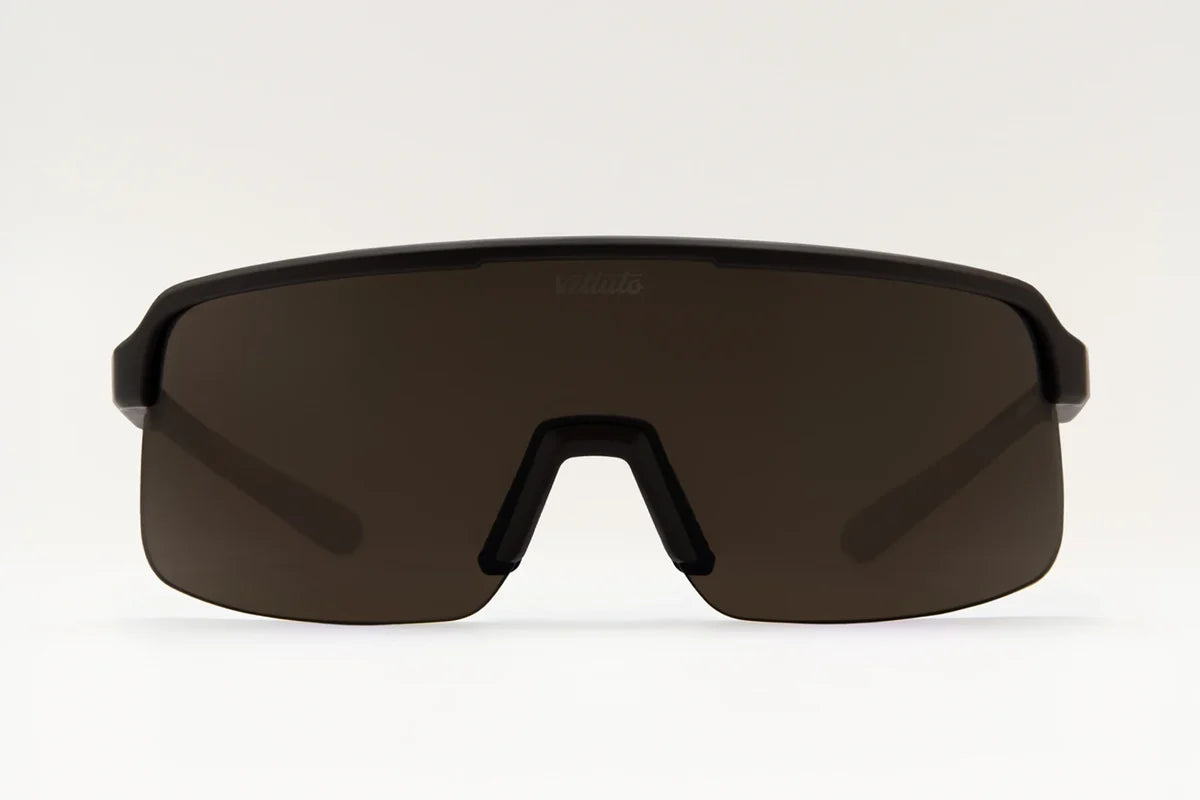
The Velluto StradaPro was designed as a road and gravel cycling frame, which means the protective features built into it map directly onto the injury risks described above. It is a German brand with Italian design, and the product decisions reflect a specific understanding of what cyclists encounter across a full season of European riding.
UV400 protection is certified across both available lenses, the VellutoPuro clear lens and the VellutoVisione high-contrast lens. This means there is no scenario, low light, overcast, or bright sun, where swapping to the appropriate lens reduces UV protection. Both lenses block 100 percent of UVA and UVB. The choice between them is purely an optical one based on ambient light level and contrast requirements.
The built-in anti-fog system addresses the vision-impairment risk category directly. On an autumn descent into a cold valley, on a slow climb where body heat is accumulating, or at a feed stop where the rider moves from high exertion to stationary in seconds, the anti-fog system maintains lens clarity. This is the feature that separates the StradaPro from frames that address UV and debris adequately but leave the rider managing fog manually.
The adjustable nose pads solve the fit stability problem with more precision than a single-geometry nose bridge. Different face structures carry frames at different angles and heights. Adjustable pads allow the rider to bring the frame into the correct position for their anatomy, which in turn ensures the lens sits at the correct distance from the eye, the correct height relative to the brow, and with minimal gap at the periphery. A frame that fits correctly is a frame that protects correctly.

At 25 grams, the frame sits below the perceptual threshold where most cyclists begin to notice eyewear weight during long efforts. On a four-hour autumn sportive, the difference between a 25-gram frame and a heavier one is the difference between glasses you forget you are wearing and glasses you periodically adjust. The less a rider interacts with their eyewear mid-ride, the less their attention is diverted from the road.
The click-in, tool-free lens swap system means that changing from VellutoPuro to VellutoVisione takes seconds at a feed stop or before a ride, without tools, without stress. For a rider who starts in pre-dawn darkness and finishes in midday autumn sun, the ability to swap lenses once or twice across the ride ensures the correct optics are in place for each phase of the ride.
08 · Lens careWhy a clean lens is a safer lens
A lens streaked with dried sweat, road grime, or lens spray residue is an impaired lens. Contrast reduction from surface contamination is gradual enough that riders often do not register it as a visibility problem, but it compounds the natural hazards of variable light conditions. A scratched lens creates internal reflections and optical distortion that reduce the clarity of the image. Both are avoidable with straightforward maintenance.
The Velluto Cleaning Spray is a 50ml, apple-fragranced, refillable spray made in Germany, used with the microfibre cloth to clean lenses without abrasion or residue. Regular cleaning before and after rides maintains full optical clarity and extends lens life. This is not a product upsell; it is a functional recommendation. A rider who spends the second half of a four-hour ride looking through a grime-streaked lens is accepting a measurable reduction in visual acuity during the period of the ride when fatigue is highest.

Lens storage matters too. A lens that is placed face-down on a feed table, tucked unprotected into a jersey pocket, or left loose in a kit bag without protection. The StradaPro is compatible with a hard case with an anti-crash guarantee and a velvet interior finish, which keeps the lens surface clean and scratch-free between uses.
09 · FAQFrequently Asked Questions
Compare the full lineup in the Velluto StradaPro cycling glasses collection.
How common are eye injuries in cycling?
What does UV400 protection actually mean for cyclists?
Are wind and debris more dangerous than UV radiation for a cyclist's eyes?
Why does anti-fog matter for eye safety, not just comfort?
Do I need different lenses for different light conditions?
Can insects and small debris cause serious eye injury on a road ride?
Is cycling eye protection important on overcast or autumn days?
How does the VellutoVisione lens improve safety compared to a standard tinted lens?
What is Velluto's 30-day trial and how does it work?


Eye protection on the bike is not optional equipment. It is the lens between your vision and everything the road throws at you across four hours of riding. The StradaPro brings UV400 certification, built-in anti-fog, interchangeable clear and high-contrast lenses, and a 25-gram frame into a single package designed for exactly this kind of riding. Try it for 30 days on your own roads, with no commitment. Find the full range and details at velluto-shop.com.