Buy Photochromic Cycling Glasses: What to Check First
Contents19 min read
The road from Bergamo drops into fog somewhere around Nembro, then opens onto a long, south-facing valley where the sun hits the tarmac at an angle that makes everything glare. If you watched Il Lombardia this month, you saw riders dealing with that exact sequence: shade, mist, then blinding light, all within twenty kilometres. The question of which glasses to wear for autumn cycling is not academic.
If you are ready to buy photochromic cycling glasses and want to know what actually matters before you part with your money, this guide covers it. Five criteria worth checking on any pair, an honest look at where photochromic suits you and where a two-lens interchangeable system might suit you better, and a full breakdown of the Velluto Chromo and the Velluto StradaPro so you can decide with real information rather than marketing language.
No invented test results here. No star ratings assigned by a brand writing about its own product. Just the specs, the context, and the questions worth asking.
01 · Why autumnWhy autumn is the hardest season for cycling eyewear
Spring and summer are relatively forgiving. You leave the house when it is light, it stays bright, and a standard tinted lens does its job all day. Autumn is different. The sun is lower on the horizon, which means it hits you at a sharper angle even in the middle of the day. Cloud cover changes constantly. Tree-lined roads that were pleasant in July become tunnels of shadow in October, interrupted by sudden bursts of direct light. And if you are riding in the Netherlands or northern Europe, you add rain, low mist, and the particular greyness of an October morning to the list.
The consequence is that fixed tints fail in both directions. A dark lens that handles bright sun leaves you underlit in the shadows. A clear or lightly tinted lens that works fine under cloud becomes inadequate the moment the sun breaks through. Experienced riders either carry two pairs, swap lenses mid-ride, or choose a photochromic lens that adapts on its own.
None of those solutions is universally correct. They reflect different riding styles, different priorities, and different budgets. What matters is knowing what each approach actually delivers before you commit to one.
The sun is lower, the light changes faster, and a fixed tint fails in both directions. Autumn is the season that earns photochromic technology its keep.Velluto Buyer's Guide, October 2026
02 · UV400The first thing to check: UV400 certification
Before weight, before aesthetics, before anything else: UV400. This is not a marketing badge. It means the lens blocks 100 percent of UVA and UVB radiation up to 400 nanometres, which is the threshold at which solar radiation stops being UV and becomes visible light. Without it, a lens can darken (creating the impression of sun protection) while still allowing UV to pass through, which is worse than wearing nothing because your pupils dilate behind the dark lens and let in more radiation than they would in open air.
For photochromic lenses specifically, the UV400 question has an additional dimension: does the certification apply across the full adaptation range, or only when the lens is fully darkened? A well-made photochromic lens carries UV400 protection at every point in its range. That should be stated explicitly by the manufacturer. If it is not, ask.
The Velluto Chromo is UV400 certified. The StradaPro's VellutoPuro and VellutoVisione lenses are both UV400 certified. On this point, Velluto is straightforward.
03 · Weight and fitWeight, fit and what happens at kilometre 80
Weight matters more on long rides than short ones. At kilometre 20 you barely notice what is on your face. At kilometre 80, on a three-hour autumn sportive or a late-season gran fondo, a frame that sits slightly wrong starts to register. Pressure on the nose bridge compounds. The temples press against your helmet. You find yourself reaching up to adjust more often than you should.
The Velluto StradaPro weighs 25 grams as a complete frame. That number is specific and documented. When you are evaluating other glasses, ask for the published weight and compare it directly. A difference of five or ten grams sounds small in isolation; over a long ride, the practical difference in comfort is not trivial.
Fit has two components: initial sizing and adjustability. Initial sizing matters because cycling glasses are typically designed around a face-width range, and the frame that fits a larger face will move around on a narrower one regardless of how you adjust it. Adjustability matters because even within the right size range, faces differ enough that fixed nose pads often create pressure points for riders whose bridge sits slightly differently from the frame's default position.
The StradaPro comes with adjustable nose pads, which means you can set the frame's position for your specific bridge width and face geometry. This is particularly relevant for riders with narrow or low nose bridges, a common fit challenge with cycling-specific frames designed around a European or North American average. The Chromo shares the same design language as the StradaPro, so the fit notes apply to both.
One more practical consideration for autumn riding: helmet compatibility. Most cycling helmets have front vents that sit close to where cycling glasses temples rest. A thicker frame or a temple that curves at the wrong angle can press against the helmet padding and shift when you look down. Check whether the glasses you are considering have been designed with standard road helmet clearances in mind.
Confirmed protection at every point in the lens range, not just at full darkness. Non-negotiable for eye safety.
Ask for the actual gram figure. A lighter frame is more comfortable on rides over two hours, and the difference adds up.
Fixed nose pads work for one face shape. Adjustable pads mean a secure, pressure-free fit for a wider range of riders.
Autumn means climbs in cool air and warm faces. A lens without an anti-fog coating becomes opaque precisely when you need clear vision most.
04 · Anti-fogAnti-fog is not optional in autumn conditions
Fogging is one of the most consistent complaints about cycling glasses in cool weather. The mechanism is straightforward: warm, humid air from your face and breath meets a cooler lens surface and condenses. The result is an opaque film at exactly the moment when you are working hardest and need the clearest vision: on the climb, in the first minutes after a stop, when your breathing rate spikes after a long descent.
Some lenses manage this with ventilation channels built into the frame design, which circulate air across the lens surface. Others use an anti-fog coating applied directly to the inner surface of the lens. The most effective systems combine both. A photochromic lens with a good anti-fog coating is the most useful configuration for autumn riding because it handles changing light and changing temperature simultaneously.
The Velluto StradaPro has a built-in anti-fog system. The VellutoPuro clear lens and the VellutoVisione high-contrast lens both benefit from this. The Chromo, designed for the same riding conditions, shares the same anti-fog approach. If you are comparing photochromic glasses from other brands, check specifically whether the anti-fog treatment is built into the lens or whether it is a coating that degrades over time, and whether the ventilation design has been tested for cycling-specific airflow at effort.
05 · The lens decisionPhotochromic versus interchangeable: which fits your riding?
This is the central decision, and it is worth being honest about it rather than steering you toward one answer.
A photochromic lens adapts automatically. You clip in, start riding, and the lens handles the light as it changes. You do not stop, you do not carry a spare lens in your jersey pocket, you do not make a decision. For riders who move through variable light quickly, who ride alone and cannot easily stop mid-climb, or who simply do not want another variable to manage on a long ride, photochromic is a strong argument. The Velluto Chromo works exactly this way: clear in low light, darkening in bright sun, and taking on a mirrored finish in full sunlight.
An interchangeable lens system gives you deliberate control. Before the ride, you assess the conditions: clear skies mean the VellutoVisione high-contrast lens; low light or rain mean the VellutoPuro clear lens. The swap takes seconds with the StradaPro's click-in system, no tools required. The trade-off is that you make a choice upfront and are committed to it for the ride. If conditions change significantly mid-route, you either stop and swap or continue with the wrong lens for the conditions.
Neither approach is objectively superior. They are different answers to the same problem. If you typically know what the weather will be before you leave and prefer certainty, the interchangeable system suits you. If you ride through variable conditions, long autumn days where the weather does not hold, or routes that mix shade and open road unpredictably, photochromic removes the decision entirely.
Some riders own both. A photochromic pair for autumn and winter, an interchangeable pair for spring and summer when the light is more predictable and they prefer the punch of a specific tint for different terrain. That is not an upsell; it is a practical observation about how experienced cyclists actually manage their kit over a full season.

06 · The Velluto ChromoThe Velluto Chromo: photochromic for changing conditions
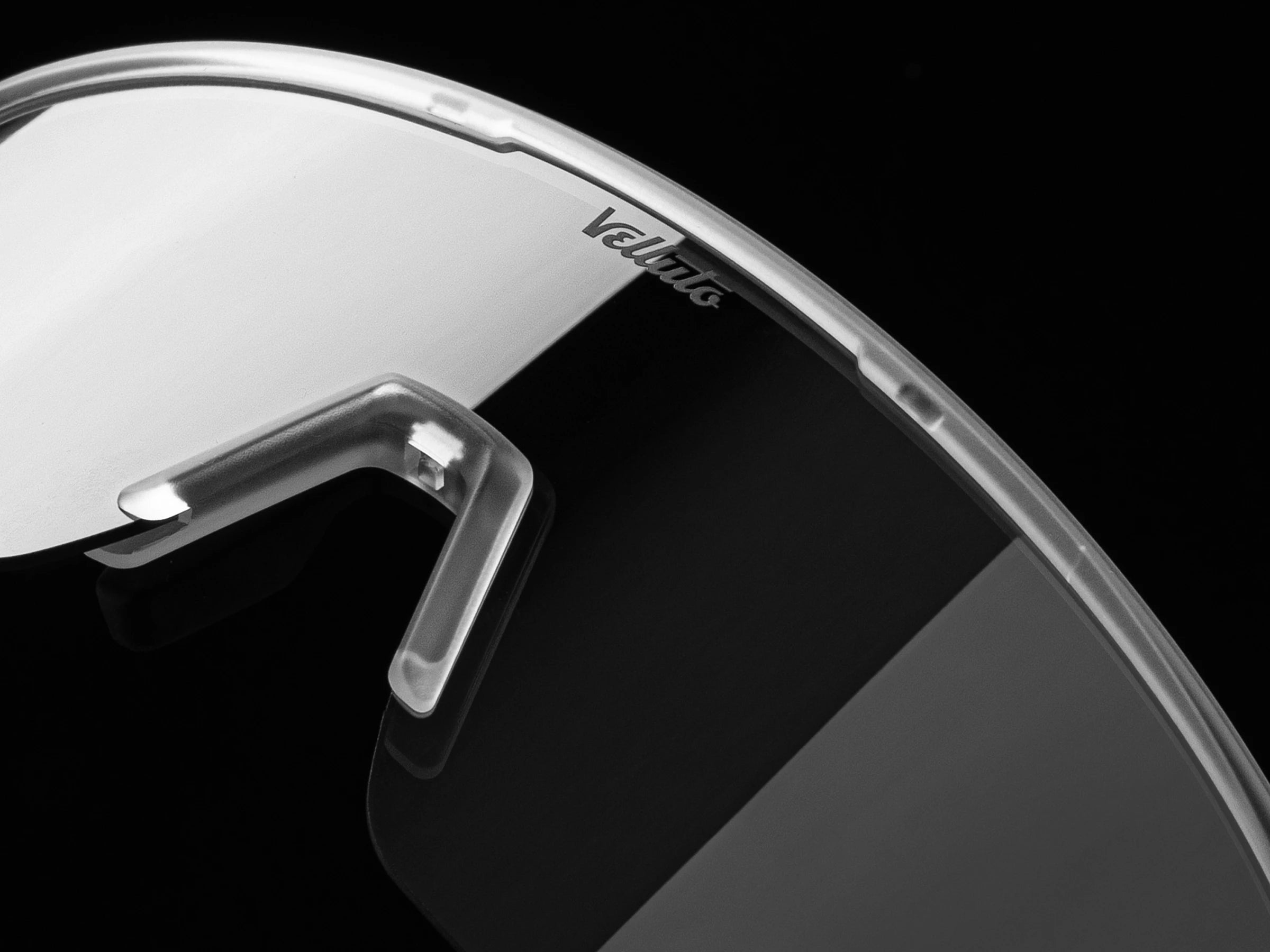
The Velluto Chromo launched in October 2026, positioned specifically for autumn and winter riding. It is the only Velluto product that is photochromic. The lens is self-tinting: it reacts to light as you ride, sitting clear in low-light conditions and darkening in bright sunlight. In full sun, the lens takes on a mirrored finish. Velluto does not publish transition speed, specific light-transmission percentages, or temperature-sensitivity data, so those numbers are not reproduced here. If they matter to your decision, the Chromo page has the current specification detail.
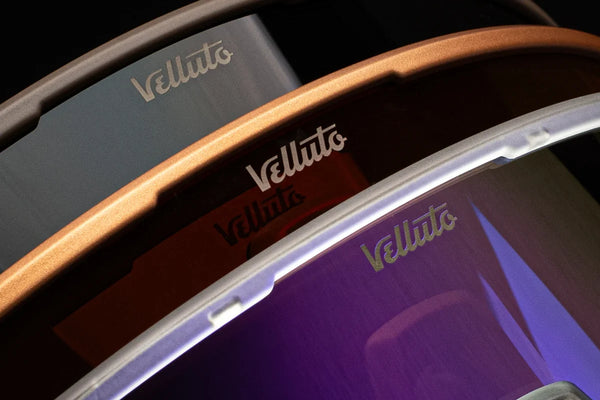
The Chromo is UV400 certified across its full range. It is priced at 119 EUR and comes in four colourways: Nero Fumo, Nero Fuoco, Bianco Lago, and Bianco Viola. The colourway names refer to the frame and accent palette. Velluto does not currently specify which tint each colourway darkens to, so if the final tint colour in bright light matters to you, check the Chromo page for visual references before ordering.
The Chromo is a German-brand product with Italian design, consistent with the StradaPro's design language. It is designed for road cycling in variable autumn and winter light, where a single adaptive lens removes the need to carry a spare or stop to swap.
Until 30 November 2026, a 2-for-1 offer is running on the Velluto Chromo: the second pair is free, and the two pairs do not have to be the same colour. Full conditions are on the Chromo page.

07 · The StradaProThe Velluto StradaPro: two lenses, one frame, your call
The StradaPro is Velluto's road cycling glasses built around a two-lens interchangeable system. It is not photochromic and it does not have a mirrored finish. What it has is a click-in lens system that lets you swap between the VellutoPuro clear lens and the VellutoVisione high-contrast lens in seconds, without tools. You choose which lens to ride before you leave. If conditions change significantly, you swap.
The frame weighs 25 grams. It has adjustable nose pads for a secure, pressure-free fit across a range of face shapes, and a built-in anti-fog system that keeps the lens clear on climbs and in the variable temperatures typical of autumn riding. Both lenses are UV400 certified.
The VellutoPuro is a clear lens optimised for road cycling: it provides full protection against wind and insects without reducing visible light. It is the right choice for early morning rides in low light, overcast days, and tunnel sections. The VellutoVisione uses VellutoVisione technology to sharpen contrast and visual definition. It is the right choice for days with partial cloud, where the contrast between road surface and background shifts as cloud cover moves across the sun.
The StradaPro comes in four colours: Arancia (orange), Espresso (brown), Nero (black), and Viola (purple). It is available from 69 EUR. Free shipping applies on orders over 89 EUR. There is a 30-day risk-free trial: you test it on real rides, and if it does not work for you, you return it within that window.


08 · Chromo vs StradaProSide by side: Chromo and StradaPro compared
If you are deciding between the two, here is an honest comparison on the attributes that matter for autumn road cycling. Note that the Chromo page carries the most current specifications; the figures below reflect Velluto's published information at the time of writing.
| Attribute | Velluto Chromo | Velluto StradaPro |
|---|---|---|
| Lens type | Photochromic, self-tinting | Two interchangeable lenses (clear + high contrast) |
| Mirrored finish | Yes | No |
| UV400 certified | Yes | Yes |
| Anti-fog | Yes | Yes |
| Lens swap | Not applicable (single adaptive lens) | Click-in, tool-free, seconds |
| Adjustable nose pads | Yes | Yes |
| Colourways | Nero Fumo, Nero Fuoco, Bianco Lago, Bianco Viola | Arancia, Espresso, Nero, Viola |
| Price | 119 EUR | from 69 EUR |
| Design origin | German brand, Italian design | German brand, Italian design |
| 30-day trial | See Chromo page | Yes |
The Chromo suits the rider who wants to stop thinking about the lens and let it work. The StradaPro suits the rider who prefers to make a deliberate choice before each ride and carry the flexibility of a second lens option. Both deliver UV400 protection and anti-fog performance. The practical difference is in how you interact with the lens when the light changes.
There is no correct answer to which is better. It depends on how you ride, how much variability you encounter, and whether you value automatic adaptation or deliberate control. Both are made by the same German brand, designed in Italy, and built for road cycling.

09 · Return policy and the trialWhat to look for in a return and trial policy
Cycling glasses are one of those categories where fit and comfort are genuinely difficult to assess without riding in them. The shape of your face, the position of your helmet, the way you tuck on the drops: all of these affect whether a particular frame works for you. A fair return or trial policy matters more in cycling eyewear than in almost any other piece of kit.
When you are evaluating any photochromic glasses, ask specifically whether the trial period covers real-world use. Some return policies apply only to unused products in original packaging, which is close to useless for cycling glasses. You cannot know if they work on a climb or in variable light without riding in them.
The Velluto StradaPro comes with a 30-day risk-free trial, explicitly covering real rides. You test it on the road, in the conditions you actually ride in, and return it within 30 days if it does not work for you. For the Velluto Chromo, the trial terms are on the Chromo page at velluto-shop.com/pages/chromo. Check those before ordering so you know exactly what the window covers.
When evaluating any photochromic glasses, look at the same question: can you test them on actual rides, in real light, before the return window closes? The Velluto StradaPro's 30-day trial covers real-world riding, so you know exactly what to expect from a fair trial policy.
10 · Keeping your lenses cleanMaintenance that protects your photochromic investment
A photochromic lens is a precision optical component and it responds to how it is cleaned and stored. A few practical notes that apply to any photochromic glasses, Velluto or otherwise.
Never wipe a lens dry with a jersey or glove. The grit that accumulates on cycling kit will scratch a lens surface that, on a photochromic pair, you cannot simply replace with a cheaper clear lens. Always use a microfibre cloth designed for optical surfaces. The Velluto microfibre cleaning cloth is 25 by 25 centimetres, with an 80/20 polyester and polyamide weave that lifts road grime without scratching.
For deeper cleaning, a purpose-made cleaning spray removes oils, sunscreen residue, and chain-lube splatter without attacking lens coatings. The Velluto Cleaning Spray is 50ml, apple-fragranced, refillable, and made in Germany. It is designed to be safe on coated lenses.
Storage matters as well. A hard case protects the lens from the kind of accidental pressure that causes stress fractures in photochromic coatings. The Velluto hard case comes with an anti-crash guarantee and a velvet interior finish that will not scratch the lens surface. It fits all road cycling glasses in the Velluto range.

11 · The decisionA practical framework for making the call
If you have read this far, you have the information you need. Here is how to use it.
Start with UV400. If the glasses you are considering do not explicitly state UV400 certification across their full lens range, remove them from your list. Eye safety is not a trade-off category.
Next, check the published weight. If the brand does not publish the frame weight, that is worth noting. It is a simple specification and there is no good reason to omit it. The StradaPro weighs 25 grams. Use that as a reference point.
Then assess your riding pattern. If you regularly move through rapidly changing light on routes that mix shade, open road, and potential low visibility, photochromic is a strong argument. If you usually know your conditions before you leave and prefer to make a conscious lens choice, interchangeable suits you. If you want both, that is what two pairs are for.
Check the anti-fog system. Autumn riding means temperature differentials, especially on climbs. A lens that fogs precisely when you are working hardest is a safety issue as much as a comfort one.
Finally, look at the trial or return policy. A brand that is confident in its fit and performance offers a real-world trial. The StradaPro's 30-day trial covers actual rides. For the Chromo, the full terms are at the link below.
The Velluto Chromo at 119 EUR is the answer if automatic adaptation is your priority. The Velluto StradaPro from 69 EUR is the answer if deliberate, flexible lens choice is your preference. Both are built by the same German brand, designed in Italy, to the same UV400 standard, with the same anti-fog and adjustable-nose-pad specification. The difference is in how the lens handles changing light, and that is a riding-style question only you can answer.

Compare the full lineup in the Velluto StradaPro cycling glasses collection.
12 · FAQFrequently Asked Questions
What does photochromic mean in cycling glasses?
Is UV400 protection different in a photochromic lens?
How heavy are photochromic cycling glasses?
Are photochromic glasses worth it for autumn cycling?
What is the difference between the Velluto Chromo and the Velluto StradaPro?
Can I use the Velluto Chromo in very low light or at night?
What colourways does the Velluto Chromo come in?
What is the 2-for-1 offer on the Velluto Chromo?
What should I check before buying any photochromic cycling glasses?
The full specification for the Chromo, including the current colourway visuals and trial terms, is at velluto-shop.com/pages/chromo. For the StradaPro and the full Velluto range, visit velluto-shop.com.