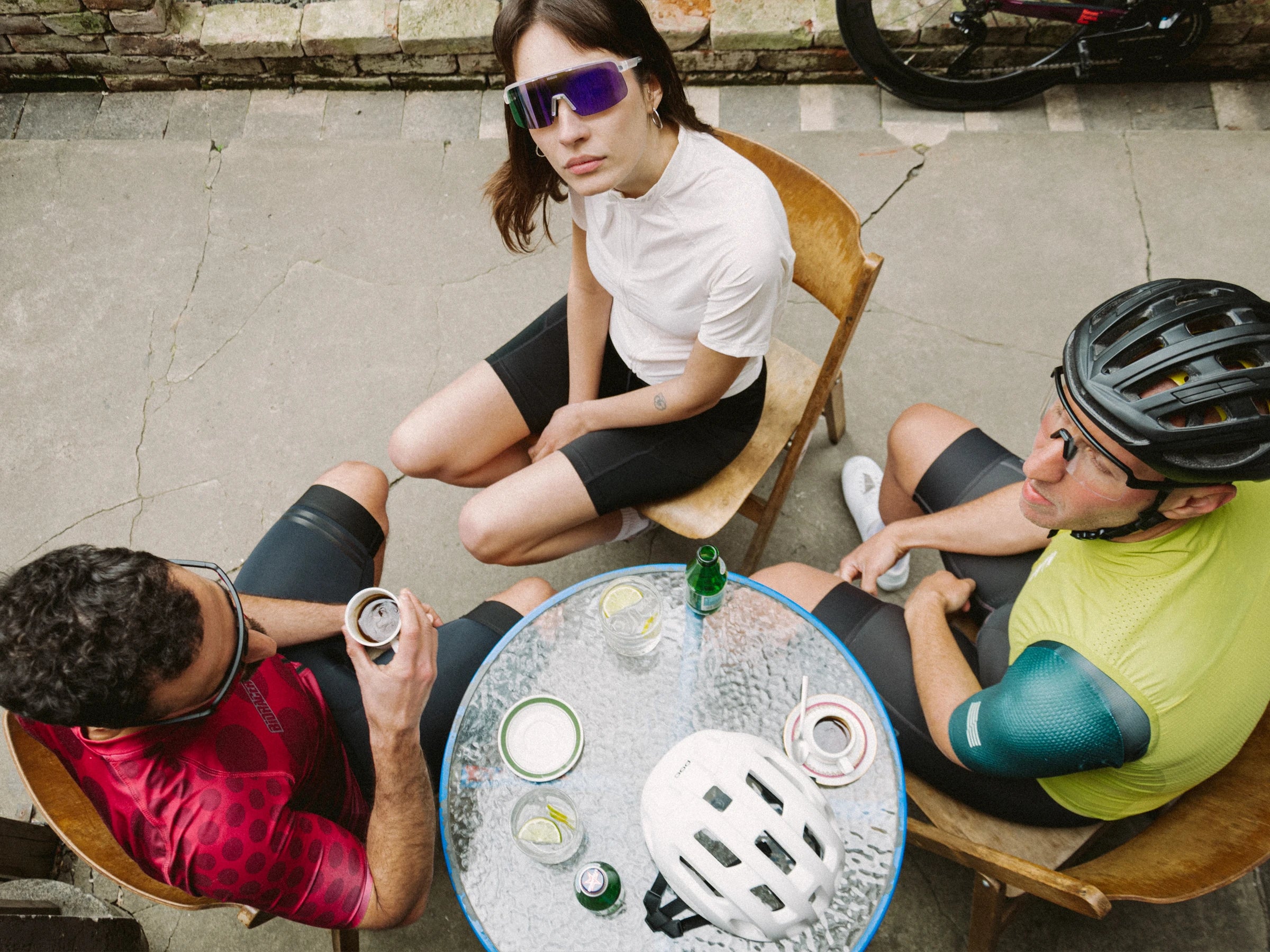
Buy Road Bike Glasses: The Complete Checklist 2027
Contents23 min read
You are standing at the start of a November cyclocross race, the mud still frozen, the sun already low and white at nine in the morning. Your lenses fog the moment your heart rate climbs. That is not a comfort issue. That is a visibility issue, and visibility at speed is a safety issue. Getting the right glasses before winter takes more than picking a colour. It takes a checklist.
This guide covers everything worth evaluating when you decide to buy road bike glasses: weight, UV protection, lens systems, anti-fog technology, fit adjustment, frame coverage and trial policy. It is written as a practical buying framework, not a verdict. Every criterion is explained so you can apply it to any glasses you are considering, including, of course, the Velluto options. The goal is to help you make the right call for your riding, not to make the call for you.
01 · WeightWhy grams matter more on the bike than anywhere else
Cycling glasses are not worn for ten minutes. A typical road ride is three to five hours. A sportive or cyclocross event might stretch longer. That duration changes what matters in eyewear completely, because weight that feels irrelevant in a shop accumulates as a pressure point on the nose bridge and temples over hours in the saddle.
The practical threshold most road cyclists report is somewhere around 28 to 32 grams. Below that range, you stop noticing the glasses are there. Above it, particularly above 35 grams, fatigue and pressure start to register on long climbs or during sustained efforts. This is especially true if you are also wearing a helmet with an aggressive forward tilt that shifts weight distribution toward the nose pads.
The Velluto StradaPro weighs 25 grams. That is a specific, documented number, not a category description like "ultralight." It is the kind of figure worth asking for from any brand you are evaluating, because weight listed on a product page is verifiable and comparable in a way that adjectives are not. When evaluating any brand, ask for weight stated in grams, as this is a verifiable and comparable figure.
What determines frame weight? The primary variable is material choice, usually a combination of TR90 nylon-based polymers for the frame and lightweight alloys or flexible rubber for the nose pads and temple tips. Lens material, hinge design and the number of frame components also contribute. A minimalist single-piece frame will almost always be lighter than a fully articulated design, though articulation serves a purpose in adjustability, as we will come to.
02 · UV400What the certification actually means and why it is non-negotiable
UV400 is not a marketing label. It is a measurable optical standard that specifies the lens blocks all ultraviolet light at wavelengths up to 400 nanometres, covering both UVA and UVB radiation at 100 percent. For context, standard sunglasses sold in the EU must meet CE EN ISO 12312-1 requirements, but not all commercial eyewear reaches UV400. Road cycling glasses should, without exception.
The reason relates to exposure profile. A road cyclist is outdoors for extended periods, often at elevation where UV index is higher than at sea level, and moving fast enough that wind does not reduce UV exposure but does remove the natural squinting and blinking that partially protects the eyes in everyday life. At cycling speeds, the eyes are also exposed laterally, which is why lens coverage geometry matters alongside UV rating, a point we return to in the frame coverage section.
When evaluating any glasses, look for UV400 to be stated explicitly and, ideally, described as certified rather than self-declared. The distinction is worth asking about. The VellutoPuro transparent lens and the VellutoVisione high-contrast lens are both UV400 certified, as is the lens in the Velluto Chromo photochromic model. UV protection applies equally to clear lenses, which is relevant to anyone who rides in low light with a transparent lens: a clear lens without UV400 is not safe for extended road use.

03 · Lens systemPhotochromic versus interchangeable: understanding both before you choose
This is probably the most consequential decision in the buying checklist, and it is one where the right answer genuinely differs between riders. There is no universally superior system. The question is which architecture suits the way you actually ride.
A photochromic lens is a single lens that reacts to UV light, darkening as intensity increases and lightening as conditions become overcast or shadowed. You do not change anything manually. The lens adjusts as you ride, which makes it particularly well suited to conditions where light shifts rapidly: a November road ride that takes you from bright hilltop exposure into shadowed valley lanes, or a cyclocross course that moves you in and out of tree cover repeatedly. The Velluto Chromo uses this photochromic technology. Its lens starts clear in low light and darkens to a mirrored finish in direct sun. It costs 119 EUR.
An interchangeable lens system gives you discrete lenses, each optimised for a specific light condition, that you swap manually before or during a ride. The advantage is precision: each lens is tuned specifically for its intended condition rather than being a compromise that adapts across a range. The practical question is whether you are willing to swap lenses, and when. If you know the weather forecast and can choose the right lens before leaving, an interchangeable system is straightforward. If the weather is genuinely unpredictable and you do not want to stop and swap, a photochromic model is more convenient.
The Velluto StradaPro uses an interchangeable system with two lenses: the VellutoPuro, which is transparent and optimised for wind and insect protection in low light, and the VellutoVisione, which uses high-contrast technology to sharpen visual definition in variable and brighter conditions. Both click in and out without tools. The swap takes seconds and is designed to be manageable with gloves on.
The right lens system is the one that matches how unpredictably your light changes, not how premium the brand sounds.Velluto Buyer's Guide
A practical way to decide: if your rides typically have one dominant light condition and you check the forecast before going out, the interchangeable system gives you the best-tuned lens for each ride. If your rides cross multiple distinct light environments in a single session and stopping to swap is not practical, photochromic solves that without any action on your part.
Both approaches are legitimate. Both are represented in the Velluto range. The important thing is to understand which problem you are actually solving before you pay for a solution.
04 · Fit adjustmentWhy adjustable nose pads change everything on a long ride
Fit is where glasses that look identical on a product page diverge completely in practice. Face shapes vary significantly in bridge width, nose height, cheekbone prominence and temple width. A frame sized and shaped for one face may sit too low, too high, or press uncomfortably on another, regardless of how well it was designed in every other dimension.
Adjustable nose pads are the most direct solution to this variation. They allow you to change the bridge position, raise or lower the frame relative to your eyes and distribute pressure across a wider area of the nose. On a two-hour club run, an ill-fitting frame is an annoyance. On a five-hour sportive or a full cyclocross race series weekend, it becomes a reason to stop wearing the glasses entirely, which defeats the purpose.
The StradaPro includes adjustable nose pads, and this is worth calling out specifically because not all road cycling glasses do. Some frames use a fixed bridge in a single profile, which suits a portion of riders well and others not at all. If you are buying online and cannot try before you commit, adjustable nose pads significantly increase the probability that the glasses will fit correctly without any in-person adjustment.
Beyond nose pad adjustability, also consider temple arm flexibility. Rigid temple arms in a fixed width create pressure on narrower or wider heads, particularly when worn over a helmet strap. Flexible rubber or semi-flexible temple tips that grip without clamping are preferred for long rides. The fit at the temples affects whether the glasses stay in position on descents and whether they create fatigue during prolonged wear.

05 · Anti-fogWhy this is not a luxury feature in November
Anti-fog performance is dismissed as a nice-to-have until the moment a lens mists over at the top of a climb and stays that way for the descent. At that point it becomes a safety issue, not a comfort preference. For road cyclists riding in autumn and winter conditions, it deserves to be on the checklist at the same level as weight and UV rating.
Fogging occurs when warm, moist air from your face meets a cool lens surface. The conditions that cause it are exactly those that define cyclocross season and winter road training: cold ambient temperature, high physical effort, variable weather, and transitions between exposed and sheltered terrain. A tunnel after a long sunny climb is a classic scenario. So is a descent into a valley after a humid forest track.
Anti-fog solutions exist on a spectrum. Passive ventilation, through channel geometry in the frame that promotes airflow across the inner lens surface, is the simplest approach. Active coatings that reduce surface tension and prevent moisture condensation are a step further. The most effective systems combine both: frame geometry that moves air across the lens, and a treated lens surface that resists misting even when airflow momentarily drops.
The StradaPro includes a built-in anti-fog system. This is a standard feature of the design, not an optional upgrade. When you are evaluating other glasses in this category, it is worth asking specifically how anti-fog performance is achieved, not just whether it is claimed. A single word on a product page is less informative than an explanation of the mechanism.
The Velluto Chromo photochromic model also carries UV400 protection and is designed for the variable conditions of autumn and winter riding. When evaluating any photochromic model, anti-fog performance is a relevant question, since the conditions that make photochromic useful, rapid light shifts, variable terrain, temperature transitions, are the same ones where fogging risk can arise.
06 · Frame coverageWhat "wraparound" actually protects and why it matters at road speed
Coverage is the geometric dimension of lens protection: how much of the eye area the lens shields from lateral, vertical and direct exposure. At cycling speeds, wind is constant and lateral air movement is significant. Dust, insects and debris approach from angles that standard eyewear is not designed to intercept. UV exposure also arrives from angles below the lens when road surface reflection is involved.
Road cycling glasses are designed with a curved, wraparound lens profile to address exactly this. The lens extends beyond the front of the frame and curves toward the temples, reducing the gap between lens edge and face. This is not an aesthetic choice. It is a functional one: the coverage it provides at 40 km/h in an open field is meaningfully different from a flatter lens profile.
When evaluating coverage, consider both lateral wrap and vertical height. A lens that wraps well but sits very high above the cheekbone leaves a gap below the lens where debris and lateral UV exposure can enter. Conversely, a lens that sits very low can interfere with sightlines when you are in an aggressive road position. The optimal balance depends partly on your riding position and partly on face geometry, which is another reason adjustable nose pads help: they allow you to shift the frame vertically to find the right coverage position for your specific eye placement.

07 · Trial periodWhy a risk-free window changes the calculus of buying online
Cycling glasses bought online carry an inherent uncertainty that in-store purchases do not. You cannot assess fog performance from a product image. You cannot feel weight distribution until the glasses are on your face at the top of a climb. You cannot know whether the lens tint or contrast level is right for your specific vision until you are actually moving at road speed in variable light.
A risk-free trial period is the mechanism that resolves this uncertainty. It allows you to put the glasses through real riding conditions during the trial window and return them if they do not perform for your use case. The practical effect is to remove the financial risk of an online purchase and replace it with a test period in the actual environment where the glasses will be used.
The StradaPro comes with a 30-day risk-free trial. That window is long enough to cover a range of conditions: a dry autumn road ride, a cold morning with fog risk, a faster club ride where frame stability matters, and a slower endurance session where pressure from nose pads accumulates. Thirty days ridden honestly will tell you whether the glasses work for you or not.
When evaluating any glasses online, check the return and trial policy explicitly before purchase. The language matters: a standard commercial return policy is different from a risk-free trial that explicitly covers use during the period. Know what you are committing to before you commit.
Thirty days on actual rides tells you more about a pair of glasses than any specification sheet.Velluto Buyer's Guide
08 · The Velluto optionsHow the StradaPro and the Chromo map to the checklist
Having walked through every criterion in the checklist, it makes sense to map the Velluto range explicitly against them. This is not a recommendation. It is a factual summary of where each product sits relative to the buying criteria covered above, so you can place them accurately in your own evaluation.
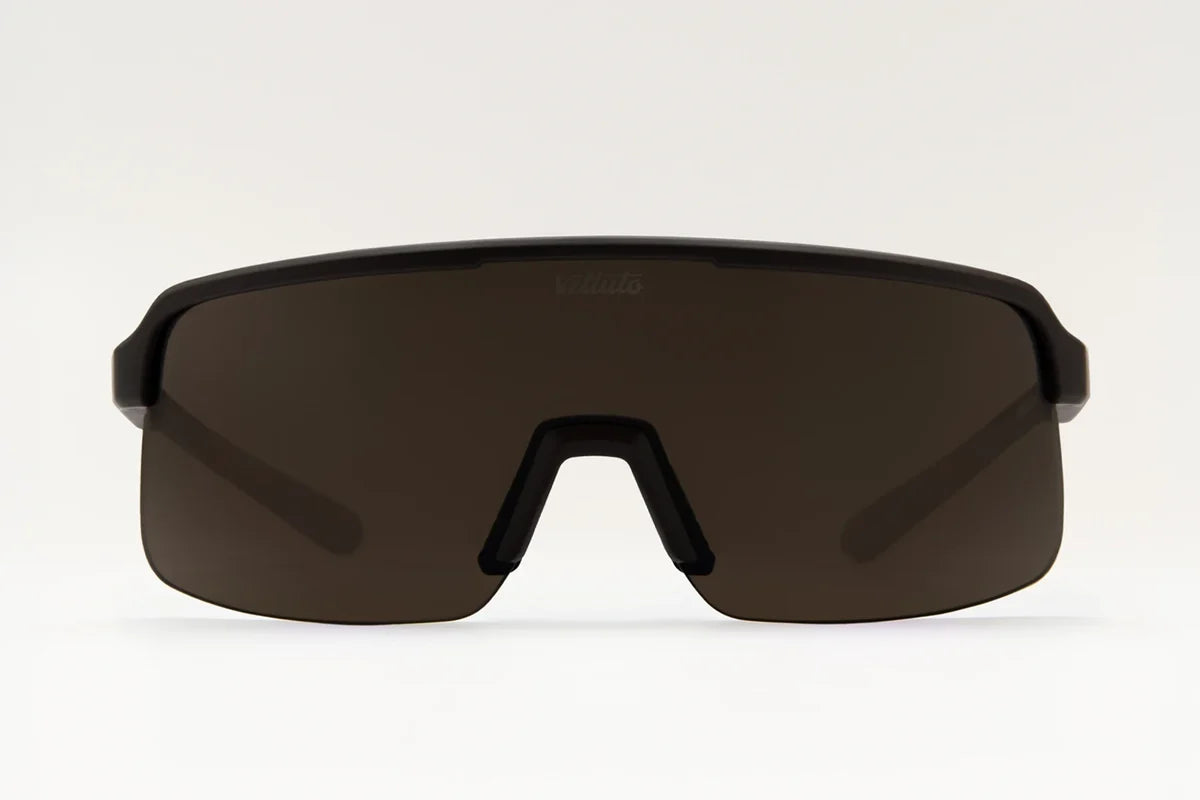
The StradaPro is the interchangeable lens model. It weighs 25 grams. It includes UV400-certified lenses in two variants: the VellutoPuro transparent lens for low light and wind protection, and the VellutoVisione high-contrast lens for variable and brighter conditions. The frame has a built-in anti-fog system and adjustable nose pads. The lens swap is tool-free and designed to work with gloves on. It comes with a 30-day risk-free trial and free shipping on orders over 89 EUR. It is available in four colours: Arancia (orange), Espresso (brown), Nero (black) and Viola (purple). The StradaPro starts from 69 EUR and is designed to be worn as a standalone frame.
The Chromo is the photochromic model, launched in October 2026. It uses a single self-tinting lens that adapts to light as you ride, starting clear in low light and darkening to a mirrored finish in direct sun. It is UV400 certified. It costs 119 EUR and is available in four colourways: Nero Fumo, Nero Fuoco, Bianco Lago and Bianco Viola. Full details are on the Chromo product page.
The two products solve different problems. The StradaPro gives you two purpose-built lenses you control. The Chromo gives you one lens that adapts without input from you. Both carry UV400 certification. These represent distinct technology architectures in distinct products. If you are unsure which suits your riding, the checklist criteria in sections 03 and 05 above are the most relevant starting point.
Through 30 November 2026, Velluto is running a 2-for-1 offer on the Velluto Chromo: the second pair is free, and the two pairs do not have to be the same colour. Full conditions are on the Chromo page.


09 · ComparisonHow the checklist criteria map across the market
The seven criteria in this guide apply equally to any road cycling glasses you evaluate, not only Velluto. To help you use the framework in practice, here is how the criteria translate into a comparison structure you can apply when researching any shortlist. The table below shows the StradaPro's verified specifications alongside the criteria headers, so you have a reference point to compare against.
| Criterion | What to look for | Velluto StradaPro |
|---|---|---|
| Weight | Published in grams, ideally under 30 g | 25 g |
| UV protection | UV400 certified, stated explicitly | UV400 certified |
| Lens system | Photochromic or interchangeable, what is included | Interchangeable, tool-free (VellutoPuro + VellutoVisione) |
| Nose pad adjustability | Adjustable pads for fit across face shapes | Yes |
| Anti-fog | Mechanism described, not just claimed | Built-in anti-fog system |
| Frame coverage | Wraparound lens profile, adequate vertical height | Road cycling wraparound design |
| Trial period | Risk-free trial for use during the period | 30-day risk-free trial |
Apply the same column to any glasses you are shortlisting. If a brand does not publish a figure in grams, ask. If UV400 is not stated clearly, that is a gap. If the return policy does not cover actual use, that is a commercial rather than a trial arrangement. The table is a tool, not a verdict: use it to get every option on the same factual footing before you decide.
10 · Who this is for and who it is notMatching the checklist to your actual riding
A buying checklist is only useful if it maps to your real riding context. The seven criteria above are universally relevant for road cyclists, but they are not equally weighted for every rider. Here is how to prioritise based on the type of riding you actually do.
If your primary use case is long road rides and sportives, weight and fit adjustability are your top priorities. The cumulative effect of frame weight and nose pad pressure over five or six hours is significantly greater than it is on a one-hour training session. UV400 is non-negotiable regardless of ride length. Anti-fog matters most on mixed-terrain routes with temperature variation. An interchangeable lens system suits you well if you check the forecast and choose your lens before leaving.
If you are riding cyclocross or early-morning winter road training, anti-fog performance moves to the top of the checklist alongside UV400. The transition between high effort and cold ambient temperature, combined with variable terrain, is exactly the environment where fog risk is highest. Here, a photochromic lens is particularly convenient because light conditions change rapidly within a single session. The Velluto Chromo is designed for this scenario. The StradaPro works well too if you select the right lens before the race or ride and conditions do not shift dramatically mid-session.
If you are buying your first dedicated road cycling glasses and want versatility across conditions without a large initial investment, the interchangeable lens system is a practical starting point. Two lenses cover a wider range of conditions than a single fixed tint, and the 30-day trial removes the financial risk of discovering they do not suit your face shape or vision preferences.
If you already own road glasses and are looking specifically for a low-maintenance, adapt-and-forget solution for autumn and winter riding, a photochromic model is the more direct answer. You are not solving a "which lens today" problem. You are solving a "just ride, the lens handles it" preference.

11 · AccessoriesWhat else is worth considering at the point of purchase
The glasses themselves are the main decision, but a few accessories are worth factoring into the buying moment, both because they are practical and because bundling them makes logistical sense.
A hard case is the most straightforward addition. Cycling glasses with large wraparound lenses are more vulnerable to frame distortion and lens scratching than standard eyewear because the lens profile is more exposed. A purpose-designed hard case with an anti-crash guarantee keeps the frame geometry intact when the glasses are in your kit bag, jersey pocket or the back of a car. The Velluto hard case fits all road cycling glasses and has a velvet interior lining that prevents surface contact scratches.
A cleaning kit is the other practical addition. Road riding deposits fine particulate matter, insect residue and sunscreen onto lenses faster than almost any other activity. Cleaning with a dry cloth or improper solution causes micro-scratches that accumulate over a season and degrade clarity. The Velluto Cleaning Spray is 50 ml, apple-scented, refillable and made in Germany. The microfiber cleaning cloth is 25 by 25 centimetres with an 80 percent polyester, 20 percent polyamide blend that is designed to lift debris without scratching coated lens surfaces.

Compare the full lineup in the Velluto StradaPro cycling glasses collection.
12 · FAQFrequently Asked Questions
What weight should road bike glasses be?
What is UV400 protection in cycling glasses?
What is the difference between photochromic and interchangeable lens systems?
How important are adjustable nose pads on road cycling glasses?
What does a built-in anti-fog system do on cycling glasses?
What is a risk-free trial for cycling glasses, and why does it matter?
Can I use the Velluto StradaPro for cyclocross and winter road training?
How does the Velluto StradaPro lens swap system work?
What should I check before buying road bike glasses online?
The seven criteria in this guide give you a framework you can apply to any glasses you are researching, wherever you are in the buying process. If you want to see how the StradaPro and the Chromo sit against that framework in detail, the full range is at velluto-shop.com. The 30-day trial means you can put the StradaPro through real November riding before committing, which is ultimately more informative than any checklist.