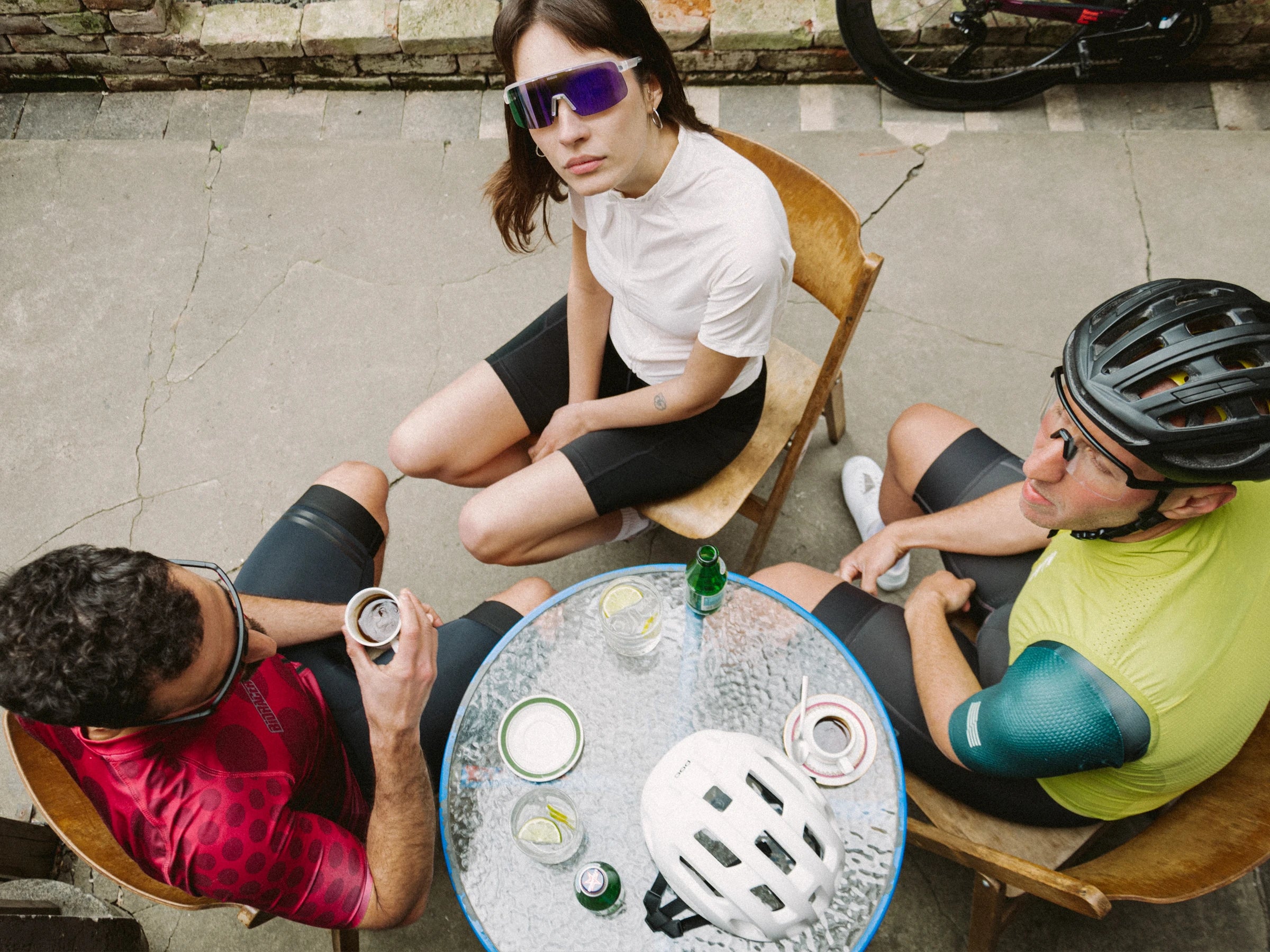
Best Gravel Bike Sunglasses 2026: Fit, Lenses & Anti-Fog Guide
Contents24 min read
The trail drops into a corridor of oak trees, the light halves in an instant, and loose gravel hammers the underside of your fork. Three seconds later you are back in open October sun with grit in your teeth and your glasses halfway down your nose. Gravel riding does things to eyewear that a smooth road circuit never will, and choosing the best gravel bike sunglasses for autumn 2026 means thinking about a different set of problems than most buyer's guides address.
This guide walks through every criterion that actually matters for gravel: lens coverage against dust and spray, ventilation and anti-fog performance on slow technical climbs, secure fit on rough ground, and lens choice for the rapidly changing light that defines an autumn ride through forests and open farmland. It ends with specific Velluto options matched to different rider priorities, a comparison table, and answers to the questions gravel riders ask most often. No test scores, no invented ratings. Just the facts you need to make a good decision before your next ride.
01 · Why gravel is harder on eyewearThe case for choosing gravel-specific
Road cycling and gravel riding share a lot of the same kit, but eyewear is one area where the demands genuinely diverge. On a road ride at 35 km/h, the airflow past your face is consistent, your glasses stay put by aerodynamic pressure alone, and the light conditions change slowly as you move through open terrain. The biggest threat to your vision is oncoming sun and the occasional insect.
Gravel riding reverses almost all of those assumptions. Speed varies wildly, from a punchy descent at 45 km/h to a crawl up a loose, steep forest track where you might be pushing single digits. That speed variation matters for two reasons. First, at low speed, airflow across the lens drops to near zero, which means any moisture from your breath or sweat has nowhere to go. Fogging becomes a real problem, and a fogged lens on a technical descent is not just annoying, it is dangerous. Second, the slower you go, the more the frame relies on its own fit and weight to stay in place rather than aerodynamic force. A frame that sits perfectly on a smooth road can vibrate off your nose on cobblestones or hardpack trail.
There is also the matter of debris. Gravel trails throw up stones, sand, dry mud and in autumn, wet leaf fragments. Your eyes are much closer to that debris than on a road bike, partly because your position is often more upright and partly because gravel surfaces generate lateral spray in a way that tarmac does not. Lens coverage matters: a slim road lens leaves the eye more exposed at the edges, while a more wraparound profile keeps debris out from the sides as well as the front.
Finally, gravel riding in October in central Europe means changing light conditions on almost every ride. You leave in morning mist, ride through dappled forest, climb into open fields at noon, then drop back into shadow for the return. The sun angle in late October is low and oblique, which makes glare more of a problem in open sections while tree-lined sections remain genuinely dark. Lens versatility is not a nice-to-have on autumn gravel; it is a core requirement.
02 · Coverage and wrap angleHow much lens do you actually need?
Lens coverage is a simple concept that buyer's guides often understate. The wrap angle of a lens describes how far it curves around the side of your face. A flat or low-wrap lens leaves a gap at the temple through which wind, dust and insects can enter. A high-wrap lens closes that gap and creates a more enclosed environment around the eye.
For road cycling at speed, a moderate wrap angle is usually enough because the airflow creates a pressure zone in front of the face that deflects most debris. For gravel, where you may be riding slowly through vegetation, climbing dusty tracks or descending with roost flying from your front wheel, a more generous wrap provides meaningfully better protection.
The practical test is whether the lens edge sits close to your face at the temple when you are in a relaxed riding position. If there is a visible gap, debris will find it. Adjustable nose pads play a role here too: by moving the frame closer to or further from your face, you effectively adjust the coverage at the sides as well as the comfort at the top of your nose.
One underappreciated benefit of a lightweight, well-fitted frame on gravel is that it sits consistently in the same position ride after ride. A heavier frame creeps down the nose under vibration, which changes the effective coverage angle over the course of a long ride. Keeping the frame light and the nose pad fit dialled in holds the lens exactly where you need it from the first kilometre to the last.

03 · Anti-fog on slow climbsWhy ventilation alone is not enough
Anti-fog performance is the most consistently underrated specification in cycling eyewear, and it matters most on exactly the kind of terrain gravel cyclists ride. The physics are simple: fogging happens when warm, moist air from your exhalation or sweat meets a cooler lens surface. At high speed, airflow across the lens replaces that moist layer fast enough that fogging never takes hold. At low speed, that replacement slows dramatically. At a standstill, it stops entirely.
Many cycling glasses address fogging purely through frame ventilation: slots or channels in the frame designed to encourage airflow past the lens. This works reasonably well at road cycling speeds. It works much less well at the 6 km/h you might be grinding up a steep forest track loaded with loose rock, or at the zero km/h when you stop to check your GPS at the top of a climb in cold October air.
A built-in anti-fog system in the lens itself, rather than relying solely on frame airflow, continues working regardless of your speed. It is a coating or structural property of the lens that prevents the moisture layer from forming in the first place. For gravel riders who regularly encounter the low-speed, high-effort sections that road cyclists mostly avoid, this is a specification worth actively seeking out rather than assuming is present.
The seasonal timing of this matters too. Autumn is when the temperature difference between your body and the air is greatest. You leave in a 6-degree morning, your core temperature climbs as you ride, and the lens temperature lags behind the air around it. October gravel rides combine maximum fogging risk with maximum terrain technicality, which is exactly when a clear lens matters most.
A fogged lens at 5 km/h on a muddy descent is not an inconvenience. It is a genuine reason to stop and wait, which on a technical gravel trail is sometimes impossible.Gravel rider's reality, autumn 2026
04 · Fit and stability on rough terrainThe case for adjustable nose pads and low weight
Frame stability on rough ground comes down to two factors: weight and fit precision. Both interact, and getting either one wrong makes the other problem worse.
Weight is intuitive. A lighter frame moves less under vibration because there is less mass being thrown around by the trail surface. The difference between a 35-gram frame and a 25-gram frame sounds trivial in your hand, but over hours of cobblestones, hardpack trail or rough tarmac, the lighter frame stays where you placed it while the heavier one gradually migrates. Ten grams is a real functional difference in this context, not a marketing rounding exercise.
Fit precision is subtler. The nose pad is the primary anchor point of your glasses. If it is a fixed pad in a standard position, it either fits your nose or it does not, and if it does not, the frame will rock or slide regardless of how light it is. An adjustable nose pad lets you position the contact point against the specific geometry of your nose so that the frame is genuinely held rather than resting. On rough ground, this is the difference between glasses that need constant nudging and glasses that you forget about entirely while you focus on the trail.
The secondary anchor points are the arms against your ears and temples. Arms that are too short or too long change the leverage geometry of the frame. Arms that do not sit cleanly inside your helmet straps create pressure points that encourage you to loosen the fit, which then allows the frame to move. When choosing gravel glasses, always try the combination with your helmet rather than testing the glasses alone.
05 · Lens choice for autumn gravelClear, high-contrast or photochromic?
Autumn gravel routes in northern and central Europe present a specific light challenge. The sun is low in the sky from mid-morning onwards, creating a narrow, oblique glare angle that standard tinted lenses handle imperfectly. Tree canopy blocks that sun entirely for long sections of a forest route, then delivers it back full-force when you emerge into open land. On a single two-hour loop in October, you might experience four or five significant light-level changes.
There are three lens approaches for this environment, each with a different practical logic.
A clear or lightly tinted lens maximises light transmission for dark conditions. The VellutoPuro transparent lens, for example, gives you full UV400 protection and anti-fog performance while keeping the environment as bright as possible. This is the correct choice if your route is predominantly shaded or if you are riding in overcast conditions where a tinted lens would darken an already dim scene. Its limitation is that it provides no protection against glare in the open sections of your ride.
A high-contrast lens does something more specific than simply reducing light levels. It selectively filters certain wavelengths to sharpen the visual definition of texture and surface variation. On a gravel trail, this means roots, ruts, loose rock and water channels read more clearly against the surrounding ground. The VellutoVisione high-contrast lens is built around this principle. It is particularly useful in the dappled, variable light of forest gravel where the mix of bright patches and deep shadow makes surface reading genuinely difficult. The limitation is that it is a fixed tint: what works in forest light may be slightly too dark for a very overcast day or slightly too light for direct midday sun.
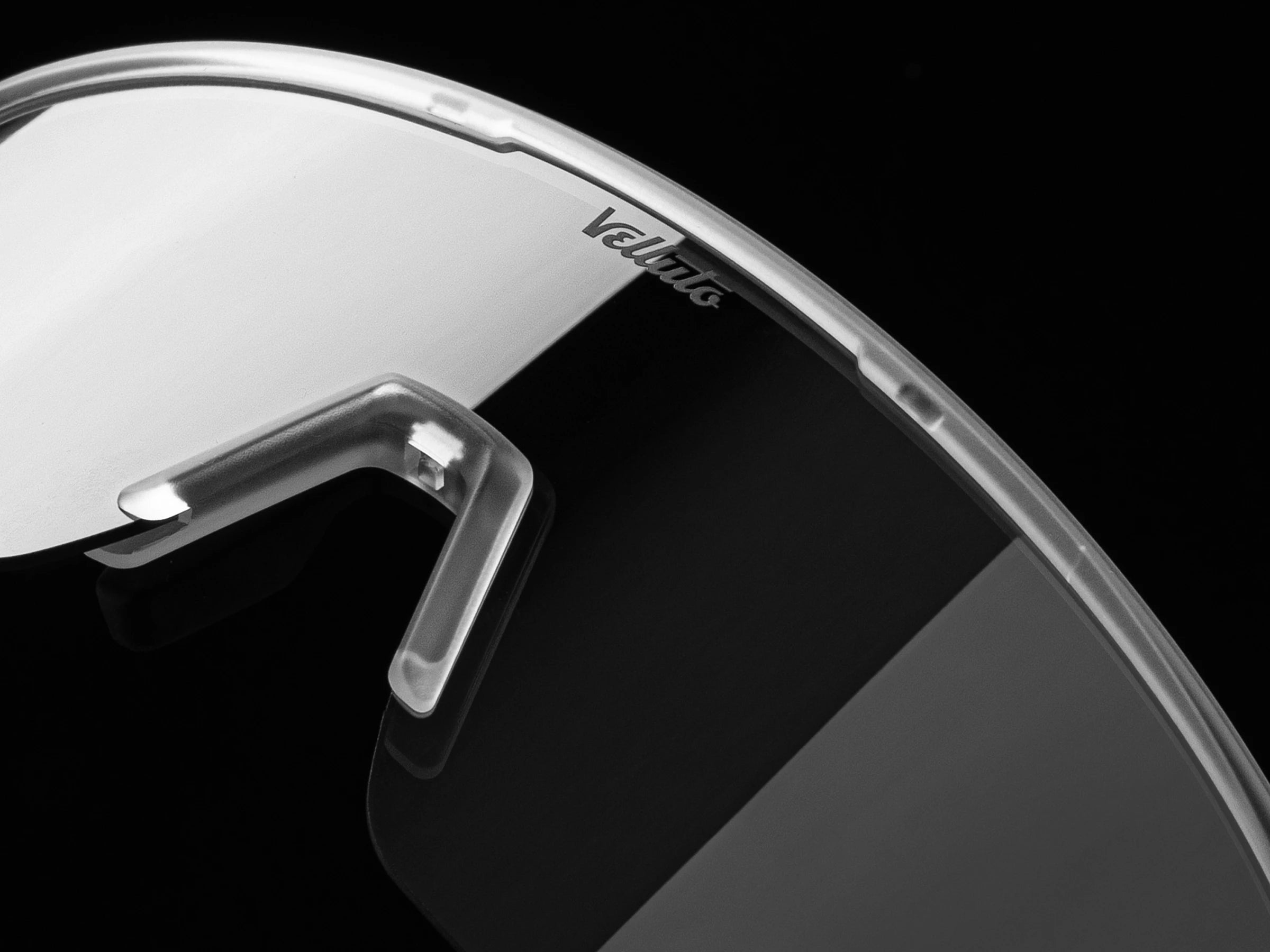
A photochromic lens removes the tint decision from your hands and handles it automatically. The lens darkens in bright light and clears in shadow, so as you move between forest and open terrain, the lens follows. The Velluto Chromo uses a photochromic lens that becomes clear in low light and darkens (with a mirrored finish) in bright sun. For an autumn gravel ride with frequent light changes, this is a practical solution because the lens adapts automatically without manual intervention. The trade-off is a single fixed lens with no option to manually override the tint if conditions do not match what the chemistry expects.
The interchangeable-lens approach of the StradaPro sits between manual and automatic: you choose your lens before the ride based on the forecast and the route, and if conditions change dramatically, you swap in seconds without tools. This gives you deliberate control rather than automatic adaptation, which some riders prefer precisely because they want to choose rather than have the lens choose for them.

06 · Comparing your optionsBest gravel bike sunglasses in 2026: a structured look
Before the Velluto options, it helps to understand the field. The gravel eyewear market in 2026 includes a wide range of products at different price points, lens technologies and fit philosophies. The brands most commonly discussed among European gravel riders include Oakley, POC, Julbo, Smith and Alba Optics, alongside a growing number of European direct-to-consumer brands. Each takes a different approach to the light-change problem that defines autumn gravel.
Some brands at the premium end of the market offer large-format lenses and extensive colour options, each with different design philosophies and price positioning. Others focus on sports-performance optics, with lens technology oriented toward contrast enhancement or photochromic adaptation. Direct-to-consumer brands have brought lightweight, technically capable options to the market at a range of price points.
The table below sets out the key gravel-relevant specifications for the Velluto StradaPro alongside the general category profile, using only specifications that are publicly documented. Where a competitor specification is not confirmed from official sources, the table notes this rather than estimating.
| Feature | Velluto StradaPro | Premium road/gravel brands (general category) | Velluto Chromo |
|---|---|---|---|
| Frame weight | 25 g | Typically 25 to 40 g (see manufacturer) | See Chromo page |
| UV protection | UV400 certified | UV400 (most premium brands) | UV400 certified |
| Lens type | Interchangeable (clear + high contrast) | Varies: fixed, interchangeable or photochromic | Photochromic, mirrored in sun |
| Anti-fog | Built-in anti-fog system | Varies by model | See Chromo page |
| Nose pad | Adjustable | Varies by model | See Chromo page |
| Trial policy | 30-day risk-free trial | See each brand | 30-day risk-free trial |
| Price | from 69 EUR | Wide range across the category | 119 EUR |
A few notes on reading this table honestly. The premium road and gravel category is broad and the specifications vary enormously within it: some brands at the high end offer excellent interchangeable-lens systems and genuine anti-fog performance, while others at similar price points deliver mainly brand recognition. The table is a starting framework, not a verdict. Use it as a prompt for the specific questions to ask about any frame you are considering, then verify the answers from the manufacturer's own documentation.
07 · Velluto options for gravel ridersStradaPro and Chromo: which fits your riding?
Velluto makes two products directly relevant to gravel riders. They solve the light-change problem differently, and the right choice depends on how you prefer to manage that problem on the trail.
The Velluto StradaPro is a 25-gram frame with adjustable nose pads, a built-in anti-fog system, and UV400-certified interchangeable lenses. The two lenses in the system, the VellutoPuro clear lens and the VellutoVisione high-contrast lens, click in and out without tools. Before a gravel ride, you choose the lens that fits the forecast: clear for overcast or low-light routes, high-contrast for forest trails where you need to read the surface clearly. If conditions change dramatically mid-ride, you can swap in seconds.
This is a deliberate, manual system. You make the call, not the lens. For riders who like to control their kit, this is exactly right. For riders who want to eliminate that decision entirely and trust the lens to handle whatever the autumn light throws at them, the Chromo is the answer.
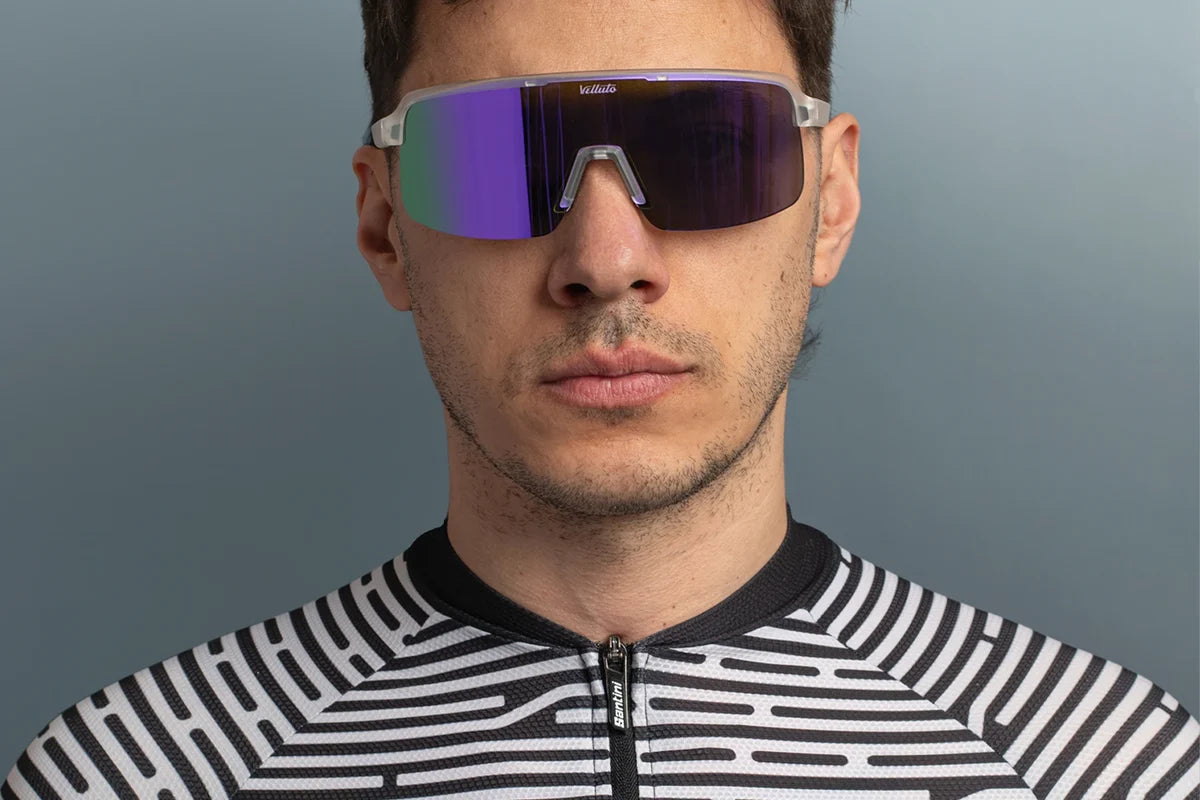
The Velluto Chromo is Velluto's photochromic model. Its single lens adapts to the light as you ride: it sits clear in low light and darkens with a mirrored finish in bright sun. On an autumn gravel ride that moves between dappled forest and open field, this adaptation happens without any action from you. There is no stopping, no lens removal, no decision to make. The Chromo is available in four colourways (Nero Fumo, Nero Fuoco, Bianco Lago and Bianco Viola) and carries UV400 protection.
The StradaPro and the Chromo are different tools for different preferences, each solving the autumn light problem in a distinct way. A rider who plans routes carefully and prefers to dial in every piece of kit in advance will likely prefer the StradaPro's deliberate two-lens system. A rider who improvises, changes plans mid-ride, or simply wants one fewer decision to make will likely prefer the Chromo's automatic adaptation. Both are legitimate approaches to the autumn gravel light problem.

08 · The Velluto StradaProSpecifications, colourways and what comes in the kit
The StradaPro is Velluto's core road and gravel eyewear. It is designed in Italy and sold across Europe, combining Italian design aesthetics with functional specifications oriented toward real riding conditions rather than marketing benchmarks.
At 25 grams, the StradaPro delivers a lightweight frame designed to minimise vibration and movement on rough terrain. The adjustable nose pads allow you to position the frame precisely against your nose, which matters both for comfort on long gravel rides and for keeping the lens in the correct position relative to your eyes and the trail surface. The built-in anti-fog system keeps the lens clear across the speed range that gravel riding covers, from a fast descent to a slow technical climb.
The VellutoPuro lens provides clear, distortion-free vision with UV400 protection and anti-fog performance: it is the lens you reach for on overcast autumn days, early morning starts, or routes that are predominantly shaded. The VellutoVisione lens adds the brand's high-contrast technology, sharpening the visual definition of surfaces and textures in the mixed light conditions typical of autumn gravel. Both lenses click in and out of the StradaPro frame without tools.
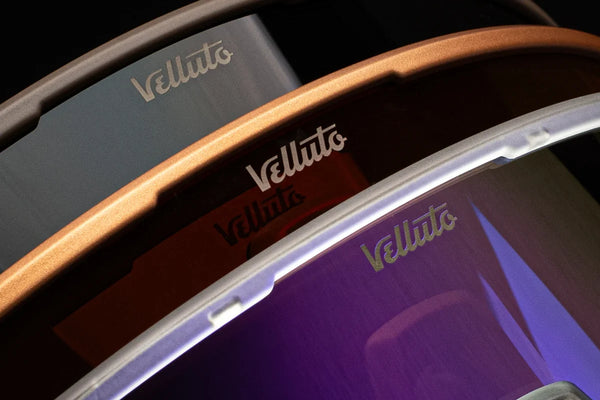
The StradaPro is available in four colourways: Arancia (orange), Espresso (brown), Nero (black) and Viola (purple). The functional specification is identical across all four; the choice is aesthetic.


09 · The Velluto ChromoPhotochromic for riders who want automatic adaptation
If the two-lens interchangeable system of the StradaPro requires more pre-ride planning than your riding style accommodates, the Velluto Chromo offers a different philosophy. One lens, no swapping, no decision mid-ride. The photochromic lens adapts to the ambient light as you ride: clear in the shade of a forest descent, mirrored and darkened in the open October sun of a plateau climb.
For autumn gravel specifically, this is a persuasive proposition. The light changes on a two-hour October route in the Netherlands, Germany or Belgium are not gradual. They are abrupt: you round a corner and the world goes from deep shade to full sun in a single second. A lens that tracks those changes continuously, without any action required from you, keeps your focus on the trail rather than on your kit.
The Chromo launched in October 2026 and is available in four colourways: Nero Fumo, Nero Fuoco, Bianco Lago and Bianco Viola. It carries UV400 protection and is priced at 119 EUR. Further specifications, including detailed lens performance information, are on the Chromo page.
From now until 30 November 2026, Velluto is running a 2-for-1 offer on the Chromo: the second pair is free, and the two pairs do not have to be the same colourway. All other conditions are detailed on the Velluto Chromo page.
10 · Accessories worth consideringCleaning and protection for gravel conditions
Gravel riding accelerates lens wear in one specific way: dust and grit contaminate the lens surface faster than on a clean road, and the instinct to wipe the lens dry is the single most common cause of scratches. Dry-wiping a lens coated in fine grit is essentially sanding it. The correct sequence is always to rinse first, then wipe, then dry. This is worth building into your post-ride habit now, before the lens shows the consequences.
Velluto's Cleaning Spray is a 50 ml, apple-fragranced, refillable spray made in Germany, designed to be safe for coated cycling lenses. The refillable design keeps ongoing cost low; the 50 ml bottle fits easily in a jersey pocket for mid-ride use when a water rinse is not available. Paired with the Velluto Microfibre Cleaning Cloth (25 x 25 cm, 80% polyester and 20% polyamide), it provides the full cleaning kit needed to maintain lens optical quality through a season of gravel riding.

The Velluto Hard Case is also worth noting for gravel riders who transport their glasses loose in a bag. It has an anti-crash guarantee and a velvet interior finish, and it fits all Velluto road cycling glasses. A damaged lens on the morning of a long gravel ride is an avoidable frustration.
11 · How to fit your cycling glasses for gravelA quick five-step check
Fit matters more on gravel than on any other surface, because vibration and variable speed make a poorly fitted frame work against you throughout the ride. The following check takes under two minutes and catches the most common fit problems before they become trail problems.
- Check the nose pad position. The frame should sit level and stable on your nose with zero pressure on the nose bridge. If there is any pain or red marks after five minutes, adjust the nose pad inward or outward until the frame rests with even, gentle contact across both pads.
- Check the eye clearance. Your eyelashes should not touch the lens when you blink. If they do, the frame is either sitting too close to your face or the nose pads need adjusting to move it back slightly.
- Check the wrap coverage. Look at the gap between the lens edge and your temple. There should be minimal space visible: if you can see clearly around the lens edge, dust and spray will find that gap on the trail.
- Add your helmet. Put the helmet on over the glasses and check that the arms sit inside the straps cleanly without being pushed forward or lifted. Any pressure from the straps on the arms will change your fit geometry.
- Shake your head. Nod forward, shake left and right. The frame should not move more than a millimetre in any direction. If it shifts, return to the nose pad and repeat step one.
Five steps, under two minutes, done before every first outing with a new frame. It is faster than fixing the fit issue on the trail at kilometre forty.
12 · Who should buy whichMatching the frame to your gravel style
Rather than declaring one option superior, here is a straightforward match between rider type and product, based on the actual differences between the two options.
The StradaPro suits you if: you plan your routes in advance and like to choose your lens based on the forecast. You prefer deliberate control over your kit. You do a mix of road and gravel riding and want a single frame that handles both with different lenses. You ride with a partner who might also want their own pair of the same glasses in a different colourway. You value the 30-day trial as a way to test the fit and anti-fog performance on real rides before committing.
The Chromo suits you if: you improvise routes and conditions, or your routes change light conditions so frequently and abruptly that stopping to swap lenses is not practical. You prefer the simplicity of a single lens that manages itself. You are riding through autumn and early winter specifically, where the photochromic lens's ability to track rapidly changing light is most useful. You want the mirrored aesthetic in sun combined with a clear lens in shade, all in a single frame.
Both options include UV400 protection. Both are Velluto products with the same 30-day risk-free trial. The decision is about system preference, not quality.

Compare the full lineup in the Velluto StradaPro cycling glasses collection.
13 · FAQFrequently Asked Questions
What makes gravel bike sunglasses different from road cycling glasses?
Gravel riding introduces more variables than a smooth road circuit: loose dust and grit thrown up from the trail, wider coverage needed around the temples, stronger vibration that can shift a poorly fitted frame, and frequent light changes as you move between open fields and tree canopy. Good gravel glasses combine a secure, stable fit with anti-fog ventilation for the slower climbs that gravel routes often include, and ideally offer lens flexibility so you can adapt to shifting autumn light without stopping.
Do I need UV400 protection for gravel riding?
Yes, and perhaps more so than on a fast road loop. Gravel routes often cross open terrain where you are exposed to direct and reflected UV for long periods, and the slower pace means longer total time in the saddle. UV400 means the lens blocks 100% of UVA and UVB radiation, which is the standard you should look for regardless of lens tint.
What is the best lens for gravel riding in autumn?
Two approaches work well for autumn gravel. A high-contrast lens such as the VellutoVisione sharpens the definition of roots, ruts and loose gravel under the filtered light typical of tree-lined trails. A photochromic lens such as the Velluto Chromo adapts automatically as you move between shade and open sky, so you never need to stop and swap. If your route is predominantly shaded, a clear lens like the VellutoPuro also provides full UV400 protection while maximising light transmission.
How important is anti-fog performance for gravel rides?
Very important, particularly on technical climbs where your effort level is high and airflow is low. A fogged lens at 5 km/h on a muddy descent is a real safety issue. Look for a built-in anti-fog system in the frame or lens rather than relying on ventilation slots alone, because ventilation depends on speed and stops working the moment you do.
Will the Velluto StradaPro stay on during rough gravel descents?
The StradaPro weighs 25 grams and uses adjustable nose pads to create a customised fit against your face. On rough ground, the lower the frame weight and the more precisely it sits against your nose, the less it bounces. The adjustable nose pads let you dial in the contact point so the frame does not shift when the trail does.
What is the difference between the Velluto StradaPro and the Velluto Chromo for gravel?
The StradaPro is a two-lens interchangeable system: you carry the VellutoPuro clear lens and the VellutoVisione high-contrast lens and click between them in seconds without tools. The Chromo is a single photochromic lens that adapts to the light automatically, darkening in bright sun and becoming clearer in shade. The StradaPro gives you manual control; the Chromo gives you automatic adaptation. Both carry UV400 protection.
Can I use cycling glasses with a gravel helmet?
Most modern gravel helmets have a longer rear coverage and some include a visor. The key check is that the arms of the glasses fit inside the helmet straps without being pushed forward or lifted. A lightweight, low-profile frame helps here. Try the combination before your ride rather than finding out on the trail.
What is the Velluto 30-day trial and how does it apply to gravel riders?
Velluto offers a 30-day risk-free trial on its glasses, which means you can ride them on real gravel routes, in real autumn weather, and return them if they do not work for you. For gravel riders who need to test fit and anti-fog performance in the field before committing, this removes the main barrier to buying online.
How do I clean gravel dust and mud off cycling glasses without scratching the lens?
Rinse the lens with water first to float off grit before wiping, since dry-wiping mud or dust is the most common cause of lens scratches. Then use a clean microfibre cloth and, if needed, a lens-safe cleaning spray. Velluto's Cleaning Spray is 50 ml, apple-fragranced and refillable, made in Germany, and is safe for coated cycling lenses. The pairing of spray and microfibre cloth is the correct post-ride cleaning sequence for any coated lens.
If you are ready to choose, the full range of Velluto road and gravel eyewear is at velluto-shop.com, including the StradaPro with its two click-in lenses and the Velluto Chromo for riders who want a photochromic option for autumn. Both come with a 30-day risk-free trial, which means your next gravel ride is the real test.