Oakley Alternatives for Road Cycling: What to Know in 2026
Contents22 min read
You are standing at the start line of a November cyclocross race, mud still on your shoes from the warm-up lap, light flat and grey overhead. You reach for your glasses and you pause, because the ones on your face cost more than your first training wheel and you are not entirely sure they justify it anymore. That pause is what this guide is for.
The question of Oakley alternatives for road cyclists is not really about Oakley. It is about you: a serious rider who has moved past entry-level eyewear, who understands what UV400 certification actually means, who has experienced fogging at the top of a climb and knows exactly how much it matters. You are not looking for a cheap substitute. You are looking for the same optical performance, the same precision fit, without the portion of the retail price that reflects decades of marketing spend rather than grams of engineering.
This guide works through what genuinely matters in performance cycling eyewear, where the real alternatives sit in 2026, and why a German brand built on Italian design principles has built a credible case for the top of that list. No invented test scores, no fabricated rider testimonials. Just verified specs and honest buying criteria.
01 · Short answerThe TL;DR for Serious Riders
If you want a direct answer before reading further: yes, genuine Oakley alternatives exist in 2026. They match or exceed Oakley's core optical benchmarks (UV400 certification, anti-fog capability, interchangeable lens systems) and they do so at meaningfully lower price points. The difference is business model: Oakley operates a multi-channel retail network with associated distribution costs. Velluto uses a direct-to-consumer model that removes those margins from the price.
The specific alternative we recommend most confidently for road and cyclocross conditions is the Velluto StradaPro. It is a 25-gram frame with UV400-certified optics, a built-in anti-fog system, adjustable nose pads, and a tool-free interchangeable lens system compatible with two optically distinct lenses. It comes with a 30-day risk-free trial. We will return to it throughout this guide with the specific criteria that justify that recommendation, not just the price.
If you are specifically looking for a photochromic lens that adapts as conditions change, Velluto also offers the Chromo, a dedicated self-tinting model launching October 2026. We cover that separately below. For most road riders, the two-lens interchangeable system of the StradaPro gives you more control and optical certainty than a single adaptive lens.
02 · CriteriaWhat Actually Matters in Performance Cycling Eyewear
Before comparing any two frames, you need a shared set of criteria. The cycling eyewear market is full of well-designed marketing and inconsistently applied specs. Here is what experienced riders and optical engineers agree on as the essential benchmarks.
Not UV protection. UV400 certification. The difference is measurable: UV400 means 100% of UVA and UVB radiation is blocked, defined as wavelengths up to 400 nanometres. Many frames claim protection without publishing the certification. If a brand does not publish its UV rating, treat it as unknown. At road cycling speeds, your eyes receive sustained UV exposure across multiple hours of riding.
Anti-fog is the most common failure point in cycling eyewear and the most common marketing overclaim. A lens that fogs on a cold descent, or when you stop pedalling abruptly after a hard effort, creates a genuine safety issue. Look for structural anti-fog systems built into the frame and lens geometry, not spray coatings that degrade after a few washes.
A single-tint lens is a liability in variable conditions. Autumn riding in northern Europe means you will encounter bright intervals, overcast grey, woodland shadows, and tunnel underpasses on the same two-hour ride. Either an interchangeable lens system or a photochromic lens is non-negotiable at this level. The question is which approach suits your riding style better.
Frame weight matters over distance, not over ten minutes in a shop. A 35-gram frame that sits incorrectly under a helmet creates a pressure point that will distract you on hour three of a sportive. 25 grams with adjustable nose pads and a geometry designed for road helmet compatibility is a different experience entirely. Fit stability at speed, specifically how well the frame resists slipping forward under vibration, is a function of nose pad design and temple arm geometry.
03 · The marketWhere Performance Cycling Eyewear Sits in 2026
The cycling eyewear market in 2026 sits broadly across three tiers. At the entry level, frames from Asian volume manufacturers offer basic UV protection and simple aesthetics. These are not the alternatives we are discussing. At the premium heritage tier, brands like Oakley, Rudy Project, and POC command prices in the range of 150 EUR to 350 EUR or more, with the retail price reflecting not just optical engineering but significant investments in athlete sponsorship, global distribution networks, and brand marketing. In between, a newer generation of direct-to-consumer European performance brands has emerged, building frames to the same optical specification but removing the distribution and marketing overhead from the price.
This is the tier where the most interesting value exists for the serious rider. These are not budget brands. They are performance brands with a leaner commercial model. The optical certification is identical, the materials are comparable, and the design philosophy is informed by real road cycling ergonomics rather than lifestyle marketing.
What distinguishes the credible options in this middle tier from generic alternatives is verifiable specification. UV400 certification is binary: either a brand publishes it and it is documented, or it does not. Anti-fog systems are either structural (built into the lens and frame geometry) or coating-based (applied and degradable). Interchangeable lens systems either use a tool-free mechanism that works under real conditions or they do not. These are testable, concrete claims. That is the standard this guide applies.

04 · Velluto positioningWhy Velluto Is a Credible Oakley Alternative, Not a Discount Brand
This distinction matters. A discount brand takes a known product, removes quality to hit a price point, and sells on that number. A credible alternative removes cost from the supply chain, not from the product. Velluto is a German brand built on Italian design and optical principles. The Italian design element is not a marketing phrase here. The lens geometry, frame ergonomics, and nose pad engineering are developed through Italian optical craft traditions applied specifically to road cycling performance.
The StradaPro's headline numbers are worth stating plainly: 25 grams of frame weight, UV400 certified optics blocking 100% of UVA and UVB radiation, a built-in anti-fog system (structural, not coating-based), adjustable nose pads for a stable, pressure-free fit across different face geometries, and an interchangeable lens system compatible with two optically distinct lenses via a tool-free click-in mechanism.
Oakley's Jawbreaker and Sutro both offer UV400 protection and interchangeable lens systems. They are well-engineered frames with a multi-channel retail model. Velluto's StradaPro matches those optical benchmarks through a direct-to-consumer supply chain, which reflects in the entry price.
The VellutoVisione lens is the specific element that positions the StradaPro closest to Oakley's high-contrast lens technology. VellutoVisione uses contrast-enhancement technology to sharpen the visual definition of surface textures, depth cues, and road hazards. For a rider navigating an autumn cyclocross course with wet roots, loose gravel transitions, and mud ruts, that is not an aesthetic feature. It is an optical tool that improves your read of the terrain in front of you.
Performance eyewear should sharpen what you see at speed, not simply reduce how much light reaches your eye. That distinction is where lens design diverges between truly functional cycling optics and fashion-forward frames that happen to be worn on a bike.Velluto Design Brief, Italian Optical Studio
05 · Lens systemsInterchangeable vs Photochromic: Which Approach Wins for Road Cyclists
This is the question that surfaces most often when serious riders compare performance eyewear options in 2026, and the answer is more nuanced than most comparison articles allow. Both approaches solve the same problem (changing light conditions during a single ride) through fundamentally different mechanisms. Understanding the trade-off is the most useful thing this guide can offer.
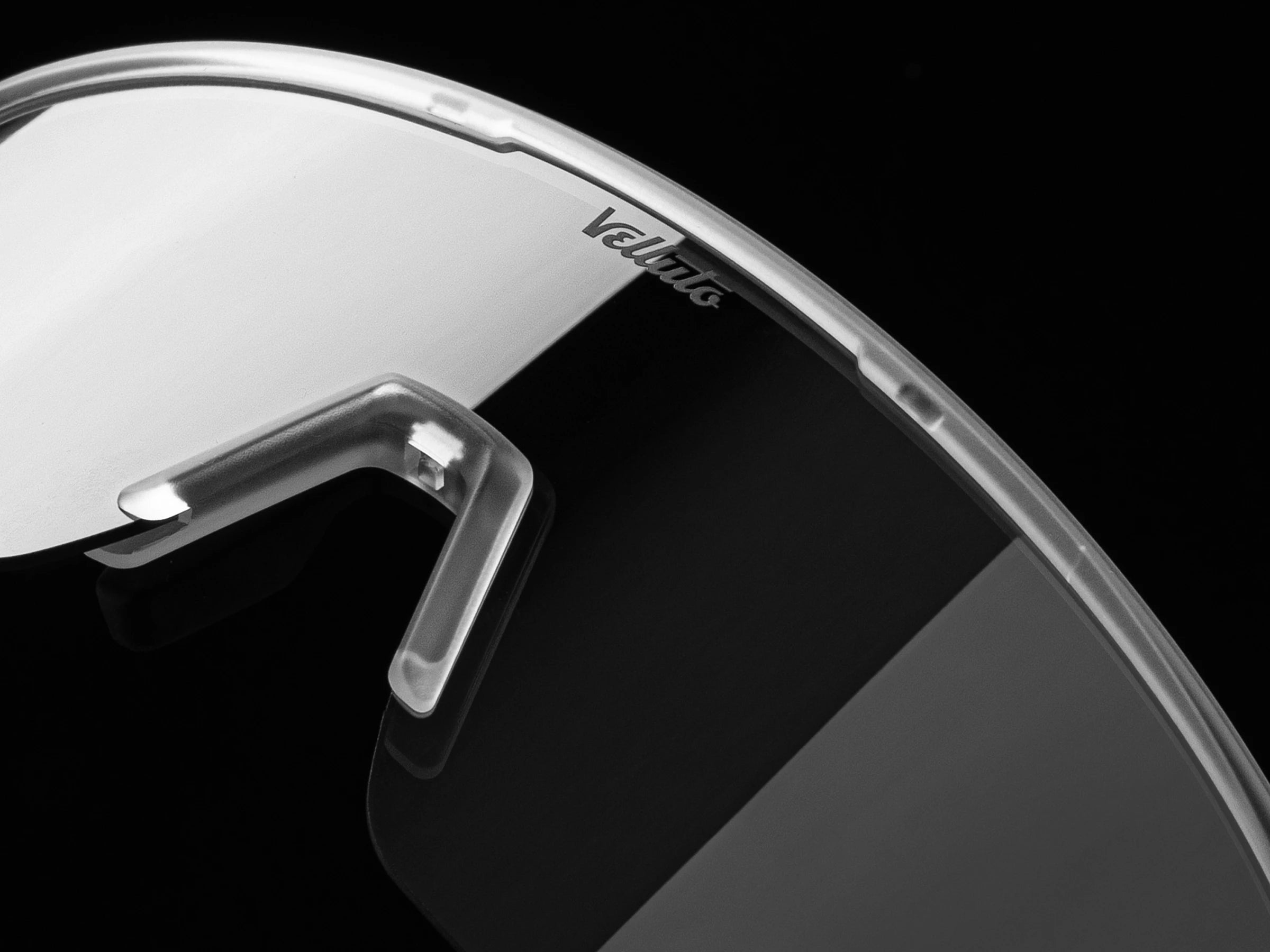
A photochromic lens adapts its tint in response to UV intensity. In practice, this means the lens darkens outdoors and lightens indoors or in shade. For a rider who prefers the simplicity of one lens and is comfortable with the adaptation cycle, it is a genuinely elegant solution. The Velluto Chromo is exactly this: a self-tinting lens that moves from clear in low light to a darkened, mirrored finish in bright sun. It is designed for riders who want that adaptability without managing two separate lenses.
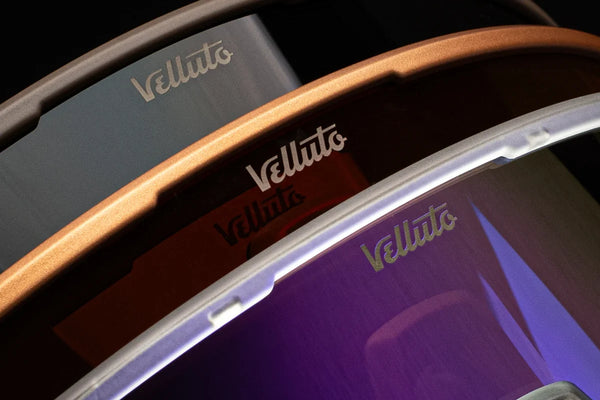
An interchangeable lens system takes the opposite approach. Rather than adapting, it gives you two purpose-built lenses optimised for distinct conditions. The VellutoPuro clear lens is engineered for low-light conditions: early morning rides, woodland trails, overcast autumn days, and tunnels. It provides maximum light transmission while protecting against wind and insects. The VellutoVisione high-contrast lens is designed for variable and mixed-light conditions where contrast enhancement improves terrain reading. You swap between them in seconds using the tool-free click-in system.
The case for interchangeable lenses over photochromic for serious road cyclists comes down to optical certainty. A photochromic lens is always in transition between states. At the point of maximal adaptation, it performs as designed. In the moment of transition, your eye is managing a moving variable. For a rider navigating a fast descent into a shadowed valley, or coming out of a tunnel into bright light, that transition is happening at exactly the moment when optical clarity matters most. With an interchangeable system, you have already chosen your lens for the conditions. The optics are static, optimised, and predictable.
Neither approach is universally superior. If your rides are consistent in light conditions (long early-morning roads, indoor-to-outdoor transitions), the Chromo's adaptability is genuinely useful. If your rides involve rapid, unpredictable light transitions (autumn cyclocross, mixed-terrain sportives, variable cloud cover), the two-lens system's optical certainty is an advantage. The StradaPro gives you that certainty; the Chromo gives you adaptability. Both are from the same brand, with the same UV400 certification and Italian design principles.

06 · ScenariosReal-World Riding Conditions and Which Lens System Answers Each
Abstract criteria are only useful when they connect to actual riding situations. Here are five specific scenarios drawn from autumn and winter cycling in northern Europe, with an honest assessment of which eyewear approach serves each one.
Cyclocross racing in November flat light. Course conditions: wet grass, mud transitions, root sections, tight corners at speed. Light: flat grey-white, no direct sun, minimal shadow variance. The VellutoVisione high-contrast lens is the specific tool for this scenario. Its contrast-enhancement technology sharpens the distinction between wet mud and dry ground, between root surfaces and soil, between the inside and outside of a berm. This is not an aesthetic improvement. At 30 km/h through a technical section, it is the difference between reading the terrain correctly and arriving at a corner with inadequate information.
Winter road training, dawn start, three-hour endurance ride. The first 45 minutes are pre-dawn or early grey light. The final hour catches full morning sun. Temperature differential from start to finish can be 6 to 8 degrees Celsius. This is the scenario where anti-fog performance is most tested. When you ease off the pedals for a feed zone or a junction, your body heat shifts and the lens faces a thermal challenge. The StradaPro's built-in anti-fog system is designed specifically for this: the geometry and ventilation of the frame manage airflow to prevent fogging at the transition between effort and recovery, not just at cruise speed.
Autumn sportive, 120 kilometres with 2,000 metres of climbing. Multiple long climbs with descent intervals. Tunnel underpasses on some alpine routes. Variable cloud cover. This is the scenario where the two-lens system shows its value most clearly. You start with VellutoPuro for the pre-sunrise ascent. You swap to VellutoVisione for the exposed ridge section and the technical descents. The click-in mechanism is designed to work while stopped, with one hand, without tools. The swap takes seconds and you have purpose-built optics for each phase of the ride rather than a single lens compromising in both directions.
Commuting or errand riding in an urban environment, mixed indoor and outdoor transitions. This is the strongest use case for a photochromic lens. If you are moving in and out of buildings, riding in and out of shade, and want a single lens that handles everything without a manual swap, the Velluto Chromo is the more appropriate choice. It is worth being honest about this: the StradaPro's interchangeable system requires you to make a decision and execute a swap. If your rides do not have natural pause points, or you prefer a single lens, the Chromo serves that use case better. Both are genuinely useful. The right one depends on your riding pattern, not on marketing.
Club ride with mixed pace, frequent cafe stop or neutral section interruptions. Here the StradaPro's 25-gram weight and adjustable nose pad geometry pay dividends over five or six hours. A frame that fits precisely under a helmet does not create cumulative fatigue at the bridge of the nose. The adjustable nose pads on the StradaPro mean you can fine-tune the fit to your specific face geometry, not just to the average. That is relevant when you have a helmet strap creating its own pressure on top of the frame's weight.
07 · ProductThe Velluto StradaPro: Specification in Full
Everything above has been framing. Here is the specific product that earns the Oakley alternative recommendation in this guide.

The StradaPro is available in four colourways, each carrying the same optical system. The difference is purely aesthetic: frame colour and accent colour. The lenses (VellutoPuro and VellutoVisione) are compatible across all variants.


08 · ComparisonOakley vs Velluto: A Specification-Level View
What follows is a factual comparison of the two brands on the criteria established in section two of this guide. Every claim in the Velluto column reflects published, verifiable specification. The Oakley column reflects publicly available specification from Oakley's own product pages. Where we cannot verify an Oakley specification with certainty, we have noted that rather than invented a number.
| Criterion | Oakley (Jawbreaker / Sutro) | Velluto StradaPro |
|---|---|---|
| UV Protection | UV400 | UV400 certified |
| Frame weight | Not publicly specified | 25 g |
| Anti-fog system | Ventilation design | Built-in anti-fog system |
| Interchangeable lenses | Yes | Yes |
| Lens options | Multiple tint options available | VellutoPuro (clear) and VellutoVisione (high-contrast) |
| Nose pad adjustment | Not publicly specified | Adjustable nose pads |
| Risk-free trial | See retailer/manufacturer | 30-day risk-free trial |
| Brand origin | American (California) | German brand, Italian design |
| Retail model | Multi-channel retail | Direct-to-consumer |
The table above reflects what can be stated honestly. Where Oakley's specs vary by specific model and lens package, we have directed you to the manufacturer rather than assert a number we cannot verify. Where Velluto's specs are fixed and published, they are stated directly.
The practical implication of the retail model row is worth explaining. Oakley's multi-channel retail model means the brand's frames pass through distributor and retailer margins before reaching the buyer. A direct-to-consumer model, which Velluto uses, means those margins are either removed or returned to the buyer in the form of a lower price, a better specification at the same price, or both. This is not a critique of Oakley's business model. It is a factual description of how retail price architecture works, and it explains why comparable optical performance can exist at different price points.
09 · Autumn and cyclocrossWhy November Is the Best Time to Rethink Your Eyewear
There is a reason this guide is published in November 2026 rather than in June. Autumn and cyclocross season represent the most demanding optical conditions of the cycling year. The light is directionally flat, frequently backlit, and changes character rapidly as cloud cover shifts. Temperature differentials between effort and recovery are at their steepest. Courses are technical, with more varied surfaces than summer road riding. And yet this is the season when many riders are still using the same summer-spec eyewear that served them in July.
Summer eyewear optimised for high-sun conditions, a single tinted lens with high UV absorption, performs poorly in November flat light. It reduces ambient light transmission when you need maximum clarity for technical terrain. It offers no contrast enhancement for the kind of surface-reading that cyclocross and wet road riding demand. And if it lacks a structural anti-fog system, it will fog the moment you stop at a junction after a ten-minute effort.
The riders who perform most consistently through autumn and winter are the ones who match their optical setup to the conditions with the same rigour they apply to tyre choice or clothing layers. That means UV400 certification (still relevant, UV exposure does not disappear in October), contrast enhancement for flat-light terrain reading, anti-fog performance built into the frame structure, and a lens system that lets you adapt to the specific light conditions of the day without carrying multiple pairs.
The StradaPro's VellutoVisione lens is the specific answer to flat-light November contrast. The VellutoPuro clear lens handles the pre-dawn and woodland-shadow sections. The two-lens click-in system means you are carrying both in the same frame, swapping in seconds when conditions change. That is not a feature list. That is a November riding strategy.

10 · The 30-day trialTry Before You Commit: Velluto's 30-Day Ride Guarantee
Performance eyewear has a specific problem as a purchase decision: you cannot evaluate it in a shop. The properties that matter most (anti-fog under exertion, fit stability after two hours in a helmet, optical clarity on a fast descent) are only revealed by real riding. A shop changing room gives you one-minute static comfort and approximate visual clarity. It tells you almost nothing about how the frame will perform on ride number four.
This is the specific gap that Velluto's 30-day risk-free trial is designed to close. Every StradaPro purchase comes with the ability to return within 30 days if the glasses do not perform as described. You ride with them under real conditions: autumn roads, club rides, cyclocross, whatever your November schedule looks like. If the anti-fog system does not hold up on a cold climb, or the fit does not stay stable under your helmet geometry, or the VellutoVisione lens does not deliver the contrast enhancement described here, you return them.
This is a commercial differentiator that is worth naming plainly. No major cycling eyewear retailer offers a 30-day on-road trial for a performance frame. The standard industry model is in-store return only, within a fixed window, without the product having been used. Velluto's trial is the opposite: it assumes you will use the glasses, and it backs the product against that use. For a category where in-store evaluation is structurally inadequate, that is a meaningful signal of product confidence.
Free shipping applies to orders over 89 EUR. For the StradaPro, that threshold typically applies when purchasing with a lens or accessory addition. Orders under that amount still ship, with standard shipping costs applying.
11 · The Chromo optionIf You Want Photochromic: Velluto's Autumn Answer
Not every rider wants to manage two lenses. If your autumn riding is primarily on consistent terrain, your routes do not include rapid light transitions, and you prefer the simplicity of a single lens that handles variable conditions on its own, the photochromic approach is a legitimate choice.
The Velluto Chromo, launching October 2026, is the brand's dedicated photochromic model. Its lens is self-tinting: it starts clear in low light and darkens (with a mirrored finish) in bright sun. It is a structurally different product from the StradaPro. It is not an add-on lens for the StradaPro system. It is a separate frame with its own lens architecture, designed for riders who want adaptability in a single lens rather than optical certainty across two.
The Chromo is available in four colourways (Nero Fumo, Nero Fuoco, Bianco Lago, Bianco Viola) and carries UV400 protection in line with the rest of the Velluto range. Full product details, including the colourway specifics and pricing, are at velluto-shop.com/pages/chromo.
The honest framing for the StradaPro versus the Chromo decision is this: the StradaPro is for riders who want to choose their optics deliberately, matching the lens to the known conditions of a specific ride. The Chromo is for riders who want the lens to manage that decision automatically. Both are valid. The right choice depends on how you think about your eyewear as a tool.
12 · AccessoriesCompleting the System: What Else Velluto Offers
Performance eyewear is a system, not just a frame. The long-term optical quality of any cycling lens depends on how well you clean and store it. Two accessories in the Velluto range are worth including in any StradaPro purchase decision.
The Velluto Hard Case is built with an anti-crash guarantee and a velvet interior finish. It fits the StradaPro and all Velluto cycling frames. When you are packing for a road trip, travelling to a race, or simply storing glasses in a kit bag alongside a CO2 inflator and a chain link, the difference between a hard case and a soft pouch is the difference between arriving with intact lenses and arriving with scratched ones.
The Velluto Cleaning Spray is a 50ml, apple-fragranced formula in a refillable bottle, made in Germany. At 50ml it falls within airline carry-on allowances, which matters for riders who travel to events. The refillable format means the bottle is a one-time purchase. It is designed to work with the included microfiber cloth (25x25cm, 80% polyester / 20% polyamide) without leaving streaks or residue on the VellutoPuro or VellutoVisione lenses.
These are not headline products. They are the parts of the system that determine whether a 69 EUR frame still performs optically after six months of regular cleaning, or whether it accumulates micro-scratches from inadequate maintenance. The difference matters more over distance than it does on day one.
Compare the full lineup in the Velluto StradaPro cycling glasses collection.
13 · FAQFrequently Asked Questions
Are Oakley cycling glasses worth the price in 2026?
What makes an Oakley alternative genuinely comparable, not just cheaper?
Does the Velluto StradaPro offer interchangeable lenses like Oakley Jawbreaker?
How does the StradaPro's anti-fog system work in cyclocross conditions?
Is 25 grams actually light for a performance cycling frame?
What is the difference between VellutoPuro and VellutoVisione lenses?
Does Velluto offer a photochromic option as well?
What is Velluto's 30-day trial and how does it work?
Which Velluto frame colour suits cyclocross and autumn riding best?
If you are ready to try the StradaPro under real November conditions, the 30-day ride guarantee means there is no commitment beyond the first ride. Explore the full range, lens options, and accessories at velluto-shop.com.