Cycling Sunglasses for Bugs and Insects: What Works
Contents19 min read
You are holding 45 km/h on a late August descent, the air thick with the end-of-summer haze that every road cyclist recognises from the Vuelta broadcasts, when something small and fast hits you directly in the eye. Not the lens. The eye. Your hand comes off the bar before your brain has processed what happened. That is the real insect problem on the bike, and it has nothing to do with how dark your lenses are.
Cycling sunglasses for bugs and insects is one of those topics that sounds minor until the moment it is not. A gnat at 20 km/h is a nuisance. A wasp at 50 km/h is a genuine safety event. The difference between those two outcomes is almost entirely about one thing: whether your glasses actually cover the part of your eye that needs covering, in the position your head is actually in when you are riding.
This guide explains the geometry of insect protection, what to look for in a frame and lens when shielding against insects is a genuine priority, and what to do in the specific situation when something gets behind the lens mid-ride. There are no gimmicks here. The answer is coverage, proximity to the face, and fit. Everything else follows from that.
01 · Why this mattersWhy Insects Are a Road Cycling Problem Specifically
Insects are present in every outdoor sport, but road cycling creates a particular combination of conditions that makes the problem acute. Speed, head angle, and duration all compound the risk.
At typical road cycling speeds, an insect impact carries enough force to cause immediate eye irritation, reflex tearing, and in the worst cases a corneal scratch. A bee or wasp hit at high speed is not just uncomfortable. It causes an involuntary flinch that can take your attention off the road at exactly the wrong moment. This is not a hypothetical. Sports ophthalmologists regularly treat cyclists who have sustained corneal foreign-body injuries from insects, and the mechanism is almost always the same: a gap between the lens bottom and the cheek, or between the lens edge and the temple.
The head angle matters because most road cyclists spend the majority of their ride time in an aerodynamic position, somewhere between upright on the hoods and low on the drops. When your head tilts forward, the bottom of your eye socket becomes more exposed. Glasses that were designed for an upright position, where the face is vertical, may offer a full seal when you are standing still but leave a gap of several centimetres below the lens when you drop into your riding position. That gap is where insects enter.
Duration matters because a 30-minute commute and a four-hour sportive are not the same exposure. Late summer evening rides, the kind that follow Vuelta stages across warm European roads, put cyclists through prolonged periods of peak insect activity. Flies, gnats, and midges tend to concentrate at road level in calm conditions, which is where your eyes are when you are in a low riding position.
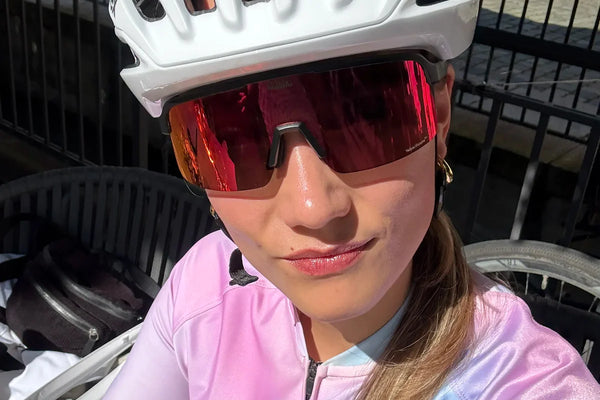
At road cycling speeds, the gap between lens and face matters more than any frame feature. Coverage geometry is the whole answer.Velluto cycling eyewear
02 · The geometryCoverage, Curvature, and the Actual Gap
When cyclists talk about insect protection in glasses, the conversation often drifts toward ventilation, lens colour, or frame weight. These are real considerations for other reasons, but they are secondary when the priority is keeping small objects out of your eyes. The primary factors are vertical lens height, face-form curvature, and the distance between the lens and your skin.
Vertical lens height is the measurement from the top of the lens to the bottom. A taller lens covers more of the exposed eye area above and below the lid. In practical terms, a lens should reach from just above the eyebrow line to the upper cheekbone when your head is in your normal riding position, not when you are standing upright looking at your reflection. The distinction matters because the two positions are different by as much as 15 to 20 degrees, and that changes which part of the eye is exposed.
Face-form curvature refers to the degree to which the lens wraps around the side of the face. A flat lens sits like a window in front of your eyes. A curved lens follows the contour of your face, closing the gap at the temples. For insect protection, a face-form curve of eight degrees or more is generally sufficient to close the temporal gap at cycling speeds. Below that, air pressure at speed can push the lens slightly away from the face, opening an entry route at the sides.
The distance between the lens and your skin is the factor most often overlooked in buying decisions. You can have a tall lens with strong curvature and still have a 10-millimetre gap between the bottom of the lens and your cheek if the nose pads are set too high or if the frame was designed for a different face shape. Adjustable nose pads are not a comfort luxury. For insect protection, they are functional. They let you move the entire frame up or down until the lens sits at the correct height for your specific face geometry.

03 · Frame shapesWhich Frame Shapes Offer the Best Insect Coverage
Not all cycling glasses are built for the same use case, and frame shape is the clearest indicator of whether a pair will protect you from insects or simply shade your eyes.
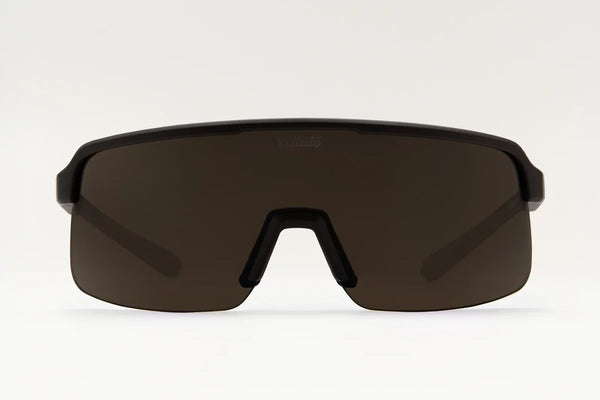
Wraparound single-lens frames are the strongest performers for insect protection. A single continuous lens with no frame break across the front provides maximum coverage without structural gaps. The lens itself acts as a shield across the entire visual field, and there is no nose bridge gap that could create an entry point for small insects approaching from directly ahead.
Two-lens frames with a connecting bridge offer slightly less coverage at the centre of the face, where the bridge meets the nose, but in practice this gap is small and well below the eye line. The bigger variable with two-lens frames is whether each individual lens is tall enough, since lens size on two-lens designs is sometimes reduced to keep the frame looking less overtly sporty.
Half-frame and rimless designs, while popular for their minimal weight and clean aesthetics, generally offer reduced insect protection. The absence of a lower rim means the lens is often smaller and positioned higher, increasing the gap between the bottom of the lens and the cheekbone. For short rides or urban cycling, this trade-off is reasonable. For long summer sportives through insect-active countryside, the full wraparound lens design is the better choice.
Shields, which are large single-piece lenses that cover from above the eyebrow to the cheekbone and wrap fully around both eyes, offer the most complete insect coverage available in cycling eyewear. Some riders find the visual field narrowing at the extreme periphery slightly disorienting, but for pure protection, shields are hard to beat.
04 · Lens choiceClear or Tinted: Which Lens Is Right for Insect Season
Lens colour has no effect on whether an insect hits your eye. A dark lens does not repel insects, and a clear lens does not attract them. This distinction is worth stating clearly because it sometimes influences buying decisions in ways that do not serve the actual problem.
What lens choice does affect in insect conditions is visibility and timing. Insects are disproportionately active at dawn, dusk, and in overcast conditions when light levels are low. These are exactly the conditions where a heavily tinted lens reduces your ability to see road hazards ahead, including insect swarms at road level, which can appear as a low dark cloud across a country road.
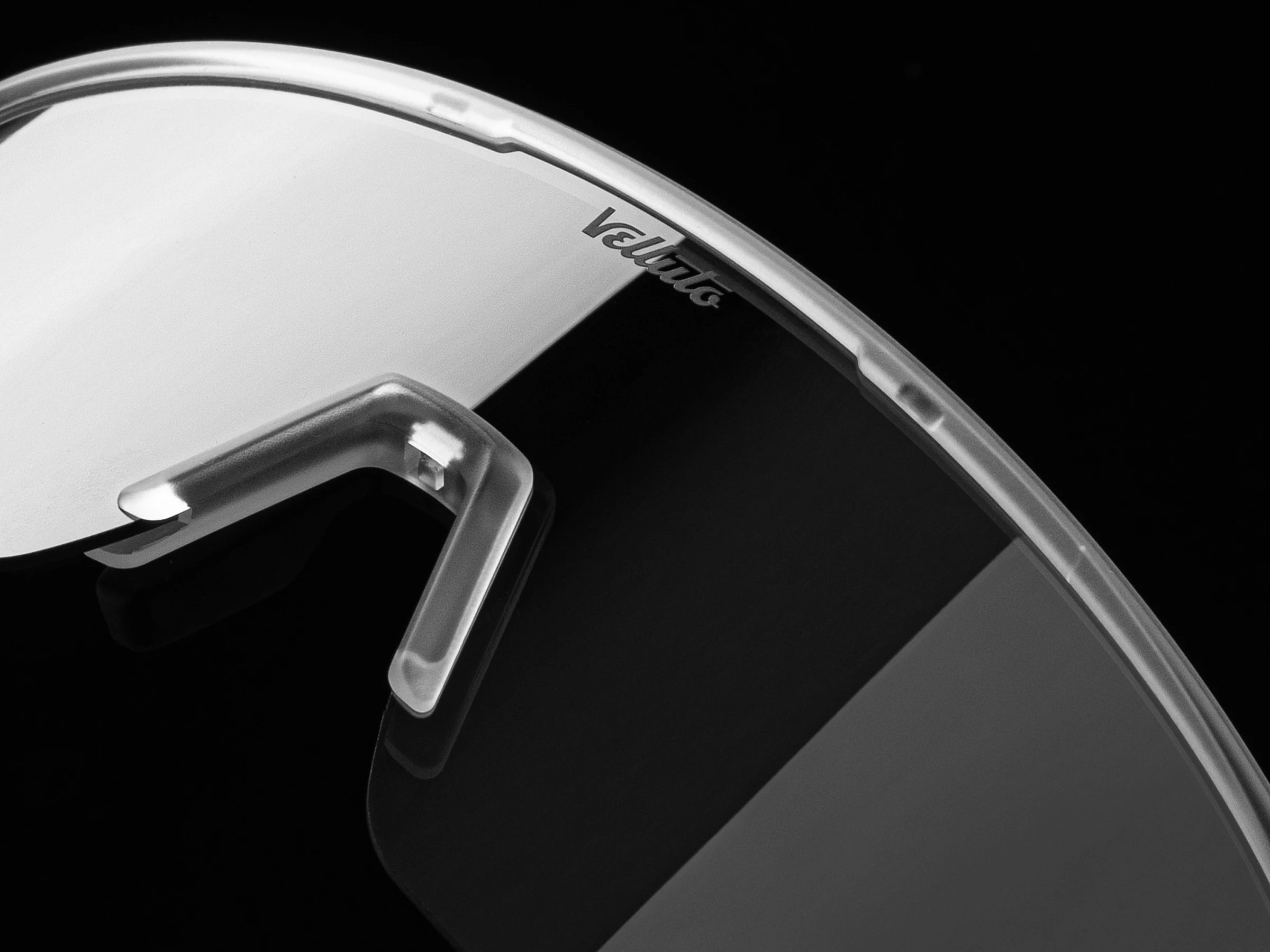
A clear lens, like the VellutoPuro, gives you full light transmission in low-light conditions while maintaining the physical coverage and UV400 protection that the frame provides. If you are riding early morning sportives or evening training loops in late August, a clear lens keeps your vision sharp while the frame geometry does the work of blocking insects from your eyes.
A high-contrast lens, like the VellutoVisione, enhances your ability to detect movement and changes in surface texture ahead. This is particularly useful when riding through areas with dense insect populations, such as country lanes with adjacent fields or river crossings, where being able to spot a swarm 20 metres ahead gives you time to close your mouth and tuck your head slightly. The contrast enhancement does not eliminate the risk but it gives you a second or two of warning that a clear or heavily tinted lens may not provide as clearly.
The practical answer for insect-heavy routes is to carry both options and choose based on light conditions rather than insect density. The VellutoPuro and VellutoVisione lenses are both compatible with the StradaPro frame via the click-in system, and swapping them takes a few seconds at the side of the road. You do not need to carry two pairs of glasses.

05 · Anti-fog and ventilationDoes Ventilation Create Entry Points for Insects
This is a genuine and reasonable concern. Ventilation channels are the only deliberate opening in a well-fitted cycling lens system, and it is fair to ask whether they create a route for insects.
The answer is: minimally, if the ventilation is positioned correctly. The risk comes from frames that have large gaps between the lower edge of the lens and the face. Frame-channel ventilation, where the airflow is managed through channels in the frame rather than across the lens surface itself, reduces the exposed surface area at the lens edge. The airflow is directional and exits at the top of the frame, away from the eye zone.
Anti-fog performance matters here more than it might seem. A fogged lens is a lens you have to lift or remove. The moment you lift the lens away from the face, the seal is broken and every insect within range has access to your eye. Glasses with a built-in anti-fog system stay clearer on climbs and in warm humid conditions without requiring you to break the face seal. This is not a minor convenience. It is a direct contribution to insect protection because it keeps the lens in position throughout the ride.
On long summer rides, glasses fog most consistently on climbs where your speed drops and airflow decreases. If your glasses fog reliably on every long ascent, you are probably riding those climbs with the lens periodically lifted. For insect protection on mixed-terrain routes, anti-fog performance is part of the same system as frame fit.
06 · Emergency protocolWhat to Do When Something Gets Behind the Lens
Even well-fitted glasses with excellent coverage cannot guarantee a 100% seal against every flying object in every condition. Small, fast insects occasionally find entry points through ventilation channels or below the lens during particularly turbulent airflow. Knowing what to do in this situation calmly and safely is as important as choosing the right glasses.
The instinct is to rub the eye. This is the worst response. A small insect body or wing fragment against the cornea will scratch if pressure is applied. The correct protocol has four steps.
First, stop riding. This sounds obvious but it is worth stating explicitly. The reflex to deal with eye irritation while still moving creates a safety risk well beyond the insect itself. Find a safe spot to stop, signal if necessary, and get off or stop the bike before doing anything with your face.
Second, tilt your head slightly forward and gently lift the bottom edge of the lens away from your face. Do not remove the glasses entirely. Tilting forward and opening the lower gap creates a downward exit route for the insect and uses gravity rather than friction. Many small insects will drop out on their own within a few seconds if you do this without touching the eye.
Third, if the insect has not dropped out, blink rapidly several times with your eye open toward the lower gap in the frame. Blinking triggers tear production and the natural flushing action of the eyelid can bring small debris to the inner corner of the eye where it can be removed without touching the eyeball directly.
Fourth, if something is still present after blinking, use a clean microfiber cloth to very gently contact the inner corner of the eye only, not the centre. The inner corner is where debris migrates naturally. Never press directly on the eye surface. If discomfort continues after you have stopped, carry water and rinse the eye from the inner corner outward. If anything feels embedded or if vision is affected, this is a medical situation. Stop the ride.
07 · Lens care afterCleaning Insect Residue Without Damaging the Lens
After a ride through dense insect conditions, the lens will carry residue. How you clean it matters for the lens coating as much as for your next ride's visibility.
The natural instinct is to wipe the lens immediately with whatever fabric is available. This is the fastest route to lens scratching, particularly on anti-fog coated lenses. Insect fragments are small but hard, and smearing them across a lens surface under pressure damages coatings progressively over time.
The correct approach is to let any wet residue dry for 30 to 60 seconds first. Dried debris is more likely to flake off without the adhesive smear effect of wet material. Then use a dedicated microfiber cloth, which has a fibre structure fine enough to lift debris without abrading the coating, rather than dragging it.
For heavier contamination, hold the lens under cool running water before wiping. Water floats the debris off the surface rather than grinding it in. After rinsing, blot gently with the microfiber cloth rather than wiping in strokes.
A purpose-made lens cleaning spray dissolves protein residue, which insect material is largely composed of, more effectively than water alone. A small 50ml bottle fits in a jersey pocket and takes care of the worst post-ride contamination in seconds. If you ride regularly through insect-active conditions in late summer, carrying a cleaning spray and a fresh microfiber cloth is the same category of preparation as carrying a spare tube.

08 · Product recommendationThe StradaPro for Insect-Active Routes
The Velluto StradaPro was designed for road cycling, which means it was shaped around the head angle, airflow conditions, and coverage requirements of riding in an aerodynamic position for extended periods. Those design priorities map directly onto the requirements for effective insect protection.
The lens profile is tall and wraps close to the face across the full width of the visual field. The adjustable nose pads are the feature that makes this relevant for a wide range of face shapes: they let you raise or lower the frame until the lens sits at exactly the right height, closing the gap between the lens bottom and the cheekbone that is responsible for most insect ingress. You set this once and it stays, ride after ride.
At 25 grams, the frame does not create pressure on the nose or temples during long rides, which means you are not tempted to push the glasses up the nose or tilt the frame away from the face to relieve discomfort. A frame that hurts to wear will always end up in a position that compromises coverage, no matter how well it was fitted at the start.
The built-in anti-fog system is relevant here too. On insect-active routes in warm late-summer conditions, climbs create exactly the fogging conditions that cause riders to lift the frame away from the face. An anti-fog system that works consistently means the lens stays in position throughout the ride, including on those long ascents where insects are most dense in the warm air rising off the road.
The VellutoPuro clear lens and VellutoVisione high-contrast lens are both available for the StradaPro via the click-in system, so you can carry the lens appropriate for your light conditions on any given route without carrying a second frame. Both lenses are UV400 certified, blocking 100% of UVA and UVB radiation.


09 · Lens care kitWhat to Carry: The Post-Ride Clean
If insect-active routes are a regular part of your riding calendar, keeping a lens cleaning kit with the bike is the same simple habit as keeping a pump and a spare tube. The lens is a precision-coated optical surface and insect residue, if left and then wiped dry, is abrasive enough to degrade anti-fog coatings over a season.
The Velluto Cleaning Spray is a 50ml apple-fragrance formula made in Germany, sized to fit a jersey pocket or a small saddle bag. It is refillable and safe for coated optics. Combined with the Velluto microfiber cleaning cloth (25x25cm, 80% polyester and 20% polyamide), it provides the combination needed to clean insect residue off anti-fog coated lenses without degrading the coating over time. These are not luxury additions. On an insect-heavy route they are maintenance tools.

Compare the full lineup in the Velluto StradaPro cycling glasses collection.
10 · FAQFrequently Asked Questions
Do cycling sunglasses actually stop insects from hitting your eyes?
What is the most important feature in cycling sunglasses for insect protection?
Can insects still get behind the lens even with wraparound glasses?
Is a clear lens or tinted lens better for insect protection?
Do anti-fog vents make insect protection worse?
What lens height do I need to block insects effectively?
Are cycling sunglasses for bugs and insects different from regular sports sunglasses?
How should I clean my cycling glasses after riding through an insect swarm?
Does the Velluto StradaPro offer good protection against insects?
If insect protection is a genuine priority on your late-summer routes, the answer starts with coverage geometry and ends with fit. Try the StradaPro across 30 days of real riding and see whether it stays where you set it, through climbs, descents, and everything in between. Full details at velluto-shop.com.