Gravel Cycling Glasses: What Actually Works Off-Road
Contents26 min read
You are three hours into a mixed-surface stage, somewhere between a pine forest and an open limestone ridge. The temperature dropped six degrees in the descent, the track surface went from dry dust to wet clay in two kilometres, and a branch you barely saw caught you across the left arm. Your glasses fogged on the way down and you rode the last technical section half-blind. That is not a lens problem. That is a glasses selection problem.
Gravel cycling asks more of your eyewear than road cycling does. That sounds obvious when you say it out loud, but most cyclists still choose their gravel glasses the same way they choose road glasses: by tint preference, brand familiarity, or whatever looked good on the peg in the shop. The result is glasses that perform adequately in one dimension (UV protection, say, or aerodynamics) and fail completely in another (fogging in forest sections, debris entry from the sides, or a nose-pad fit that shifts on rough terrain).
This guide is not about finding the most expensive option or the brand with the biggest marketing budget. It is about understanding what gravel specifically demands of a pair of glasses, and then matching those demands to frame design, lens system and fit mechanics. By the end of it, you will know exactly what to look for and why, whatever frame you ultimately choose.
01 · Gravel DemandsWhy gravel cycling glasses are a different brief from road
Road cycling is, in eyewear terms, a relatively predictable environment. You know the surface quality within a few centimetres of flatness. Wind comes consistently from the front at speed. Light conditions shift slowly. The biggest variables are UV intensity and the occasional insect at 40 km/h.
Gravel cycling rewrites every one of those assumptions. Surface variation means you slow down and speed up constantly, so the aerodynamic wind pressure that normally holds glasses in place on the road is absent for significant portions of a gravel ride. You descend loose gravel tracks at 30 km/h, which means debris is thrown upward and sideways in directions a road frame simply is not designed to intercept. You ride through vegetation. You push through gates. You are, compared to a road rider, close to the environment in a way that changes what your glasses need to do.
Then there is the light environment. Gravel routes are often planned specifically to avoid roads, which means they go through places roads do not: valley floors with canopy cover, exposed moorland, south-facing limestone faces in full afternoon sun, north-facing forest descents where the light is flat and bluish and contrast drops sharply. A single fixed lens tint that is optimal for one of those conditions is suboptimal for all the others. A road cyclist might spend an entire four-hour ride in broadly similar light. A gravel cyclist of the same duration might pass through five or six radically different visual environments.
And then there is temperature. Gravel routes climb to altitude because that is where the unpaved surfaces are. They descend into valley floors because that is how geography works. The temperature differential between a sun-exposed climb at 1,400 metres and a shaded forest descent 400 metres lower can be ten degrees or more. That differential is the direct cause of lens fogging, and it is far more pronounced on gravel than on a road sportive where you stay broadly at one altitude for long sections.

02 · Wrap CoverageWhy wrap-around geometry matters more off-road
The phrase "wrap-around" gets used loosely in cycling eyewear marketing, sometimes to describe almost any lens that curves slightly beyond the temples. For gravel purposes, what you actually need is meaningful peripheral coverage: a lens that extends far enough around the side of the face to close the gap between the frame edge and your cheekbone.
On a smooth road at high speed, the aerodynamic flow around a rider creates a relatively stable air envelope. Debris that would otherwise enter from the side is deflected by that airflow. On gravel at lower speeds, no such envelope exists. Grit and sand thrown up by your front tyre can enter at almost any angle, including from directly below and from the sides. A lens with shallow wrap leaves those angles exposed.
The secondary function of wrap coverage on gravel is wind protection in cooler, more variable conditions. Gravel cyclists frequently stop to check navigation, push through difficult sections, or wait at a gate. In those stationary moments, if the temperature is low, wind-chill becomes a real eye irritation. A closer-fitting, deeper-wrap frame continues to protect when you are not moving, where a shallower road frame might let airflow reach the eye directly.
There is also the vegetation factor. Gravel routes pass through narrow tracks, hedgerows and woodland where low branches are a genuine hazard. A deeper lens profile means that in the event of a branch contact, it is more likely to hit the lens edge than your brow or temple. That is not a guarantee of protection, but it shifts the probability in your favour.
The counterargument against deep wrap has always been ventilation: a lens that sits very close to the face traps warm air exhaled through the nose, which rises and condenses on the inside of the cold lens surface, causing fogging. This is the core engineering tension in gravel eyewear design, and it is why anti-fog is not optional at this level. A frame that solves wrap coverage but ignores ventilation just trades one problem for another.
The engineering tension in gravel eyewear is simple: the more coverage you add, the more you need to solve fogging. You cannot address one without the other.Velluto Design Brief, 2025
03 · Anti-FogThe fogging problem: why it hits gravel riders hardest
Lens fogging is caused by condensation: warm, moist air (from your breath, from your skin) meets a cold lens surface and the water vapour turns to liquid. On a road ride at constant speed, the cooling airflow over the lens keeps its temperature relatively stable. On a gravel ride with repeated sharp transitions between hot climbing and cold descending, the lens surface temperature swings with the ambient temperature and the fogging cycle can repeat several times in a single ride.
Forest sections compound this further. Under canopy, humidity is higher. Air movement is reduced. Your body temperature stays elevated from the climb that got you there. The combination of still air, high humidity and the temperature drop of a north-facing slope is almost guaranteed to produce fogging on a lens without an active anti-fog solution.
The word "anti-fog" in eyewear refers to one of two things: either a coating applied to the lens surface that reduces the surface tension of water droplets and spreads them into a thin, invisible film rather than allowing them to bead, or a ventilation channel built into the frame that creates airflow across the inside of the lens to equalise temperature. Both approaches work. The best frames combine both.
For gravel cycling specifically, the requirement is that the anti-fog system works when you are moving slowly or stationary, not just at road speed. A coating-only solution that relies on airflow to stay effective will fog at low speeds. A purely passive ventilation channel may be adequate for road but insufficient in humid, low-speed gravel conditions. The built-in anti-fog system in the Velluto StradaPro is designed to manage exactly this scenario: clear vision maintained whether you are climbing at 8 km/h or descending at 35 km/h, through the full range of temperature and humidity conditions a gravel route creates.
One practical point that is often overlooked: anti-fog performance degrades with cleaning. Many lenses have anti-fog coatings that are damaged by aggressive wiping or by cleaning sprays containing alcohol or solvents. Using a proper microfibre cloth and a purpose-designed cleaning spray is not a luxury; it is part of maintaining the anti-fog performance of the lens over time.

04 · Lens SystemsInterchangeable versus fixed tint: why gravel changes the answer
On a road bike, the argument for a single fixed tint is stronger than it is often given credit for. If your rides are at consistent times of day, on open roads, the light environment is predictable enough that one lens tint can cover it well. A dark smoke lens for bright conditions, or a light rose lens for variable light. Pick your use case and buy accordingly.
On gravel, that logic breaks down. A gravel ride at 7 am in summer might start in low golden light on a flat track, move into full sun on an open climb by 9 am, pass through a dense beech forest by 11 am, and finish on an exposed plateau in bright early-afternoon light by 1 pm. Those four environments have genuinely different optimal lens requirements. No single fixed tint is the best answer for all of them.
Photochromic lenses attempt to solve this by reacting to UV intensity, darkening in bright light and lightening in low light. They are a legitimate option, and for some riders a photochromic lens that covers most conditions adequately is the right practical choice. The limitation is reaction time and the fact that photochromic response is driven by UV intensity, not overall light level. Under canopy, UV is blocked by the tree cover, so a photochromic lens may stay relatively dark even when the actual light level at ground level is low and you want a clearer lens. In a tunnel or under a bridge, it will not lighten quickly enough to give you instant clarity.
An interchangeable lens system gives you precise, instant control that a photochromic lens cannot match. You decide the lens for the next section based on what you can see ahead, click it in, and ride. There is no waiting for chemistry to react. The limitation, of course, is that you need to carry the spare lens, and swapping takes a moment. A click-in system that works tool-free in seconds reduces that limitation significantly.
For gravel, the most practical setup is a frame that accepts both a clear lens (for pre-dawn starts, forest sections, or overcast mountain routes) and a high-contrast lens (for variable-light conditions where depth perception and surface definition matter most). That combination covers the full range of gravel light environments without the compromises of photochromic chemistry.
05 · Fit on Rough TerrainThe fit mechanics that gravel actually tests
Fit is the dimension of cycling eyewear that is hardest to evaluate from a product page and easiest to underestimate until you are three hours into a rough day in the saddle. On a smooth road, a slightly loose frame is an inconvenience. On a gravel track with surface vibration transmitted through the fork into your head, a slightly loose frame is a constant distraction that becomes intolerable by hour four.
The two contact points that determine gravel fit are the nose bridge and the temples. The nose bridge is where the majority of the frame's weight is carried, and where fit problems express themselves as either slipping (frame too wide or nose pads too low) or pressure marks (frame too narrow or pads too high). Temple grip provides lateral stability and stops the frame from bouncing on rough descents.
Adjustable nose pads are significantly more valuable on gravel than on road for one specific reason: gravel bikes tend to put riders in a slightly more upright position than road bikes, particularly adventure gravel bikes with taller head tubes. That positional difference changes the angle at which the frame sits on the nose. Nose pads that are fixed at a position optimised for a road-bike fit may sit incorrectly for a gravel-bike position, creating a gap under the lens (debris entry point) or excessive downward pressure.
Weight also becomes a more significant variable on rough terrain. A 25-gram frame distributes almost no force at the nose and temples even on vibrating surfaces. A heavier frame amplifies the vibration at every contact point. Over a five-hour gravel ride, that amplification is felt cumulatively in the form of fatigue and irritation that you might not consciously attribute to the glasses but that would disappear if you changed them.
The practical test for gravel fit is not the first fifteen minutes on tarmac; it is the third hour on a rough track when you have sweated through your kit and the frame has warmed to body temperature. Does it still sit in the same position? Do you reach up to adjust it? Does it bounce on steep descents? If the answer to any of those is yes, the fit mechanics are not right for gravel use, regardless of how good the lens is.

06 · Lens Choice by ConditionWhich lens for which gravel condition
The two lens types that cover gravel riding comprehensively are a clear lens and a high-contrast lens. Here is how to think about which to choose for different scenarios.
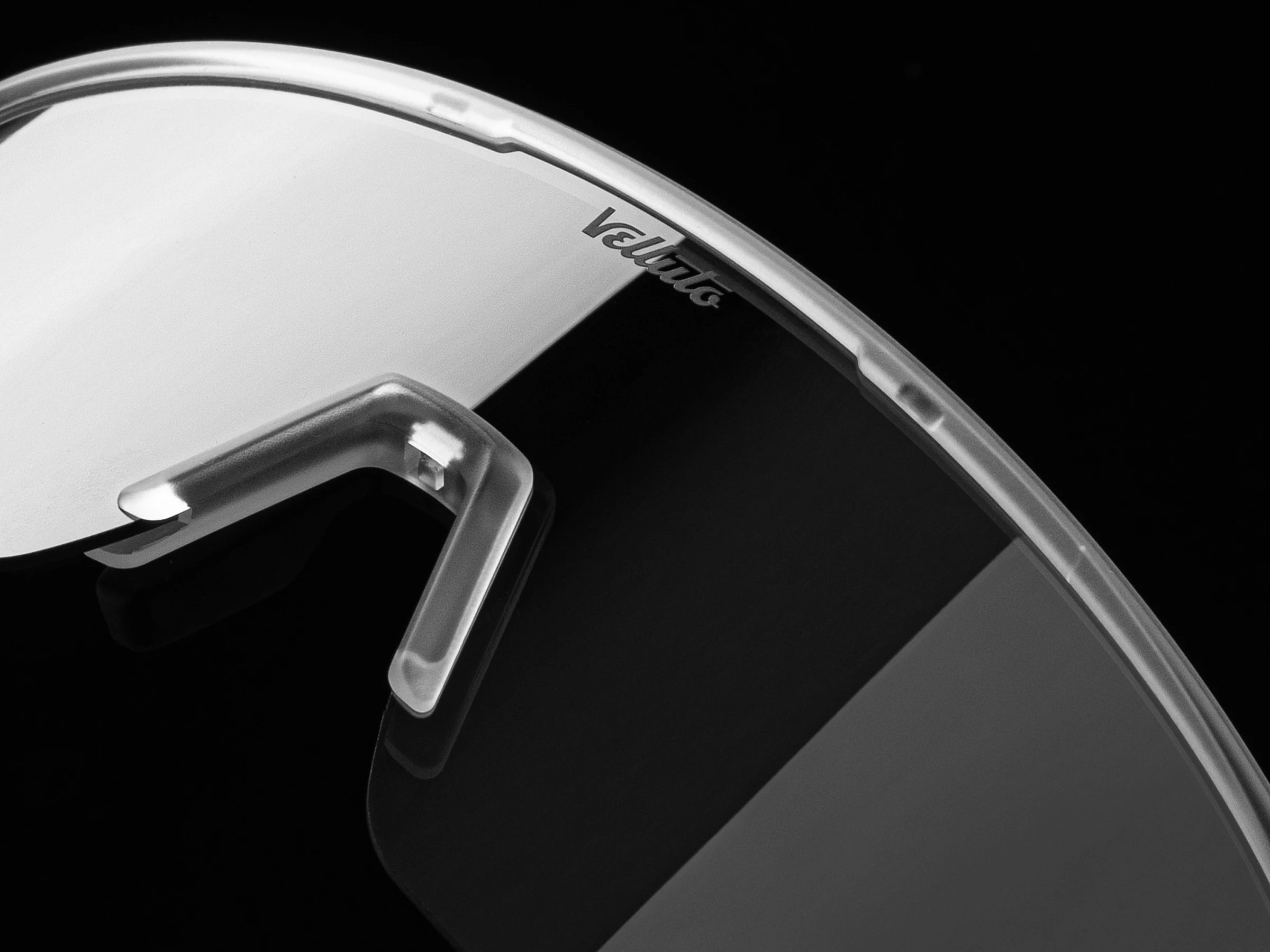
Clear lens (VellutoPuro): Use this for early starts before sunrise, for extended forest sections with heavy canopy cover, for overcast rides where a tinted lens reduces contrast without adding any useful glare protection, and for any night or low-light riding. A clear UV400 lens still protects against ultraviolet radiation while transmitting close to 100% of visible light, giving you maximum visual clarity. It also provides the physical protection against wind and debris that is relevant at any light level.
High-contrast lens (VellutoVisione): Use this for the majority of daytime gravel riding, particularly on routes with mixed surfaces where reading the ground ahead matters. A high-contrast lens filters specific wavelengths to make surface texture more visible, which is directly useful on gravel: the difference between loose over hard and compacted gravel, the shadow that indicates a rut, the slight colour shift that signals wet clay ahead. On road, high-contrast lenses are pleasant. On gravel, they are functionally useful.
The practical approach for a full-day gravel ride is to start with the VellutoPuro if you are setting off before the sun is fully up, then swap to the VellutoVisione once you are in good light. Both lenses click in and out of the StradaPro frame tool-free in seconds, so the swap adds no meaningful time to a transition stop. Carry the spare lens in the Starter Vision Kit, which includes both lenses together in one practical package.
For gravel, a properly designed high-contrast lens provides the surface-definition clarity you need across the full range of light conditions you encounter, making it more versatile than a single-purpose tint limited to one type of terrain.
07 · Velluto StradaProHow the StradaPro handles gravel-specific demands
The Velluto StradaPro is designed as a road cycling frame, and it is worth being precise about what that means for gravel use. It is not a dedicated gravel glasses design in the sense of a goggle-style frame or a deep-coverage enduro lens. It is a performance road frame whose combination of features happens to address gravel demands very directly.
The frame weighs 25 grams. On rough terrain, that number matters: less mass means less vibration amplification at the nose and temples, less fatigue over distance, and better retention because there is less inertia pulling the frame down on sharp impacts. It is a concrete, verified specification, not a marketing approximation.
The built-in anti-fog system is the feature that makes the StradaPro genuinely relevant to gravel beyond its road performance. Forest sections and valley descents are exactly the conditions where anti-fog matters most, and the system in the StradaPro is designed to maintain clear vision through the temperature and humidity swings that gravel routes generate.
The adjustable nose pads give you the positional control that gravel riding requires. You can set the frame lower on the nose bridge for a gravel-bike position, which keeps the lens in the correct field of view and closes the gap between lens edge and cheekbone that would otherwise allow debris ingress from below.
The VellutoPuro and VellutoVisione lenses both click in and out without tools. Carrying both lenses in your jersey pocket adds almost nothing to your kit weight, and the swap takes seconds at a navigation stop. That combination of clear and high-contrast lens coverage, selectable by the rider in real time, is the most practical lens solution for the variable light environment of a long gravel route.
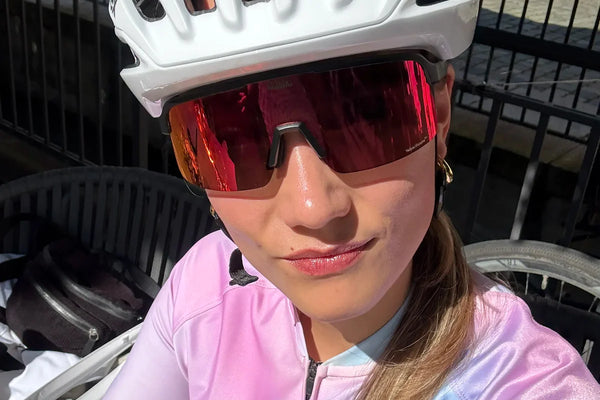
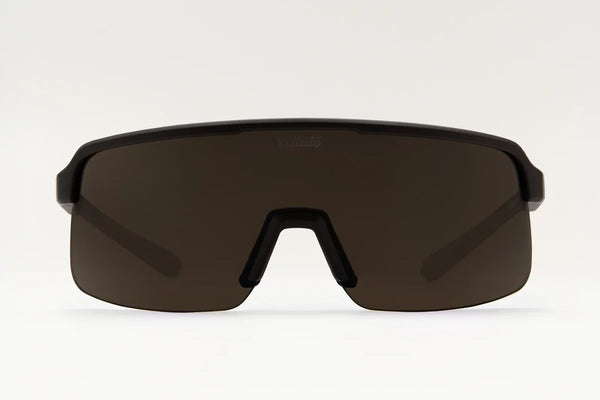
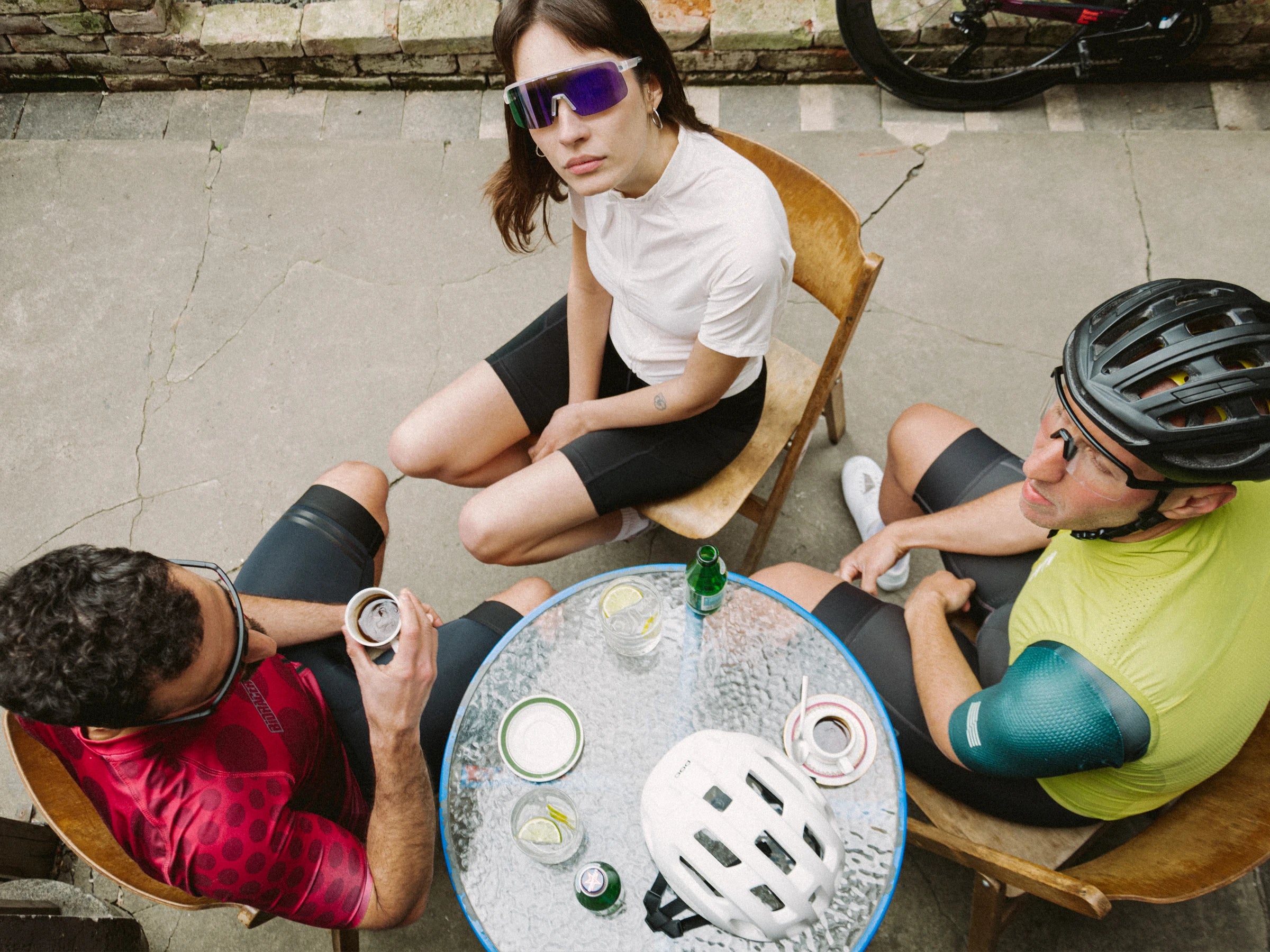
The StradaPro is available in four colours: Nero (black), Espresso (brown), Arancia (orange), and Viola (purple). All four share the same frame geometry, the same 25-gram weight, the same adjustable nose-pad system and the same anti-fog performance. The colour choice is purely aesthetic. If you want a frame that disappears visually into a dark kit, Nero. If you want something that reads as warm and distinctive, Espresso or Arancia. If you want a colour that stands out on the bike and looks confident on the body, Viola.

08 · Colour VariantsFour colours, one performance standard
The StradaPro frame comes in four colours, each with an Italian name that reflects the design origin of the glasses. The performance specifications are identical across all four; the choice is entirely about visual preference and how you want the frame to read against your kit and face shape.


Nero is the most versatile choice for riders who want a frame that works with any kit colour. Espresso has a warmer, more distinctive character that pairs well with earth tones and tan-coloured gravel kit. Arancia is the statement option, bold against dark kit and visible in low light. Viola sits between the dramatic and the refined: it is distinctive without being loud, and it has become one of the more recognisable choices among riders who want something that signals attention to detail.
All four colours are available in the Starter Vision Kit configuration, which includes the frame and both interchangeable lenses in one package. For gravel riders who want the full lens flexibility from day one, the Starter Vision Kit is the most practical entry point into the StradaPro system.
09 · Care & MaintenanceKeeping your gravel glasses performing between rides
Gravel riding is hard on glasses in ways road riding is not. Mud spray, dust, organic debris and the occasional hedge contact mean that gravel glasses get dirtier faster and require more frequent cleaning. How you clean them determines whether the lens coatings, including the anti-fog treatment, stay effective over the life of the glasses.
The two most common cleaning mistakes are using a dry cloth to wipe a lens with grit on it (the grit acts as an abrasive and scratches the coating) and using household glass cleaners or alcohol-based sprays (which degrade anti-fog coatings and can attack lens materials). The correct sequence is to rinse with clean water first to flush loose particles, then clean with a purpose-designed optical spray and a microfibre cloth.
The Velluto Cleaning Spray is a 50ml refillable formula with an apple fragrance, made in Germany, and it is designed specifically for coated optical lenses. It will not attack anti-fog treatments or lens materials. The accompanying microfibre cloth (80% polyester, 20% polyamide, 25x25cm) lifts residue without scratching. Used together after every gravel ride, they maintain the anti-fog and UV coating performance that makes the glasses worth buying in the first place.

Between rides, store the glasses in a hard case rather than in a jersey pocket or bag without protection. Gravel kit tends to carry more debris than road kit, and loose glasses in a bag with tools, snacks or a multi-tool will accumulate scratches quickly. The Velluto Hard Case has an anti-crash guarantee and a velvet interior lining. It fits the StradaPro frame and protects the lens surface between rides.
If you are running two lenses and swapping between them during rides, the lens not in use should travel in its case or in a protective lens pouch. Loose lenses in a jersey pocket are at high risk from keys, CO2 cartridges and the general detritus that accumulates over a long gravel day.
10 · Buying DecisionA gravel cycling glasses buyer's checklist
Before spending money on gravel cycling glasses, run through this list of questions. Your answers will tell you more about what you need than any brand recommendation.
What are the typical light conditions on your most common gravel routes? If most of your riding is in open countryside in good light, a high-contrast lens may be all you need. If your routes include dense forest, early starts or late finishes, you need a clear lens in addition. If the answer is "both," an interchangeable lens system is the right investment.
How long are your typical gravel rides? Shorter rides in controlled conditions are more tolerant of fit imperfections. Five-hour rides on rough terrain expose every fit weakness. If you regularly ride long, fit mechanics (adjustable nose pads, frame weight, temple grip) should weigh heavily in your decision.
Do your routes include significant elevation change with forest sections? If yes, anti-fog is not optional. Make sure the anti-fog system in any frame you consider is built into the frame design, not just a surface coating that will degrade with cleaning.
How important is lens interchangeability to you? If you are a one-lens-for-all-conditions rider who values simplicity, a fixed lens in the right tint for your conditions is fine. If you want precise visual control across variable light environments, an interchangeable system is the better long-term investment even if the initial cost is slightly higher.
What is your risk tolerance for buying online? Cycling glasses fit is personal and difficult to evaluate from a product page. A 30-day trial period removes that risk by letting you test on real rides before committing. If a frame does not offer a meaningful trial or return policy, factor in the risk of a poor fit that you are stuck with.

11 · ContextGravel cycling in summer 2026: why this conversation is happening now
The growth of gravel cycling in Europe over the past five years has not been evenly distributed. It has concentrated in the mountain regions, in the limestone massifs of southern France, the Dolomites, the Ardennes, the Spanish interior, and the high Alpine passes that have always been the backdrop to road cycling's most dramatic moments. In summer 2026, with the Tour de France route bringing attention to the Pyrenees and Alps, and with Dutch cycling camps filling the valley towns of both mountain ranges, gravel riding in those same mountains is at an all-time visibility high.
That geographic concentration matters for eyewear. Mountain gravel is not the same as lowland gravel. It involves genuine altitude, genuine temperature swings, genuine forest sections and genuine debris from limestone surfaces that generates sharp-edged particles. The casual gravel rider on a smooth forest track in the Netherlands is making fewer demands of their glasses than the rider who is threading between pine roots on a 1,200-metre pass in the Pyrenees in late July when afternoon thunderstorms are building.
It also matters for the market. As gravel cycling has moved from a niche pursuit to a mainstream discipline with its own events, calendar and aesthetic identity, the eyewear market has responded with products aimed specifically at the gravel rider. Some of those products are genuine engineering advances. Some are road glasses relabelled with a "gravel" or "trail" designation and a price premium. The ability to distinguish between the two requires understanding what gravel actually asks of a lens and frame, which is the purpose of this guide.
The specifications that matter for gravel are not complicated: anti-fog that works at low speed, wrap coverage that intercepts side-entry debris, a secure and adjustable fit that holds through rough terrain, and a lens system flexible enough to handle the range of light environments a mountain gravel route covers in a single day. Any frame that delivers all four of those things is a good gravel frame, regardless of whether it carries a "gravel" marketing designation or a road-specific one.
Mountain gravel in summer asks more of eyewear than a flat lowland track does. Altitude, temperature swings, forest humidity and limestone debris are not the same problem as a smooth gravel path in open countryside.Velluto, Gravel Guide 2026
Compare the full lineup in the Velluto StradaPro cycling glasses collection.
12 · FAQFrequently Asked Questions
Do I need specific gravel cycling glasses, or can I wear road glasses off-road?
What does wrap-around coverage actually protect against on gravel?
Why do cycling glasses fog more on gravel than on the road?
Are interchangeable lenses worth it for gravel riding?
How much should I expect to spend on gravel cycling glasses?
What UV protection rating do I need for gravel cycling?
Do adjustable nose pads make a difference on long gravel rides?
Can I use the Velluto StradaPro for both road and gravel riding?
What is the 30-day risk-free trial and how does it work?
If the performance case above reads like a description of what you have been missing on your gravel rides, the most practical next step is a 30-day trial. Ride them on the routes that have been causing problems. Test the anti-fog on your foggiest descent, the debris protection on your dustiest track, the fit stability on your roughest surface. If the StradaPro does not work for your riding, return it within 30 days. If it does, which is the more likely outcome, you have found the last pair of gravel cycling glasses you need to think about for a while. Start at velluto-shop.com.