Cycling Glasses for Narrow Faces 2026: The Complete Buyer's Guide
Contents16 min read
Cycling Glasses for Narrow Faces 2026: The Complete Buyer's Guide
Watch the Tour de Suisse peloton descend the Gotthard and you will notice one thing every rider has in common: glasses that do not move. No slipping, no bouncing, no frantic mid-descent adjustment. What you do not see from the roadside is the quiet frustration shared by millions of cyclists who have bought a pair of performance glasses only to find them resting on their cheeks rather than their nose, migrating backward on every climb, or simply too wide to feel secure. If you are shopping for cycling glasses for narrow faces, this guide is written for you.
Why Narrow Faces Are Underserved by Most Cycling Eyewear
The cycling eyewear industry defaults to a single size. Browse any major brand and you will find one frame geometry designed around an average, and that average is built around a wider, more prominent facial structure than many riders actually have. The result is a pair of glasses that perches rather than sits: wide enough that the temples apply no lateral grip, the nose bridge hovers above the nose pad, and the lens sits too low to provide the full field of view a road cyclist needs when riding on the drops.
The consequences are more than cosmetic. A frame that sits too low exposes your upper visual field to wind, grit and insects, exactly what cycling glasses are supposed to prevent. On a long summer gravel ride, where dust is constant and re-centering your glasses every ten minutes is a genuine irritation, a poor fit taxes your focus. During variable-weather riding such as the mountain stages that defined the 2026 Critérium du Dauphiné, glasses that fog and slip at the same time are a performance liability. Fit is not a comfort detail. Fit is a safety and performance requirement.
Adjustability is therefore the most important specification a narrow-faced cyclist should look for, more important than lens tint, more important than brand name, and arguably more important than weight. A frame that can be adapted to your specific nose geometry will always outperform a lighter frame that cannot.
What to Look for: A Practical Checklist for Narrow-Face Fit
Before you buy, run every candidate pair against this checklist.
Adjustable nose pads. This is non-negotiable. Fixed nose bridges are moulded around one nose shape. Adjustable pads allow you to narrow the bridge gap, raise or lower the lens relative to your eye, and distribute pressure evenly across a smaller nose profile. Without this feature, every other specification is secondary.
Temple grip without pressure. Temples that are too long slide back; temples that are too short grip uncomfortably tight. For narrow faces, look for a flexible rubber tip on the end of the temple, it should hook gently behind the ear without digging in, even on a three-hour ride.
Weight under 30 grams. Heavier frames sink on narrow noses regardless of pad adjustment. Once you go below 30 grams, inertia works in your favour: there is simply less mass trying to pull the frame downward. The lightest frames in the performance category currently sit between 22 and 26 grams.
Lens coverage geometry. A lens that is too wide will sit proud of the face on a narrow skull, creating gaps at the sides that allow wind ingress. Look for a moderate lens width combined with a curvature that follows the face rather than projecting away from it.
Anti-fog system. Narrow faces tend to produce a tighter seal between lens and face, which ironically increases internal air temperature and fog risk on climbs. A built-in ventilation system is essential, not optional.
Interchangeable lenses. Summer rides span dawn starts, shaded forest gravel and high-alpine glare within a single morning. A lens system you can swap without tools in seconds gives you one pair that genuinely covers every condition.
Trial period. Fit cannot be verified in a shop or from a product photo. A risk-free trial period of at least 30 days means you can test the glasses on real rides, including that Saturday morning three-hour gravel loop, before the purchase is final.
Why the Velluto StradaPro Works for Narrow Faces
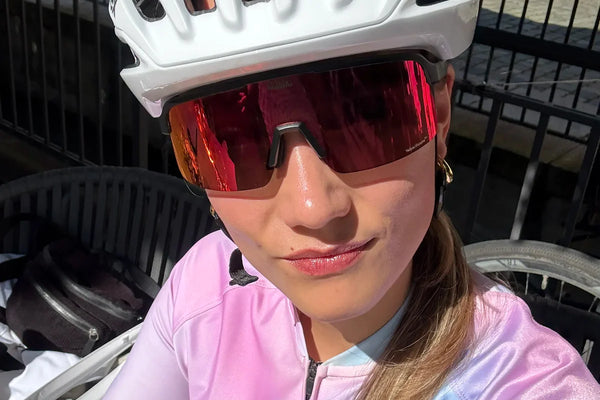
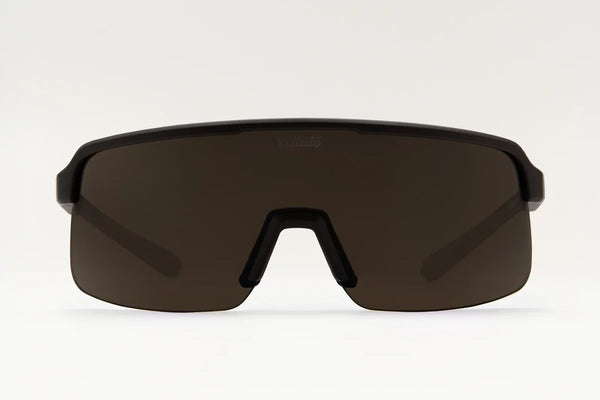
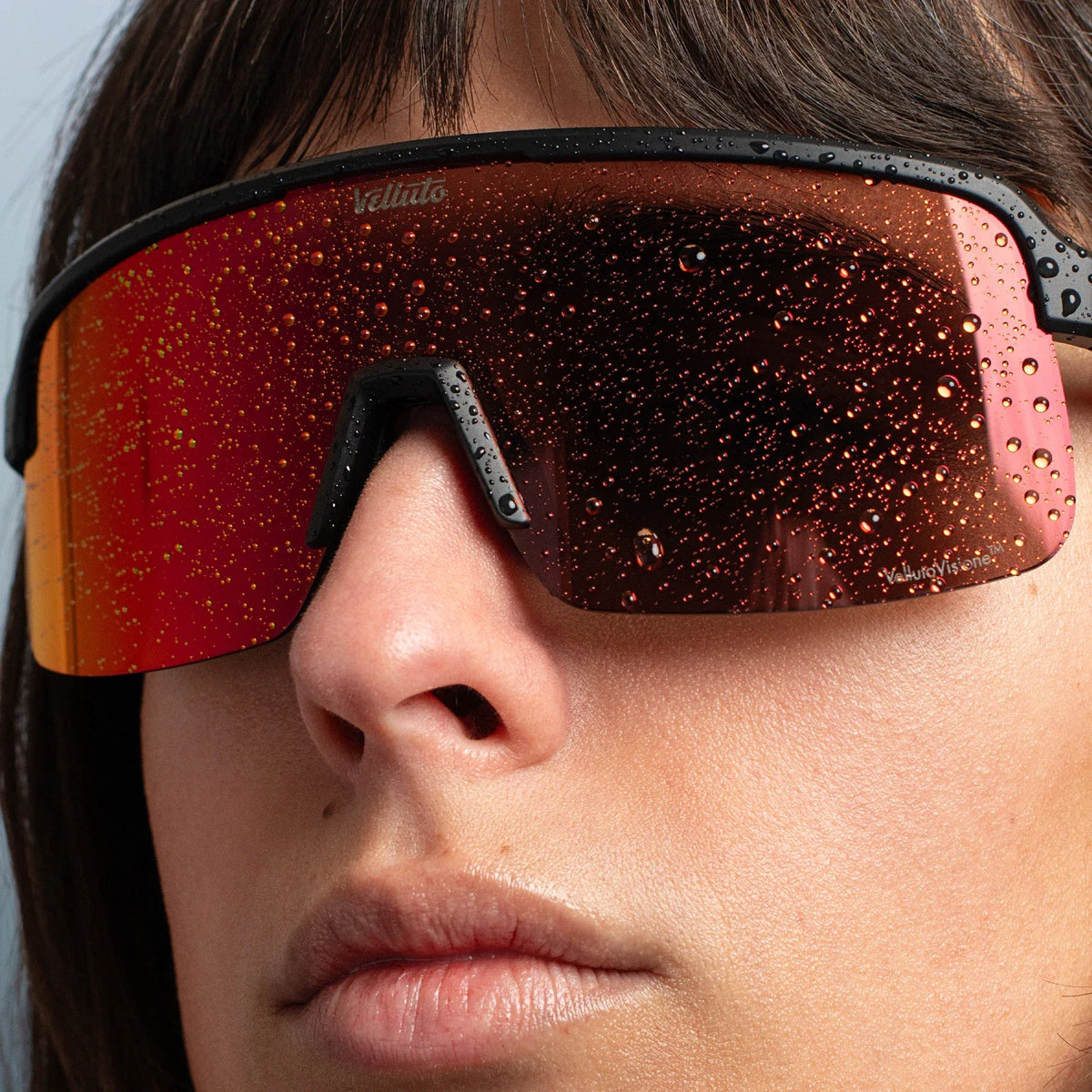
The StradaPro was designed in Italy with road cycling fit at the centre of the brief, and the specification set maps directly onto the checklist above. At 25 grams, it sits below the threshold where weight becomes a slip risk on a narrower nose bridge. The adjustable nose pads are the most important detail here: they allow you to close the bridge gap and raise the lens to sit flush with your brow line, which is precisely what narrow-faced riders need. There is no fixed-bridge compromise.
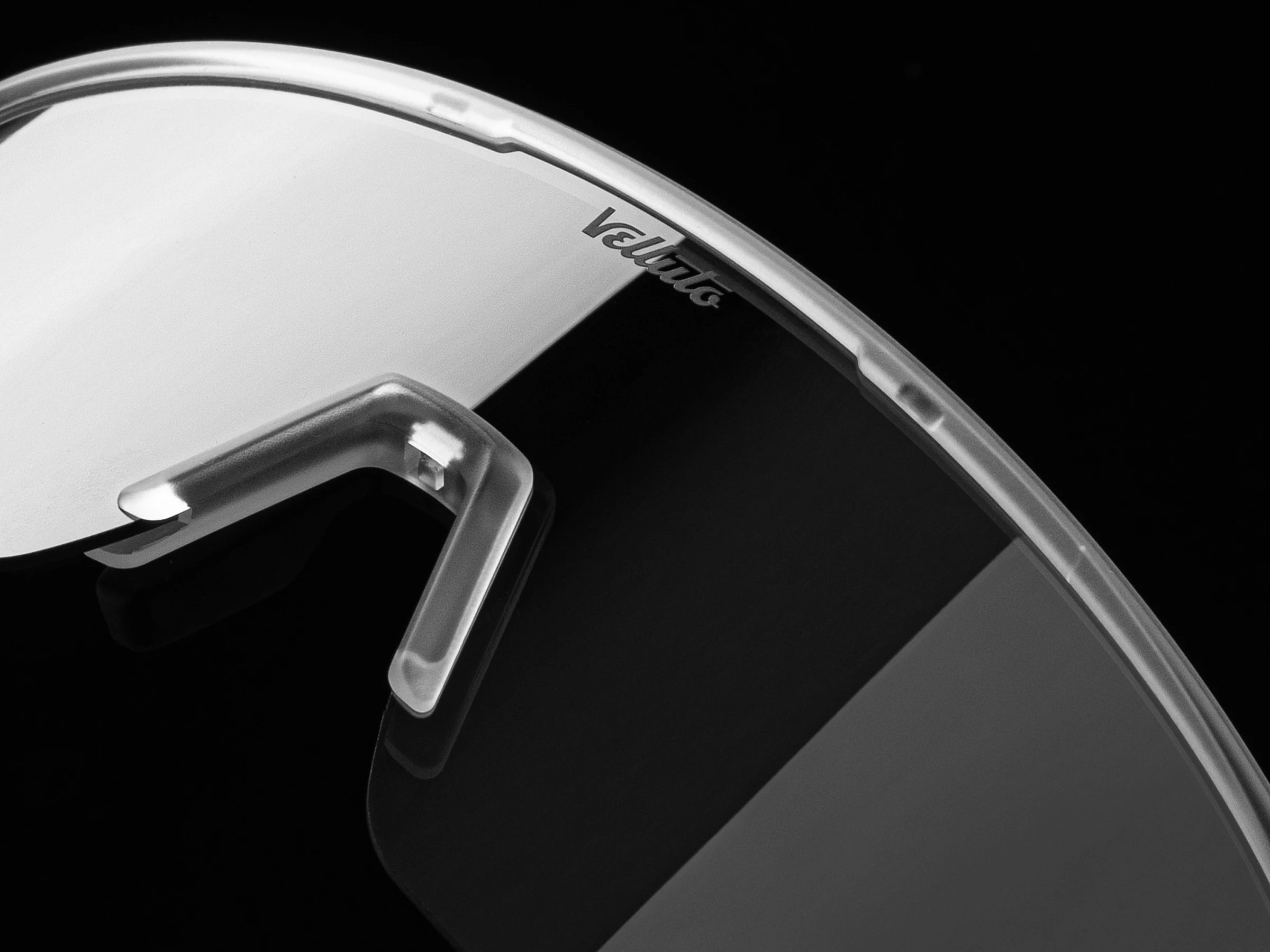
The built-in anti-fog system handles the ventilation problem that tight facial fits create, tested in the kind of temperature swings that characterise summer alpine riding. UV400 certification means 100% UVA and UVB protection regardless of which lens is installed. The click-in lens system is tool-free: the VellutoPuro transparent lens for low-light and dawn rides, and the VellutoVisione high-contrast lens for variable summer conditions, each swap in seconds without loosening any screw or carrying a separate case for spare hardware.
The StradaPro is available in four colours: Arancia, Espresso, Nero and Viola. If you prefer a lens that sharpens contrast on overcast summer gravel, the VellutoVisione is your default install. If you are riding before sunrise or through wooded singletrack, the VellutoPuro clear lens gives full protection without reducing available light. One frame. Two lenses. Every condition covered.
Velluto offers a 30-day risk-free trial. Wear them on real rides for a full month. If the fit is not right for your face, return them. Free shipping applies on orders over €99.
 Velluto StradaPro Glasses | Arancia
Frequently Asked Questions
How do I know if cycling glasses will fit my narrow face before buying?
The single most reliable indicator is whether the frame features adjustable nose pads rather than a fixed bridge. Adjustable pads allow the fit to be tuned to your specific nose width and bridge height. Beyond that, look for a lens width that is described as moderate rather than oversized, and always prioritise brands that offer a genuine trial period so you can test the fit on real rides.
Do cycling glasses fog more on narrow faces?
They can. A narrower face often creates a closer seal between the lens and the skin, which reduces airflow and raises the temperature inside the lens. This makes an active anti-fog system more important for narrow-faced riders than for those with wider faces where natural ventilation gaps exist. The Velluto StradaPro includes a built-in anti-fog system designed specifically for this kind of variable-temperature, high-exertion riding.
Are 25-gram cycling glasses actually noticeably lighter to wear?
Yes, and the difference matters most on longer rides. Below approximately 30 grams, the frame produces almost no downward force on the nose pads during normal riding. On a three-hour summer gravel ride with repeated climbs, this means the glasses stay in position without constant readjustment. For narrow faces specifically, the lower weight reduces the tendency for the frame to slip down a less prominent nose bridge.
Ready to find a pair that actually fits? Browse the full Velluto range at velluto-shop.com and try them risk-free for 30 days.
How to Actually Tell If Cycling Glasses Will Fit Your Narrow or Small Face Before You Buy
Most cyclists with narrow or small faces have been burned at least once: the photos looked right, the reviews seemed positive, and the glasses arrived only to sit half a centimetre too wide on either side, leaving visible gaps at the temples and no lateral grip whatsoever. The problem is that eyewear brands almost never publish the one number that matters most for a narrow face: frame width. Here is how to make a smarter call before spending money.
What measurements actually matter for small-face cycling glasses?
The two critical numbers are total frame width (temple hinge to temple hinge) and lens height. For a genuinely small or narrow face, look for a total frame width under 135mm and a lens height that still clears your eyebrow line. Most standard cycling frames run 140–145mm wide, which is why they feel loose rather than secure on narrower faces.
If a brand does not publish frame width, and many do not, use this workaround: measure a pair of glasses that currently fits you acceptably, even fashion sunglasses. That measurement becomes your benchmark. Anything within 3–4mm of that number is worth trying; anything beyond 6–7mm wider will almost certainly slip.
Lens height matters for a different reason. A taller lens sounds more protective, but on a small face it pushes the frame downward, and the top of the lens can sit below your eyebrow line, exposing your upper visual field to wind and road debris, exactly the problem you are trying to solve. A lens height of 38–44mm typically works well for smaller facial proportions.
Adjustable nose pads change the equation significantly. A frame that runs 3–4mm too wide can often be brought into acceptable fit with proper nose pad adjustment, because raising the lens relative to your eye also changes how the temples contact your skull. It is not a perfect fix for a dramatically oversized frame, but it is the difference between a 70% fit and a 90% fit, and on a four-hour ride, that 20% matters. This is the single most useful feature to look for if you have a narrow or small face, more useful than weight, tint or any other specification on the list.
Cycling glasses women small face: is there a meaningful difference between "women's" and "small" frames?
Women's cycling glasses are often, not always, built on a slightly narrower, lower-volume frame geometry than unisex equivalents from the same brand. But "women's" is not a reliable proxy for "small face fit." Some women's frames are simply narrower colour options on an identical unisex frame. The relevant question is always frame width and nose pad adjustability, regardless of how the product is marketed.
Female cyclists with narrow faces often find that genuine small-fit or youth frames from specialist brands serve them better than frames badged as women's. The honest approach: ignore the gender label, find the measurement, and trial the frame in person or through a brand that offers a return or trial window.
At Velluto, the frame geometry and fully adjustable nose pads are designed to serve smaller facial profiles without being siloed into a separate women's or small-face product line, the adjustability does the work that segmentation otherwise would.
Fit Problems Cyclists with Small Faces Actually Run Into (And How to Solve Them)
Why do cycling glasses slip on a narrow nose even when they seemed fine in the shop?
Cycling glasses slip on narrow noses primarily because the nose pad gap is too wide for the nose to generate lateral resistance. In a shop, you are standing still; on a bike, vibration, sweat, and the aerodynamic pressure of moving at speed all combine to work against a loose fit. A frame that passes a brief shop test can be sliding down your nose within twenty minutes of a hard effort.
The fix is almost always at the nose pad. If the pads are adjustable, pinch them inward until the frame sits higher and the lens aligns just below your eyebrow. If they are fixed, no amount of temple adjustment will fully compensate. Some cyclists add thin adhesive silicone pads to fixed-pad frames as a workaround, it can help marginally, but it is a patch rather than a solution.
Sweat compounds the problem. Most cycling frame materials become slightly more slippery when wet. Rubberised nose pad material grips better under sweat than bare plastic or metal; check what the pad itself is made from, not just whether it adjusts.
Cycling glasses don't fit with helmet: what is actually happening and how do you fix it?
Cycling glasses fail to work with a helmet when the temple arms conflict with the helmet retention system or the helmet's internal webbing. On a narrow or small head, this problem is more acute because the helmet sits lower and the retention cradle sits closer to where the temple arm needs to run. The result is either the glasses being pushed forward and down onto the nose, or the helmet sitting unevenly because the temples are disrupting the fit.
The practical fixes, in order of effectiveness:
- Adjust glasses first, then helmet. Put your glasses on and set them at the position you want. Then fit the helmet over them, adjusting the retention dial from that baseline. Most cyclists do it in the wrong order and wonder why nothing works together.
- Check temple arm thickness. Thinner, more flexible temple arms cause less interference with helmet cradles. Bulky wraparound temple designs are the most common culprit on small heads.
- Look for glasses with a lower-profile temple curve. The ear hook section should curve gradually rather than sharply; a sharp bend creates a pressure point that the helmet then pushes against.
- Consider frame weight. On a small face, a heavier frame requires more nose pad contact force to stay in place. Under helmet pressure, that balance shifts. Frames under 30 grams require less compensating grip to stay stable.
Velluto's frame comes in at 25g, which reduces the inertia-related slip that heavier frames create under helmet pressure, useful context when you are comparing options.
The Honest Comparison: What to Know About Key Brands Before You Buy
What are some good alternatives to SunGod for cyclists with small faces?
SunGod's main appeal is their lens customisation and UK-based brand identity. Solid alternatives for small-faced cyclists include Oakley's Sutro Lite (available in a trimmed-down geometry), Smith Optics' Resolve (notably narrower than most performance frames), and Velluto, which is built explicitly around adjustable nose pad fit and weighs 25g. Each serves a slightly different priority: Oakley for lens optics, Smith for heritage, Velluto for fit-focused adjustability and a 30-day trial.
SunGod's frames are not specifically engineered for narrow or small faces, and the brand does not publish detailed frame width measurements in a way that makes narrow-face shopping straightforward. Their customisation strengths lie elsewhere, lens colour combinations and personalised text, rather than in fit adaptability. If fit precision on a small face is your primary requirement, it should not be your first stop.
Are SunGod a British company?
Yes, SunGod is a British brand, founded in 2013 and headquartered in London. They manufacture lenses and assemble products with an emphasis on sustainability and a direct-to-consumer model. Their British identity is genuine, not a marketing posture, and their warranty and customer service infrastructure reflects that.
What are the differences between SunGod and Oakley glasses for cycling?
Oakley and SunGod approach cycling eyewear from different angles. Oakley invests heavily in proprietary lens technology, their Prizm road lens is widely regarded as one of the best contrast-enhancing optics available for road cycling, particularly in variable light. Frame construction is premium, with extensive R&D behind aerodynamics and impact resistance. The trade-off is price: Oakley cycling glasses typically cost significantly more, and their fit is built around a standard to large facial geometry.
SunGod competes on customisation and value relative to Oakley's price tier. Their lens optics are competent without matching Oakley's Prizm contrast enhancement. For a small-faced cyclist, neither brand makes narrow-face fit a core design priority, which is the honest limitation of comparing these two specifically through a fit lens.
What sunglasses are pro cyclists wearing in 2026?
In 2026, the WorldTour peloton is dominated by Oakley, Rudy Project, and 100% as the most visible team-kit sponsors. Oakley's Kato and Sutro designs remain prominent. 100%'s Speedcraft and Hypercraft continue to appear across multiple teams due to their wide coverage and aerodynamic profile. Rudy Project maintains strong presence particularly in continental European squads.
What cycling sunglasses does Pogacar wear?
Tadej Pogacar wears Oakley glasses under his UAE Team Emirates kit deal, most commonly the Oakley Kato for road stages and the Oakley Sutro for mountain stages where peripheral vision and coverage take priority. The Kato's single-lens wrap design has become closely associated with him particularly since his 2024 and 2025 dominant seasons.
It is worth noting that pro cyclists are sponsored, what Pogacar wears tells you about Oakley's sponsorship budget more than it tells you about what will fit your face. A frame worn by a professional with a specific facial geometry and a team mechanic on hand to adjust it daily is not automatically the right choice for a club cyclist with a narrow face buying glasses online.
Who makes the best cycling glasses for small faces in 2026?
No single brand dominates this category, but the best options for small faces in 2026 share common characteristics: published frame widths under 135mm, adjustable nose pad systems, and weights under 30g. Smith Optics, Tifosi, and Velluto each offer strong options. Tifosi in particular has historically offered narrow-fit geometries at accessible price points. Velluto's adjustable nose pad system and 25g weight make it a strong candidate if fit precision and a risk-free trial period matter to you.
The honest answer to "best" depends on your specific priorities. Best optics: Oakley. Best value at entry level: Tifosi. Best adjustable fit with a trial period: Velluto. Best photochromic lens (note: Velluto does not offer photochromic): Rudy Project or Smith. Knowing which variable matters most to you gets you further than any ranked list.
Getting the Best Value from Cycling Glasses When You Have a Narrow or Small Face
Value for a narrow-faced cyclist is not simply about price per pair. A cheaper pair that slips, sits incorrectly, or requires replacement after one season costs more over three years than a slightly more expensive pair that fits, lasts, and improves each ride. The calculation changes when you factor in replaceable lenses: frames with interchangeable lens systems mean you are not discarding the entire product when a lens gets scratched or when the light conditions of your riding change season to season.
The other value factor specific to narrow-face buying is returns and trials. Because fit cannot be reliably predicted from photos and measurements alone, facial features interact in ways that no spec sheet fully captures, buying from a brand that offers a genuine trial window costs you nothing extra and eliminates the main risk of online eyewear purchases. Velluto's 30-day trial exists for exactly this reason: frames that cannot be returned are an implicit bet that the brand's default geometry matches your face, and for narrow-faced cyclists that bet has poor historical odds.
A few practical value checks before committing to any pair:
- Are replacement lenses available and priced reasonably? A great frame with discontinued lens availability is a two-year product, not a long-term investment.
- Is UV400 protection confirmed? This is a minimum standard, not a premium feature. Do not accept vague "UV protection" claims without the UV400 designation.
- Does the anti-fog coating apply to both lens surfaces? Single-surface anti-fog treatments wear faster and perform worse in the transitions between efforts, exactly when a small-faced cyclist needs the glasses to stay clear while also staying in place.
- What does the warranty cover and for how long? Manufacturing defects in frame or lens coatings should be covered for at minimum one year by any brand worth buying from.
For narrow and small-faced cyclists, the honest summary of 2026's market is this: the options are better than they were five years ago, but the industry still has not made small-face fit a design priority at scale. The brands and products that do treat it as a priority, through adjustable nose pad systems, trimmed frame geometries, and published measurements, are worth paying moderate attention to, regardless of where they sit in the brand hierarchy. Fit is the specification that determines whether you think about your glasses at all on a ride, and for a cyclist with a narrow face, finding a frame that disappears on your face is genuinely worth the search.