Best Sports Glasses for Cycling: A Complete Buyer's Guide
Contents27 min read
The road out of the valley is still in shadow when you clip in for a six-thirty start, and by the time you crest the first climb the sun is full in your face. Two hours later, a low cloud rolls across the ridge and the temperature drops four degrees in as many minutes. On an autumn ride, the light does not stay still, the temperature does not cooperate, and the glasses you chose at home will either earn their place on your face or quietly ruin your morning. This guide is about making that choice correctly, once, before the season ends.
The phrase "best sports glasses for cycling" appears in a lot of searches, and the results are often a mix of general fitness eyewear, running shades, and lifestyle sunglasses that happen to be sold near a bike shop. This guide is narrower than that. It is specifically about road cycling, specifically about what separates a purpose-built cycling glass from everything else, and specifically about the criteria that matter over three or four hours on the road rather than twenty minutes on a treadmill.
By the end, you will have a checklist of seven criteria, an understanding of how each one affects a real ride, and a clear picture of where the Velluto StradaPro sits against those criteria. For autumn riding specifically, you will also find information on the Velluto Chromo, which is a separate, photochromic model designed around the season's shifting light. Both are covered honestly, with their differences spelled out clearly, so you can decide which suits your riding.
01 · Sports glasses vs lifestyle sunglassesWhy the gap is larger than it looks
Walk into any optician or fashion retailer and you will find frames marketed as "sport" that share almost nothing with purpose-built road cycling eyewear. The differences are not cosmetic. They affect whether you arrive at the top of a climb with clear vision or fogged lenses, whether your glasses are still on your face at kilometre 80 or slowly sliding forward, and whether you finish a four-hour ride without a headache from frame pressure.
Here is what the categories actually differ on in practice:
Wrap angle and coverage. Cycling produces airflow across your face at speeds from 15 to 60 kilometres per hour, plus debris from the road surface, insects, and in autumn, leaves and grit. A lifestyle frame with shallow lenses and open sides lets all of that through. A road cycling frame wraps around the orbital area, covering the eye fully and reducing the gap through which wind and particles can enter. This is not about aesthetics. It is about protecting your cornea and maintaining vision on a fast descent.
Weight. Lifestyle frames are frequently in the 30-to-50 gram range. That is fine for a walk or a brunch. Over four hours of cycling, with the frame resting on your nose and temples, frame weight compounds into discomfort. Purpose-built road frames target the low twenties to low thirties in grams. The difference between 25 grams and 45 grams is irrelevant in your hand; it is noticeable on your face after two hours.
Anti-fog design. Lifestyle frames make no provision for anti-fog because their wearers are not generating sustained body heat, climbing gradients, or creating the temperature differential between warm exhaled air and a cold lens that causes fogging. Road cycling frames address this either through ventilation channels, hydrophilic lens coatings, or both. If your glasses are not designed for this, expect to see your lens go opaque at the worst possible moment.
Lens interchangeability. Lifestyle sunglasses come with one lens and one lens only. For road cycling, where a single route can pass through a dark forest, a bright exposed ridge, and a shadowed valley, a single lens tint is a compromise at every point. Interchangeable lens systems exist specifically for this problem.
Secure fit under movement and sweat. Cycling involves sustained vibration, repeated changes in body position, and significant sweat. A frame that sits well for a five-minute store fitting will migrate forward, bounce, and lose grip in ways that only become apparent after an hour on the road.
None of these are minor refinements. They are foundational differences that separate a tool suited to road cycling from a frame that happens to look similar on a shelf.
02 · The seven-point checklistWhat to evaluate before you buy
These seven criteria cover the practical demands of road cycling. Run any candidate pair of glasses against them before committing to a purchase. They apply regardless of brand, price point, or what the product page says about the sport.
1. Weight
Target: under 30 grams for a performance road frame. Weight is the most quantifiable criterion and the easiest to compare across brands. Manufacturers publish it; if a frame listing does not include a weight, that is itself informative. On short rides, the difference between a 25-gram frame and a 40-gram frame is negligible. On an autumn century or a three-hour mountain ride, the lighter frame simply disappears from your face in the way the heavier one does not.
The Velluto StradaPro weighs 25 grams.
2. Coverage and lens geometry
The lens should cover the full eye area, including from the side. A partial lens allows wind in from the temporal angle, which causes tearing at speed. The wrap angle on a road cycling frame is typically more pronounced than on a running or general sports frame, because cycling speeds are higher and sustained rather than intermittent. Check that the lens sits close enough to the brow line to prevent gap airflow from above.
3. Ventilation and anti-fog
This is the criterion most buyers overlook and most regret. Anti-fog matters most on climbs, in wet weather, and in the cool morning starts that define autumn riding. The mechanism varies: some frames use upper-rim ventilation slots to draw air across the inner lens surface; some use a hydrophilic coating that prevents water molecules from grouping into light-scattering droplets; some use both. Ask the manufacturer which approach is used. "Anti-fog" as a general claim with no mechanism behind it is not the same as an engineered solution.
The Velluto StradaPro has a built-in anti-fog system. The Velluto Chromo, as a photochromic model with a single fixed lens, also benefits from anti-fog performance suited to autumn conditions.
4. Fit security: nose pads, temple arms, and grip
Fit has two components: initial adjustment and long-term retention. A frame should be adjustable at the nose bridge so you can position it correctly for your face geometry. A non-adjustable bridge forces you into whatever nose profile the designer assumed, which may or may not match yours. Temple arms should provide enough grip to stay in place under vibration and during the head movements of checking junctions or looking back over your shoulder. Test both: a frame that fits well in a shop may not grip adequately once sweat changes the interface between rubber and skin.
The StradaPro uses adjustable nose pads that allow you to set bridge height and angle for your nose specifically.
5. Lens system: tints, swaps, and conditions coverage
A single fixed lens is a compromise. In bright midday sun it may be excellent; in a shadowed forest section or a predawn start, it may be dangerously dark. The two approaches to this problem are:
Interchangeable lenses: two or more separate lenses, each optimised for different light, stored in the same frame via a click-in mechanism. You swap manually when conditions change. This gives you precise control over what goes in front of your eyes and is well suited to riders who plan their conditions in advance or do not mind a brief stop to swap.
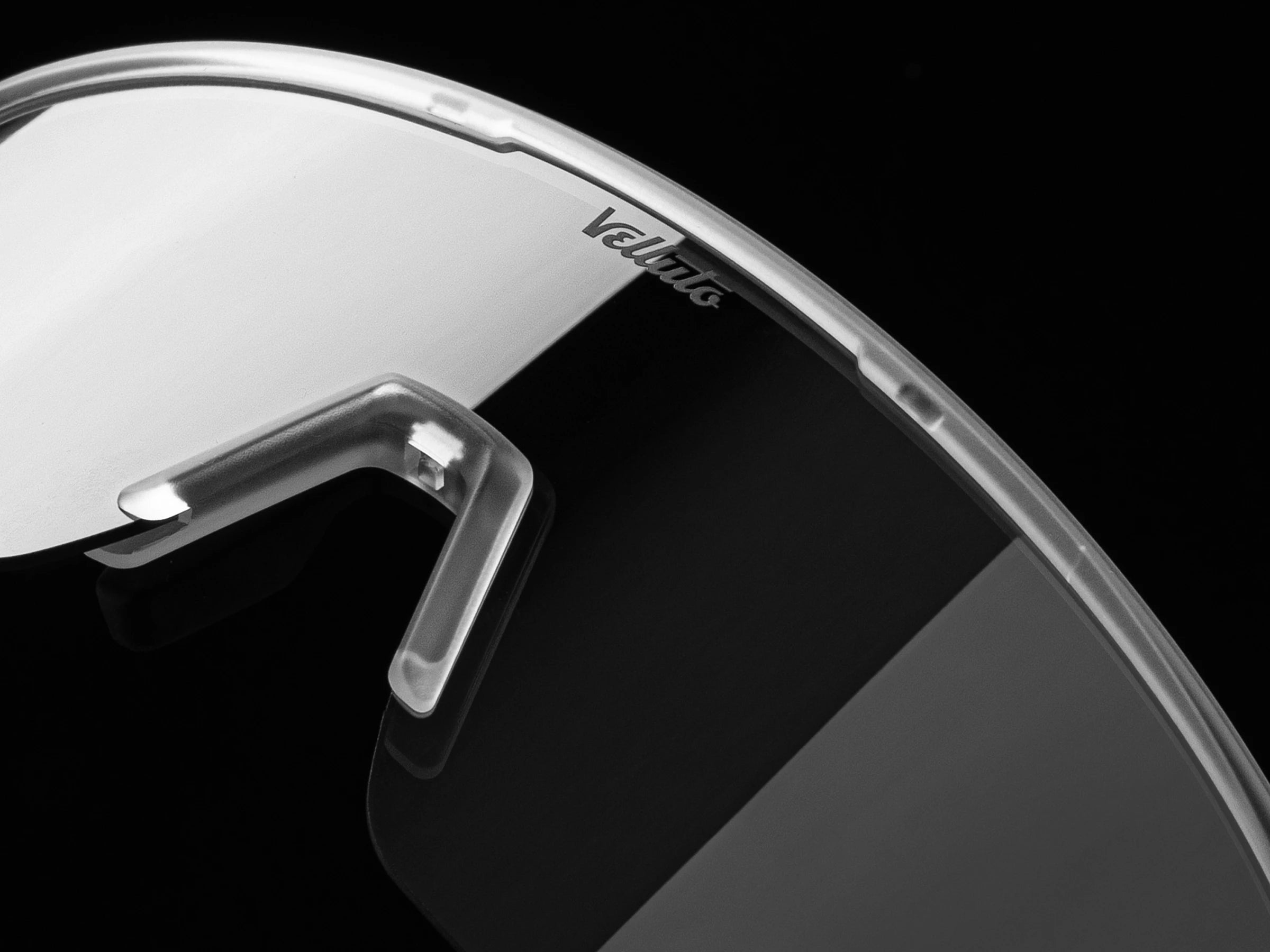
Photochromic lenses: a single lens whose tint adapts automatically to ambient light. In low light it is clear or near-clear; in bright sun it darkens and, on some models, becomes mirrored. This is the hands-free approach: the lens does the work so you do not have to stop or carry a spare. The trade-off is that you have less direct control over the tint at any given moment.
The Velluto StradaPro uses an interchangeable lens system. It is compatible with the VellutoPuro clear lens and the VellutoVisione high-contrast lens, both swapped via a tool-free click-in mechanism. The Velluto Chromo is the photochromic model in the range: its single lens adapts to light, darkening and becoming mirrored in bright conditions, clearing in low light. These are two genuinely different approaches to the same problem, and the right choice depends on how you prefer to manage light variation on your rides.
6. UV400 certification
UV400 is not a marketing phrase; it is a measurable standard. A lens certified to UV400 blocks 100 per cent of ultraviolet radiation up to 400 nanometres, covering the full UVA and UVB spectrum. On the bike, UV exposure comes not only from above but from reflective surfaces below, including wet tarmac and standing water. A tinted lens that is not UV-certified may reduce visible glare while doing nothing for UV exposure. Always check for the certification, not the tint.
The StradaPro carries UV400 certification. So do the VellutoPuro and VellutoVisione lenses. The Velluto Chromo is also UV400 certified.
7. Trial period
Cycling glasses perform differently on the road than in a shop. You cannot assess anti-fog performance in a fitting room. You cannot evaluate long-ride nose-pad comfort in five minutes. A meaningful trial period gives you actual ride time in real conditions: at minimum, a mix of dry and damp days, climbs and descents, bright and low-light sections. A 30-day window in autumn covers that range. If a brand does not offer a trial period, factor in the risk of a purchase you cannot return once you have ridden in them.
The Velluto StradaPro comes with a 30-day risk-free trial.
03 · Weight in detailWhy 25 grams matters over four hours
Weight in cycling eyewear deserves its own section because it is consistently underestimated as a buying criterion. When you hold two pairs of glasses, one at 25 grams and one at 40 grams, the difference in your palm is genuinely small. It registers, but it does not feel significant. That intuition is misleading.
On the bike, frames rest on two points: your nose bridge and your temples behind the ears. A heavier frame exerts more pressure at both points. Over one hour, this is negligible. Over three hours, the cumulative pressure starts to register as mild discomfort. Over five hours, the same frame may be actively distracting: a dull ache behind the ears, a soreness at the nose bridge, a growing impulse to take the glasses off even though you need them.
The physics here are simple. Force equals mass times gravity. A 40-gram frame applies nearly 60 per cent more downward force on your nose bridge than a 25-gram frame, sustained without interruption for the entire duration of the ride. Over a three-hour autumn ride that includes a long climb and a technical descent, that difference is not theoretical.
For context, road cycling helmets have been optimised over decades to reduce contact pressure because the community long ago established that even small reductions in pressure improve comfort and reduce fatigue over long efforts. The same logic applies to glasses frames. The 25-gram target that serious road cycling eyewear aims for is not a specification chosen for its marketing appeal. It reflects what happens to comfort over time.
There is a secondary benefit that rarely appears in product descriptions: a lighter frame vibrates less on rough road surfaces. At 40 kilometres per hour on a chip-seal descent, a heavier frame will bounce in ways a lighter one does not, which means visual stability as well as comfort favours the lighter option.

04 · Anti-fog in detailThe criterion that decides autumn rides
Of all the criteria on the checklist, anti-fog performance is the one that most separates a satisfactory purchase from one you will regret by November. This is because fogging is invisible until it happens, happens fast when conditions are right, and is genuinely dangerous when it occurs on a descent or in traffic.
The conditions that produce fogging are precisely the conditions of an autumn road ride:
A climb with high exertion. Your body generates significant heat and moisture. The warm, humid air rises from your jersey collar toward the lens. If the outer lens surface is cold, which it will be in autumn temperatures, the temperature differential causes condensation on the inner surface. Your vision degrades in seconds.
A shaded section after sun exposure. When you move from full sun into a shadowed tree-lined section, the lens temperature can drop quickly while your exertion level remains high. Again: temperature differential, condensation, fogging.
A damp or misty morning. Before the sun has had a chance to warm the air, the ambient humidity is high and your body heat is in full contrast with the environment. These are the conditions in which frames without anti-fog provision fail within the first twenty minutes of a ride.
The engineering solutions are two: ventilation and coating. Ventilation channels built into the upper rim of the frame allow cooler ambient air to move across the inner surface of the lens continuously, preventing the stagnant warm air that enables condensation. A hydrophilic anti-fog coating changes the surface chemistry of the inner lens so that water molecules spread into a thin, transparent film rather than grouping into light-scattering droplets. The coating approach works even when airflow is minimal, such as in a long tunnel or when you have stopped at a light.
The best road cycling glasses use both. The Velluto StradaPro's built-in anti-fog system addresses the problem structurally rather than relying on a single solution. For an autumn season that starts with Il Lombardia conditions and ends with December morning rides, this is not an optional feature. It is a baseline requirement for a glass that will remain useful throughout the season.
Fogging on a descent is not an inconvenience. It is a safety event. The right frame prevents it before it starts.Velluto design brief, anti-fog system
05 · Interchangeable lenses vs photochromicTwo different solutions to variable light
This is where most buying guides collapse into a false choice, presenting one approach as better than the other. They are not better or worse. They are different, and the right one depends on how you ride and how you prefer to manage decisions on the bike.
The interchangeable lens approach
You carry two lenses and one frame. Before you leave the house, or at a planned stop during the ride, you select the lens that suits the conditions. The swap takes seconds and requires no tools. You have explicit, deliberate control over what is in front of your eyes at any point. If you know your morning ride will start in low light and finish in full sun, you might start with the clear or high-contrast lens and swap to a tinted one at the base of the final climb.
The limitation is that you need to anticipate or plan for the swap. If conditions change faster than expected, you are riding in a lens that is not optimal until you stop. For riders who plan routes carefully and are comfortable with a brief stop, this is not a constraint. For riders who prefer zero management on the bike, it may feel like friction.
The Velluto StradaPro uses a tool-free click-in system compatible with two lenses: the VellutoPuro (clear, UV400 certified, optimised for wind and insect protection in low light) and the VellutoVisione (high-contrast, UV400 certified, designed to sharpen visual definition and contrast in variable light). Both swap in seconds without removing the frame from your face.
The photochromic approach
You carry one lens and one frame. The lens reads the ambient light and adjusts its tint automatically. In overcast or shaded conditions, it stays light to maximise vision. In direct sun, it darkens, and on some models becomes mirrored. You do not stop, you do not make a decision, and the lens is always in the process of adapting to the current conditions.
The limitation is that you are working with what the lens decides rather than what you choose. Transition behaviour is governed by the photochromic chemistry of the lens, not your preference in that moment. This suits riders who want to stay in motion and trust the lens to handle conditions management on their behalf.
The Velluto Chromo is Velluto's photochromic model. Its lens adapts to light automatically: it clears in low light and darkens, becoming mirrored, in bright sun. It is available in four colourways: Nero Fumo, Nero Fuoco, Bianco Lago, and Bianco Viola. It is UV400 certified and is priced from 119 EUR. Full details are at the Velluto Chromo page.
To be explicit about the distinction: the StradaPro is not photochromic and does not have a mirrored finish. It is an interchangeable-lens system. The Chromo is not an interchangeable-lens system; it is photochromic with a single adapting lens. These are separate products with separate design philosophies, and neither is a substitute for the other unless you have decided which approach suits your riding.

06 · Fit and nose pad adjustmentWhy one size does not fit cycling
Fit in cycling glasses fails in two distinct ways, and both are worth understanding before you buy.
The first failure is initial fit: the frame does not sit correctly on your face geometry. A fixed nose bridge assumes one nose shape. Most cycling glasses manufacturers design around a single bridge width and height, which fits a proportion of riders well and the remainder imperfectly. An imperfect initial fit means the frame sits too high, too low, or at an angle that compromises the optical centre of the lens. You are not looking through the part of the lens it was designed for, and vision quality degrades accordingly.
The second failure is fit retention: the frame fits well at the start of the ride and migrates during it. Sweat reduces the friction between rubber nose pads and skin. Temple grip loosens under sustained vibration. The frame inches forward over the course of an hour until you are periodically pushing it back with a gloved hand. On a descent or in traffic, that reflex becomes a safety problem.
Adjustable nose pads address the first failure directly. By allowing you to set the pad angle and width for your nose, they let the frame sit at the correct height and angle for your specific face, which means the lens is positioned where it should be optically and the contact point is where it provides maximum grip without pressure.
The Velluto StradaPro has adjustable nose pads. This is a feature that matters on rides of ninety minutes or longer, on faces at either end of the nose-geometry spectrum, and for any rider who has experienced the mild but persistent irritation of a frame that does not stay put.
The related question is temple fit. Arms that curve behind the ear with the right radius provide grip without clamping; arms that are too stiff or too flexible do one or the other. Adjustable or flexible temple arms are the standard approach in quality road cycling eyewear because they accommodate the range of ear geometry across the riding population.
One practical test: put the glasses on in a fitting or at home, lower your head to the handlebar position, and shake your head gently side to side. If the frame moves, it will move more on the road. This test is more informative than any amount of upright fitting-room assessment.
07 · UV400 and autumn lightProtection matters more when you think it does not
The instinct in autumn is to relax UV concerns. The sun is lower, the days are shorter, and the light has the characteristic warmth of the season that does not feel aggressive to the eye. This instinct is wrong, and it is worth being direct about why.
UV radiation does not track with perceived brightness. On a hazy autumn day, UV levels remain meaningful even though the sun looks mild and the light feels comfortable. The UV that reaches your eye is not reduced proportionally with visible light: UV can penetrate cloud cover at levels that cause cumulative damage to the lens of the eye and the macula over time. Repeated long-duration UV exposure without proper protection is a demonstrated cause of cataracts and macular degeneration, both of which develop over years of cumulative exposure rather than as acute events.
For cyclists, the exposure geometry adds a further consideration. You are typically looking forward and slightly upward for hours at a time, at a face angle that provides no natural shading from eyebrows or orbital bone. On a bright autumn day with the sun low and directly in front, the UV angle is particularly direct. On wet roads, UV reflects upward at angles that would not occur in normal pedestrian exposure.
UV400 certification means the lens has been measured and confirmed to block 100 per cent of ultraviolet radiation across the UVA and UVB spectrum. The standard is set at 400 nanometres because that is the boundary between UV and visible light. A lens certified to UV400 provides complete UV protection; a lens without that certification may or may not, and the product description will not reliably tell you.
On the Velluto StradaPro, UV400 certification applies to the frame and both compatible lenses: VellutoPuro and VellutoVisione. The Velluto Chromo is also UV400 certified. This is a non-negotiable criterion: any cycling glass without UV400 certification is not a road cycling glass in any meaningful sense of the term.

08 · Velluto StradaPro: evidenced specsHow the checklist scores in practice
Running the StradaPro against the seven-point checklist produces a straightforward picture. The following is based on published specifications, not on testing or editorial assessment.
Weight: 25 grams. Below the 30-gram threshold that marks the lighter end of performance road cycling frames.
Coverage and lens geometry: Italian design with a wrap-around road cycling profile. Full orbital coverage with side wrap to reduce wind and insect exposure at speed.
Anti-fog: Built-in anti-fog system. Suitable for autumn conditions including climbs, mist, and cool ambient temperatures.
Fit security: Adjustable nose pads for bridge height and angle. Suitable for a wide range of face geometries.
Lens system: Interchangeable, tool-free click-in. Compatible with VellutoPuro (clear, UV400) and VellutoVisione (high-contrast, UV400). Two lenses, one frame.
UV400: Certified. Applies to the frame and both compatible lenses.
Trial period: 30 days, risk-free. Applicable in the autumn season, which provides sufficient ride variety to make a meaningful evaluation.
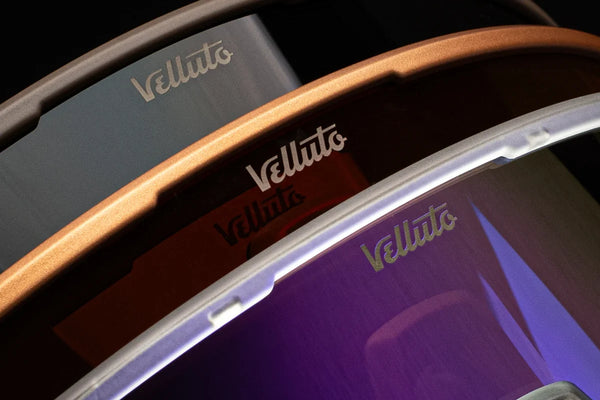
The StradaPro is available in four colourways: Arancia (orange), Espresso (brown), Nero (black), and Viola (purple). All four use the same 25-gram frame, the same adjustable nose pad system, and the same lens compatibility.
For autumn riding where automatic light adaptation is the priority rather than interchangeable lenses, the Velluto Chromo is the photochromic option at 119 EUR, with its own separate product page for full details.

09 · Comparison: StradaPro vs ChromoChoosing the right Velluto for your autumn riding
Both the StradaPro and the Chromo are road cycling glasses designed by Velluto. Both carry UV400 certification. Both sit at the performance end of the road cycling category. The decision between them is a decision about how you prefer to manage changing light on the bike, not a decision about quality or build standard.
The table below sets out the key differences based on published specifications only.
| Criterion | Velluto StradaPro | Velluto Chromo |
|---|---|---|
| Lens system | Interchangeable (tool-free click-in) | Single photochromic lens (self-adapting) |
| Light adaptation | Manual: swap VellutoPuro or VellutoVisione | Automatic: lens darkens and becomes mirrored in sun, clears in low light |
| UV400 | Certified | Certified |
| Anti-fog | Built-in anti-fog system | Anti-fog performance |
| Mirrored finish | No | Yes (in bright sun) |
| Colourways | Arancia, Espresso, Nero, Viola | Nero Fumo, Nero Fuoco, Bianco Lago, Bianco Viola |
| Trial period | 30 days, risk-free | See product page |
| Price | from 69 EUR | 119 EUR |
Choose the StradaPro if you want deliberate control over what lens is in front of your eyes at any moment, if you ride in conditions that can be anticipated and planned for, or if you prefer the flexibility of a two-lens system that covers both clear low-light and high-contrast scenarios explicitly.
Choose the Chromo if you want the lens to handle light management without any intervention, if you ride in highly variable conditions that change faster than a planned stop can accommodate, or if a mirrored finish in bright sun is a priority for you. Full details on the Chromo, including colourway specifics and further specifications, are at the Velluto Chromo product page.
Neither is a substitute for the other. They solve the same underlying problem with different mechanisms, and both are worth evaluating against your actual riding rather than on the basis of specifications alone.


10 · AccessoriesWhat rounds out the kit
A cycling glass is only as useful as the condition its lens is in. Road grime, fingerprints, and salt from sweat degrade optical clarity progressively. A lens that started the season perfectly clear and has been cleaned with a jersey or a dry cloth will have micro-scratches and film deposits that are not immediately obvious but reduce contrast and visual definition over time.
The Velluto Cleaning Spray is made in Germany, comes in a 50ml refillable bottle with an apple fragrance, and is designed for optical surfaces. It removes the salt and oil residue that cycling deposits on lenses without the abrasion risk of dry wiping. It pairs with the Velluto Microfibre Cleaning Cloth (25x25cm, 80% polyester / 20% polyamide), which provides a lint-free wiping surface that will not damage lens coatings.
For transport and storage, the Velluto Hard Case provides an anti-crash guarantee and a velvet-lined interior. It fits all road cycling glasses in the Velluto range. If you are travelling to a sportive or taking the glasses on a training camp, a case that protects the lens from scratches and frame deformation over a weekend of bag handling is a worthwhile addition to the kit.

Compare the full lineup in the Velluto StradaPro cycling glasses collection.
11 · FAQFrequently Asked Questions
What makes a sports glass better than regular sunglasses for cycling?
How much do the best cycling sports glasses weigh?
What is UV400 protection and why does it matter on the bike?
Why do cycling glasses fog up and how is it prevented?
What are interchangeable lenses and do I really need them?
What is the difference between the Velluto StradaPro and the Velluto Chromo?
How do adjustable nose pads improve fit on a long ride?
What should I look for in cycling glasses for autumn rides specifically?
Is a 30-day trial period meaningful for cycling glasses?
The best sports glasses for cycling are the ones that disappear on your face, keep your vision clear from the first cold climb to the last descent, and give you exactly as much control over your optics as you want: no more, no less. The StradaPro and the Chromo represent two honest approaches to that goal. Explore both at velluto-shop.com and use the 30-day trial to let the road make the decision.