Blurry Vision at High Speed Cycling: Causes and Fixes
Contents18 min read
You are 55 km/h into a descent in the Sierra Nevada, the road unwinding fast and loose beneath your wheels, and your vision smears. Not darkness, not pain, just an infuriating wash of blur at exactly the moment you need your eyes working hardest. You sit up, blink, it clears. Then it happens again. If that moment sounds familiar, the good news is that blurry vision at high speed cycling almost always has a specific, fixable cause. The bad news is that people keep treating the wrong one.
Late summer is when this problem spikes. The Vuelta a España peloton is threading mountain passes; club riders are finishing their sportive season on long, sun-hammered days. Heat, speed, extended hours in the saddle and the transition between shaded climbs and bright descents create a combination of conditions that exposes every weakness in your eye-protection setup. Understanding what is actually happening when your vision goes blurry is the first step to choosing the right solution. This guide separates the four main causes clearly, because each one has a different fix.
01 · The problemWhy blurry vision at high speed cycling is not one single problem
Most articles on this topic treat blurry vision as a single complaint with a single remedy: buy better glasses. That framing skips the diagnosis. There are at least four distinct causes of blurry or degraded vision on a bike, and they produce different symptoms, happen at different moments in a ride, and respond to different solutions. Treating them all as one issue is why riders keep buying glasses that do not fix their problem.
The four causes are: wind-induced reflex tearing, lens optical distortion, fogging, and eye fatigue. They can overlap, and on a long summer ride all four can appear in sequence. But each has a signature that you can learn to recognise, and once you identify which one you are dealing with, the fix becomes clear.
Four causes. Four fixes. Most riders treat all of them with the same solution, which is why the problem keeps coming back.Velluto Vision Guide, 2026
02 · Cause oneWind-induced reflex tearing
This is the most common cause of blurry vision at high speed on a road bike, and it is also the most misunderstood. Your eyes have a natural protective reflex: when they detect a moving airstream, they respond by producing more tears to lubricate and protect the corneal surface. At walking pace this does not matter. At 40 or 50 km/h, the reflex produces more tear fluid than your drainage system can handle. Tears pool at the lower lid margin and then, when you blink or look through the lower portion of your visual field, they smear across your cornea. The result is a sudden, watery blur that clears when you blink but returns within seconds.
The signature of wind-induced tearing is onset that tracks speed precisely. Your vision is fine on a 15 km/h climb. It starts breaking down above 30 km/h and becomes a genuine problem above 40 km/h. It is worse into a headwind and almost absent in a tailwind. It often gets worse as a ride progresses because your eyes become increasingly sensitised. You will also notice that the blur feels wet, almost like looking through a thin layer of water, rather than foggy or distorted.
The fix is a frame that creates a protective airflow boundary between the wind and your eye. A close-fitting wraparound shape deflects the air stream without cutting off all ventilation, which would cause the lens to fog instead. The positioning of the frame matters too: glasses that sit too low on the nose leave a gap at the bottom through which turbulent air enters directly onto the ocular surface. Adjustable nose pads are not a luxury feature for this reason. They let you position the lens correctly relative to the eye, closing the gap that is driving the reflex.

03 · Cause twoLens optical distortion
Lens distortion is less talked about but more insidious than wind-related blur. It does not come and go with speed. It is present whenever you look through a portion of the lens that has inconsistent optical geometry, and it becomes noticeable on fast descents because that is when you are making rapid, wide-angle eye movements to track the road, assess corners and check for hazards. When the lens introduces distortion at the edges of your visual field, your brain cannot fully compensate at the processing speed required for fast riding.
How do you test for it? The simplest method is to hold your glasses at arm's length and look through each lens at a straight, high-contrast line: a door frame, a window edge, the line where a wall meets the ceiling. Sweep your gaze slowly from the centre of the lens toward each edge. If the straight line stays straight, the lens has consistent optical quality across its full surface. If the line bends, bows, or shows colour fringing at the periphery, the lens is introducing distortion. That distortion is present on every ride. You may not consciously notice it in normal conditions, but at high speed, under cognitive load, it adds up.
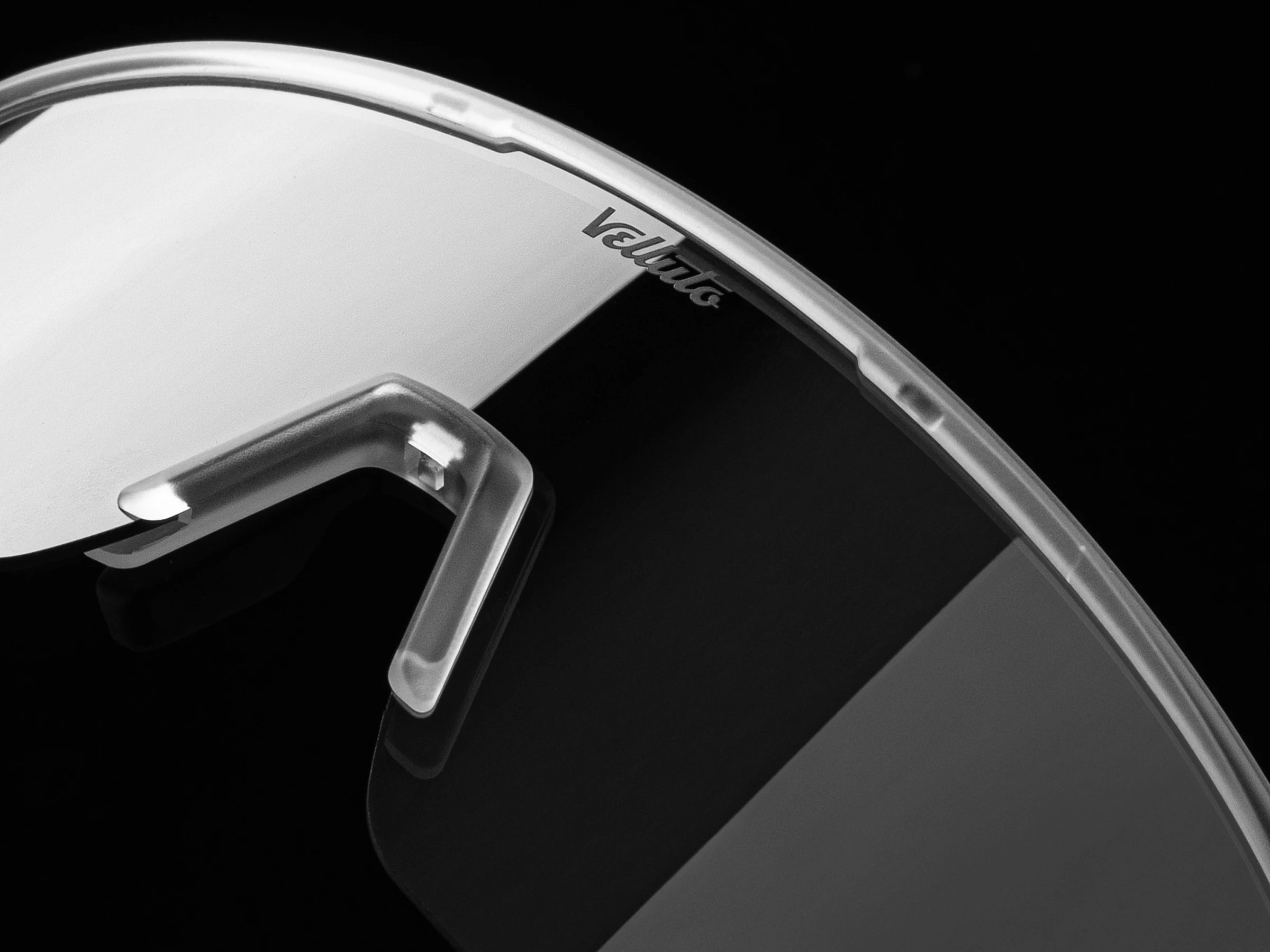
Base curve is the underlying optical concept here. Cycling lenses are curved to match the geometry of the face, but the curvature needs to be optically corrected so that a curved lens still behaves like a flat one to the eye. Well-made lenses are ground or moulded to compensate for the curvature. Lower-quality lenses skip this step or execute it inconsistently, particularly toward the edges. This is not something manufacturers advertise widely, which makes the at-home straight-line test your most reliable screening tool before committing to a pair.
It is also worth noting that lens distortion can interact with existing refractive error in a way that amplifies both. This guide does not cover prescription correction, which falls outside Velluto's product range and requires an optometrist's input. What it can say is that optically clean lenses with consistent base-curve geometry are the right starting point for any rider, with or without refractive needs.
04 · Cause threeFogging: why climbs blur and descents clear
If your vision blurs specifically on climbs and then clears once you descend, you are almost certainly dealing with fogging rather than any of the other three causes. The physics is straightforward. On a hard climb, your body generates significant heat and moisture. Your breath rises across the lower face and reaches the inner surface of the lens. The lens surface, cooled slightly by ambient air, causes the warm moisture to condense. The result is a film of tiny water droplets that scatter light and degrade clarity.
On the descent that follows, speed increases, airflow around and through the frame increases, and the condensation evaporates. Vision clears. This gives the problem a very clean diagnostic signature: it follows your effort level and your speed almost exactly. The faster you climb, the worse it gets. The faster you descend, the quicker it clears.
Two factors drive the severity of fogging. First, the gap between your facial skin temperature and the ambient air temperature: this is why fogging is worse in autumn and spring, but can still occur in summer at altitude, where air temperatures drop significantly even in August. Second, airflow through the lens system: frames that seal completely against the face trap warm air behind the lens with no exit, creating the ideal condensation environment. The solution is a ventilation system that moves air through the frame continuously, combined with a lens coating that disrupts the surface tension of water droplets before they can form a coherent film.
A built-in anti-fog system addresses both vectors simultaneously. The coating prevents droplet cohesion; the ventilation channels maintain airflow at low speeds when the rider's effort level is highest. The critical word is "built-in." A lens that relies purely on external airflow will fog the moment the rider slows, whether at a feed station, a traffic light, or the steepest section of a long col.

05 · Cause fourEye fatigue on long summer rides
Eye fatigue is the quietest of the four causes and the one most likely to be dismissed as general tiredness. It accumulates across a ride rather than appearing suddenly, and it is often worst in the final third of a long summer day when UV exposure has been sustained for four or more hours. The mechanism involves two parallel processes. First, the extraocular muscles that control focus and eye movement tire with sustained use, just as leg muscles do. Second, unfiltered or poorly filtered UV radiation causes photooxidative stress to the lens of the eye and the retinal surface, which manifests partly as reduced visual sharpness and increased sensitivity to glare.
The diagnostic signature of fatigue-related blur is gradual onset, worse late in the ride, often accompanied by a sense of heaviness or mild stinging in the eyes, and temporarily improved by closing the eyes for a few seconds. It does not track speed changes the way wind-related tearing does, and it does not appear as a surface film the way fogging does.
UV protection is the primary structural defence. UV400 certification means the lens blocks 100% of UVA and UVB radiation up to 400 nanometres. This is not marketing language. It is a measurable threshold that directly limits the photochemical load reaching the ocular surface over the course of a long ride. Cycling without UV400 certification on a full summer day is the optical equivalent of riding without sunscreen: the damage is not always immediate, but it accumulates across seasons.
Hydration plays a supporting role that most riders underestimate. The tear film, which is the optical surface your eye actually uses to focus light, is composed partly of water. Moderate dehydration, which is common in summer cycling, reduces tear film stability and contributes to optical blur independent of any equipment factor. On long rides in August heat, eye hygiene is part of your hydration strategy.
06 · LensesHow the right lens changes what you see
Once you have identified which cause or combination of causes is affecting your vision, the next question is which lens type addresses it. Not all blur problems are solved by a darker lens. Not all of them require a lighter one. The choice depends on what you are trying to solve.
For wind-related tearing and for UV fatigue, the priority is optical clarity and UV400 certification, not tint density. A clear lens that blocks 100% of UVA and UVB is more protective than a lightly tinted lens that does not. The VellutoPuro clear lens is built for exactly this scenario: full UV400 certification, anti-fog performance, and wind protection without any reduction in the light available to your eyes. For evening rides, early morning starts, and shaded forest roads, a clear lens is the only choice that maintains vision without creating additional darkness.
For the perceptual blur that comes from low contrast between tarmac and surroundings, specifically the flatness of overcast light that makes road surfaces and shadows merge, a high-contrast lens addresses something a clear lens cannot. The VellutoVisione high-contrast lens uses VellutoVisione technology to sharpen the boundary between light and dark areas in the visual field. This does not increase optical sharpness in the clinical sense. What it does is increase the perceived definition between surfaces that would otherwise appear similar in tone, making the road ahead feel visually crisper and easier to read at speed. This is particularly relevant on the kind of grey-sky autumn morning that follows a long summer season, when light conditions shift unpredictably.
The ability to swap between these two lenses without tools, using a click-in system that takes a few seconds, is what makes a two-lens setup genuinely practical rather than a theoretical feature. If your morning descent is sun-drenched and your return climb is in overcast shade, you want to be able to change lens characteristics at the feed stop without reaching for a toolkit. The lens swap also means you are not choosing between protection and visibility: you carry both and use each when conditions require it.

07 · The StradaProHow the Velluto StradaPro addresses each cause
It is worth being specific about how the StradaPro's design features map to the four causes described above, because the features are only useful if they address real problems.
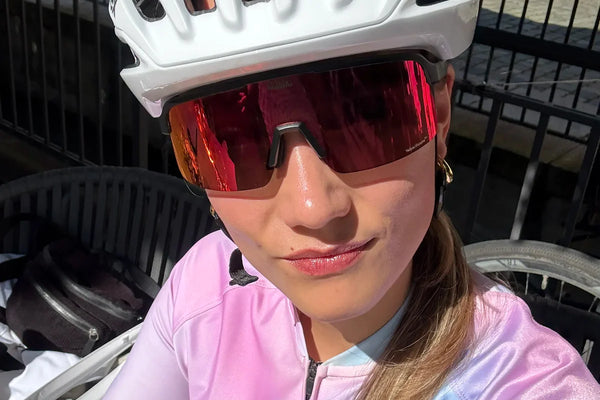
For wind-induced tearing, the wraparound frame geometry creates a partial boundary between the moving air and the eye surface. The adjustable nose pads let you position the lower edge of the lens to close the gap through which turbulent air typically enters. This is not a sealed goggle arrangement, which would remove the ventilation that prevents fogging. It is a calibrated compromise that reduces the direct airstream without eliminating airflow.
For fogging, the built-in anti-fog system works on both vectors: the lens coating disrupts droplet cohesion on the inner surface, and the frame design channels air through the lens area to maintain evaporative airflow during low-speed efforts. The combination means the lens does not depend solely on descending speed to stay clear.
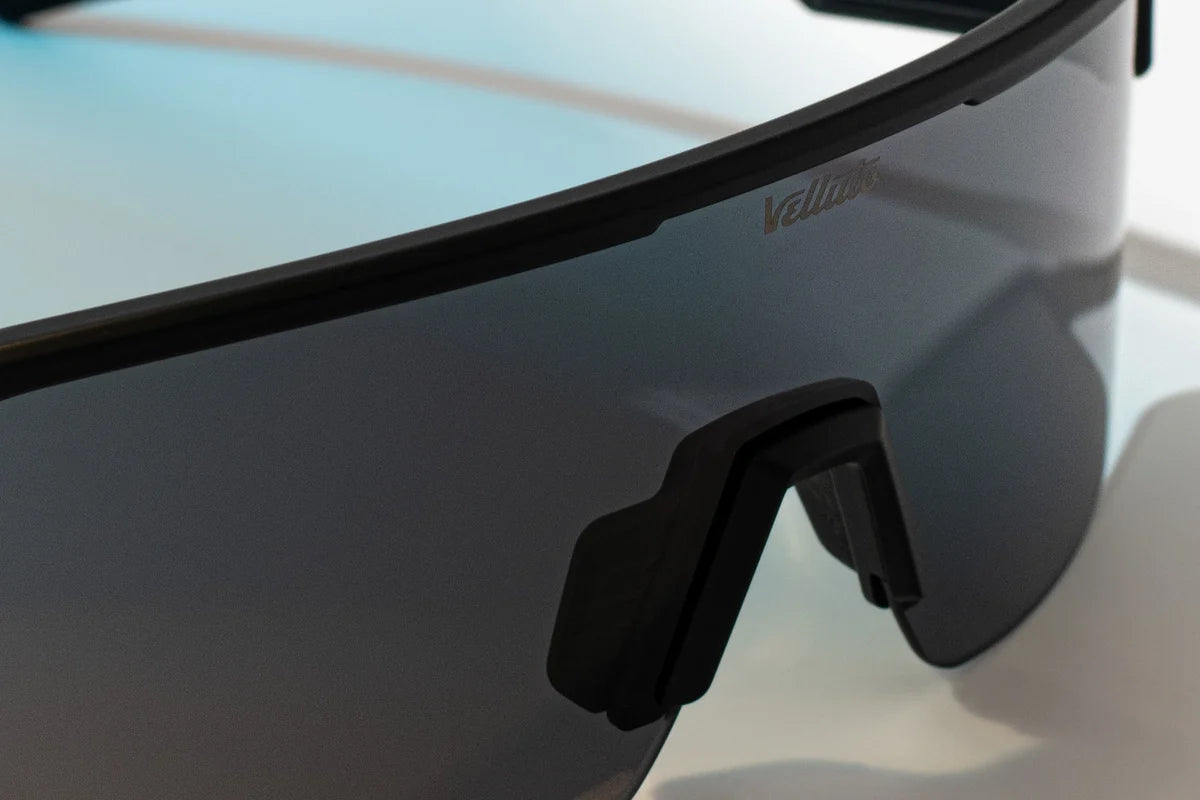
For lens distortion, the lenses are made to consistent optical standards across the full surface. You can apply the at-home straight-line test to any pair of StradaPro glasses and check this yourself. The geometry is consistent from centre to edge.
For UV fatigue, both the VellutoPuro and VellutoVisione lenses carry UV400 certification. 100% of UVA and UVB is blocked across the lens surface. This applies at every tint density in the range, including the clear VellutoPuro lens.
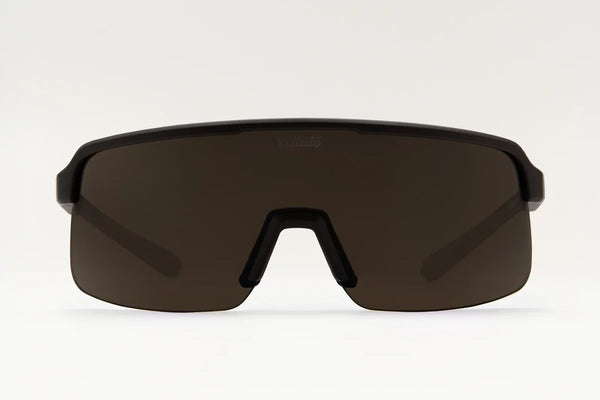
The frame weighs 25 grams. This is relevant not just as a comfort statistic but as a fatigue factor on long rides. A heavier frame creates more pressure on the nose and temples over four to six hours, which distracts attention and contributes to the general fatigue load that affects visual performance late in a ride. At 25 grams, the StradaPro stays below the threshold most riders notice.

08 · MaintenanceThe lens surface you are not thinking about
A cause of visual degradation that sits outside the four main categories but affects all of them is lens contamination. Smeared lenses do not announce themselves the way fogging or tearing do. The effect is subtle: a mild reduction in contrast and sharpness that you might attribute to tired eyes or overcast conditions, when the actual cause is a film of road oil, sunscreen residue, insect debris, or salt from sweat on the lens surface.
On a summer ride this accumulates faster than most riders expect. Sunscreen is particularly problematic because it is oil-based and bonds to the lens coating rather than sitting on the surface like water droplets. Wiping a contaminated lens with a dry jersey or bare fingers spreads the contamination rather than removing it and can scratch the coating if there are any abrasive particles present.
A purpose-made microfiber cloth and a lens-specific cleaning spray are the practical solution. The Velluto Cleaning Spray is a 50ml apple-fragrance formula made in Germany, packaged in a refillable container that fits in a jersey pocket. Paired with a 25x25cm microfiber cloth (80% polyester, 20% polyamide), it removes oil-based contamination without leaving a secondary residue. Cleaning the lens before a descent, when optical performance matters most, takes about fifteen seconds and removes one variable from the vision-quality equation entirely.


Compare the full lineup in the Velluto StradaPro cycling glasses collection.
09 · FAQFrequently Asked Questions
Why does my vision go blurry when I cycle at high speed?
What is the difference between fogging and wind-related blurring?
Can lens edge distortion cause blurry vision on fast descents?
Does eye fatigue cause vision blur during long rides?
What UV protection do I need for cycling glasses?
Do high-contrast lenses help with blurry vision on fast descents?
How do I know if my cycling glasses are causing distortion rather than my eyes?
Why does vision blur specifically on climbs, then clear on descents?
Can the fit of cycling glasses affect vision clarity?
If blurry vision at high speed has been costing you confidence on descents or dragging on your enjoyment of long summer rides, the starting point is diagnosing which of the four causes is actually affecting you, then addressing that cause with the right equipment. The Velluto StradaPro, with its built-in anti-fog system, UV400-certified interchangeable lenses, and adjustable fit, is designed to address all four. Try it on real roads for 30 days, risk-free, at velluto-shop.com.