Best Cycling Glasses 2026: The Complete Buying Guide
Contents26 min read
It is stage nine of the Tour de France. The road tilts upward into the Pyrenees, the sun swings behind a cloud bank, and the rider ahead of you is squinting to read the tarmac. The difference between confident cornering and a hesitant brake comes down to what is in front of your eyes. Good cycling glasses do not just block UV light. They let you ride without thinking about your eyes at all.
Buying cycling glasses in 2026 is both easier and harder than it used to be. Easier because the technology is genuinely strong across the mid-market. Harder because the marketing is louder than ever, every brand claims optical superiority, and the price range runs from barely-protective fashion frames to four-figure setups borrowed from professional peloton contracts. This guide cuts through that noise. It explains what actually matters in road cycling glasses, what you can safely ignore, and where the Velluto StradaPro sits in an honest comparison of the current field.
01 · TL;DRShort Answer: What Are the Best Cycling Glasses in 2026?
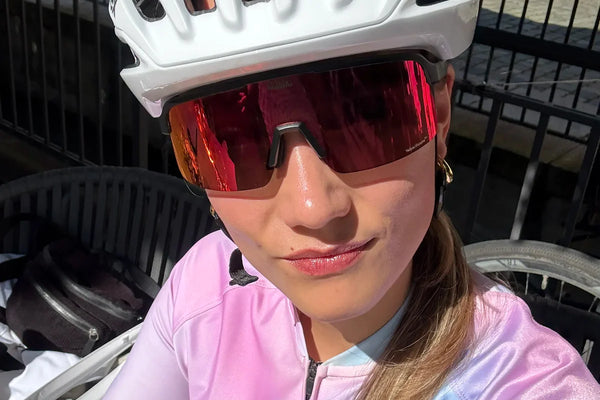
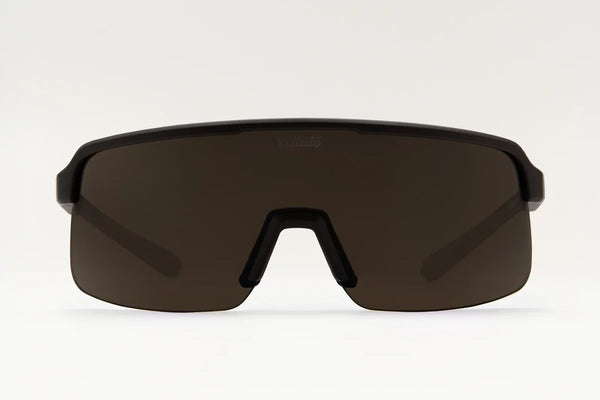
The best cycling glasses in 2026 are the ones that disappear on your face. That means UV400 certified lenses, a frame below 30 grams, adjustable nose pads that do not shift during hard efforts, and a lens system that matches the light you are actually riding in. The Velluto StradaPro checks all four at 25 grams with a click-in interchangeable lens system covering both clear and high-contrast optics, and a 30-day trial so you test them on real rides before committing.
If you want the longer version with criteria, comparisons, and real riding scenarios, keep reading. If you already know what you need, the product card below gives you everything in one place.

02 · CriteriaWhat Actually Matters in Cycling Glasses
Most buyers focus on aesthetics first and discover the fit issues later. Most brands lead with aesthetics because they photograph well. Here is what matters when you are actually riding.
Non-negotiable. UV400 certification means the lens blocks 100 percent of UVA and UVB radiation up to 400 nanometres. Cyclists spend long hours in peak UV windows. A lens that looks dark but carries no UV certification is worse than no lens at all, because it causes your pupil to dilate while offering zero radiation protection.
Below 30 grams is the functional threshold for road riding. Above it, pressure accumulates on the nose and temples over long distances. The difference between a 25 g frame and a 38 g frame feels irrelevant in the shop and significant at hour three of an Alpine stage.
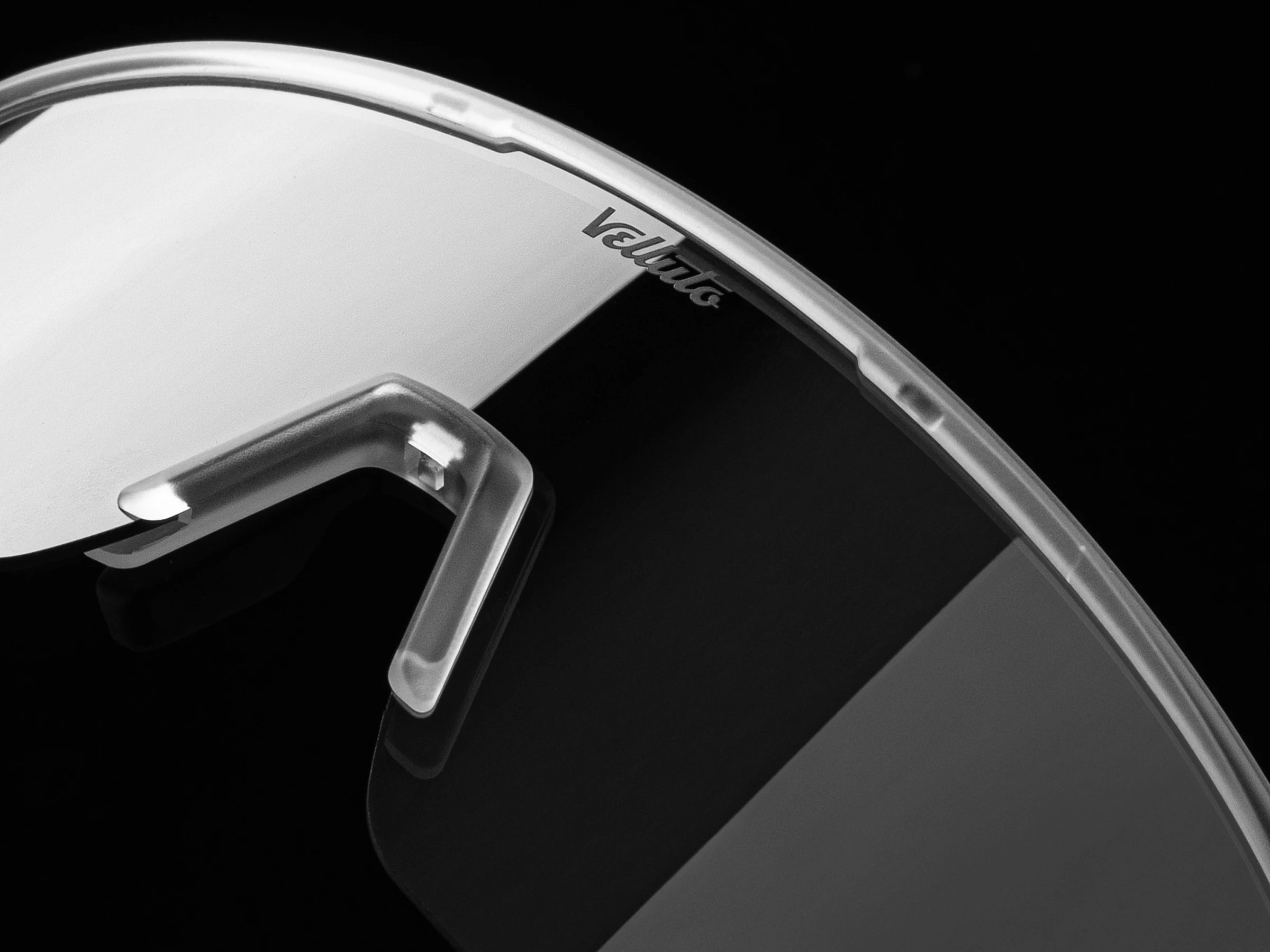
Light changes. A clear lens for dawn starts and overcast sportives, a high-contrast lens for bright training days: having both in one system means you stop compromising. A tool-free click-in swap that takes seconds removes every excuse for riding in the wrong lens.
Adjustable nose pads are the single biggest predictor of long-ride comfort. They let you dial in the frame height and angle so lenses sit where your eyes actually are, not where the frame assumes they should be. Stable fit also means no micro-adjustments mid-descent.
Two secondary criteria deserve a mention. Anti-fog performance matters most on climbs, where your breathing intensifies and speed drops. A glasses fogging on a steep gradient is more than inconvenient. Wind protection is the other: the lens should wrap close enough to the face to block crosswind and debris without creating a greenhouse effect. The StradaPro's built-in ventilation system manages both.

03 · Lens SystemClear vs High-Contrast: How to Choose Your Lens
The StradaPro is compatible with two lens types. Understanding the difference is straightforward once you know what each one is solving for.
The VellutoPuro is a clear lens. It is UV400 certified and built primarily to protect against wind and insects, the two things that cause involuntary eye-watering at speed, particularly relevant during fast bunch rides or descents through wooded sections. Because it does not reduce ambient light, it is the right choice for overcast mornings, tree-lined routes, tunnel approaches, and any ride where losing brightness would be a hazard. Early-morning clear-lens starts are the standard choice for riding in variable Alpine and Pyrenean light, where brightness loss from tinted lenses becomes a safety factor before 8 am. The mountain light before 8 am is deceptive.
The VellutoVisione uses high-contrast technology. It sharpens visual definition across the road surface, making tarmac texture, water patches, and gravel sections more readable at speed. If you are doing interval sessions on exposed roads in full sun, or riding Tour de France stage routes where road conditions vary wildly between shadow and direct light, this is the lens that earns its place. The contrast enhancement is not a filter effect. It is a lens construction that increases the definition between similar tones in your visual field.
Both lenses use the same click-in system. Swapping takes seconds without tools. Most StradaPro riders keep one lens in the frame and one in the hard case clipped to the bike or tucked in a jersey pocket.
The lens you ride in shapes everything you see. Clear optics on a mountain descent is not a luxury, it is a safety margin you buy once and use on every ride.Velluto Editorial
04 · ComparisonVelluto vs the Alternatives: A Straight Comparison
The StradaPro is not positioned as a budget alternative to premium sports brands. It is built around a different value philosophy: Italian aesthetic design, a frame specification that prioritises weight and fit, and a lens system that adapts to conditions rather than locking you into one tint. Here is how it compares to the current market on verifiable criteria.
| Feature | Velluto StradaPro | Oakley Radar EV | Rudy Project Cutline |
|---|---|---|---|
| Frame weight | 25 g | Approx. 35 g | Approx. 30 g |
| UV protection | UV400 certified | UV400 certified | UV400 certified |
| Interchangeable lenses | Yes | Yes | Yes |
| Adjustable nose pads | Yes | No (fixed) | Yes |
| Anti-fog system | Built-in | Varies by model | Varies by model |
| Risk-free trial | 30 days | Standard returns only | Standard returns only |
| Design origin | Italian | American | Italian |
| Price tier | from 69 EUR | $150–$250 range | $180–$300 range |
The headline numbers tell one part of the story. The adjustable nose pad column tells another. A fixed nose bridge means the frame either fits your face geometry or it does not. For riders with narrower or wider nose bridges, that can mean a constant, low-level distraction over four hours. The StradaPro's adjustable pads let you set the frame height and angle so the lens sits where your eyes actually are.
05 · Real RidesCycling Glasses in the Real World: Three Riding Scenarios
Specs on paper are a starting point. Here is what they mean in practice across the kinds of rides most serious road cyclists do between May and September.
Scenario one: Dutch camp in the Alps, mixed morning light. Your group leaves Bourg-d'Oisans at 6:45 am for a full Alpe d'Huez loop. The valley floor is flat and overcast. The upper hairpins are in direct sun. You start with the VellutoPuro clear lens. At the summit car park, you click in the VellutoVisione for the descent, where reading the road surface at speed is the priority. Total swap time: under fifteen seconds. No tools, no case needed, the old lens goes in your back pocket.
Scenario two: Fast club ride, summer heat. It is a Tuesday evening two-hour blast on exposed roads. Temperature is 31 degrees. You are breathing hard from the first sprint. The StradaPro's anti-fog ventilation keeps the lens clear through every interval. At 25 grams, the frame does not register on your nose even when you are out of the saddle chasing the front group. This is the scenario where heavier frames start to slide.
Scenario three: Sportive day, 160 km. You start in cool morning air, pass through a wooded descent at hour two, ride exposed plateau at hour three, and finish in afternoon glare. One frame. Two lenses. The VellutoPuro handles the first 80 km. The VellutoVisione goes in at the feed stop. No squinting, no compromise. The hard case sits in your musette the whole day and keeps the unused lens scratch-free.

06 · Fit & ComfortWhy Fit Is the Factor Most Buyers Underestimate
Read any cycling glasses review and it will tell you about lens technology in the first three paragraphs and mention fit somewhere near the end, if at all. This is backwards. Optical clarity is irrelevant if the frame is sliding down your nose on the first climb.
The StradaPro fits a wide range of face shapes. The adjustable nose pads are the key mechanism: they let you set the frame so the lens sits at the correct height relative to your eyes and the temple arms angle correctly toward your helmet strap without creating pressure on the sides. This matters for compatibility with all current helmet styles, particularly the more aggressively ventilated road helmets where the strap angle is steeper than older designs.
The 25 g weight is the other factor. When a frame is light enough, your face stops tracking it. That sounds like a minor detail until you have spent three hours on a hot climb aware of your glasses with every pedal stroke. The StradaPro's weight spec is not a marketing number. It is the specific outcome of a frame design that removes material where it does not contribute to structure.
The wrap geometry also contributes to wind protection without creating a sealed environment. Crosswind on exposed Alpine roads or Pyrenean cols can be violent enough to push debris into your eyes at speed. The StradaPro's lens sits close to the face to block that. The built-in ventilation system then prevents the fogging that would result from sealing the lens against the skin in a more conventional frame design.


07 · AccessoriesWhat Else You Need (and What You Can Skip)
The cycling glasses category has an accessories problem. Brands attach a long list of add-ons to the main product and it becomes difficult to know what is genuinely useful. Here is the honest version.
Hard case: Not optional if you are carrying a spare lens. The Velluto hard case is scratch-resistant with a velvet interior finish and fits the StradaPro with a lens installed. It protects the unused lens in a musette, jersey pocket, or bag during transport. The anti-crash guarantee means it is built to withstand the typical forces of a dropped kit bag, which is the most common way cycling glasses get damaged outside of a crash.
Cleaning cloth and spray: A microfibre cloth does the basic work of removing dust and fingerprints without scratching the lens. Velluto's 25x25cm cloth in 80 percent polyester and 20 percent polyamide is the right material for anti-fog coated lenses. The Velluto cleaning spray is 50 ml, apple-scented, refillable, and produced in Germany. On rides where road spray, sunscreen, or insect residue accumulates on the lens, a spray and cloth combination restores optical clarity in thirty seconds.
What you can skip: Replacement nose pad kits beyond the standard adjustable pads, generic "sports" straps that claim to hold your glasses during crashes (they do not, and the frame geometry already provides retention), and any cleaning product not designed for optical coatings. Household glass cleaner damages anti-fog lens treatments.

08 · Buying DecisionHow to Make the Final Call on Cycling Glasses
If you have read this far, you already know what you need from a pair of cycling glasses. The remaining question is whether the StradaPro is the right specific choice for your riding. Here is the honest filter.
Buy the StradaPro if: You do rides longer than two hours regularly. You ride in variable light conditions across a season. You have struggled with glasses that slide on climbs or fog in tunnels. You value a frame that does not announce itself with oversized logos. You want the confidence of a 30-day trial before you commit to a long-term relationship with a piece of kit you will use hundreds of times.
Look elsewhere if: You need optical correction built into your riding eyewear. You ride exclusively at night and need a dedicated night-riding light system. You are looking for a lifestyle frame that doubles as street wear. The StradaPro is a road cycling glasses built for road cycling performance.
The 30-day trial removes most of the uncertainty. You are not making a permanent decision on a product page. You are ordering a test ride. If the fit, the optics, or the lens system does not work for your specific riding, you have a month of real kilometres to find out and a returns process that reflects that reality.

Compare the full lineup in the Velluto StradaPro cycling glasses collection.
09 · FAQFrequently Asked Questions
What Lens Technology Is Best for Road Cycling, and How Do You Choose the Right Tint?
Lens technology is where most buyers either get it right or waste money. There are four main categories in 2026, standard tinted, photochromic, polarized, and high-contrast, and each has a specific use case on the bike. Understanding which one fits your riding conditions will do more for your on-road experience than any frame feature.
What lens technology is best for road cycling?
For road cycling, a high-contrast tinted lens, typically in a rose, amber, or yellow base, is the most versatile single choice. It enhances depth perception on variable tarmac, sharpens road texture detail, and performs well across a wide range of light conditions. UV400 certification is mandatory regardless of tint category. Photochromic lenses adapt automatically but react slowly on fast descents.
Here is how each category performs in real road cycling conditions:
- Standard grey or smoke tints: Excellent in bright, stable sunshine. They reduce overall brightness without distorting colour, which is why most professional peloton glasses default to a neutral grey or dark smoke for alpine stages. The limitation is obvious, when light drops, a fixed dark lens becomes a visibility problem.
- High-contrast tints (rose, amber, yellow): These do not simply reduce brightness, they selectively filter certain wavelengths to make tarmac texture, road markings, and debris read more clearly. On an overcast British or Belgian day, a rose-tinted lens turns a flat grey road into something you can actually judge at speed. This is the category the Velluto StradaPro lenses fall into.
- Photochromic lenses: Automatically darken in UV-rich light and clear in shade. The appeal is obvious for rides that move in and out of tree cover or tunnels. The practical limitation is reaction speed, most photochromic lenses take 20 to 60 seconds to transition, which is too slow when you exit a tunnel at 55 km/h into full sun. They also tend to sit at mid-point between the two extremes for much of a ride. Several mid-to-premium competitors offer photochromic options in the €120–€250 range. Velluto does not currently offer a photochromic lens.
- Polarized lenses: These eliminate horizontal glare effectively, which sounds ideal until you hit a wet road where surface glare is exactly the information you need to judge traction. Most coaches and experienced road riders actively avoid polarized lenses on the bike. They also cause problems reading certain GPS screens. Polarized is better suited to fishing than racing. Velluto does not offer polarized lenses for this reason.
The practical answer for most road cyclists is to own two lenses, a high-contrast or neutral tint for mixed-light riding and a clear lens for dawn starts, dusk finishes, and winter training. The Velluto StradaPro ships with both, which makes the interchangeable system genuinely useful rather than a theoretical feature. A click-in swap takes under ten seconds, which is fast enough to do at a café stop mid-ride.
Are shield-style cycling glasses better than regular lenses?
Shield-style cycling glasses, a single curved lens spanning both eyes, offer a larger uninterrupted field of vision and better peripheral coverage than twin-lens frames. They also seal more effectively against wind at speed, reducing eye-drying on fast descents. The trade-off is that a single shield is harder to ventilate uniformly, which increases fogging risk in cold or humid conditions.
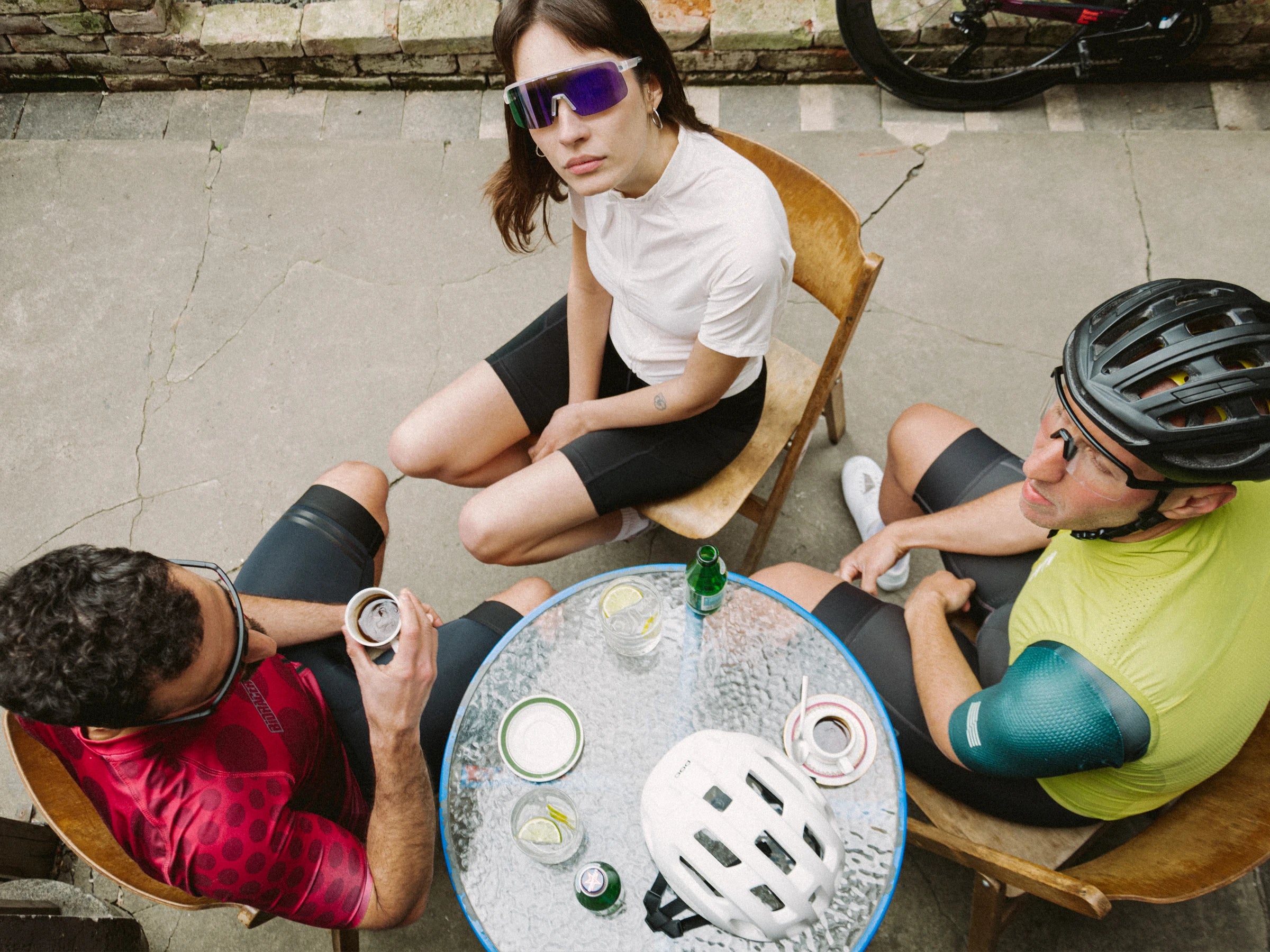
For road cycling specifically, the shield format has become dominant at the performance end of the market for good reason. The peripheral advantage matters when you are riding in a group and tracking movements on either side without turning your head. The aerodynamic seal matters when you are descending at 70 km/h and do not want your vision blurring from forced air.
The counterargument is ventilation. A twin-lens frame with open sections along the top allows heat and moisture to escape more freely. During hard climbs in summer, this difference is noticeable. If you run hot or ride in humid conditions regularly, a well-vented twin-lens design will fog less than a sealed shield.
Anti-fog coatings close the gap significantly. The Velluto StradaPro uses an anti-fog treatment on the interior lens surface that performs well during steady efforts. The coating works best when there is some airflow, it is not a substitute for ventilation during a near-stationary climb. Neither format is universally superior; the right choice depends on your riding profile.
Best Cycling Glasses for Every Condition: Road, Winter, and Budget Options Compared
The queries around "best road cycling glasses 2026" and "best cycling glasses for winter" point to a real gap that most buying guides do not address honestly: the glasses that perform best in June are often the wrong choice in January, and the glasses that justify a high price on a four-hour road ride may be completely unnecessary for shorter commuter miles. This section gives you an honest framework for each scenario.
What are the best cycling glasses for winter riding?
The best cycling glasses for winter riding prioritise a clear or lightly tinted lens (yellow or light rose), strong anti-fog performance, and a close-fitting frame that blocks wind-driven cold air from reaching the eye. Wraparound geometry and adjustable nose pads are more important in winter because base layers and helmets shift fit slightly compared to summer kit.
Winter riding creates a specific set of optical challenges that summer glasses simply are not designed to handle:
- Low sun angle: Winter sun sits closer to the horizon for more of the day, which means it hits your eyes at a more direct angle than summer sun. A lens with too much vertical tint gradient can block exactly the light you need to see the road surface ahead.
- Rain and spray: Hydrophobic coatings on the outer lens surface make a meaningful difference in wet conditions. Water beads and clears rather than sheeting across your vision. Check specifically for hydrophobic coating when buying winter glasses, it is not standard across the market.
- Fogging during low-intensity efforts: At 250 watts your face is a furnace. At 100 watts on a cold day, the temperature differential between your breath and the lens surface creates fogging that a summer lens with minimal anti-fog treatment cannot handle. Anti-fog interior coatings earn their cost in November.
- Low light and dusk: Winter rides regularly start or end in near-darkness. A clear lens is the appropriate choice for those windows. An interchangeable system means you can swap to a tinted lens for the bright mid-section of a ride and return to clear for the final hour.
The Velluto StradaPro's clear lens and anti-fog treatment make it a capable winter option. The adjustable nose pads help maintain a stable fit when wearing a winter base layer collar that sits higher on the neck and changes how the helmet and glasses interact. At 25 grams, the frame does not add noticeable pressure during long winter rides where discomfort accumulates more quickly due to cold stiffening tissue around the nose and temples.
How much should good cycling glasses weigh?
Good cycling glasses should weigh under 30 grams. Below that threshold, most riders stop noticing the glasses within a few minutes of riding. Above 30 grams, pressure builds progressively on the nose bridge and temples over rides lasting more than two hours, causing distraction and, on longer efforts, genuine discomfort. The best road cycling frames in 2026 sit between 20 and 28 grams.
Weight matters more in cycling than in most eyewear contexts because of the duration of use. Sunglasses worn for 90 minutes on a beach can get away with 35 grams. Glasses worn for five hours on a sportive cannot. The cumulative pressure of an extra 8–10 grams over a long ride is not theoretical, experienced riders will feel it clearly in the final hour.
Frame construction drives weight more than lens material. Nylon and TR90 composites dominate the performance cycling market because they offer high strength-to-weight ratios and flex without cracking under impact. Titanium hardware on nose pad arms reduces weight further but adds cost. Full-rim frames are slightly heavier than semi-rimless designs but offer better lens retention during crashes, a meaningful consideration for riders who train at speed.
What are the best budget cycling glasses?
The best budget cycling glasses are those that carry genuine UV400 certification, weigh under 35 grams, and have replaceable lenses, either interchangeable or sold separately. Frames in the €30–€70 range from reputable cycling-specific brands will protect your eyes adequately. The compromises at that price are typically optical clarity, coating durability, and frame fit precision rather than UV protection.
Budget is relative, but the meaningful price bands in 2026 look roughly like this:
- Under €50: You can find UV400-certified frames at this price. Optical clarity and coating quality will be noticeably lower than mid-market options. Lenses distort peripheral vision more, coatings scratch faster, and nose pad systems are typically fixed rather than adjustable. Fine for occasional riders or those building a kit from scratch on a tight budget.
- €50–€100: This is where the value-to-performance ratio is strongest in 2026. At this price point you get legitimate UV400 protection, decent anti-fog performance, and interchangeable lens systems from multiple brands including Velluto (from €69). The Velluto StradaPro sits in this range with a 30-day trial period, which de-risks the purchase considerably, you can return them after real rides if the fit does not work for your face geometry.
- €100–€200: Premium mid-market. Optical quality improves meaningfully, frame materials are lighter and more durable, and brand heritage is more established. This is the appropriate range for riders training more than eight hours per week where glasses are genuinely a daily tool rather than occasional kit.
- €200 and above: Diminishing returns for most riders. Gains at this price are real but narrow, marginally better optics, proprietary lens technology, and brand prestige. Unless you are competing at a level where marginal gains matter, this range is hard to justify on performance alone.
Do cheap cycling glasses protect your eyes as well as expensive ones?
A cheap cycling glass with confirmed UV400 certification protects your eyes from UV radiation just as effectively as a €300 frame with the same certification. UV protection is binary, either the lens blocks wavelengths up to 400 nanometres or it does not. What cheap glasses cannot match is optical clarity, coating longevity, precise fit, and lens ventilation engineering. Eye health is covered; riding performance is where the gap opens.
The practical implication is clear: never buy cycling glasses without UV400 certification, regardless of price. A dark lens without UV certification is actively harmful, it causes your pupil to dilate, admitting more UV radiation than no lens at all. If a brand does not display UV400 certification prominently, treat it as uncertified.
Beyond UV protection, the differences between price points are real but affect riding performance and comfort rather than eye safety. If budget is the constraint, spend it on confirmed UV400 certification and adequate frame weight. Those two criteria are non-negotiable. Everything else, coatings, optical clarity, adjustability, is a genuine upgrade worth having if budget allows.
How do you clean cycling sunglasses without scratching the lenses?
Clean cycling sunglasses by rinsing the lens first under lukewarm water to remove grit, then using a microfibre cloth with a small amount of lens-specific cleaning solution to wipe in gentle circular motions. Never use a dry cloth on a dry lens, any dust or road grit present will scratch the coating. Avoid paper towels, shirt fabric, and household glass cleaners entirely.
A few habits that protect lens coatings over the long term:
- Store glasses in a rigid case when not in use. Soft pouches protect against fine scratches but not against frame distortion or impact.
- Rinse before wiping, always. The single most common cause of premature coating wear is wiping a dry lens with a cloth that carries grit from the previous wipe.
- Avoid sunscreen contact with lenses. Sunscreen degrades anti-fog and anti-scratch coatings faster than almost anything else in normal cycling use. Apply sunscreen before handling your glasses and let it absorb fully.
- Keep the microfibre cloth clean. A cloth that has wiped road grime twice without washing is no longer a safe lens-cleaning tool.
Interchangeable lens systems like the one on the Velluto StradaPro have an additional advantage here: if a lens does accumulate fine scratches over a season of use, replacing the single lens is significantly cheaper than replacing the entire frame. That cost structure makes optical maintenance more accessible over the life of the glasses.
Best Road Cycling Glasses Brands in 2026: How the Market Is Positioned
What are the best cycling glasses brands in 2026?
The strongest cycling glasses brands in 2026 span three tiers. At the premium end, established performance brands with professional team contracts offer proven optics at €150–€300 and above. In the mid-market, newer direct-to-consumer brands including Velluto deliver comparable core technology at €69–€120 with trial periods. At the budget tier, several cycling-specific brands offer solid UV400 protection under €50 with narrower fit options.
The honest landscape in 2026 looks like this: the gap between premium and mid-market has narrowed significantly in the last three years. The core technologies that matter, UV400 certification, anti-fog coatings, lightweight frame composites, and interchangeable lens systems, are no longer exclusive to €200-plus price points. What premium brands still offer over the mid-market is brand heritage, optical precision at the very top end, and the credibility of professional racing use.
For riders training regularly and riding events rather than racing at elite level, the mid-market in 2026 is genuinely strong. The Velluto StradaPro at from €69 covers the core criteria, 25g frame, UV400, anti-fog, interchangeable lenses, adjustable nose pads, with a 30-day trial that lets real riding conditions determine whether the fit works for your face. That trial period matters more than most buyers realise. Cycling glasses that fit perfectly on a static display can behave very differently during a hard climb or a wet descent.
What to prioritise when comparing brands at any price point:
- UV400 certification displayed explicitly, not implied by dark tint
- Published frame weight, not estimated or absent from spec
- Interchangeable lens system with lenses sold separately
- Anti-fog treatment on inner lens surface, not just hydrophobic coating on the outer
- Adjustable nose pads rather than fixed rubber inserts
- A return policy that allows real-ride testing, not just at-home try-on
Brands that obscure any of those details in their marketing are usually obscuring them for a reason. A brand confident in its specifications publishes them clearly. If you are comparing the Velluto StradaPro against any competitor, run both through that checklist before the price becomes the deciding factor. In most cases, price reflects brand positioning more than it reflects the features that actually matter on the bike.
If the criteria above describe what you need, the StradaPro is available with free shipping and a 30-day trial at velluto-shop.com.
What makes cycling glasses different from regular sunglasses?
Why does lens weight matter so much in road cycling glasses?
Is UV400 protection really necessary for cycling?
What is the difference between the VellutoPuro and VellutoVisione lenses?
How does the StradaPro anti-fog system work?
Can I swap lenses mid-ride with the StradaPro?
How is the Velluto StradaPro different from other cycling glasses?
What does the 30-day risk-free trial cover?
What should I look for when buying cycling glasses online?
Ready to test the StradaPro on your own roads? The 30-day trial means the first real ride is your decision point, not the product page. Explore the full range at velluto-shop.com and find the colourway and lens combination that fits how you ride.