Oakley Alternatives for Cyclists: Lighter, Sharper, 2027
Contents20 min read
You are standing in a bike shop, holding a pair of cycling sunglasses with a logo you recognise from every pro peloton you have ever watched. They are well-made. They look right. Then you check the price tag and something shifts: you are no longer deciding whether these glasses are good, you are deciding whether the name justifies the number.
That is the moment this guide was written for. Not to dismiss the established brands, several of which make genuinely excellent eyewear, but to give you a clear, spec-based answer to the question you are actually asking: what else is out there, and how do you evaluate it without being swayed by either heritage or hype?
This is an honest look at what cycling sunglasses actually need to do, what the market offers as Oakley alternatives, and where the Velluto StradaPro sits in that field. No fabricated tests, no star ratings, no manufactured comparisons. Just the specs that matter and the riding scenarios that reveal them.
01 · Short answerThe TL;DR on Oakley alternatives
If you want a direct answer before reading further: yes, there are cycling sunglasses that deliver UV400 certification, anti-fog performance, interchangeable lenses, and a stable helmet-compatible fit at a lower price than Oakley's premium tier. The Velluto StradaPro is one of them. It weighs 25 grams, carries UV400 certification, has a built-in anti-fog system, and comes with a tool-free click-in lens system. You get a 30-day risk-free trial to ride in them before you decide.
What differs relative to Oakley's highest-end models is the choice of lens technology: Oakley uses proprietary Prizm systems, while Velluto offers UV400 certification, high-contrast VellutoVisione lenses, and built-in anti-fog. What you gain is a frame built entirely around road cycling performance criteria, at a price point that reflects what the product is rather than what the product represents culturally.
If those trade-offs suit your priorities, read on for the full breakdown. If you are genuinely interested in Oakley's technology and willing to pay for it, that is a defensible choice too. The goal here is not to tell you which brand wins but to give you the information to decide for yourself.
02 · CriteriaWhat actually matters in cycling sunglasses
Before comparing brands or models, it helps to agree on what cycling sunglasses are supposed to do. The sport places specific demands on eyewear that casual or running sunglasses do not share: sustained physical effort at speed, variable weather, rapid transitions between bright and shaded sections of road, and the need for frames to stay precisely in place while your head is in a low aerodynamic position.
Here are the five criteria that separate genuinely useful cycling eyewear from glasses that merely look the part.
Not UV protection in a general sense. UV400 specifically means the lens blocks 100% of ultraviolet radiation up to 400 nanometres, covering both UVA and UVB. This is the threshold defined by EN ISO 12312-1, the European standard for sunglasses. Any lens without this certification is a risk, particularly if it is tinted: a dark lens without UV filtration dilates the pupil, actually increasing the amount of harmful radiation reaching the retina. Verify the certification, do not assume it.
Weight is not just a performance metric. On rides of two hours or more, heavier frames create cumulative pressure on the nose bridge and temple. At 30 grams or above, most riders notice this. At 25 grams (the StradaPro's measured weight), the glasses register as present but not intrusive. Combined with adjustable nose pads that distribute contact points, the difference over a four-hour sportive or a cyclocross race is tangible.
Autumn and winter cycling in particular exposes a critical flaw in many glasses: they fog the moment you ease off the pace. At the top of a climb, behind a bunch, in rain, or when you stop at a junction in cold air, temperature differential causes condensation. Glasses without an active anti-fog system force you to remove them exactly when you most need protection. For cyclocross racing and winter road training, this is not an optional feature.
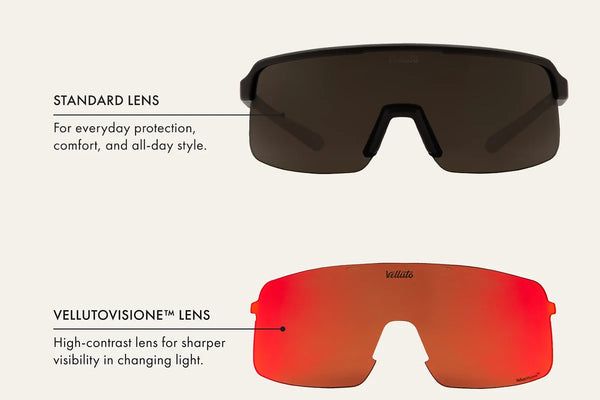
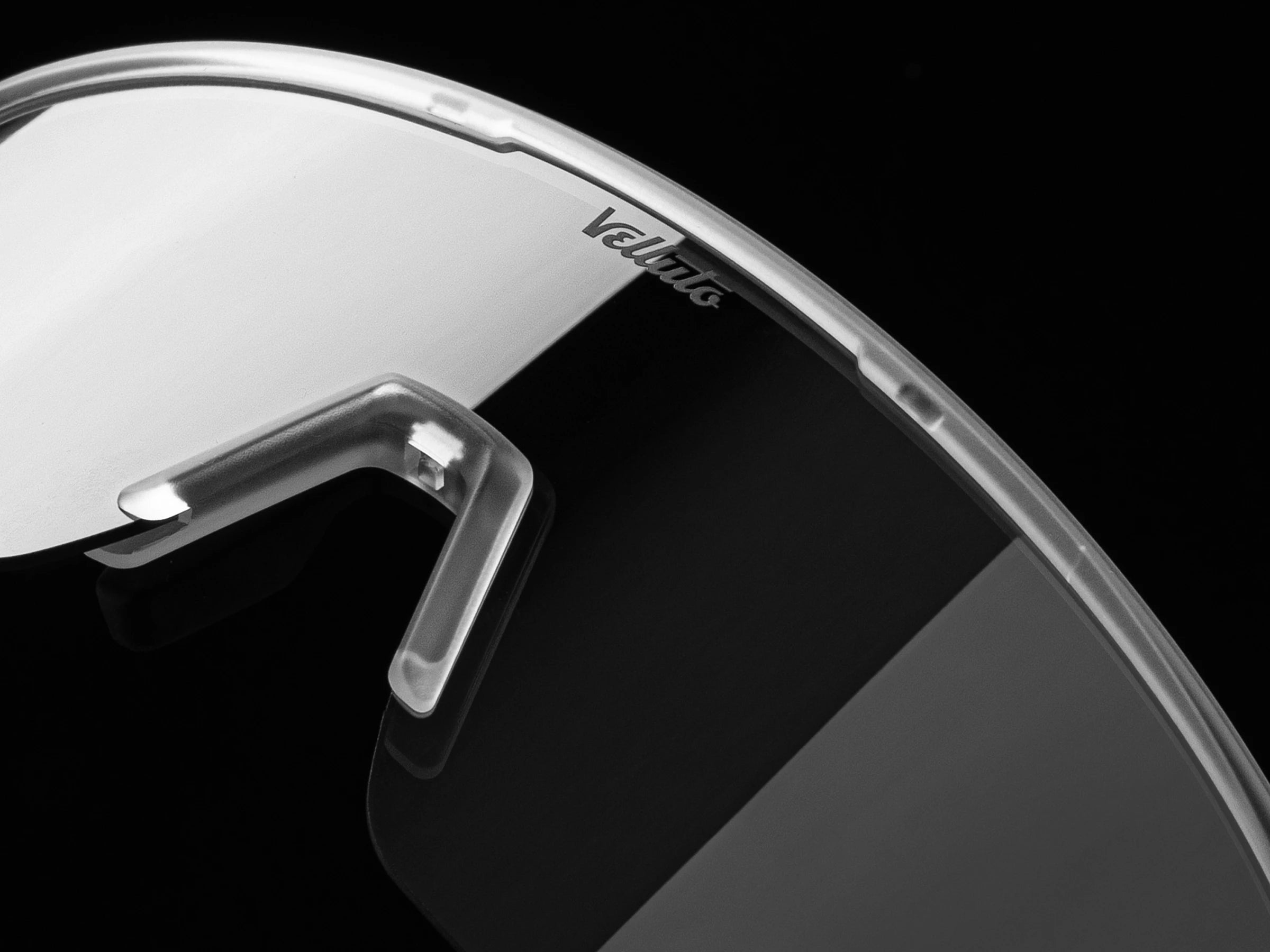
A single tinted lens is a compromise. Dark enough for a Mediterranean summer afternoon, it is too dark for a grey November morning in the forest. Interchangeable lens systems solve this by letting you carry two or more lenses and swap them without tools in seconds. The StradaPro uses a click-in system compatible with the VellutoPuro transparent lens and the VellutoVisione high-contrast lens: one for low light and wind protection, one for variable conditions where visual definition matters.
Fit is the fifth criterion, and it is the hardest to spec precisely because it is personal. What can be verified is the presence of adjustable nose pads (which give you a range of positions rather than a single contact point), a stable profile that does not shift when you look down at the road, and compatibility with a standard road helmet geometry. These are design decisions, not marketing ones, and they reveal themselves quickly on an actual ride rather than a shop fitting.

03 · Market overviewWhat the Oakley alternatives landscape actually looks like
Oakley occupies a specific position in the cycling eyewear market: premium pricing, proprietary lens technology, strong pro-team visibility, and a broad range covering road, MTB, and casual use. Their road cycling models are well-regarded and genuinely used at the highest level of the sport. That is not in question.
What is worth examining is whether the premium you pay for Oakley's flagship models reflects performance features that you will actually use on your rides, or whether part of that price represents category leadership, marketing investment, and the association with professional cycling.
Oakley's proprietary lens materials are genuinely engineered and represent significant research investment. Premium cycling eyewear across the market ranges widely in price; your choice should be based on which specific performance features (UV400 certification, anti-fog, interchangeable lenses, weight) matter most for your riding.
The cycling eyewear market now offers a wide range of price points and feature combinations. Brands including Rudy Project, 100%, Alba Optics, and newer entrants like Velluto now offer UV400-certified, anti-fog, interchangeable-lens systems across a wider price range. The question is not whether alternatives exist. It is which specific specs each delivers, and whether those specs match what your riding actually demands.
What follows is not a ranked list of the best cycling sunglasses on the market. It is a framework for evaluating any pair, applied to the StradaPro as the product we can speak to with verified specifics, with the broader market referenced where it adds useful context.
The question is not whether Oakley alternatives exist. It is which specs each delivers, and whether those specs match what your riding actually demands.Velluto Buyer's Guide, 2027
04 · ComparisonVelluto StradaPro vs the premium tier: a spec-based view
Rather than making claims about competitors that could become outdated or that rely on data we cannot verify independently, the most useful comparison is a transparent look at what the StradaPro specifically offers alongside the category benchmarks that the premium tier has set. You can then verify any competitor's current specs directly on their website and make a like-for-like assessment.
The table below sets out the criteria from Section 02 against the StradaPro's verified specs. It is not a head-to-head comparison with specific competitors (see the note on competitor specs above), but it gives you a consistent framework to apply to any glasses you are evaluating.
| Criterion | Velluto StradaPro | What to verify in any alternative |
|---|---|---|
| UV protection | UV400 certified (100% UVA + UVB) | Look for UV400 certification, not just "UV protection" |
| Frame weight | 25 grams | Ask for or find the published gram weight, not just "lightweight" |
| Anti-fog | Built-in anti-fog system | Distinguish between ventilation-only and active anti-fog coating or system |
| Lens system | Tool-free click-in (VellutoPuro + VellutoVisione) | Check whether spare lenses are available and at what cost |
| Nose pad | Adjustable, zero-pressure design | Fixed nose pads mean one fit position only |
| Trial period | 30 days, risk-free | Check the competitor's current returns policy directly on their site |
| Price entry point | From 69 EUR | Premium cycling glasses range broadly; check whether spare lenses are included |
| Colourways available | 4 (Arancia, Espresso, Nero, Viola) | Some brands offer customisation at additional cost |
| Helmet compatibility | Designed for road and gravel geometry | Wider frames may not fit cleanly under aero road helmets |
Use this table as a checklist when you are evaluating any pair of cycling glasses, including competitors not mentioned here. The goal is not to rank brands but to give you a consistent set of criteria so that your decision is based on verified facts rather than marketing language.

05 · Riding scenariosWhere the StradaPro performs: real-world context
Specs are abstract until you place them in the conditions where you actually ride. The following scenarios are drawn from the riding situations where cycling eyewear choices become genuinely consequential, rather than theoretical. They apply to the StradaPro specifically because those are the specs we can verify precisely.
Cyclocross racing: November mud, sprint starts, constant motion
Cyclocross is arguably the hardest test for cycling eyewear. You are racing in temperatures that sit between cold enough to fog and warm enough to sweat, often in rain or on wet grass, with repeated efforts that spike your heart rate and body heat. You crash. You run. You remount. The glasses need to stay in place through all of that.
The anti-fog system in the StradaPro is directly relevant here: the temperature swings between full-effort racing and momentary pauses behind a barrier or in a pit are exactly the conditions that reveal whether a glasses system actually manages condensation. At 25 grams, there is minimal leverage for the frame to shift when you are off the bike and running. The adjustable nose pads allow you to set the contact pressure before the race rather than tolerating whatever position the fixed pads land on.
For lens choice in cross conditions, the VellutoPuro transparent lens protects against mud spray, insects, and wind while maintaining maximum light transmission on overcast November days. If the race is under stronger light or if visual definition on a technical descent matters, the VellutoVisione lens clicks in without tools in the pits or before the race.
Winter road training: four hours in changing conditions
A four-hour winter road ride in central Europe will typically pass through several light conditions: grey overcast at the start, patches of low winter sun on a clear descent, shade in a valley, and potentially rain on the way home. No single tinted lens is optimal across all of those transitions. This is precisely the problem that an interchangeable lens system solves.
Starting with the VellutoPuro transparent lens for maximum light transmission in overcast grey, then clicking in the VellutoVisione once the sun breaks on a climb, takes seconds and requires no tools. You are not committed to a compromise: you can ride with the right lens for the conditions you are actually in, not the conditions you expected when you left the house.
The 25-gram weight across four hours means you are likely to notice the glasses less rather than more as the ride progresses. This sounds like a minor point and becomes a significant one around hour three, when anything that is creating friction on the nose or pressure behind the ear starts to compound.
The cyclocross spectator who also rides: mixed-use versatility
A specific but common scenario among road cyclists in autumn: you attend a cyclocross race as a spectator, you ride to the venue, and you want one piece of eyewear that covers both. The StradaPro's VellutoPuro lens is appropriate for riding in low or variable autumn light. Its UV400 protection means it is working even on overcast days (UV radiation penetrates cloud cover; a lens without UV400 certification is not protecting you even when it feels unnecessary). The frame is unobtrusive enough that it transitions from bike to field without looking out of place.
The sportive rider who wants to stop thinking about their glasses
For many riders, the ideal cycling glasses are ones they put on and forget about. That requires three things: a fit stable enough that the frame does not shift on descents or in a head-down sprint position, a lens clear enough that it does not intrude on visual acuity, and a weight low enough that there is no cumulative discomfort over distance.
The 30-day risk-free trial exists precisely for this scenario. You cannot know whether a pair of glasses will disappear from your awareness on a four-hour ride by trying them in a shop. You need to ride in them on your actual routes, in your actual conditions, before committing. The trial removes that risk.

06 · LensesUnderstanding the VellutoPuro and VellutoVisione lens system
The StradaPro's interchangeable lens system is worth examining in more detail because it represents a specific design philosophy: rather than a single lens that attempts to perform adequately across all conditions, you get two lenses optimised for different situations, with a click-in mechanism that makes switching genuinely fast and tool-free.
VellutoPuro: the transparent lens
The VellutoPuro is the StradaPro's clear lens. It is designed for road cyclists who need protection from wind and insects without any reduction in light transmission. This makes it the correct choice for pre-dawn training, overcast winter rides, forest sections with low or dappled light, and any situation where you want your eyes protected but cannot afford the visual darkening of a tinted lens.
UV400 certification applies to the VellutoPuro: transparency does not mean absence of UV filtration. The lens is clear to the eye while still blocking 100% of UVA and UVB radiation. This matters because many cyclists remove their glasses in low light precisely because they assume a clear lens offers no protection. The VellutoPuro addresses that assumption directly.
Anti-fog performance is built into the StradaPro system, so the VellutoPuro benefits from the same anti-fog architecture as the tinted lens. In cold, damp conditions, this is particularly important because a clear lens fogs more visibly than a tinted one.
VellutoVisione: the high-contrast lens
The VellutoVisione uses high-contrast filtering to sharpen visual definition and edge clarity. In practice, this is most useful in variable or mixed-light conditions: a road ride that passes between sun and shade, a gravel track where surface texture matters, or a cyclocross course where the difference between mud and grass is information you need to process quickly.
High-contrast lenses work by filtering specific wavelengths that reduce depth perception and edge definition. The result is that surfaces and objects appear more distinct rather than merely darker. For road cyclists, this translates to better surface reading on descents and improved visibility of obstacles in conditions where a standard tinted lens would flatten the visual field.
The VellutoVisione also carries UV400 certification and benefits from the StradaPro's anti-fog system. Like the VellutoPuro, it clicks in and out of the frame in seconds without tools.
A note on the Velluto Chromo
If you are specifically interested in a photochromic lens, that is a separate Velluto product: the Velluto Chromo, launched in October 2026 at 119 EUR. The Chromo's lens self-tints as you ride, running clear in low light and darkening to a mirrored finish in bright sun. It is available in four colourways: Nero Fumo, Nero Fuoco, Bianco Lago, and Bianco Viola. The StradaPro is a two-lens interchangeable system; it is not photochromic and does not have a mirrored finish. These are different products solving the same variable-light problem in different ways.

07 · Who should consider whatMatching eyewear to your riding: an honest guide
Different cyclists have genuinely different needs, and the right answer to "which cycling glasses should I buy" varies by rider. What follows is a straightforward attempt to match rider type to product characteristics, without inflating the StradaPro's case or diminishing alternatives.
The committed road cyclist who rides year-round
If you ride throughout the autumn and winter in northern or central Europe, variable light and weather resistance are your most pressing specs. The StradaPro's interchangeable lens system (clear and high-contrast lenses, tool-free swap) combined with its built-in anti-fog system addresses that directly. The 30-day trial means you are not making a blind commitment. This rider profile is where the StradaPro is most directly designed to perform.
The cyclist who wants Oakley's specific lens technology
Oakley's Prizm lens technology is a genuinely developed proprietary system with a specific approach to contrast enhancement and colour filtering. If you have used Prizm lenses and found them transformative for your riding, that is a real preference based on a real product feature. No article can tell you that preference is wrong. Oakley is a well-established, high-quality brand, and for cyclists whose riding demands or personal preference aligns with their flagship offerings, the investment is defensible.
The Velluto StradaPro does not replicate Prizm technology. It offers UV400 certification, a high-contrast VellutoVisione lens, and a built-in anti-fog system. These are different implementations of related goals. Whether one is better for you depends on your own riding and your own eyes.
The cyclist who values customisation above all
Several brands in the premium tier (100%, Alba Optics, and others) offer extensive colour customisation at additional cost. If the ability to specify your exact lens tint, frame colour, and temple finish is a priority for you, those brands' customisation programmes are worth exploring directly. The StradaPro offers four colourways (Arancia, Espresso, Nero, Viola) and two lens options; it does not offer bespoke customisation beyond those variants.
The cyclocross racer who needs confidence in variable conditions
For cross racing specifically, the combination of anti-fog performance, light frame weight, stable fit under physical stress, and lens versatility makes the StradaPro a direct fit. The 30-day trial period allows you to race in them before committing, which is a meaningful practical advantage in a category where glasses that fog or shift in a race are genuinely unsafe.

08 · ColourwaysThe StradaPro range: four variants, one system
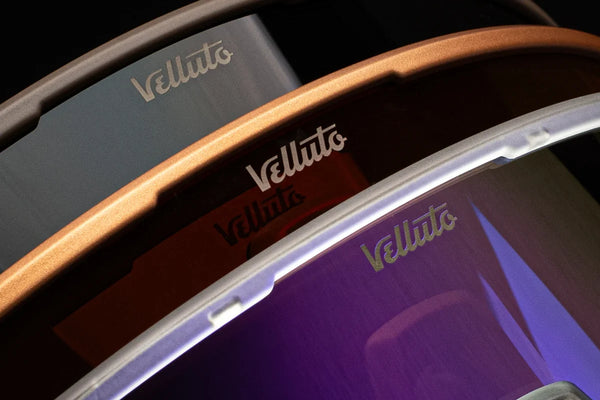
The StradaPro is available in four colourways. The frame architecture, weight, UV400 certification, anti-fog system, and lens compatibility are identical across all four. The choice between them is aesthetic.


All four colourways use the same VellutoPuro and VellutoVisione interchangeable lens system with the same click-in mechanism. The Nero is the most versatile match for kit in a range of colours. The Espresso suits riders whose kit leans towards earth tones or white. The Arancia is a high-visibility option that works particularly well in autumn light. The Viola is a more individual choice that pairs well with both black and purple-accented kit.
09 · FAQFrequently Asked Questions
Compare the full lineup in the Velluto StradaPro cycling glasses collection.
Are there cycling sunglasses as good as Oakley for less money?
Yes. Several brands now produce UV400-certified, anti-fog cycling glasses with interchangeable lens systems at a lower price point than Oakley's flagship models. The Velluto StradaPro, for example, starts from 69 EUR, weighs 25 grams, and includes a built-in anti-fog system alongside a tool-free click-in lens swap. Whether any glasses are "as good" depends on the specific features you prioritise, so the best approach is to identify your non-negotiables (weight, anti-fog, lens versatility) and match them to verified specs rather than brand reputation.
What should I actually look for in cycling sunglasses?
Five things matter most: UV400 certification (100% UVA and UVB blockage), weight (lighter frames cause less pressure and fatigue on long rides), anti-fog performance (critical on climbs and in cold or wet conditions), lens versatility (interchangeable systems let you adapt to changing light without buying multiple pairs), and fit (adjustable nose pads and a stable helmet-compatible profile make a significant difference on rough terrain or at speed).
What is UV400 and why does it matter?
UV400 is the certification standard that confirms a lens blocks 100% of ultraviolet radiation up to 400 nanometres, covering both UVA and UVB rays. It is the highest UV protection category defined under EN ISO 12312-1. Without it, lenses that simply darken the view can actually cause more damage: a tinted lens without UV filtration causes the pupil to dilate, letting in more harmful UV radiation. UV400 certification is non-negotiable for any serious riding, regardless of brand or price.
Do heavier cycling glasses cause problems on long rides?
Yes, noticeably so. Glasses that weigh 30 grams or more can create pressure points on the nose and behind the ears during rides of two hours or longer, particularly if the nose pads are not adjustable. The Velluto StradaPro weighs 25 grams and includes adjustable nose pads, which allows riders to distribute the contact area and reduce pressure during multi-hour efforts.
How important is anti-fog in cycling glasses?
Very important, especially in autumn and winter cycling. When you stop at a junction, crest a climb, or ride in cold rain, temperature differentials between your face and the lens surface cause condensation. Glasses without an active anti-fog system fog instantly and clear slowly, forcing you to remove them. The Velluto StradaPro has a built-in anti-fog system designed to handle the temperature swings common in cyclocross and winter road riding.
What is an interchangeable lens system and do I need one?
An interchangeable lens system allows you to swap the lens in your glasses without tools, adapting to different light conditions with the same frame. The Velluto StradaPro uses a click-in system compatible with the VellutoPuro transparent lens (ideal for low light and wind protection) and the VellutoVisione high-contrast lens (sharpens visual definition in variable conditions). If you ride across seasons or in changing light, one frame with two lenses is more practical and more economical than buying separate pairs.
What is the Velluto Chromo and is it different from the StradaPro?
Yes, they are distinct products. The Velluto Chromo is Velluto's photochromic model, launched October 2026 at 119 EUR. Its lens self-tints: it adapts as you ride, running clear in low light and darkening to a mirrored finish in bright sun. The StradaPro is a two-lens interchangeable system: you carry two separate lenses (VellutoPuro and VellutoVisione) and click in whichever suits the conditions. Neither is better in all situations; they solve the same variable-light problem in different ways. See the Chromo at velluto-shop.com/pages/chromo.
Are Velluto glasses compatible with road cycling helmets?
Yes. The StradaPro is designed for road and gravel cycling, with a profile that is compatible with standard road helmet geometry. The adjustable nose pads help you fine-tune the position so the frame does not shift when you look down in a low aerodynamic position, which matters equally on road bikes and in cyclocross racing where terrain is constantly changing.
Does Velluto offer a trial period?
Yes. Every Velluto StradaPro purchase comes with a 30-day risk-free trial. That means you can ride in them on actual training rides and races before committing. Free shipping applies to orders over 89 EUR.
10 · SourcesFurther reading
The following sources are cited for the technical standards and cycling context referenced in this article.
- EN ISO 12312-1: Eye and face protection, sunglasses and related eyewear (ISO standard reference)
- British Cycling: Eyewear and cycling (guidance on UV protection for cyclists)
- World Cycling League: Cyclocross equipment guidance 2026
If you are ready to try a pair on real rides before committing, the StradaPro's 30-day risk-free trial is the lowest-friction way to find out whether the specs translate to your riding. See the full range at Velluto cycling eyewear.