Cycling Sunglasses UV400: What the Standard Really Means
Contents22 min read
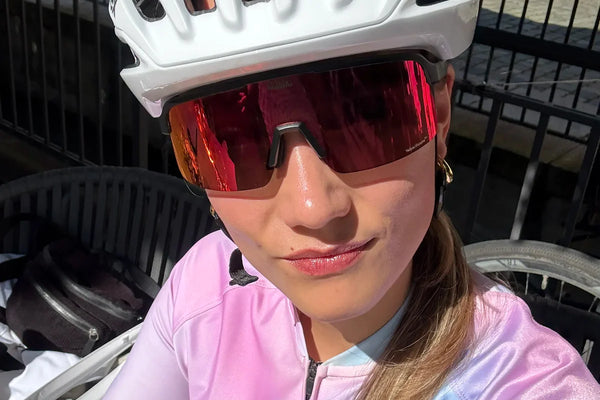
The peloton of the Vuelta a España rolls out of the start town into eight hours of Iberian summer sun: tarmac temperatures above 50°C, altitude passes where the atmosphere thins and UV intensity climbs hard, and riders who spend more time exposed to ultraviolet radiation on a single stage than most people absorb in a week. The glasses on their faces are not a style accessory. They are certified, tested, medically meaningful protection. And the standard that makes that protection real has three characters: UV400.
Most cycling sunglasses on the market carry some version of a UV protection claim. But what the label actually means, what it protects against, how you verify it, and why a surprising number of products fail to meet it genuinely are questions that get surprisingly little straightforward explanation. This guide answers all of them, starting with the physics and finishing with the practical decisions you make when choosing road cycling eyewear.
01 · The StandardWhat UV400 actually means
UV400 is a shorthand for a specific measurement threshold in optical certification. It means a lens blocks 100% of ultraviolet radiation up to and including 400 nanometres (nm) in wavelength. That single number covers the entire UV spectrum that reaches the Earth's surface, split across two bands:
UVB runs from approximately 280 to 315 nm. These are the shorter, higher-energy rays that cause the acute, rapid-onset damage most people can name: sunburn on skin, and the equivalent effect on the eye's cornea, called photokeratitis. If you have ever spent a long day skiing without goggles and woken up with gritty, aching eyes that feel like you have sandpaper under the lids, that is UVB doing its worst to your corneal surface. For cyclists, UVB is the immediate risk on any exposed summer ride.
UVA runs from approximately 315 to 400 nm. These rays are longer, lower in immediate energy, and far more insidious. They penetrate deeper into the eye, past the cornea and into the crystalline lens and retina. UVA does not announce itself with acute pain. It accumulates silently over years, contributing to cataract formation, age-related macular degeneration, and other forms of long-term retinal damage. The word "up to 400 nm" in UV400 exists precisely because this is where the UV spectrum ends and visible light begins. Blocking everything below that threshold blocks both UVA and UVB in their entirety.
Critically, UV400 says nothing about visible light. A UV400 lens can be clear, lightly tinted, very dark, amber, or any other colour. The UV filtering is a property of the lens material or coating, completely separate from how much visible light the lens transmits. This distinction has real consequences for cyclists, and we will return to it in detail.
02 · The ScienceWhy road cyclists face higher UV exposure than most outdoor athletes
UV exposure in cycling is not simply a function of how sunny the day feels. Several compounding factors push road cyclists into a meaningfully higher exposure category than someone walking, running, or even playing tennis for a similar duration outdoors.
Duration is the first factor. A typical endurance road ride runs three to six hours. Gran fondo events and training camps routinely push this to eight hours of continuous outdoor time. The total UV dose absorbed is proportional to time: even moderate UV intensity becomes significant when you are under it for half a day.
Altitude is the second factor, and it is one that climbers feel most acutely. Atmospheric thickness provides some natural UV filtration at sea level. For every 1,000 metres gained in altitude, UV intensity increases by roughly 10%. A stage finishing at 2,000 metres delivers approximately 20% more UV than the same duration at sea level. For cyclists targeting Pyrenean or Alpine rides, or the high-altitude climbs of the Vuelta, this is a substantial additional dose.
Surface reflection is the third factor. UV bounces. Pale road surfaces, light-coloured jersey fabrics, white painted road markings and cycle path surfaces all reflect UV upward toward the face. This reflected UV bypasses the brow's natural shade and hits the lower portions of the eye, the zones a standard visor cap offers no protection for. It is one reason why cycling eyewear needs full lens coverage rather than the narrow strip of a fashion sunglass.
Speed and angle are the fourth factor. Because you are moving quickly and maintaining an aerodynamic head position, UV arrives from multiple angles simultaneously: directly overhead, reflected from the road below, and scattered laterally from surroundings. The eye is exposed on vectors that casual sunglasses, designed for upright static wear, are not shaped to address.
The cumulative result is that a committed road cyclist training through spring and summer accumulates UV exposure that, without proper eyewear, would be considered clinically significant from an ophthalmological standpoint. The good news is that UV400 certified lenses eliminate the UV component of that risk entirely, regardless of how many hours you spend in the saddle.

03 · The ProblemWhy cheaper cycling sunglasses often fail the standard
Walk into any sports shop or browse any mass-market online retailer and you will find cycling glasses at every price point claiming UV protection. Many of those claims are accurate. A meaningful number are not, or are not accurate in the way the label implies. Understanding why requires a brief look at how UV blocking is actually achieved in a lens.
There are two legitimate routes to UV400 protection in an optical lens. The first is intrinsic UV absorption: UV-blocking compounds are integrated chemically into the lens material during manufacture. Polycarbonate, for example, has some inherent UV absorption, though cheaper unoptimised formulations may only block to around 380 nm rather than the full 400 nm. High-quality lens materials use formulations where the UV-absorbing chemistry is built in completely, so protection cannot wear off, chip, or degrade over time.
The second route is a UV-blocking coating applied to the lens surface. When done properly, under controlled manufacturing conditions, these coatings are effective. When done cheaply, they can be incomplete, unevenly applied, or subject to gradual degradation from UV exposure itself. A coating that blocks 400 nm on day one might offer less protection after two years of regular use and UV exposure.
The problem consumers face is that there is no visual way to distinguish a properly certified UV400 lens from an uncertified one. A dark lens looks protective. A tinted lens looks like it is doing something. The actual UV transmission is invisible. You cannot see UV, you cannot feel UV, and you will not notice the absence of UV protection until the long-term consequences begin to manifest, years after the rides that caused them.
Independent testing conducted by consumer protection bodies has found that a significant proportion of low-cost sports and fashion sunglasses fail to meet the UV400 threshold when spectrometrically measured. The issue is particularly prevalent in glasses sold for under 15-20 EUR on marketplace platforms, where quality control and certification documentation are often absent.
The additional irony is that dark lenses without proper UV certification may actually increase eye damage compared to wearing no glasses at all. A very dark tint causes the pupil to dilate (because the eye interprets the reduced visible light as low-light conditions), which then admits more UV into the eye than would have entered through a normally-constricted pupil in bright light. Dark without certified UV400 is not just ineffective: it can be counterproductive.
A dark tint with no UV certification can cause more UV damage than wearing no glasses at all, because it dilates the pupil while blocking nothing ultraviolet.Optical physics principle, widely documented in ophthalmological guidance
04 · The VerificationHow to confirm a cycling glass is genuinely UV400 certified
Genuine UV400 certification in European-market eyewear references specific standards. The one to look for in cycling sunglasses sold across the EU is EN ISO 12312-1, the international standard for sunglasses and related eyewear. This standard defines filter categories, UV transmission limits, and testing protocols. A lens that complies with EN ISO 12312-1 at the UV400 threshold has been independently verified to block 100% of radiation up to 400 nm.
The CE mark on eyewear sold in Europe indicates conformity with relevant EU safety requirements, including optical quality and UV protection thresholds. But a CE mark alone is not the end of the verification story: the mark indicates self-declared conformity, meaning the manufacturer has declared compliance. For eyewear purchased from established brands with documented quality control processes, this is typically reliable. For no-name products purchased from unverified market platforms, the CE mark may be present on the packaging without genuine underlying certification.
What to look for in practice:
First, check the product's technical specification sheet or documentation, not the hang tag or lens sticker. Properly certified products reference the standard number (EN ISO 12312-1 or equivalent ANSI Z80.3 for North American market products) and specify the UV transmission value. If documentation states only "UV protection" or "blocks 99% UV" without a standard reference, that is insufficient for confident verification.
Second, check whether the UV400 claim applies to all lenses in the system, not just the frame or primary lens. This matters particularly for interchangeable lens systems, where a brand might certify its standard dark lens but not its clear or lightly tinted interchangeable options. For cyclists who swap lenses for dawn rides, tunnel sections, or overcast days, this gap in coverage means they are riding unprotected precisely when they think they are covered.
Third, consider the brand's position in the market. Established cycling eyewear brands with multi-year track records in the European market have significant legal and reputational reasons to maintain accurate certification. A brand that openly documents its UV testing protocol and certification basis is offering a form of accountability that a bulk-produced unbranded product cannot.
05 · The Lens SystemUV400 across interchangeable lenses
The practical reality for most road cyclists is that no single lens tint is optimal for all conditions. A moderately dark lens that works well at noon on a cloudless August stage is too dark for a pre-dawn club ride and too little contrast for a foggy October morning in the hills. Interchangeable lens systems address this by allowing riders to carry two or more lenses and swap based on conditions.
The UV protection question for interchangeable systems is: does each lens individually carry UV400 certification, or does only the primary (typically darker) lens carry it? This matters because cyclists increasingly use clear or very lightly tinted lenses during the low-light portions of their rides, precisely the moments when they might assume UV is not an issue. But UV radiation is not simply a function of how bright the sky looks. Significant UVA reaches the eye even through cloud cover, and the cumulative UVA exposure from dozens of cloudy-day training rides is real.
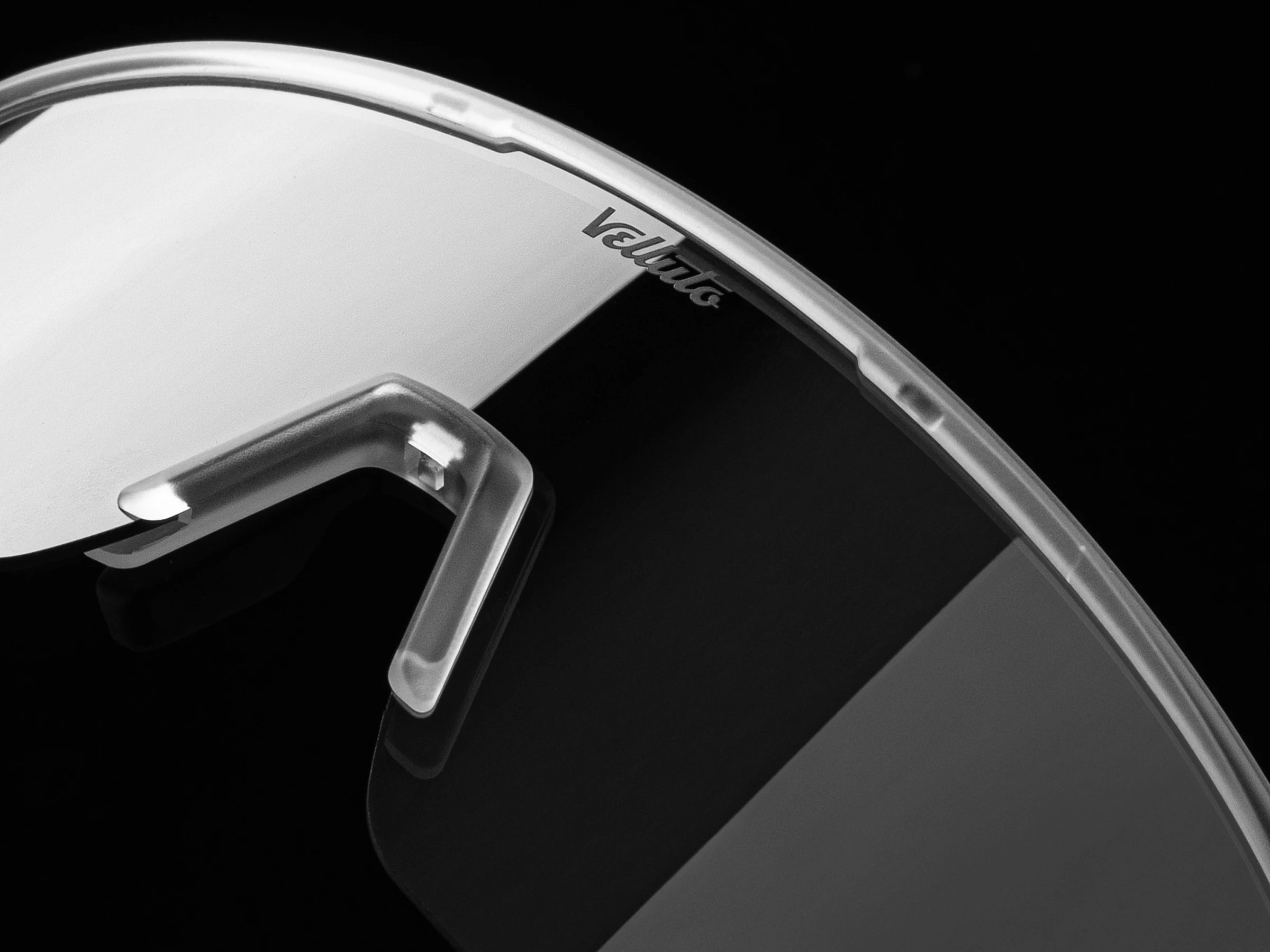
A well-designed interchangeable system certifies every lens to UV400 independently. Both the VellutoPuro clear lens and the VellutoVisione high-contrast lens in the Velluto ecosystem carry UV400 certification individually. Swapping lenses for a dawn training session or a rainy sportive does not mean accepting a gap in UV protection. The certification travels with the lens, not just with the frame.
The click-in swap mechanism matters here too, practically. A lens swap system that requires tools, significant disassembly, or careful handling under pressure is one cyclists will skip when they are at the base of a climb and conditions are changing. A fast, secure, tool-free click-in mechanism means the system actually gets used, which means UV protection is actually maintained across varying light conditions rather than defaulting to whichever lens was installed at home.

06 · The MarketHow established brands approach UV400 in 2026
Among the cycling eyewear brands at the upper and mid tiers of the market, UV400 certification is standard. Established brands including Oakley, Julbo, and POC all offer UV400 certified options across their road cycling ranges.
Where differentiation occurs is less in the UV400 binary (certified or not) and more in what accompanies it: weight, lens system breadth, anti-fog performance, fit adaptability, and value relative to specification. These are the dimensions where the comparison between established brands becomes genuinely useful for buyers, because the baseline UV protection is consistent across reputable players at this level.
The gap in the market that remains meaningful is between this established tier and the large volume of cycling glasses available at lower price points, often without a clear brand identity, where UV400 certification may be claimed but not independently documented. For cyclists buying in this zone, the verification steps outlined in section 04 matter most.
One structural difference that affects everyday UV protection in practice: whether a brand's interchangeable or secondary lenses carry the same UV400 certification as the primary lens. This matters because a rider who uses different lenses across varying light conditions needs UV400 protection on every lens to maintain consistent protection across all rides.
07 · The FitUV protection is only as good as coverage
Certification is necessary but not sufficient. A UV400 certified lens that sits away from the face, allows significant peripheral light ingress, or leaves the lower orbital area exposed is not delivering the protection its certification promises. Lens geometry and frame fit are the physical delivery mechanism for the optical certification.
Road cycling glasses are typically designed with wrap geometry: the lens curves around the lateral face to reduce peripheral UV entry, and the lower edge sits low enough to intercept the reflected UV bouncing off road surfaces. This is not aesthetic: it is the physical architecture that makes the certification meaningful in practice.
Nose pad fit is particularly important and often underestimated. A frame that rides too high or too low due to an unsuitable nose pad height creates a gap between the lower lens edge and the cheek, which allows reflected UV to enter from below. Adjustable nose pads allow the frame to be positioned correctly for different face geometries, closing this gap and ensuring the certified lens area is actually covering the eye and its immediate surround.
Frame weight matters for sustained coverage. A 25-gram frame stays in position through six hours of climbing, descending, and variable terrain without the rider pulling it off or repositioning it constantly. A heavier or more uncomfortable frame gets removed, and removed glasses provide zero UV protection. The weight specification on road cycling glasses is not a vanity number: it is directly related to whether the protection is actually maintained across the full duration of a ride.
Anti-fog performance is UV-relevant in a less obvious way. A fogged lens gets pushed up or removed by the rider, eliminating protection. The anti-fog system in a quality road cycling glass is not just about vision clarity on climbs: it is about keeping the glasses on the face and functioning as certified eye protection throughout the ride, including the sections where conditions change rapidly.

08 · The PracticeUV400 in real-world road cycling decisions
The certification discussion above is important groundwork, but most cyclists arrive at this question from a practical angle: which glasses should I actually ride in, and how do I know the UV protection is real? Here is how the principles translate to decisions on the bike.
For summer road riding in peak UV conditions, the lens tint should be moderate to dark in visible light transmission, which both reduces visual glare and helps the eye maintain healthy contrast perception in high-brightness conditions. UV400 certification is the baseline requirement; the tint category governs visual comfort. The VellutoVisione high-contrast lens is designed for road riding in variable and bright conditions, sharpening contrast and visual definition while carrying UV400 certification. It is the lens to reach for on a Vuelta-style long stage through exposed terrain.
For dawn rides, evening training sessions, forested routes, or the kind of late-summer sportive that starts in darkness and finishes in sun, the clear lens option becomes the practical choice. This is precisely where UV certification of the secondary lens matters. The VellutoPuro clear lens is UV400 certified and optimised for road cycling: it provides wind and insect protection with uncompromised optical clarity, and full UV protection in conditions where the light is low but UV remains present. Swapping between these two lenses takes seconds with the tool-free click-in system, so the decision to match conditions costs nothing in time or convenience.
For multi-day events, altitude-heavy routes, or the extended summer training blocks that serious amateur cyclists build into late July and August, the cumulative UV exposure across the block is the relevant number. A rider who protects their eyes on the sunny days but reaches for uncertified glasses on the cloudy days is still accumulating significant unfiltered UV exposure over the season. Consistent certified protection on every ride, regardless of apparent conditions, is the approach that actually addresses cumulative risk.
The anti-fog consideration becomes particularly important as August transitions into September, when morning temperature gaps between valley and summit widen, and the exertion of sustained climbing generates significant moisture. A lens that fogs on a col descent interrupts both visibility and UV protection simultaneously. The built-in anti-fog system in the StradaPro addresses this as a design requirement, not an afterthought, making sustained clear and protected vision reliable across the temperature and humidity variations of a full late-summer ride.

09 · The CleaningMaintaining UV400 performance over time
UV400 protection built into quality lens materials is inherently durable. Unlike surface coatings that can be compromised by improper cleaning, a lens where UV blocking is integral to the material itself will maintain its certification for the functional life of the lens. That said, lens care still matters for optical performance and longevity.
The main threats to lens performance over time are surface scratches (which affect optical clarity and light transmission, not UV blocking directly), and the degradation of any additional surface coatings (anti-reflection, hydrophobic) from aggressive cleaning agents. Using a proper microfiber cloth rather than a jersey hem or tissue prevents surface scratching. Using a cycling-specific optical cleaning spray rather than general household cleaners preserves any additional surface treatments.
Velluto's microfiber cleaning cloth (25x25cm, 80% polyester, 20% polyamide) is the correct tool for the StradaPro lens surfaces. Combined with the Velluto Cleaning Spray, a 50ml apple-fragrance formula made in Germany that is also refillable, the cleaning system maintains optical quality without compromising lens coatings or UV performance.
Physical protection matters too. A lens stored loosely in a jersey pocket or bag accumulates micro-scratches from contact with keys, zips, and other surfaces. The Velluto Hard Case, with its anti-crash guarantee and velvet interior finish, protects lens surfaces between rides and during travel to events. A lens in good optical condition is a lens the rider is confident in and keeps on their face, which is the practical requirement for sustained UV protection.
One practical maintenance note for interchangeable lens systems: each lens swap is an opportunity to check both lenses for any damage, fogging residue, or surface contamination before the ride rather than discovering it mid-climb. A 30-second check and wipe at the start costs nothing; discovering a compromised lens at 2,000 metres costs visibility, UV protection, and the comfort of the remaining descent.
10 · The ComparisonUV400 across cycling glasses categories in 2026
For cyclists evaluating the market in late summer 2026, the following summary places UV400 certification in the context of the broader specification landscape for road cycling eyewear.
At the premium tier, UV400 certification is standard and reliable across established brands. The meaningful differentiators at this level are frame weight, lens system design, fit adaptability, and anti-fog performance. Established options in the market include Oakley's Sutro Lite with integrated lens design, Julbo's Aerospeed with its ventilation geometry focus, and POC's Devour with its endurance road positioning.
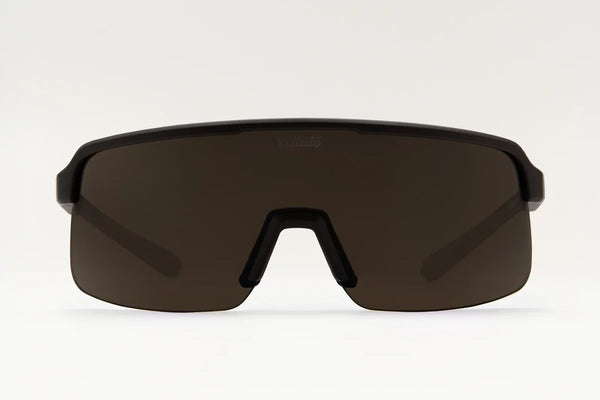
The Velluto StradaPro offers its own specification profile: 25 grams of frame weight, UV400 certification across both the VellutoPuro and VellutoVisione lenses, built-in anti-fog system, adjustable nose pads for fit adaptability across face shapes, and a 30-day risk-free trial that allows riders to confirm fit and performance on actual road rides before committing. The interchangeable lens system uses a tool-free click-in mechanism, so lens swapping between the clear and high-contrast options is practical rather than theoretical.
The table below places these options in a structured context. Competitor UV claims are taken from each brand's publicly available product documentation.
| Model | UV400 | Weight (approx.) | Interchangeable lenses | Anti-fog system |
|---|---|---|---|---|
| Velluto StradaPro | UV400 certified (both lenses) | 25 g | Yes (click-in, tool-free) | Built-in |
| Oakley Sutro Lite | UV400 (Plutonite material) | See manufacturer | Single-lens (no swap) | See manufacturer |
| Julbo Aerospeed | UV400 | See manufacturer | Yes (model dependent) | See manufacturer |
| POC Devour | UV400 | See manufacturer | Yes (model dependent) | See manufacturer |
Note: specifications for other brands are drawn from their public documentation where available. Always verify current specifications directly with the manufacturer before purchasing.
11 · The VariantsVelluto StradaPro: four colours, one standard
The StradaPro is available in four colourways, each with identical UV400 certification, identical frame specification, and full compatibility with both VellutoPuro and VellutoVisione interchangeable lenses. The colour choice is an aesthetic decision with no impact on protective performance.


Compare the full lineup in the Velluto StradaPro cycling glasses collection.
12 · FAQFrequently Asked Questions
What does UV400 mean on cycling sunglasses?
Are UV400 cycling sunglasses necessary for road riding?
What is the difference between UVA and UVB rays?
Why do cheaper cycling sunglasses often fail UV400 protection?
Does a darker lens tint mean better UV protection?
What are the best cycling sunglasses with UV400 protection in 2026?
Do interchangeable lenses on cycling glasses all have UV400 protection?
Can UV damage to eyes from cycling be reversed?
How do I know if my cycling sunglasses are genuinely UV400 certified?
Road cycling eyewear is a category where the gap between a certified product and an uncertified one is invisible to the eye and consequential over a lifetime of riding. UV400 certification, across every lens in the system, on a frame light and comfortable enough to wear for six hours, is the specification that turns a pair of glasses into genuine eye protection. The StradaPro is built around that standard from the ground up, with a 30-day risk-free trial so you can confirm it on your actual roads before committing. Explore the full range at Velluto cycling eyewear.