Cycling Sports Glasses Price: What You Actually Get

Contents25 min read
Il Lombardia has just finished and the peloton has hung up its race tyres for the season. But the rides keep coming: Sunday mornings in the Ardennes, long loops through the polders, the last of the sportives before November closes the window. Autumn light is honest and difficult, and it is exactly the moment when many riders stop and ask a question they have been putting off for months: what should good cycling eyewear actually cost, and what do you get when you pay more?
This guide is not a ranking or a product review. It is a breakdown of the specs that genuinely affect your ride, and the ones that are mostly there to fill a product page. The goal is simple: by the time you reach the end, you will know which cycling sports glasses price is worth paying for your situation, and why. Where Velluto products fit those criteria, they are described honestly and with full pricing. Where a spec is genuine, that is stated. Where a feature is marginal, that is stated too.
Every Velluto price quoted in this article appears only beside the specific product that carries it. No totals, no savings, no bundles. Just the information you need to decide.
01 · What you are actually paying forThe real anatomy of a cycling glasses price tag
Walk into any cycling shop or open any browser tab and you will find cycling glasses spanning an enormous range of prices. The frames at the lower end and the frames at the higher end often look similar on a hook or in a thumbnail. So what is different?
The honest answer is: sometimes a great deal, sometimes very little. The specs that matter on a road bike are not always the ones that attract the headline price. Understanding which features are structural and which are marketing allows you to read any product description more clearly, regardless of the brand or the number at checkout.
There are four areas where price genuinely tracks performance in cycling eyewear. There are at least two where it frequently does not. Start with the ones that matter.
02 · Spec oneUV protection: what the standard actually means
UV400 is a certification, not a marketing term. It means the lens blocks 100 percent of ultraviolet radiation up to 400 nanometres, covering the full UVA and UVB spectrum. It is the most important optical safety standard a pair of cycling glasses can carry, and it is non-negotiable for anyone riding outdoors.
What UV400 is not: a premium feature. It is achievable at multiple price points and in multiple lens materials. The presence or absence of UV400 tells you whether a lens is safe; it does not tell you that a more expensive lens with UV400 protects your eyes better than a less expensive one with the same certification. Both block 100 percent. The number does not go higher.
When you are comparing glasses at any cycling sports glasses price, look for the UV400 label explicitly. If a product page lists a different standard, or no standard at all, treat that as a reason to look elsewhere. If two glasses both carry UV400, that particular column of the comparison is a draw, and you should move to the specs that are not standardised.
The Velluto StradaPro carries UV400 certification on its frame, and both the VellutoPuro and VellutoVisione interchangeable lenses are UV400 certified independently. The Velluto Chromo photochromic lens also carries UV400. Eye safety is not treated as optional at any point in the range.
03 · Spec twoFrame weight: why 25 grams feels different from 38 grams after four hours
Weight is one of the most concrete and verifiable specs in cycling eyewear, and it is also one of the most frequently ignored until it is too late. A pair of glasses that feels fine in the shop can become a source of real distraction on a four-hour autumn ride. The nose bridge pressure, the drift on descents, the moment you reach up mid-climb to push them back into position: these are not dramatic problems, but they are persistent ones. Persistent discomfort changes how you ride.
The difference between a 25-gram frame and a 38-gram frame is not enormous in your hand. On your face, across 120 kilometres of autumn road, it is noticeable. The lighter frame disappears; the heavier one stays present. For road cycling, where comfort over distance is part of the product, frame weight is a spec that justifies attention at any price point.
Lighter frames tend to require more precision in materials and construction, which is one reason weight tracks price to some degree in the higher end of the market. But it is not a linear relationship, and the published weight of a frame is something you can verify before you buy. Check it. Ask for it if it is not listed. A brand that does not publish its frame weight is asking you to trust something they are unwilling to measure.
The Velluto StradaPro weighs 25 grams. That number appears on the product page, and it is the number the frame is built to. It is not a range; it is not approximate.

04 · Spec threeAnti-fog performance: the feature that matters most when the season turns
Fog is not a nuisance. On a descent after a long climb, reduced visibility is a safety issue. On a wet autumn morning when pace varies and temperature drops between the forest and the open road, a lens that fogs is a lens you stop trusting.
Anti-fog performance is one area where cycling glasses genuinely diverge. Some frames rely on ventilation alone: airflow through the frame body carries moisture away from the lens surface, which works well at race pace but less well when you slow, stop, or drop into a sheltered section. A dedicated anti-fog system, whether coating-based or structural, addresses the problem at the source rather than relying on speed to compensate.
This is a spec that is harder to verify from a product page than UV rating or weight, because the language around it is inconsistent. "Ventilated" and "anti-fog" are sometimes used interchangeably by brands, and they are not the same thing. "Ventilated" means the frame allows airflow. "Anti-fog" means the system is specifically designed to prevent fogging in variable conditions. Ask which one you are looking at before you decide.
The Velluto StradaPro has a built-in anti-fog system. This is not described as a ventilation feature. It is the reason the glasses are specified for autumn and winter riding, where the conditions that cause fogging, cold air, variable pace, humidity, are most frequent. If you are buying glasses for this time of year specifically, anti-fog is not an optional extra. It is the specification that earns its place most directly on an October or November ride.
The lens that fogs on the first climb of the day is the lens you ride the rest of the day without. Anti-fog is not a comfort feature. It is a visibility feature.Velluto design brief, autumn 2026
05 · Spec fourLens systems: one lens or two, and why it changes the maths
Here is the practical problem that cycling glasses must solve: light conditions change constantly and dramatically across a single ride. The first hour of an autumn sportive might be dark, damp, and overcast. By mid-morning the sun is low and bright. A forest section drops the light again. The final hour might be anything.
There are two design responses to this problem. The first is a single lens that adapts: a photochromic lens that self-tints depending on light intensity. The second is a frame with interchangeable lenses that you swap when conditions change, carrying one lens per dominant condition.
Both approaches work. They suit different riders and different habits.
A photochromic lens adapts continuously and automatically. You do not think about it. The tint adjusts as you ride. The trade-off is that the adaptation happens at its own pace, which may not always match the speed at which light changes, and photochromic coatings add to the overall lens cost. For riders who want a single unified solution with no manual intervention, a photochromic model is the natural answer.
An interchangeable lens system requires a deliberate swap, typically at the start of a ride or at a natural pause. The benefit is that each lens is optimised for its specific condition: a clear lens for low light, a high-contrast lens for variable or bright conditions. The swap mechanism matters: a tool-free click-in system takes seconds and can be done with cold hands. A system that requires tools or careful alignment is less likely to be used on the road.
The Velluto StradaPro uses an interchangeable lens system. The click-in mechanism is tool-free: press, click, done. It is compatible with two lenses.
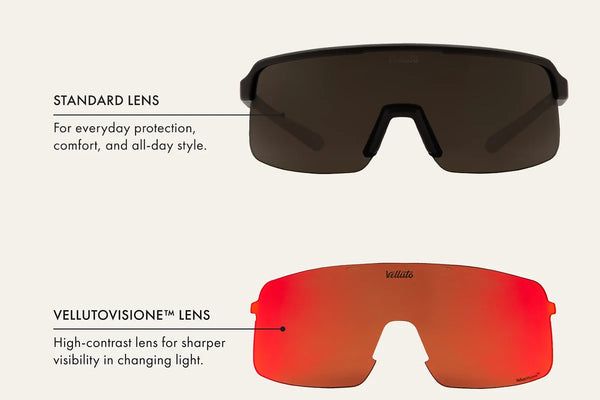
The VellutoPuro is a transparent lens. It is designed for road use in low light, with UV400 certification and anti-fog performance. It protects against wind and insects, which are genuine hazards at speed even when sun protection is not required. It is priced at 19 EUR and is sold separately for riders who want a spare or a replacement.
The VellutoVisione uses high-contrast lens technology to sharpen visual definition and improve depth perception in variable or bright conditions. It is designed for the kind of reading you do on an autumn road: judging surface texture, spotting gravel, tracking the rider ahead through changing light. It is priced at 39 EUR and is sold separately.
Note clearly: these lens prices are for the lenses purchased on their own, as individual accessories. The Velluto StradaPro Starter Vision Kit, which includes the frame, is priced from 69 EUR. Do not add lens prices to the kit price; the kit and the lenses are separate products for separate purposes.

06 · The photochromic alternativeVelluto Chromo: when one self-tinting lens is the answer
The Velluto Chromo is a different product from the StradaPro. It is worth understanding clearly, because the two solve the same underlying problem by different means, and the right choice depends on how you ride and what you value.
The Chromo is Velluto's photochromic model, launching in October 2026. Its lens is self-tinting: it reads ambient light and adjusts its tint automatically, running from clear in low light to a darkened, mirrored finish in bright sun. There is no manual intervention. You put the glasses on and ride; the lens does the rest.
This makes the Chromo particularly well-suited to autumn riding, where the light can shift from flat and grey to sharp and low-angle within a single hour, and where conditions are not always predictable enough to commit to a single fixed tint before you set off. The mirrored finish that appears in bright conditions also provides a visual comfort layer that a non-mirrored tinted lens does not.
The Chromo is priced at 119 EUR. It is available in four colourways: Nero Fumo, Nero Fuoco, Bianco Lago, and Bianco Viola. It carries UV400 protection.
What the Chromo does not offer is the interchangeable lens system of the StradaPro. There is no click-in mechanism, no separate clear or high-contrast lens option. The Chromo is a single self-adapting lens in a dedicated frame. The StradaPro is a fixed-tint interchangeable system in its own frame. They are not variants of each other; they are distinct products designed around different preferences for how a rider manages light.
If you know you want a single lens that adapts without intervention, the Chromo is the product to look at. If you want to choose and control your lens by condition, the StradaPro with its two-lens system is the answer. Both carry UV400. Neither is objectively better; the right one depends on how you ride.
Full details on the Velluto Chromo, including colourway images and specification, are at velluto-shop.com/pages/chromo.
You want to select your lens deliberately by condition, prefer separate clear and high-contrast options, and value a tool-free swap system. From 69 EUR.
You want a single lens that self-tints without manual intervention, including a mirrored finish in bright sun, and autumn light variability is your primary challenge. 119 EUR.
You ride frequently in dawn, dusk, or low-overcast conditions and want a dedicated clear lens for wind, insect, and UV protection without tint. 19 EUR, sold separately.
Variable and bright conditions are your dominant riding context and you want a high-contrast lens that sharpens surface detail and depth. 39 EUR, sold separately.
07 · The specs that are mostly marketingWhat sounds important but rarely changes a ride
Cycling eyewear marketing is sophisticated and often persuasive. Several features appear frequently on product pages and in price justifications that, on examination, have limited practical impact on what happens during a ride. Knowing these helps you focus your budget on the specs that actually matter.
Frame colour as a performance claim. A frame's colour affects nothing about how you see the road. It affects how the glasses look on your face and on the bike, which is a legitimate consideration, but it is a preference, not a performance differentiator. Do not pay a premium specifically for a colour option unless you are paying for a premium finish or material that happens to come in that colour.
Lens category numbers without context. Lenses are often described by a category number from 0 to 4, indicating light transmission. Category 0 is clear; category 4 blocks more than 92 percent of light and is not road-legal for driving in most European countries. The category number tells you about tint depth, not about optical quality or UV protection. A category 3 lens from a credible optical manufacturer will be better than a category 3 lens from a low-quality source, regardless of the number.
Case design and accessories. A glasses case protects a lens from scratching during transport. A microfibre cloth cleans a lens without scratching it. These are functional accessories worth having, but the quality of a frame is not determined by the quality of the case it ships in. If a premium case is included, that is a useful addition. If it is used as a primary justification for price, treat it with appropriate scepticism.
Brand heritage claims without product specifics. A brand's history in professional sport is not directly transferred to the glasses on your face. What transfers are the specs: the weight, the certification, the fit system, the lens quality. These are things that can be verified. "Worn by pros" is a marketing position, not a specification. Pros ride in all kinds of conditions with specific team-supply arrangements that do not necessarily reflect consumer availability. Read the spec sheet, not the sponsorship announcement.
Exotic materials described in marketing language only. If a product page describes a frame material in technical-sounding terms that do not appear in any objective specification (weight, flexibility, temperature range, durability standard), those terms are probably there to justify a price rather than to inform a decision. Ask what the measured outcome of the material is, not what it is called.
None of this means that expensive glasses cannot be excellent. Many are. But the features that justify a higher cycling sports glasses price are the ones you have already read about: UV certification, frame weight, anti-fog performance, and a lens system that matches how your riding conditions change. Everything else is secondary.
08 · Fit, nose pads, and the feature most buyers underestimateWhy secure fit is worth more than any lens coating
There is a simple test for whether cycling glasses fit well: on a hard climb, at the moment when your head is down and your breathing is at maximum effort, do the glasses move? Do they press? Are you aware of them? A pair of glasses that passes this test is, in practical terms, doing its job. A pair that fails is distracting you at the worst possible moment, regardless of what the lens costs.
Fit is determined partly by frame geometry and partly by the nose pad system. A fixed nose pad works well for the face shape it is designed around. An adjustable nose pad allows the rider to calibrate the position: higher or lower on the nose bridge, closer together or further apart, angled for their specific face geometry. For a brand selling to a general audience across multiple European markets, with riders of very different face shapes, an adjustable system is the only honest answer to fit.
The Velluto StradaPro uses adjustable nose pads. This is not a headline feature on the product page, but it is one of the most practically significant ones. A rider with a narrow nose bridge and a rider with a broader one can both wear the same frame and find a stable, pressure-free position. On a long autumn ride, that matters more than most optical specs.
Fit also determines whether anti-fog performance works as intended. A frame that seals well against the face in the right places allows the anti-fog system to do its job. A frame that sits too low or moves under effort creates gaps where humid air enters freely, defeating the purpose of any anti-fog treatment. The two features are connected. A well-fitted frame with a built-in anti-fog system performs better than a poorly-fitted frame with a theoretically superior coating.
When evaluating cycling glasses at any price point, try them on if possible, and if not, check the return or trial policy. A brand that offers a genuine trial period is one that is confident the glasses will fit and perform. That confidence is itself a form of quality signal.

09 · The 30-day trial and what it tells you about a productRisk-free purchase as a genuine specification
A return policy is not typically listed alongside UV rating and frame weight, but it should probably be given more weight than it is. Here is why: cycling glasses are a product where real-world performance is extremely difficult to predict from a product page. Anti-fog behaviour depends on your riding conditions, your pace profile, the temperature differential on your specific route. Fit depends on your face. Lens performance in variable autumn light depends on the specific climbs and descents of your specific rides. No photograph or spec sheet captures any of this.
A 30-day risk-free trial period means you can test the glasses on real rides, in real conditions, before committing. Not in a shop car park. Not on a turbo trainer. On the roads where you actually ride, in the weather and light of the season you are actually riding in. If the glasses do not perform as described, you return them.
This is a meaningful commercial commitment by a brand. It requires confidence in the product at a level that a standard 14-day statutory return window, which applies to unopened goods, does not. A 30-day on-the-bike trial is a different category of promise, and it changes the risk calculation for the buyer substantially.
The Velluto StradaPro comes with a 30-day risk-free trial. This means that the cycling sports glasses price you are comparing is not a committed spend until the glasses have done a month of actual riding. That is the kind of guarantee that makes the comparison more straightforward, because the outcome of the purchase is not final until you have tested the only thing that matters: how the glasses perform on your rides.
Velluto also offers free shipping on orders over 89 EUR. This is a shipping threshold, not a product price. The StradaPro Starter Vision Kit is priced from 69 EUR.

10 · Reading a cycling glasses spec sheetA practical checklist for any price point
Before making a final decision on cycling sports glasses at any price, run through these five questions. They apply to every brand and every product, including Velluto's own.
1. Does the lens carry UV400 certification? If not, or if the certification is not named specifically, that is the first and most important filter. Move on.
2. What is the published frame weight in grams? If it is not published, ask. A brand confident in its product publishes its weight. If the number is available, consider what that means across three or four hours of riding.
3. What does anti-fog mean for this specific product? Is it a dedicated system, or a ventilation design? Does the product page specify? For autumn and winter riding, this distinction matters.
4. Does the lens system match your riding pattern? If you ride in consistent conditions, a single fixed-tint lens may be sufficient. If light varies significantly across your typical route or across the season, an interchangeable or photochromic system will earn its keep. Be honest about your actual riding, not your ideal riding.
5. What is the trial or return policy? Not the statutory minimum, which applies to all online retailers by law, but what the brand specifically offers. A 30-day on-the-bike trial is a different proposition from a two-week window that applies to unused goods only. The terms matter.
These five questions do not require you to trust any particular brand. They require you to read the product page carefully and to hold it to a standard. The answers will tell you more about whether a price is justified than any marketing claim or comparison table built by the brand itself.
11 · The accessories: what actually adds valueHard case, cleaning cloth, spray, and what to skip
Cycling glasses are a precision optical product. How you store and maintain them determines how long they perform at the standard you paid for. The accessories that are genuinely worth having are the ones that protect the lens surface.
A hard case with a protective interior is the most important accessory. Lenses scratch in kit bags. The velvet-finish interior of the Velluto Hard Case is specifically designed to prevent contact scratching, and the anti-crash structure means the case protects during travel and transport, not just at home. It fits all road cycling glasses. If you are carrying a spare lens, the case is essential, not optional.
A proper microfibre cloth is the second essential. Wiping a cycling lens with a jersey or a piece of tissue is an efficient way to introduce micro-scratches. The Velluto Microfibre Cleaning Cloth is 25 by 25 centimetres, in an 80 percent polyester, 20 percent polyamide weave specifically selected for optical surfaces. This is the correct tool for the job. It is not glamorous. It matters.
The Velluto Cleaning Spray is 50 millilitres, apple-scented, refillable, and made in Germany. Used with the microfibre cloth, it removes sweat, road spray, and lens coating deposits without abrading the surface. The refillable design reduces plastic waste, which is a minor but genuine design consideration.
The Velluto TACX Bidon is a limited edition accessory: 500 millilitres, dishwasher-safe to 40 degrees Celsius, made in the Netherlands. It is worth mentioning because it is the only Velluto-adjacent product that is not made in Germany, and because it represents the kind of considered accessory that turns a single-item order into a practical kit bundle, particularly for riders who are replacing multiple items at the end of season.
What to skip: any accessory that adds presentation value but not functional value. Premium packaging, branded bags, or decorative items that do not protect the lens or the frame are preferences, not investments. Buy the case. Buy the cloth. Everything else is optional.
12 · Velluto StradaPro at a glanceThe complete specification in one place
For readers who have worked through the criteria and want to see how the StradaPro maps against them before making a decision, this section collects the full specification in one place. Nothing here is new to this article; it is the same information presented in the order the spec sheet would use.
Frame weight: 25 grams.
UV protection: UV400 certified on the frame. UV400 certified independently on both the VellutoPuro and VellutoVisione lenses.
Anti-fog: Built-in anti-fog system, designed for variable-condition road cycling.
Nose pad: Adjustable, for secure fit and zero pressure on long rides.
Lens system: Interchangeable click-in lenses, tool-free. Compatible with VellutoPuro (clear, 19 EUR sold separately) and VellutoVisione (high-contrast, 39 EUR sold separately).
Design: Italian design, produced for the road cycling market.
Trial period: 30-day risk-free trial.
Shipping: Free on orders over 89 EUR.
Kit price: From 69 EUR (Starter Vision Kit).
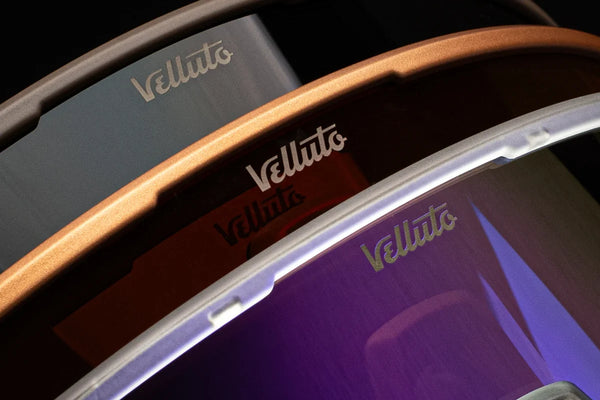
Colourways: Arancia (orange), Espresso (brown), Nero (black), Viola (purple).
The StradaPro is not a photochromic product. Photochromic performance and mirrored lenses are attributes of the Velluto Chromo, a separate product at 119 EUR. The two models are distinct. The StradaPro solves changing light conditions through its interchangeable lens system. The Chromo solves the same problem through a self-tinting photochromic lens. Neither replaces the other; they serve different preferences.


Compare the full lineup in the Velluto StradaPro cycling glasses collection.
13 · FAQFrequently Asked Questions
What is a fair cycling sports glasses price for a serious road cyclist?
Does a higher price mean better UV protection in cycling glasses?
Are interchangeable lenses worth the extra cost?
What is anti-fog performance worth in cycling glasses?
How much does a Velluto StradaPro cost?
What is the difference between the VellutoPuro and VellutoVisione lenses?
What is the Velluto Chromo and how does it differ from the StradaPro?
Is a 30-day trial period standard with cycling glasses?
Does frame weight matter at different cycling sports glasses price points?
The right cycling sports glasses price is the one that buys you the specs you will actually use on your actual rides. UV400 protection, a weight your face will forget, anti-fog performance for the season you are riding in, and a lens system that matches how your light conditions change: these are the features that earn their cost. The rest is context. If you want to see how the Velluto StradaPro and Chromo sit against those criteria with their full specifications, the complete range is at velluto-shop.com. The 30-day trial means the decision does not have to be final until the glasses have done a month of real riding.