Cycling Glasses for Long Distance Rides: Comfort at Hour 4+
Contents19 min read
Hour four of a 200-kilometre autumn ride and the glasses that felt invisible at the start have become the loudest thing on your face. A dull ache sits across the nose bridge. The lenses fogged on the last climb and only half-cleared on the descent. The frame is heavier than you remembered. None of this was a problem at kilometre 30.
Long distance cycling exposes every compromise in your equipment. A saddle that is merely adequate at 60 kilometres becomes genuinely painful at 140. A jersey that sits slightly wrong starts to chafe. Cycling glasses follow the same rule: the problems that are invisible on short rides accumulate into serious distractions on long ones. Choosing the right pair before a granfondo, an autumn sportive, or a multi-day audax is not a marginal gain. On a difficult day, it can be the difference between finishing strong and counting down the kilometres with one hand pressed against your face.
This guide focuses specifically on what happens to cycling glasses at hour four and beyond: the pressure mechanics, the ventilation physics, the lens fatigue that shorter rides never reveal. By the end, you will know exactly what to look for and what to avoid.
01 · The Core ProblemWhy short-ride glasses fail on long rides
Most cycling glasses are designed and tested at a ride length that most cyclists actually do: somewhere between 60 and 90 minutes. At that duration, a slightly heavy frame is not a problem. A nose pad that creates mild pressure is tolerable. A lens with marginal anti-fog performance will get you through one climb without embarrassing you in front of your group.
Extend that ride to four, five, or six hours, and the tolerances change completely. What follows is the specific failure sequence that repeats itself across every long distance cyclist who buys the wrong pair.
The first failure point is usually the nose bridge. A frame that weighs 30 or 35 grams sits on two small contact points for the entire duration of a ride. At 60 kilometres, your skin has barely registered the pressure. At 180 kilometres, the same force, applied continuously to the same spot, creates localised soreness that becomes genuinely distracting. This is not dramatic. It is the slow accumulation of a small discomfort, and it is almost entirely preventable with the right frame weight and the right nose pad geometry.
The second failure point is lens fogging. Autumn riding in particular, with its cool mornings, sun-warmed afternoons, and wet road sectors, creates precisely the temperature variability that exposes weak ventilation systems. When you climb hard and then tip into a shaded descent, the temperature differential between your exhaled breath and the inside of the lens is enough to condense moisture in seconds. If your glasses have passive ventilation only, clearing that fog depends entirely on airflow. If airflow is low, because you are moving slowly, climbing steeply, or riding in a sheltered valley, the lens stays foggy. On a short ride, this is annoying. On a long climb during a sportive, it can become dangerous.
The third failure point is less discussed: lens-induced visual fatigue. A lens tint that is optimised for one light condition will create visual stress in others. A dark lens in October forest roads, or a lens with optical distortion from poor-quality materials, forces your eyes to work harder to resolve the road surface. Over short rides, your eyes adapt. Over long rides, that adaptation comes at a cost. Visual fatigue is real, and it compounds with overall physical fatigue to degrade your concentration and your enjoyment significantly.
02 · Frame WeightThe grams that add up over 200 kilometres
Frame weight in cycling glasses is one of those specifications that sounds like a marginal detail until you experience the difference across a long day in the saddle. The relevant comparison is not between 25 grams and 50 grams. It is between 25 grams and 30 grams, or between 25 grams and 35 grams. In your hand, that delta is almost nothing. On your face for six hours, it is substantial.
The physics are simple. The nose bridge and temple contact points bear the full weight of the frame every moment you are wearing it. A heavier frame does not just sit there: it also transfers more force during vibration from road surfaces, it shifts position slightly more on steep descents when your head angle changes, and it requires small muscular adjustments from your face to keep it stable. None of these effects are dramatic at any single moment. Across 200 kilometres, they compound.
The practical guideline for long distance riding is to target frames at or below 25 grams. At that weight, most riders report that the glasses genuinely disappear from their awareness after the first 30 minutes. Above 30 grams, the frame remains present as a sensory object throughout the ride, which is a level of cognitive intrusion that costs concentration over time.

Frame weight also interacts with nose pad design. A heavy frame on adjustable nose pads distributes its weight across a larger, correctly-angled contact surface. A heavy frame on fixed nose pads concentrates that force on a small area at whatever angle the manufacturer chose. This is why nose pad adjustability matters more the heavier the frame. Conversely, a light frame with adjustable pads is the most forgiving combination available for long distance use.
03 · Pressure DistributionNose pads, temples, and the long-ride fit equation
Fit on cycling glasses is a topic that rarely gets the technical treatment it deserves. Most buying guides discuss fit in terms of coverage and style. For long distance riding, fit is an engineering problem with a specific anatomy: nose bridge pressure and temple pressure are the two dominant variables, and both are addressable with the right frame design.
Nose bridge pressure accumulates because most fixed nose pads are designed for an average face geometry that does not match every rider. When the pad angle is wrong, the contact footprint is small and the pressure per square centimetre is high. Adjustable nose pads solve this by allowing the contact surface to rotate until it sits flush against your specific nose bridge angle. The pressure is distributed across a larger area, and the rocking and micro-shifting that causes irritation over long rides is eliminated.
Temple pressure is less commonly discussed but equally important. Temples that are too tight grip the sides of the head with constant force. Over several hours, this creates the specific type of headache that many long-distance riders attribute vaguely to dehydration or eye strain, when the actual cause is mechanical compression. Temples that are too loose allow the frame to slip forward, requiring constant adjustment and creating the other failure mode: glasses that are permanently slightly in the wrong position.
The ideal long distance fit sits the frame securely enough that it does not shift during climbs, descents, or rough road sectors, but with zero active clamping pressure on the temples at rest. At that adjustment point, the glasses become genuinely invisible in the proprioceptive sense. You stop registering them as a discrete object on your face, which is exactly where you want your attention to be on a long, hard ride.
04 · VentilationWhy fogging gets worse as the ride gets longer
Anti-fog performance on cycling glasses is not a binary property. A lens does not simply fog or not fog. It foggs to different degrees depending on the delta between your face temperature and the ambient air temperature, the humidity, your exertion level, and how many transitions between those conditions you have been through in the previous few hours.
Short rides rarely stress a ventilation system fully. If you leave the house in stable autumn weather and ride at a consistent tempo on flat roads, even mediocre anti-fog performance may get you through without incident. Add a long climb at threshold effort, a shaded valley descent, a café stop that lets the lens cool down before you ride hard again, and a wet sector in the afternoon, and you have created four separate fogging events in a single ride. That is the thermal environment of a 200-kilometre granfondo, and it is the environment that reveals whether a glasses system actually works.
The technical solution to fogging is not ventilation alone, though airflow ports in the frame help significantly. The more robust solution combines frame ventilation with a lens coating or surface treatment that actively reduces the surface tension at which condensation forms. When both are present, the glasses can manage high-humidity, low-airflow conditions, which is precisely the scenario that occurs on a steep climb.

For autumn sportives in particular, the ventilation requirement is higher than it is for summer riding. October air is cold and humid. The temperature swings between sustained climbing and exposed ridge descents are larger than in July. Glasses that performed acceptably through the summer may fog repeatedly in October conditions. This is not a coincidence. It reflects the fact that most glasses are implicitly designed for summer use, not for the longer, colder, more variable days that define the autumn sportive calendar in northern Europe.
05 · Lens ChoiceWhich lens to use when the light changes every hour
An autumn ride over six hours will pass through several distinct light conditions. Pre-dawn grey. Low-angle morning sun. Shaded forest roads. Bright midday sectors. Flat cloud-filtered afternoon light as fatigue accumulates. Each of these conditions places different demands on a lens, and no single fixed tint is optimised for all of them.
The relevant choice for most long distance autumn riding sits between two options: a clear lens for maximum light transmission in all conditions, and a high-contrast lens that sharpens road surface definition in low and flat light. A dark lens, which is the default choice for many road cyclists, is rarely the right tool for October or November riding unless the event is confined to a bright midday window.
High-contrast lens technology works by filtering specific wavelengths that create visual noise in grey or overcast conditions. The effect is not that the image becomes brighter. It is that the road surface detail, the texture of tarmac, the edge of a pothole, the line of a painted turn marker, becomes more defined and easier to read at speed. On a long ride, this matters for two reasons. First, safety: better road reading at hour five, when your concentration is taxed, reduces the risk of an unplanned meeting with road furniture. Second, fatigue reduction: eyes that are working less hard to resolve the road surface accumulate less visual fatigue across the full duration of the ride.
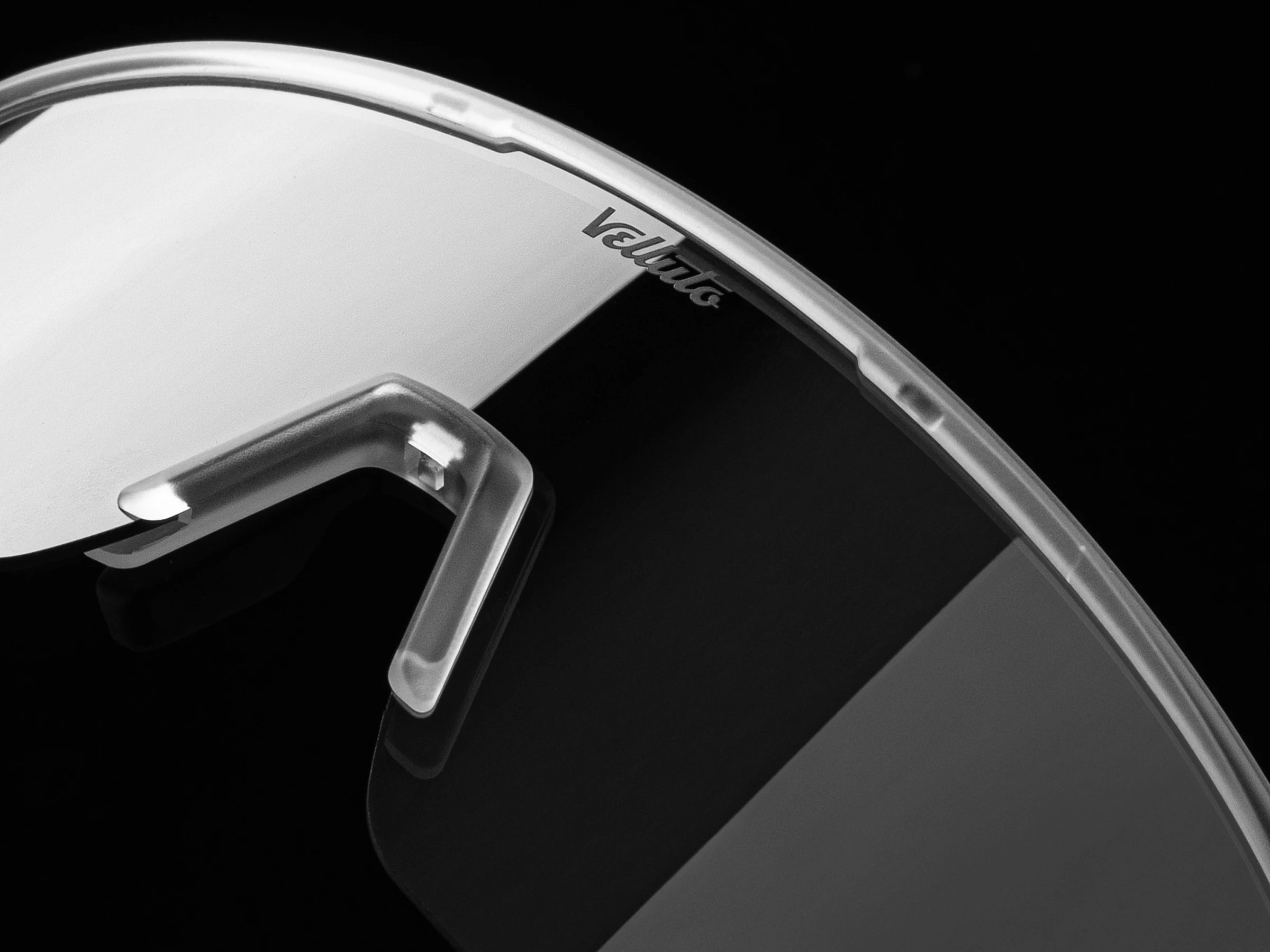
The practical answer for long distance riding in autumn is a frame with an interchangeable lens system. You leave the house with your high-contrast lens installed for the grey morning light. If the afternoon sun becomes intense, or if conditions change unexpectedly, a 30-second tool-free lens swap gives you the appropriate optic for the next sector. This is not a luxury feature. On an all-day ride, it is the most direct answer to a real problem that a fixed-lens frame cannot solve at all.
The lens that suits a bright July morning is not the lens that suits an October long ride. The best glasses for long distance rides are the ones that let you adapt.Velluto riding notes, autumn 2026
06 · UV ExposureAll-day rides and the case for UV400 certification
UV protection on cycling glasses is often treated as a given, but the standard varies significantly across price points and brands. UV400 certification means a lens blocks 100 percent of ultraviolet radiation up to 400 nanometres, covering the full UVA and UVB spectrum. This is the minimum standard you should accept for any serious riding.
The reason UV400 matters more on long distance rides than on short ones is cumulative exposure. A 60-minute ride delivers a relatively small UV dose. A six-hour autumn ride, particularly in September when sun angle is still high during the middle hours, delivers substantially more. Uncertified lenses with dark tints can actually increase UV damage: the tint dilates the pupil behind a lens that offers inadequate protection, admitting more harmful radiation than if the rider had no glasses at all.
UV400 certification is verifiable, not marketing language. A lens either meets the standard or it does not. When you are evaluating cycling glasses for a serious long distance event, UV400 should be a non-negotiable entry requirement, not a premium differentiator. Any frame without it should be ruled out at the first filter.
07 · The StradaProHow the Velluto StradaPro addresses each long-ride failure point
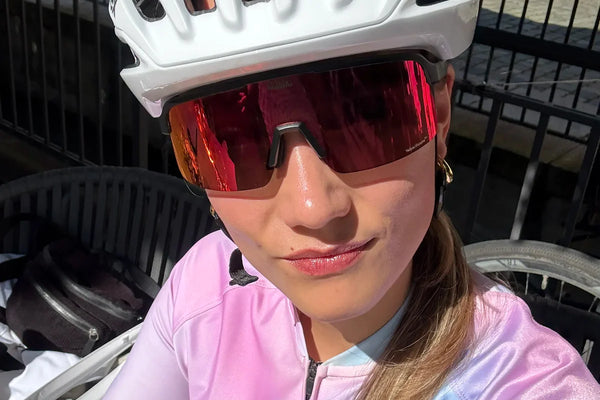
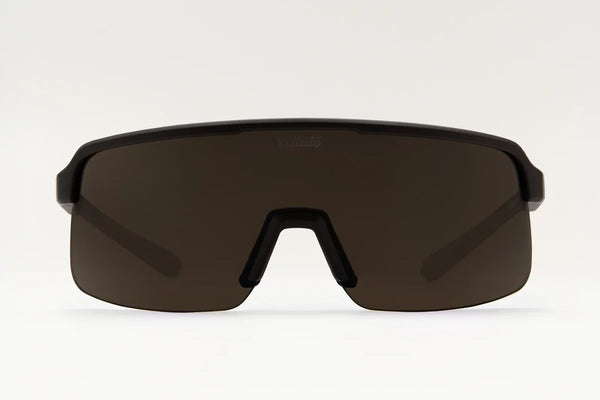
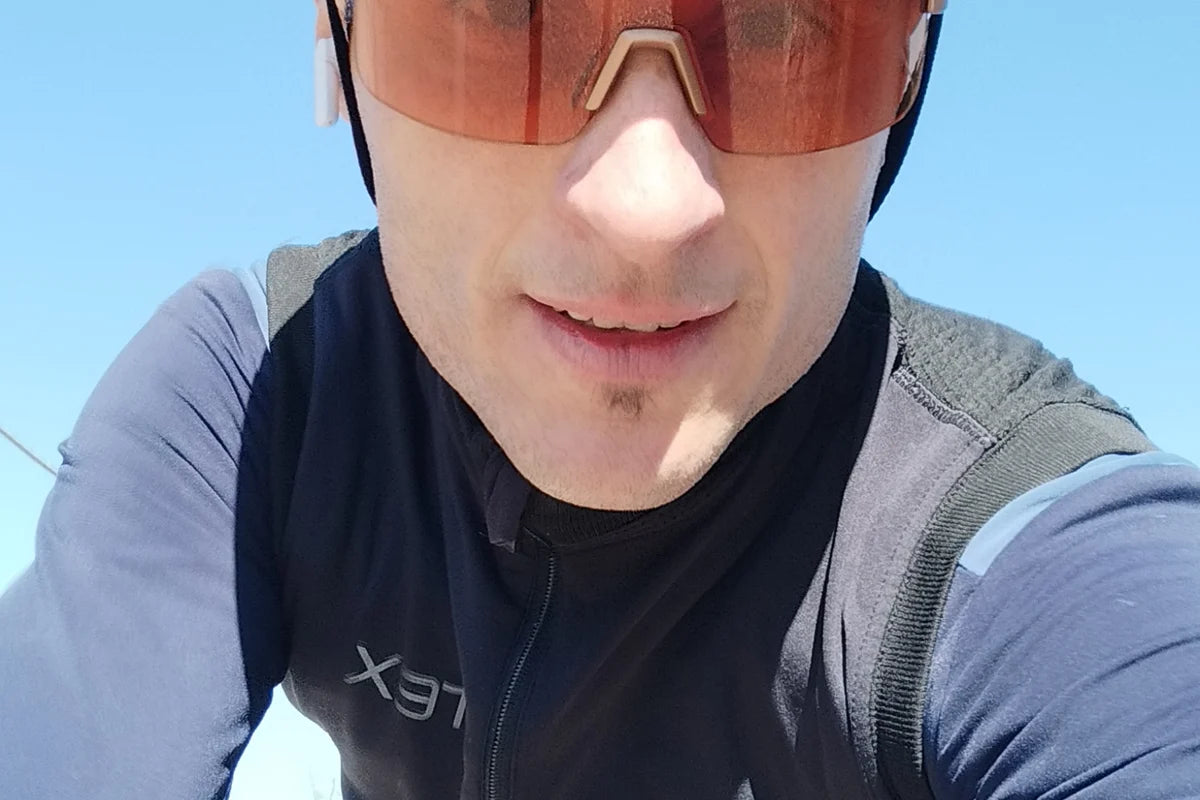
The Velluto StradaPro was designed specifically as a road cycling tool, and the design decisions are legible through the lens of long distance use. The frame weighs 25 grams. It sits below the threshold where most riders register a frame as a sensory presence. The nose pads are adjustable, so the fit is calibrated to your bridge geometry rather than an average template. The frame incorporates a built-in anti-fog system, not just ventilation ports, which handles the repeated thermal cycling of a long autumn ride. And the lens system is interchangeable by design: the VellutoPuro clear lens and the VellutoVisione high-contrast lens both click in and out without tools in under 30 seconds.
UV400 certification is standard across both lenses. The Italian design results in a wraparound geometry that tracks the orbital bone and keeps the lens in the correct optical plane across climbing, descending, and sprinting head positions without requiring frame adjustment during the ride.
For the autumn sportive context specifically: the StradaPro with a VellutoVisione high-contrast lens is well suited to the grey, variable-light conditions of September and October cycling in northern Europe. The 30-day risk-free trial means you can evaluate the fit across real training rides before your target event, rather than discovering a pressure issue 40 kilometres into the race.

08 · Buying FrameworkWho should prioritise what when choosing cycling glasses for long distance rides
Different long distance riding formats make different demands on cycling glasses. The following framework maps the key use cases to the specifications that matter most, so you can weight your own priorities against what a given frame actually delivers.
Granfondo and sportive riders (100 to 200 km, mixed terrain, autumn calendar): Anti-fog performance and lens adaptability are the dominant variables. You will pass through more light and temperature conditions in one event than a typical club rider encounters in a week. Prioritise a frame with a built-in anti-fog system and an interchangeable lens kit. Frame weight matters, but it is secondary to ventilation performance for this format.
Audax and ultra-distance riders (200 km and above, pre-dawn starts, night riding): Lens light transmission is critical. A dark lens is counterproductive. A clear lens, or the option to carry one for low-light sections, is essential. Frame weight becomes increasingly important above 300 kilometres, where cumulative nose bridge pressure across a full day and night of riding is a genuine comfort variable. UV400 protection remains necessary during daylight sections regardless of the lens tint installed.
Training riders targeting a specific event: The most underrated factor is fit verification time. Buying a pair of glasses two days before a major event and discovering a pressure issue in the first hour is entirely avoidable. A trial period that allows real-ride testing across multiple training sessions before the event is one of the most practically useful features a glasses purchase can include.
Riders in variable northern European conditions (Belgium, northern Germany, Scandinavia): Autumn light in these regions is characteristically flat, low-angle, and grey. A high-contrast lens that sharpens definition in those conditions is more useful for the majority of ride days than a dark lens optimised for Algarve sun. Prioritise optical quality and contrast enhancement for grey conditions over peak tint darkness.

The single most common mistake in choosing cycling glasses for long distance riding is optimising for short-ride feel. Glasses that feel comfortable in a five-minute shop fitting, or on a 45-minute test ride, may be entirely different objects at hour four. The relevant test is not how a frame feels when you first put it on. It is how it feels when you have been riding for 150 kilometres and the next climb is still 40 kilometres away.
09 · AccessoriesWhat to carry on a long ride
Long distance riding creates a maintenance problem for cycling glasses that shorter rides do not. Over six hours, lenses accumulate road grime, insect residue, chain oil mist, and sweat. A lens that is optically clean at the start of a ride may be substantially degraded by the 150-kilometre mark. Carrying the means to clean it is not obsessive. On an autumn ride in the Netherlands or Belgium, where wet roads spray continuously, it is practical preparation.
The Velluto Cleaning Spray is a 50 ml apple-fragrance formula, made in Germany, and refillable. It is sized for a jersey pocket and pairs with the microfibre cleaning cloth for a lens refresh that takes under a minute at a feed stop. On a full-day ride, a mid-ride lens clean at a feed stop restores optical clarity during the ride.

One additional consideration for long rides is lens protection between stages. If you are doing a multi-day cycling event, or storing your glasses in a jersey pocket during a car transfer, a hard case with an anti-crash guarantee protects the lens surface from the kind of impact that creates micro-scratches. Micro-scratches do not show up as dramatic optical defects. They show up as lens fatigue at hour four, when your eyes are already working hard and the degraded lens surface creates visual noise that a clean lens would not.
Compare the full lineup in the Velluto StradaPro cycling glasses collection.
10 · FAQFrequently Asked Questions
What makes cycling glasses good for long distance rides?
How much does frame weight actually matter on a 200 km ride?
Why do cycling glasses fog up more on long rides than on short ones?
What lens should I use for an autumn sportive or granfondo?
Are interchangeable lens systems worth it for long rides?
How do adjustable nose pads help on long distance rides?
Will cycling glasses cause headaches on very long rides?
What is UV400 certification and why does it matter on all-day rides?
Can I try cycling glasses before committing to them for a big event?


The glasses you choose for long distance rides will either earn their place or remind you they exist, kilometre after kilometre. The StradaPro is designed to earn its place. Test it across your training rides before your next event at velluto-shop.com, with 30 days to decide whether it is right for you.