Cycling Glasses for Sportives: The 100km+ Comfort Guide

Contents31 min read
It is 06:45 and your sportive starts in fifteen minutes. The road is still in shadow, the first col is two hours away in full August sun, and by the afternoon you will be descending into a valley that smells of eucalyptus and tarmac heat. Your glasses need to handle all of it. Not in theory. Over six hours, on your face, without you thinking about them once.
That is the sportive test. It is harder than it sounds. Most cycling glasses are designed and marketed for the decisive moment: the sprint finish, the dramatic descent, the podium photo. Nobody photographs hour four of a gran fondo, when the nose pads are leaving red marks and the lens has fogged twice on the lower ramps. But that is where the gear either works or it doesn't. This guide is written specifically for that scenario: 100km and beyond, variable light, variable weather, and the kind of cumulative discomfort that only becomes visible when it is too late to fix it.
We will cover every element that matters for sportive-specific comfort, from frame weight to lens strategy to the exact moment anti-fog stops being a marketing word and becomes a reason you made it up the col without losing your line. By the end, you will have a clear checklist for choosing cycling glasses for sportives and a working understanding of what actually breaks down at hour six.
01 · The sportive problemWhy distance changes everything about eyewear
A 40-minute club ride is a bad test of cycling glasses. Discomfort that would become intolerable over four hours is barely noticeable in under an hour. This is the reason many riders arrive at their first gran fondo or long sportive with glasses that worked perfectly in training and start causing problems around the 60km mark. The issue is not the glasses failing. It is that the distance reveals what was always there.
Here is what changes when you go beyond 100km. First, cumulative pressure. Even light nose pad contact adds up over hours. A nose pad geometry that feels neutral at thirty minutes can create a genuine hotspot at three hours. Second, thermal cycling. You start cold, warm up, climb, cool on the descent, warm again. Each transition is a fogging risk if the lens and frame are not matched to manage airflow. Third, light variation. A sportive that starts at dawn in valley shadow and finishes in late-afternoon mountain sun covers a wider range of light conditions than most riders experience on a training ride. Fourth, fatigue. Eye strain from optical distortion, poor contrast or lens coatings that degrade with sweat add to overall ride fatigue in ways that are hard to isolate but real in the final hour.
The Vuelta a España, which runs through August and September across Spain's most demanding terrain, is useful context here. The peloton faces early morning neutral zones in deep valley shadow followed by high-altitude finishes in fierce sun, all within a single stage. The conditions are more extreme than a sportive, but the pattern is identical. Professional teams carry multiple lens options for each stage and make decisions at the final team car stop before the key climb. Amateur riders cannot do that, but they can carry a second lens and swap it at a feed zone. The equipment logic is the same.

02 · Frame weightThe 25-gram argument for long-distance riding
Let us be specific about weight, because cycling eyewear marketing is not. Most road cycling glasses fall somewhere between 28 grams and 35 grams. That is a small range in absolute terms, but the difference between 25 grams and 32 grams on a nose bridge over six hours is not a small difference in comfort. It is the difference between glasses you forget you are wearing and glasses you are aware of every time you stand on the pedals.
The physics is straightforward. Nose pad contact pressure scales with frame weight and the position of the weight relative to the bridge. A heavier front section, even if the total frame weight is moderate, creates more downward torque on the nose pad contact points. On climbs, when your head drops and your breathing becomes laboured, this pressure concentrates exactly where you least want extra sensation. It is also worth noting that sweat softens silicone nose pad contacts over time, which can allow even a well-fitted frame to migrate down the nose slightly by hour four, increasing the contact area and the perceived pressure.
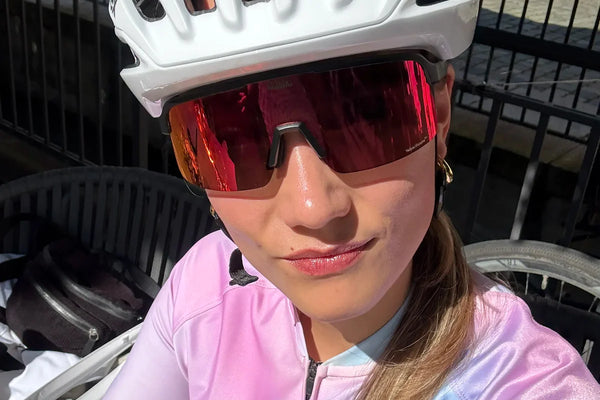
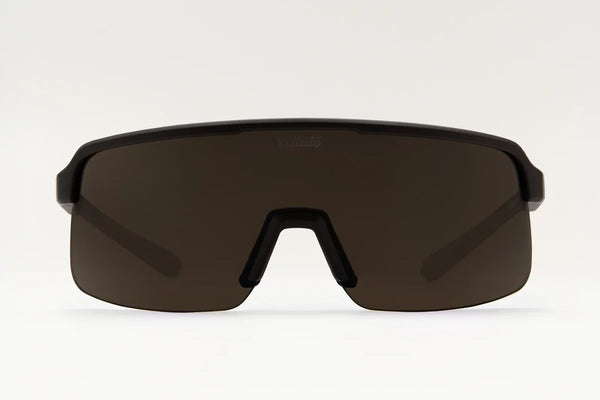
The Velluto StradaPro weighs 25 grams. That is a documented, specific number. The frame is designed with Italian-influenced minimalism in mind, keeping material where it is needed for structural integrity and removing it everywhere else. The result is a frame that most riders stop noticing within the first twenty minutes, which is precisely what you want from glasses on a long ride. You should be thinking about your cadence, your hydration and the road ahead. Not your nose.
When comparing cycling glasses for sportives, ask for the published frame weight and be sceptical of "ultra-light" claims without a number behind them. A figure you can check is useful. A superlative you cannot verify is not.
A frame you forget you are wearing is not a luxury on a sportive. It is the whole point.Velluto Design Brief, German engineering standard
03 · Nose pad fitAll-day pressure and the adjustable nose pad advantage
The nose pad is the single most underrated component of a sportive cycling glass. It is also the part that fails first on a long ride. Here is why it matters more than most buyers realise at the point of purchase.
Nose bridges vary significantly across face shapes and ethnicities. A fixed nose pad system that works perfectly on one face will create pressure points on another. It will sit too high on a low nose bridge, causing the lens to float up into the field of vision. It will sit too low on a high nose bridge, pulling the frame away from the face and reducing side wind protection. Most cycling glasses in the mid-range use fixed silicone nose pads, which means they fit a fairly narrow range of face shapes well and everyone else tolerates them.
Adjustable nose pads change this entirely. With an adjustable system, you can set the pad angle and spacing at home, test it on a few training rides, and dial in a fit that is genuinely custom to your face geometry. This matters on a sportive for two specific reasons. First, a correctly fitted nose pad distributes weight over a larger contact area, reducing the hotspot pressure that develops after two or three hours. Second, a well-fitted nose pad holds the lens in a consistent optical position throughout the ride, so the bottom edge of the lens does not drift into your sightline when you drop your head on a steep climb.
The StradaPro's adjustable nose pads were designed with exactly this scenario in mind. Adjust them before your first training ride, refine the fit over a few sessions, and by the time your sportive arrives you should have a fit that holds across the full distance. The adjustment takes less than a minute and requires no tools.
04 · Anti-fogWhat actually happens on a col and how it fails
Anti-fog is one of the most commonly claimed and least commonly explained features in cycling eyewear. Every brand lists it. Very few explain the mechanism. And almost no marketing material describes the conditions under which anti-fog coatings stop working, because that would require honesty about their limitations. Let us be honest about it here, so you know what you are actually buying.
Standard anti-fog coatings work by making the lens surface hydrophilic, meaning water molecules spread into a thin even film rather than beading into droplets that scatter light. This works well in mild temperature transitions. It works less well when sweat drips directly onto the inner lens surface, when the temperature differential between your body and the air is large, or when the lens has been wiped repeatedly with a jersey sleeve (which degrades the coating surface over time). A coating alone is not a complete anti-fog system.
A built-in anti-fog system, as distinct from a coating, addresses the problem through frame geometry as well as surface treatment. The goal is to maintain airflow across the inner lens surface to prevent the warm humid air that accumulates between your face and the lens from reaching saturation and condensing. This requires a frame design that promotes rather than blocks air circulation while still providing the wraparound coverage you need for wind and debris protection. It is an engineering trade-off that requires genuine design intent, not an additive coating applied in the final production step.
The StradaPro's built-in anti-fog system combines frame ventilation geometry with lens treatment to manage this transition actively. On a long climb, when your speed drops and your body temperature rises, the system maintains the airflow needed to prevent fog without the frame becoming too open to provide meaningful protection. It is the difference between glasses that fog occasionally and glasses that do not fog, which matters more on a sportive than on any other ride type because the climbs are longer, the speed differentials are greater and you have fewer opportunities to stop and wipe the lens.

Practical tip: if you are riding a sportive with a major col, the highest-risk fogging moment is not the summit. It is the first kilometre of the descent, when your speed increases rapidly and cold air hits a lens that was warm and humid from the climb. If your glasses fog at this moment, you are descending blind at the start of the fastest, most technical section of the ride. This is not a theoretical risk. It is the reason anti-fog engineering matters more on a sportive than anywhere else.
05 · Lens strategySwapping between the start line and the cols
A sportive that starts before 07:00 and finishes in mid-afternoon covers a light range that no single fixed lens handles perfectly. This is not a niche problem. Most major European sportives start early precisely to get riders off exposed mountain roads before afternoon heat and thunderstorms. The Vuelta's mountain stages create the same pattern in professional racing. You start in shadow, you ride into sun, you climb into altitude light that is significantly brighter than the valley, and you may finish in overcast late-afternoon conditions that flatten contrast and make road surface reading difficult.
There are two approaches to this problem. The first is a photochromic lens, which transitions automatically between light and dark depending on UV intensity. Photochromic lenses are a genuine convenience: you do not have to carry anything extra or make a decision at the feed zone. Their limitation is the speed of transition, which typically takes 30 to 60 seconds in full operation and can lag behind rapid changes like entering a tunnel or moving from bright sun into deep forest shadow. They also tend to retain a light tint in very cold temperatures, which can affect performance at altitude.
The second approach is an interchangeable lens system with a fast, tool-free swap mechanism. This gives you complete control over your optics at any point in the ride. You carry two lenses, both rated UV400, optimised for different conditions. At a feed zone or at the base of a col, you swap in under a minute. The disadvantage is that you need to make an active decision and carry the second lens. The advantage is that each lens is fully optimised for its intended conditions, with no compromise for the transition range.
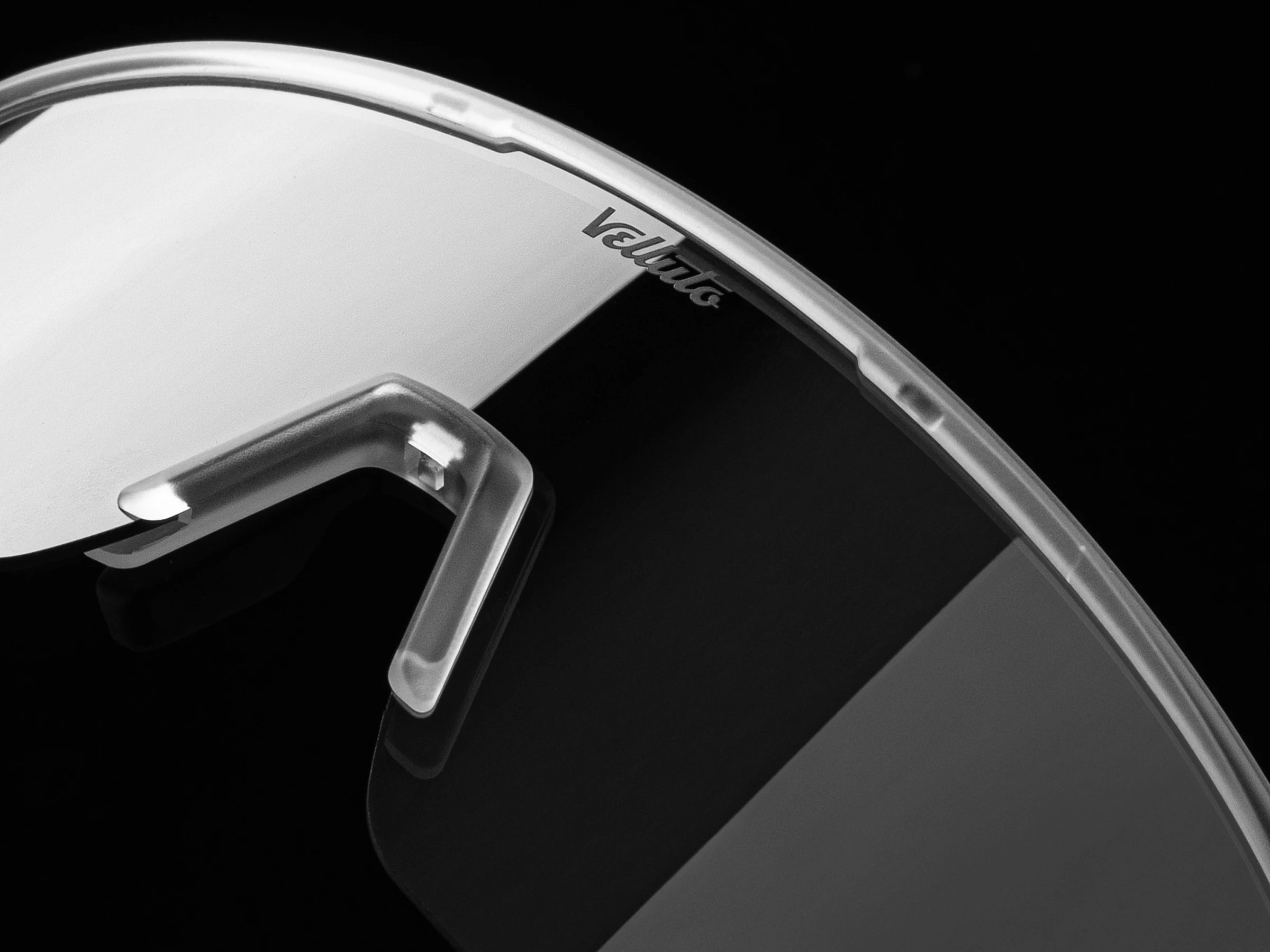
The StradaPro uses a click-in lens system that is compatible with both the VellutoPuro clear lens and the VellutoVisione high-contrast lens. The swap is tool-free and takes seconds. For a sportive, the recommended approach depends on your start conditions. If you are starting before sunrise or in a long valley section, begin with the VellutoPuro clear lens for maximum light transmission and swap to VellutoVisione when the sun is established and the col approach begins. The high-contrast lens sharpens road surface definition and makes the visual work of reading tarmac texture less fatiguing over a sustained climb.
Carrying a second lens on a sportive is easier than it sounds. A hard case in your jersey pocket is the cleanest solution. The Velluto Hard Case has an anti-crash guarantee and a velvet interior, and it is sized to fit a jersey pocket without creating the kind of bulk that becomes annoying by hour three. The lens swap itself can be done with sweaty hands, which matters: a click system that requires dry, precise finger pressure is not a useful sportive feature.

06 · UV protectionSix hours of exposure and why UV400 certification matters
UV protection is treated as a commodity in cycling eyewear marketing. Every brand lists UV400. The difference is whether that claim is certified or stated, and whether you can verify it independently. This distinction matters more on a sportive than on a training ride because the cumulative exposure time is significantly higher.
UV400 certified protection means the lens blocks 100% of both UVA and UVB radiation across the full spectrum up to 400 nanometres. The European standard for this is EN ISO 12312-1, which covers sunglass performance requirements including UV transmittance. A lens that is UV400 certified has been tested against this standard. A lens that is "UV400" by manufacturer claim without third-party certification has been stated to meet the standard, which is a different thing.
Why does this matter on a sportive? First, altitude. UV intensity increases by approximately 10 to 12 percent for every 1,000 metres of elevation gain. A sportive that climbs to 2,000 metres exposes your eyes to roughly 20 to 24 percent more UV radiation than the same ride at sea level. Second, duration. Six hours of UV exposure, even at moderate intensity, is a meaningful cumulative dose for the cornea and lens of the eye. Third, reflection. On exposed mountain roads, UV reflects off tarmac, limestone rock faces and, in alpine conditions, remaining snow patches. Total UV load is not just what comes directly from the sun.
The StradaPro's UV400 certified protection blocks 100% of UVA and UVB radiation. This is a documented, verifiable claim, not a marketing statement. On a sportive with significant climbing, it is the baseline you should be looking for in any glasses you consider, not a premium feature. If a frame in your consideration set does not publish a UV standard reference, that is the first question to ask before purchase.

07 · What breaks at hour sixA systematic failure checklist for long rides
Hour six is where sportive gear gets honest. Everything that was marginal at hour one is a problem by hour six. Here is a systematic look at what breaks down, why it happens, and what to look for when buying to avoid each failure mode.
Nose pad pressure hotspot. This is the most common long-ride complaint. A nose pad that seemed comfortable in the shop or on a 45-minute training ride has created a visible red mark and is causing enough distraction that you are adjusting the glasses every fifteen minutes. Root cause: fixed pad geometry that does not match your nose bridge, or insufficient pad surface area distributing the frame weight. Solution: adjustable nose pads that you have dialled in over at least two training rides before the event.
Temple squeeze fatigue. The second most common failure. The temple arms of most cycling glasses are designed to grip the head securely, which is correct for a short ride. Over six hours, constant low-level lateral pressure on the temples creates a cumulative fatigue that feels like a very mild headache behind the ears. This is rarely discussed in reviews because reviewers rarely wear the same glasses for six consecutive hours. When evaluating glasses, the key question is whether the temple grip is adjustable or whether it relies on the inherent stiffness of the material.
Lens fogging on climbs and in variable weather. Already covered in section four, but worth restating here in context: the risk increases with ride length because your body temperature variance over a sportive is greater than on a training ride. You heat up and cool down more times, over a longer period. An anti-fog system that handles one or two thermal transitions adequately may be pushed beyond its working range on a sportive with multiple major climbs.
Lens optical fatigue. This is the subtlest failure mode and the hardest to diagnose in the moment. It manifests as general eye fatigue that you might attribute to the effort level, bad sleep before the event, or dehydration. The actual cause is often a lens with poor optical clarity or a tint that is slightly mismatched to the light conditions. The eyes are working harder than they should to resolve road surface detail, especially on technical descents. This is why lens quality and appropriate lens choice for the conditions matter as much as the frame itself.
Sweat interference. Sweat running off the brow and onto the inner lens surface is a specific sportive problem that occurs on hot climbs. It coats the lens with a salt film that is harder to wipe than road dust, and on some anti-fog coatings it can affect the coating if left and dried. Carry a small microfiber cloth in your jersey pocket rather than wiping with your sleeve. The jersey fabric carries grit from the road that scratches lens coatings in a single wipe.
Lens shift on descents. At speed on a technical descent, the aerodynamic load on the frame changes relative to a climb or flat. A lens that is seated correctly at low speed can shift or buzz slightly in the frame at 70 kilometres per hour. This is almost always a sign of lens retention wear in the frame interface, or of a lens that was not fully clicked in to begin with. Check your lens seating before every descent, especially after a mid-ride swap.
UV dose accumulation in valley corridors. This is the least obvious failure mode because it is physiological rather than mechanical, and the effects are not felt during the ride. Repeated exposure to intense reflected UV in valley sections, particularly in limestone or granite mountain environments, adds cumulative UV load even if your lens has UV400 certification. The certification is doing its job, but the intensity of exposure in this terrain is a reminder that UV protection is not a feature to compromise on in order to save money on a sportive-specific frame.

08 · Colour choiceMatching your StradaPro colour to your kit and conditions
The StradaPro is available in four colours: Arancia (orange), Espresso (brown), Nero (black) and Viola (purple). Frame colour does not affect optical performance, because the lens is the optical element, and the lens is interchangeable across all four colours. So the colour choice is a personal one, but it is not entirely trivial, and it is worth a moment of thought.
Arancia. The orange colourway is the most visible on the road, which has a marginal safety benefit in low-light conditions when other road users need to read your position. It pairs well with warm-toned kit colours, the kind of summer palettes that dominate the late-season sportive peloton in August and September. The Arancia is also the frame that photographs best in mountain light, which is relevant if your sportive includes a photographer section on the col.
Espresso. The brown frame is the most neutral option, pairing with the widest range of kit colours and looking equally appropriate on road and gravel. It has a classic, understated quality that sits well with the Italian design language of the StradaPro. For riders who prefer their glasses to complement rather than define their kit, the Espresso is the default recommendation.
Nero. Black is the frame choice of riders who want their glasses to disappear into their overall look. It is the most versatile colourway in terms of kit compatibility and the most common choice among riders who prioritise function over identity. If you are genuinely indifferent to colour and just want the best glasses for the ride, Nero is a sound default.
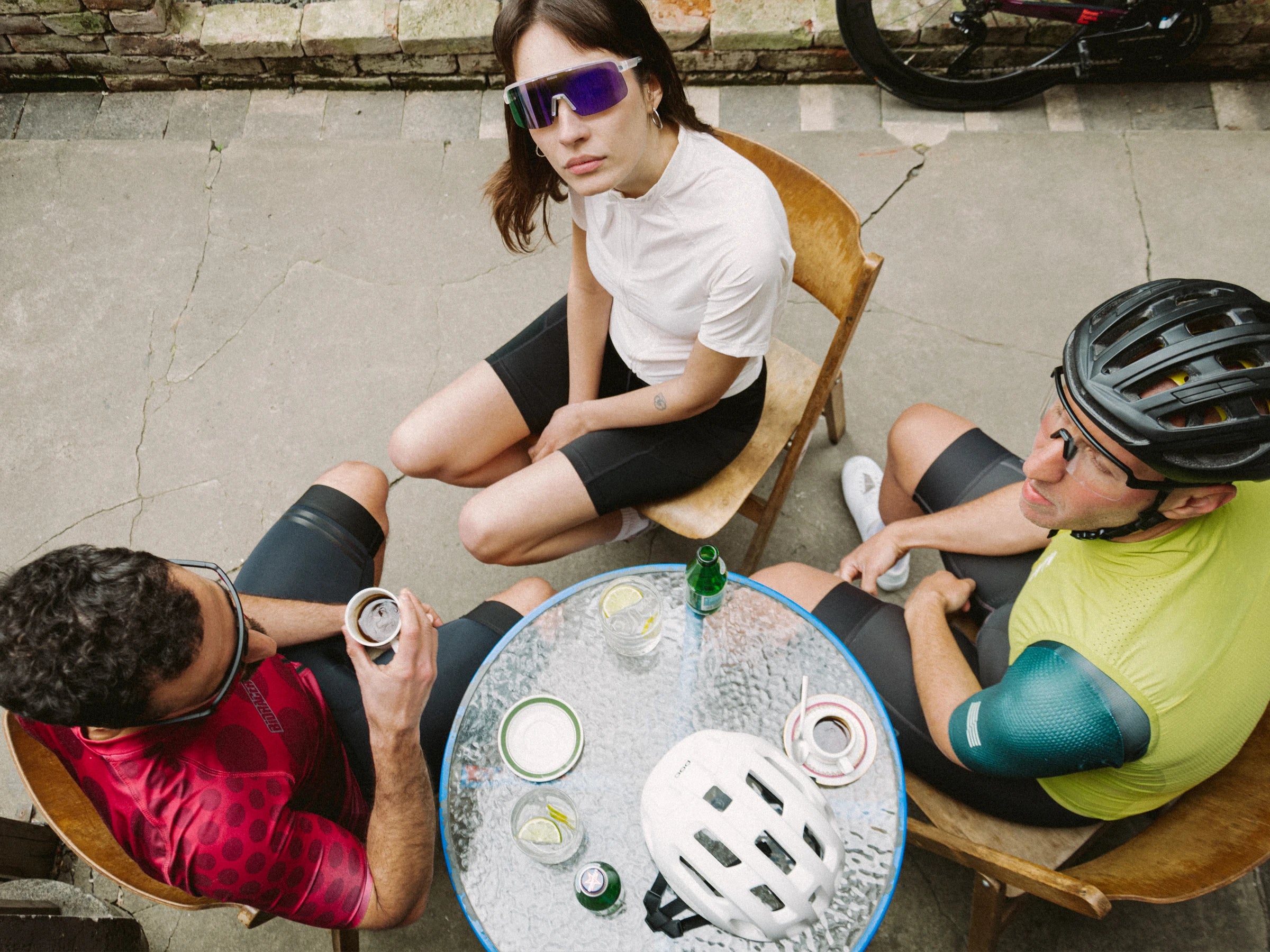
Viola. The purple colourway is the most distinctive option and the one most likely to prompt a conversation at the feed zone. It has become associated with a particular strand of European cycling aesthetics: premium, considered, slightly contrarian. It pairs exceptionally well with grey and black kit, and it is the frame that rewards the rider who wants their gear to make a considered visual statement.


09 · The complete checklistEverything your sportive glasses must do before the start
The following is a practical pre-sportive checklist. Go through it in the week before your event, not on the morning. Most of these items require a training ride or two to verify correctly.
Frame weight verified. Check the published specification, not the marketing category. Under 30 grams is the threshold for long-ride comfort. 25 grams is better. Anything above 32 grams will be felt over six hours by most riders.
Nose pad adjusted and tested. If your glasses have adjustable nose pads, set them to your bridge geometry and test on at least two rides of 90 minutes or more before the event. If they need further adjustment, do it before the event week.
Anti-fog system tested in a climb scenario. Find the longest, slowest climb in your training area and ride it in the glasses. If you fog, you need to address the cause before the event. Check that you are not wearing the glasses too close to your face, that the ventilation channels in the frame are not blocked by your helmet brim, and that the inner lens surface is clean.
Lens strategy confirmed. Decide on your lens plan for the event: single lens or two-lens swap. If swapping, carry the second lens in a hard case in your jersey pocket and practice the swap with gloves on. Confirm that the lens clicks fully into the retention points before you need to do it on the road.
UV400 certification confirmed. Check the product specification page for the UV standard reference. If it is not published, ask the manufacturer directly. Do not accept "UV400 protection" as a standalone claim without a standard reference on a long mountain ride.
Temple fit tested at speed. On a training descent at your fastest comfortable speed, check that the glasses do not shift or create pressure. If they are moving at 60 kilometres per hour, they will be a distraction on every descent of the sportive.
Lens surfaces cleaned. Use a proper lens cleaning spray and a microfiber cloth the night before the event. Scratched or smeared lenses increase optical fatigue over a long ride in a way that is difficult to appreciate until you have clean lenses to compare against. The Velluto Cleaning Spray is 50ml, apple-fragranced and made in Germany, which makes it a realistic jersey-pocket carry for a multi-day event.
30-day trial used effectively. If you are buying new glasses for a sportive, use the trial period to do this testing on real training rides, not to try them on once indoors and decide they look good. The 30-day risk-free trial that comes with the StradaPro exists precisely to allow this kind of systematic fit testing before you commit.

10 · Care on the roadCleaning, carrying and protecting your lenses mid-sportive
Sportive lens care is a practical topic that almost no eyewear brand addresses directly, perhaps because it does not sound glamorous. It matters. Here is how to manage your lenses correctly across a long ride.
The most damaging thing you can do to a lens on a sportive is wipe it with your jersey. Jersey fabric picks up road grit, dried chain oil residue and salt crystals from your own sweat over the course of a ride. Any of these wiped across a lens surface at even moderate pressure will leave fine scratches in the coating. Over several rides, these scratches accumulate into a diffuse haze that reduces optical clarity and increases lens flare on descents. It is not dramatic. It is gradual. But a lens that has been jersey-wiped fifty times looks and performs noticeably differently from one that has been cleaned correctly.
The correct tool is a microfiber cloth: specifically 80% polyester and 20% polyamide, which is the formulation used in the Velluto Microfiber Cleaning Cloth. This blend has sufficient surface tension to lift dust and oil without requiring pressure, which is what protects the coating. Carry one in a small zip-lock bag in your jersey pocket. The bag keeps it clean and dry through sweat and rain, which matters because a dirty or damp microfiber cloth is less effective than a clean, dry one.
For sweat build-up on the inner lens surface on hot climbs, the correct approach is to remove the glasses briefly at a feed zone or flat section, breathe gently on the inner surface to hydrate the film, and wipe with the cloth in a single linear stroke from centre to edge. Do not use circular strokes, which spread contamination. Do not wipe a dry dusty lens: hydrate it first, either with breath or a small amount of cleaning spray.
The Velluto Cleaning Spray is 50ml and refillable, which makes it the right size for a sportive kit bag or a small saddle bag. It is not necessary to carry it on the bike during the ride, but having it available at the start line for a final lens clean before rolling is a worthwhile habit. A clean lens at the start of a sportive is the best foundation for six hours of clear vision.

11 · Comparison overviewWhat to look for at each price tier for sportive use
The cycling glasses market for sportive use spans a wide price range, roughly from budget options under €50 to premium performance frames above €300. The relevant question for this guide is not which tier is best in absolute terms, but which tier represents the right trade-off for the specific demands of a 100km-plus sportive.
At the budget tier, below €50, you will generally find fixed nose pads, UV protection claims without published standard references, and no interchangeable lens system. For sportive use, the absence of an adjustable nose pad is the limiting factor. A budget frame can be entirely adequate for comfort on rides under 90 minutes. The same frame on a six-hour sportive carries a higher risk of the hotspot and pressure issues described in section three. This is not a categorical dismissal of budget frames. It is a specific observation about how the absence of adjustability scales with ride duration.
At the mid-range, roughly €70 to €150, you typically find at least one of the three sportive-critical features: adjustable nose pads, a genuine anti-fog system, or an interchangeable lens system. The best frames in this range combine all three. This is the tier where the StradaPro sits, offering all three features plus UV400 certification and a 25g frame in a single product. For riders whose primary use case is sportives and long road rides, this tier represents excellent engineering value.
Above €150, premium frames from established brands offer excellent optical engineering and professional-racing heritage. These glasses deliver genuine performance and attract riders for whom brand recognition and design prestige are part of the overall experience. The sportive-critical features, adjustable nose pad, built-in anti-fog, interchangeable lenses, UV400 certification and sub-30-gram frame, are available across multiple price tiers. Your choice depends on whether additional premium positioning aligns with your priorities for the ride.
The point is that the sportive-critical features, adjustable nose pad, built-in anti-fog, interchangeable lenses, UV400 certification and a sub-30-gram frame, are available at the mid-range tier. Choosing a frame means matching features to your priorities rather than assuming higher price delivers more of what matters most on long rides.
Six hours on the road is the real test. Not the spec sheet, not the podium photo. What fits at kilometre 100 is what matters.Velluto Design Philosophy
12 · Sportive contextsThe Vuelta conditions and what they tell amateur riders
The Vuelta a España is a useful reference point for sportive eyewear thinking not because amateur riders face the same intensity, but because the terrain and light conditions are genuinely comparable. The Vuelta climbs through Andalucia, Extremadura and the Sierra Nevada in August heat, then moves into the northern Spanish mountains in September. The stages cover the same kind of light and weather variation that characterises a well-designed sportive route: valley heat in the morning, col altitude in the afternoon, potential for rapid weather changes at elevation.
Professional cyclists at the Vuelta do not use a single lens for the full stage. Team eyewear kits include multiple lens options selected for the day's specific route profile, start time and forecast. The mechanism for swapping is a team car or directeur sportif, which amateurs do not have. The principle is identical: one lens is not optimal for all conditions across a long day in the mountains.
What the Vuelta context also illustrates is the relationship between eyewear and safety. On a technical descent at racing speed, vision quality is a direct safety input. On a sportive descent, the speeds are lower but the rider's skills, reflexes and fatigue level mean that the quality of visual information reaching the brain matters just as much. A fogged lens on a descent, an optically fatigued eye from six hours of poor contrast, or a frame that has shifted from its correct position on the nose are not inconveniences at that moment. They are hazards.
This is the underlying reason this guide is as detailed as it is. Cycling glasses for sportives are not a fashion accessory or a marginal performance enhancement. Over 100km and six hours in variable conditions, they are a core component of the ride. The features that differentiate a sportive-capable glass from a casual summer sunglass are specific, testable and documented. The checklist in section nine is the practical expression of all of them.

Compare the full lineup in the Velluto StradaPro cycling glasses collection.
13 · FAQFrequently Asked Questions
Are cycling glasses worth it for a sportive?
What is the best lens colour for road cycling on a sportive?
How do I stop my cycling glasses fogging up on climbs?
Is 25g light for cycling glasses?
Can I swap lenses during a sportive?
What should I look for in cycling glasses for a 100km ride?
Do I need different glasses for a gran fondo versus a club ride?
How do I clean my cycling glasses mid-ride?
What colours does the Velluto StradaPro come in?
If you are riding a sportive this season and want glasses that hold up across the full distance, the StradaPro has a 30-day risk-free trial. Use it on your longest training rides, test the lens swap, dial in the nose pad fit, and make your decision based on how it performs at hour four rather than how it looks in the box. Full details at velluto-shop.com.