Chromo 2-for-1 Cycling Glasses Deal: What to Know

Contents18 min read
You roll out at seven in the morning, sky the colour of old pewter, and by the time you reach the forest climb an hour later the sun has broken through the cloud and the mud on the trail ahead is suddenly blinding. You are already committed to the descent. This is cyclocross season, November light, and your eyes need to keep up with it.
Photochromic cycling glasses exist to solve exactly that moment. One lens, adapting continuously, so the decision about which optic to wear is one you made before you left the house rather than one you are making mid-corner. This guide covers what photochromic technology does, who genuinely benefits from it, what to look for in a photochromic road or cross lens, and how the Velluto Chromo sits within that picture. There is also a current Chromo offer running until the end of November: it is stated once below, plainly and completely.
01 · What it isHow Photochromic Lenses Work
The core mechanism is photochemistry. A photochromic lens contains molecules, typically silver halide compounds or organic alternatives, that change their structure when struck by ultraviolet radiation. In the absence of UV, the molecules return to their original configuration and the lens is at or near its clearest state. In bright UV-rich conditions, the structural change causes the lens to absorb more visible light, and the lens darkens. When UV exposure decreases, the process reverses.
From a practical riding standpoint, what this means is that the same lens gives you something usable in overcast morning light and something protective in a midday sun gap, without you having to do anything except ride. The transition happens continuously and in proportion to the available UV, rather than in a binary switch between two fixed states.
It is worth being clear about what photochromic technology does not do. It is not polarization: it does not filter glare from reflective surfaces the way a polarized lens does. It is not interchangeability: you are not clicking a different lens in for a different condition. And the speed and depth of the transition depend on the specific product's formulation. Because Velluto does not publish transition speed or light transmission figures for the Chromo, those numbers are not stated here. For specifics on those dimensions, the Chromo page is the right source.
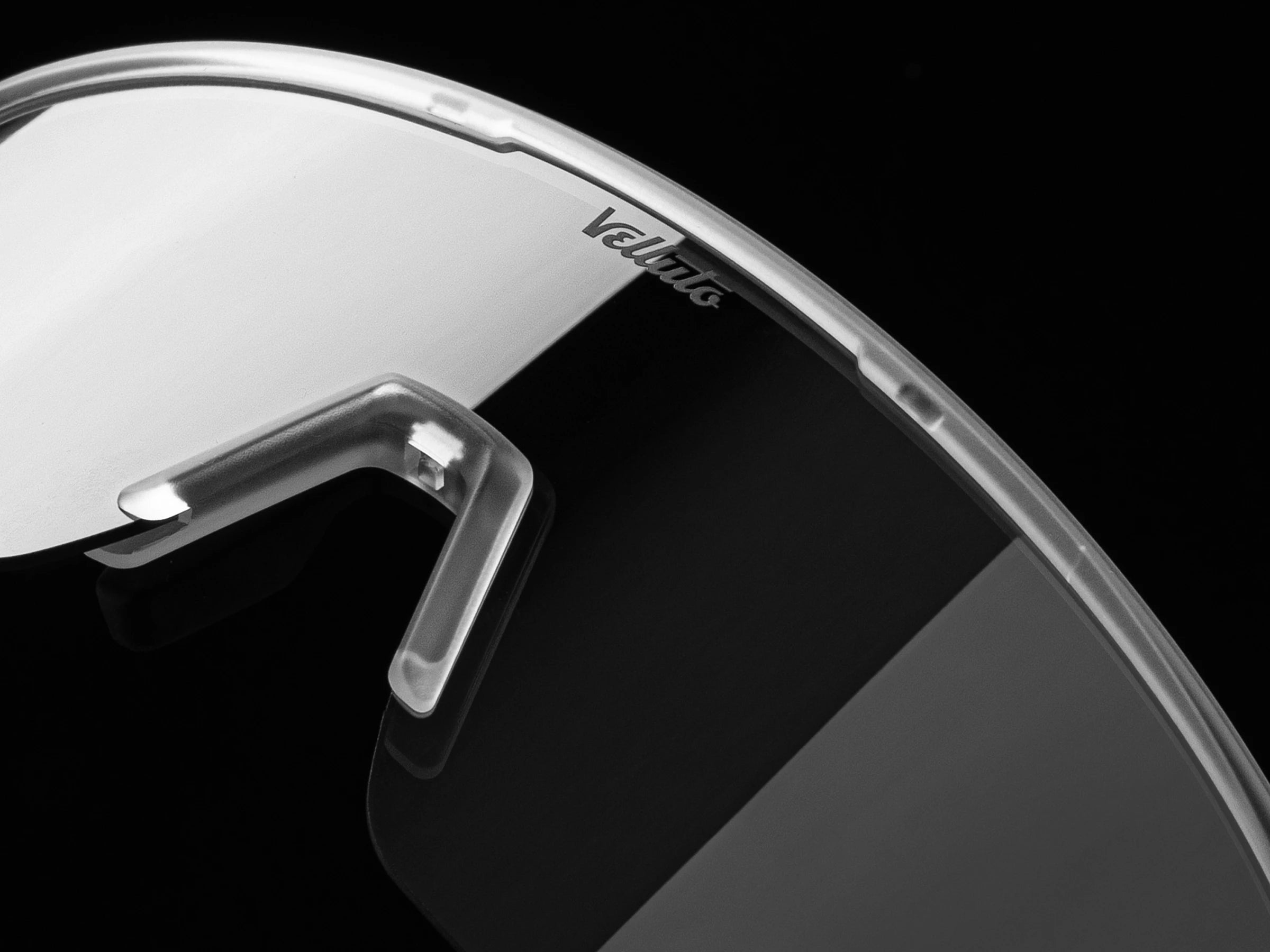
What the Velluto Chromo does specify: UV400 protection in both states, a lens that is clear in low light and progressively darker with a mirrored finish in bright sun, and four colourways to choose from. That is a solid, honest brief for an autumn cyclocross lens.
One lens that moves with the light means one fewer decision before a November start.Velluto Cycling Eyewear
02 · The riding contextWhy Cyclocross and Winter Riding Are the Natural Home for Photochromic
Ask any cyclocross rider what the hardest part of November riding is and they will not say the mud, though they will mention it. They will say the light. Cross races start early, often in conditions that are still near-dark. By the time you are racing the second half of a fifty-minute effort, the sun may be low and direct or it may have disappeared entirely behind a band of cloud coming off the sea. The light changes within a single race, let alone across a morning of riding.
Road riders preparing for winter training face a similar pattern. The long climbs that were done in full sun in August are now done in variable light, with shaded north-facing sections followed by exposed ridge tops where the sun angle is lower and more direct than at any other point in the year. Low winter sun is not just bright: it comes at angles that make a tinted lens genuinely necessary rather than merely comfortable.
This is precisely the terrain where the photochromic proposition is strongest. When the light is consistent, the interchangeable-lens approach is straightforward: you pick the right lens before you leave and you are set. When the light genuinely cannot be predicted, or when it changes faster than you can stop and swap, a self-adjusting lens removes friction. The Chromo was launched for this kind of riding.

03 · The offerThe Chromo 2-for-1 Deal, Stated Once
Until 30 November 2026, the Velluto Chromo is available on a 2-for-1 basis: the second pair is free, and the two pairs do not need to be the same colourway. Full conditions are on the Chromo page.
The practical value of two pairs being different colourways is real. You could take a Nero Fumo for road training and a Bianco Viola for cross racing, or keep one pair at home and one in your kit bag permanently. The colourway is a frame and lens combination, not just a cosmetic choice, so the two pairs can serve genuinely different purposes within your riding week. That is all this section covers: the offer terms. For anything else, the Chromo page has the detail.
04 · The productVelluto Chromo: What It Is and What It Offers
The Velluto Chromo launched in October 2026 as Velluto's photochromic model. It is the only Velluto product with a photochromic lens: the lens is self-tinting, clear in low light and darkening to a mirrored finish in bright sun. UV400 certification applies across both states. The price is 119 EUR.
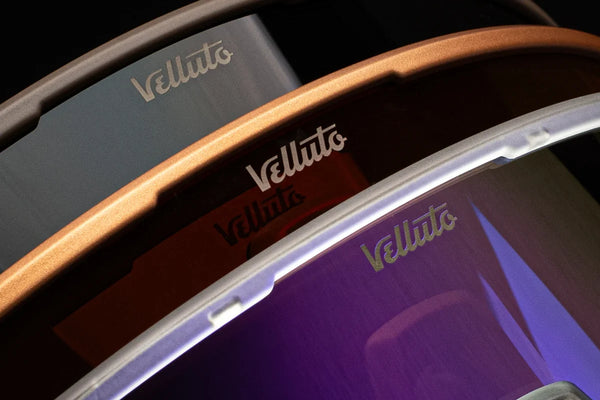
The Chromo is available in four colourways: Nero Fumo, Nero Fuoco, Bianco Lago, and Bianco Viola. Each colourway is a distinct frame and lens combination. The colourways share the same photochromic technology and the same UV400 protection. No other Velluto product is photochromic or has a mirrored lens.
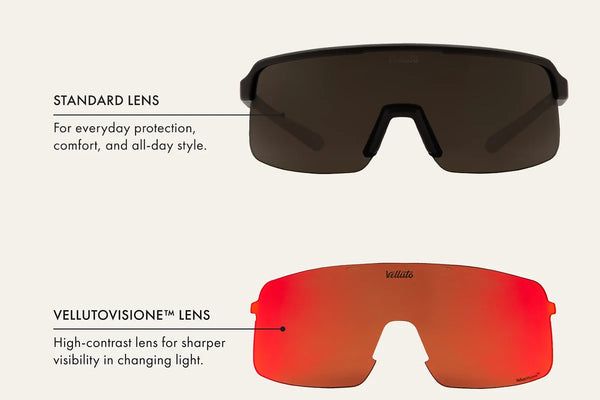
It is worth being explicit about what distinguishes the Chromo from the StradaPro, since both are Velluto cycling glasses launched in the same period. The StradaPro uses a two-lens interchangeable system: a clear VellutoPuro lens for low-light and variable conditions, and a high-contrast VellutoVisione lens for defined light. The lenses click in and out without tools. The StradaPro is not photochromic and does not have a mirrored finish. The Chromo, conversely, is photochromic and mirrored in sun, and does not use the click-in interchangeable system. They are genuinely different tools, suited to different approaches to the same problem of variable light.
If your answer to variable conditions is to swap lenses at a convenient point, the StradaPro is the right frame. If your answer is to wear one lens that handles the range, the Chromo is the right frame. Neither answer is universally better: they reflect different preferences and different types of riding. The honest thing to say is that both are well-engineered for road and cross cycling, and the right choice depends on how you ride and what you value in a glass.

05 · The colourwaysNero Fumo, Nero Fuoco, Bianco Lago, Bianco Viola
The four Chromo colourways share identical photochromic performance and UV400 protection. The difference between them is the frame and lens combination, which affects how the glass looks on the bike and how it integrates with your kit. Here is what is known about each.
Nero Fumo. Fumo means smoke in Italian. The name signals a dark, neutral colourway. For riders who want an eyewear aesthetic that reads as equipment rather than fashion, and who want something that works across kit colours without clashing, Nero Fumo sits cleanly in that space. The dark frame tends to disappear against darker helmets and jersey colourways.
Nero Fuoco. Fuoco means fire. This is a Nero base with something warmer in the accent. If Nero Fumo is the understated choice, Nero Fuoco is the choice for riders who want the dark frame profile with more visual energy. On the bike, particularly in the low November light that the Chromo is designed for, the warmer accent reads as a deliberate detail rather than a neutral default.
Bianco Lago. Lago is lake. A light frame, clean in the same way that a white or pale kit reads as clean on a wet cross day. Bianco Lago suits riders who run lighter kit colour palettes or who simply want their glasses to be the brightest thing on their face. The photochromic lens in its lighter state will read clearly against a pale frame, and in its darkened, mirrored state the contrast with the frame becomes its own aesthetic.
Bianco Viola. Viola is violet. The Velluto palette has included violet as an accent colour since the StradaPro range. In the Chromo, Bianco Viola brings that accent into the frame colourway itself, not just as a graphic detail. For riders who run purple or violet in their kit, this colourway gives the eyewear a coherent place in the overall look. For riders who run neutral kit, Bianco Viola functions as the deliberate statement piece.

None of the four colourways is objectively the best choice. The right one is the one that fits how you ride, what you wear on the bike, and what you want to see when you pick the glasses up before an early-morning start. The 2-for-1 offer makes the choice easier, because it means you can take two colourways rather than one and distribute them across your riding.
06 · Who it suitsRiders for Whom a Photochromic Lens Makes Most Sense
Not every rider needs a photochromic lens, and it would be misleading to suggest otherwise. The honest version of the buyer guidance here is a set of conditions under which photochromic is the right answer, and a set under which a different approach is likely better.
If your November rides consistently move between shaded woodland, exposed ridge, and low-sun descents within the same hour, a self-adjusting lens removes the management overhead entirely.
Cyclocross races last forty to sixty minutes at full intensity. There is no sensible moment to stop and change a lens. A photochromic lens means the optic adapts to whatever the light does during that window.
Some cyclists prefer to manage kit with as few decisions as possible. If the idea of carrying a second lens in a jersey pocket is an irritant rather than an option, photochromic suits your preference profile.
November through February in northern Europe means you genuinely cannot know at the start of a three-hour road ride whether it will be grey all the way or whether the cloud will lift for forty minutes at the turnaround. A photochromic lens hedges that uncertainty.
Conversely, if your rides are largely in consistent conditions, if you have a clear habit of when you need a clear lens versus a tinted lens, or if you value the ability to tailor your optic precisely to a specific condition, the interchangeable system of the StradaPro gives you more deliberate control. Neither approach is superior in absolute terms: they are different tools for different rider profiles.
07 · The alternativeWhen the StradaPro's Interchangeable System Makes More Sense
The StradaPro solves the variable-light problem differently. Rather than a single lens that adjusts, it gives you two lenses: the VellutoPuro, which is clear and optimised for low-light, wind and insect protection, and the VellutoVisione, which uses high-contrast technology to sharpen visual definition in defined light conditions. Both click in and out without tools, so the swap takes seconds rather than minutes.
The StradaPro weighs 25 grams and carries UV400 certification on both lenses. For more details on fit, comfort features, and shipping thresholds, the StradaPro product page has full specifications.
The case for the StradaPro over the Chromo is strongest when you know in advance what light you will be riding in. If you are heading out on a foggy morning group ride and you know it will stay overcast, the VellutoPuro gives you clean, clear vision for the entire ride without any adaptation lag or uncertainty. If you are doing a sunny criterium warm-up with a clear forecast, the VellutoVisione is a precisely tuned optic for that condition. The deliberate choice, made once, can be better than a continuously adapting one, depending on your preference and the riding context.

The StradaPro is backed by a 30-day risk-free trial, which gives you the chance to assess whether the interchangeable approach suits your riding. That is a meaningful safeguard for a rider genuinely uncertain which direction to go in.
08 · ComparisonChromo vs StradaPro: A Straightforward Look at the Differences
Both products are from Velluto, a German cycling eyewear brand with Italian design. Both carry UV400 certification. Both are designed for road and cross cycling. Beyond that, the two products take different approaches to the same challenge of variable light, and the table below reflects those differences without inflating one or diminishing the other.
| Feature | Velluto Chromo | Velluto StradaPro |
|---|---|---|
| UV Protection | UV400 certified | UV400 certified |
| Lens Type | Photochromic, self-tinting, mirrored in sun | Interchangeable: clear VellutoPuro + high-contrast VellutoVisione |
| Light Adaptation | Automatic, continuous | Manual, tool-free click-in swap |
| Anti-Fog | See Chromo page | Built-in anti-fog system |
| Adjustable Nose Pads | See Chromo page | Yes |
| Weight | See Chromo page | 25 g |
| Colourways | Nero Fumo, Nero Fuoco, Bianco Lago, Bianco Viola | Nero, Espresso, Arancia, Viola |
| Price | 119 EUR | from 69 EUR |
| Trial Period | See Chromo page | 30-day risk-free trial |
| November Offer | 2-for-1 until 30 Nov 2026 | No current offer |
Where the Chromo page does not publish a specific figure, the table says so rather than leaving an inference that the feature is absent. The honest answer is that if a spec matters to you and the table directs you to the Chromo page, that is where to find it.
09 · Buying guideHow to Choose Between Photochromic and Interchangeable for Your Riding
The simplest version of the decision is this: if you are regularly in conditions where the light changes within a single ride and stopping to swap is either impractical or undesirable, photochromic is worth the premium. If you have the habit and the opportunity to choose your lens before the ride and the conditions are mostly predictable, interchangeable gives you more precision for less reliance on chemistry.
There is a third rider, and it is worth naming them directly: the rider who wants both. The rider who races cyclocross on Saturday mornings and does long road training rides mid-week. The cyclocross starts are fast and unpredictable: photochromic makes sense. The road rides are longer and more plannable: interchangeable makes sense. This rider does not have to choose. They can run a Chromo for the cross races and a StradaPro for the road training block. The 2-for-1 Chromo offer, combined with the fact that the second pair can be a different colourway, makes this a natural moment to build out a two-frame kit if that reflects how you ride.
What you should not do is buy either product expecting the other's strengths. The Chromo will not give you the tool-free lens swap of the StradaPro. The StradaPro will not give you the continuous automatic adaptation of the Chromo. Both are genuinely good at what they are designed to do. The question is which design fits your riding season.

10 · Care and kitKeeping Your Glasses in Condition Through the Cross Season
November riding is hard on equipment. Mud, rain, condensation from breathing hard on a cold climb, and the general debris of a cross course all reach your eyewear. A photochromic lens in particular benefits from careful cleaning because the lens surface is where the photochemical reaction takes place, and abrasives or inappropriate cleaning agents can affect the coating over time.
The Velluto Cleaning Spray is a 50ml, apple-scented, refillable spray made in Germany and sized to live in a jersey pocket or kit bag. Used with the 25x25cm Velluto Microfiber Cleaning Cloth (80% polyester, 20% polyamide), it gives you a cleaning routine that works without putting pressure on the lens surface. For storage and transport between events, the Velluto Hard Case has an anti-crash guarantee, a velvet interior, and fits all road cycling glasses. It is the difference between arriving at a cross venue with your glass in the condition you left home with it and arriving with a scratched lens from a bag that got dropped during transition.


11 · ContextWhat Other Photochromic Cycling Glasses Offer (Without Naming a Winner)
The photochromic cycling glasses market has matured significantly in the last four years. Where photochromic lenses were once an expensive addition to specialist frames, they are now available across a wide price range and from multiple reputable brands. Names that come up regularly in road cycling circles include SunGod, Oakley, Rudy Project, Scicon, and Koo, among others. Each offers a photochromic option in their road lineup.
The honest thing to say about the category is that photochromic technology, in its core mechanics, is well understood and broadly available. What differs between products at this point is the specific lens formulation, the frame design, the weight, the ventilation approach, the aesthetic, and the support infrastructure around the product: return policies, lens availability, service. These are the dimensions to compare when you are choosing between the Chromo and an alternative from another brand.
For the specific colourway options, the frame aesthetics, and the November 2-for-1 offer, the Chromo stands on its own ground. For independent assessments of how photochromic lenses from various brands perform in road and cross conditions, publications like road.cc and Cyclingnews cover the category with genuine editorial depth. Neither this article nor Velluto's brand content is a substitute for independent editorial assessment, and you should use both in combination when making a purchase decision.
What this article can do is give you an accurate picture of what the Chromo is, what it costs, what colourways it comes in, what the current offer is, and how it compares to the StradaPro interchangeable system. Those facts are covered here from verified product information, without fabrication or inflation.
Compare the full lineup in the Velluto StradaPro cycling glasses collection.
12 · FAQFrequently Asked Questions
What does a photochromic cycling lens actually do?
Is the Velluto Chromo the same as the StradaPro?
What are the Velluto Chromo colourways?
What is the Velluto Chromo 2-for-1 deal?
Does photochromic mean polarized?
Why is the Chromo well suited to cyclocross and autumn riding?
Can the Velluto Chromo lens be swapped like the StradaPro lenses?
What UV protection does the Velluto Chromo offer?
Where can I find the Velluto Chromo and check the current offer?
If the Chromo is the direction you are heading, the offer runs until 30 November 2026. If the StradaPro interchangeable system suits your riding better, the 30-day risk-free trial means the decision carries no long-term risk. Either way, the full range is at velluto-shop.com.