Italian Cycling Glasses: Design, Heritage and Performance
Contents24 min read
The peloton sweeps through a Castilian village somewhere between Madrid and the coast, and for a moment the cameras slow down. Not to catch the sprint, but to frame the image: tanned forearms, white kit catching the late-afternoon sun, and a row of curved lenses catching the light in amber and smoke. Italian cycling glasses have looked like this for forty years. The design did not happen by accident.
Road cycling has always had an aesthetic problem. Performance demands push frames toward full coverage, ventilation channels, adjustable parts and interchangeable lenses. None of those requirements, taken individually, sounds beautiful. Italian design studios have spent decades proving that they can all be beautiful together, if you treat the brief seriously from the first sketch rather than the last one. This guide explores what that means in practice: where the tradition comes from, which brands shaped it, what the design philosophy actually involves, and how to use it when choosing your next pair of Italian cycling glasses.
01 · HistoryWhy Italy Became the Home of Road Cycling Eyewear
The answer begins not with optics, but with the Giro d'Italia. For most of the twentieth century, professional cycling's calendar centred on European roads, and the sport's supply chains clustered accordingly. Frame builders in Vicenza and Varese, glassmakers in Veneto, textile manufacturers in Emilia-Romagna: the whole ecosystem that served professional riders was Italian, or at least deeply embedded in Italian commercial culture. Eyewear followed naturally.
What made the Italian contribution distinctive was not geography but methodology. Italian industrial design in the postwar decades developed a specific conviction: that beautiful and functional are not trade-offs but the same question asked differently. This is the tradition that produced the Olivetti Valentine typewriter, the Vespa scooter, and the Ferrari Dino. Cycling eyewear was a smaller canvas, but the same thinking applied. If a frame needed to wrap around the face at a specific angle for aerodynamic efficiency, then that angle became a design decision, not just an engineering constraint. If a lens needed to cover a defined area for wind protection, the perimeter of that coverage became a shape that could be considered for proportion and elegance.
The professional peloton accelerated everything. Teams needed frames that stayed in place at 70 kilometres per hour on a descent, did not fog on a wet col, and held a replacement lens that could be swapped at a team car. These demands pushed Italian manufacturers toward technical solutions that eventually became features: adjustable nose pads, ventilated cavities, click-in lens systems. By the time those features became standard across the industry, the Italian brands had been living with them for years.
Beautiful and functional are not trade-offs. They are the same question asked differently.The Italian industrial design tradition, applied to road cycling eyewear
02 · The BrandsBriko, Rudy Project, and the Lineage of Italian Road Cycling Design
Two names define the Italian cycling glasses tradition in the professional peloton. Understanding what each one contributed helps clarify what to look for in any frame that draws on that heritage.
Briko was founded in 1985, initially as a ski goggle manufacturer. The brand moved into cycling eyewear in the early 1990s and quickly became ubiquitous in the professional road scene. Briko's design sensibility at its best was almost austere: clean lens shapes, restrained colour, a frame that did not shout. The glasses appeared on the faces of some of the most celebrated riders of the era precisely because they did not look like equipment. They looked like something someone had chosen rather than been given. Briko also understood early that the lens was the product, not the frame: the frame was a delivery system for the optical surface, and the better that surface performed, the better everything else worked. Their approach to tint selection and coverage geometry influenced how the category thought about vision quality for a generation.
Rudy Project took a different path. Founded in Treviso in 1985, Rudy built its reputation on customisation and fit science. The brand's insight was that no two faces are identical and that a performance frame needs to accommodate real human variation: different nose bridge heights, different interpupillary distances, different head widths. Adjustable nose pads, flexible temples, interchangeable lenses offered in multiple tints: Rudy Project turned fit personalisation into a brand proposition. At gran fondos across Europe, the brand's frames became a shorthand for a certain kind of serious amateur: someone who had done the research and made a deliberate choice. Rudy Project has also historically supplied sponsored professional teams, maintaining that connection to elite racing performance that underpins the brand's authority.
Beyond these two, the broader Italian design ecosystem has influenced the category in less visible ways. Smaller studios in Milan and Padua have contributed lens geometry research, frame material innovation, and the kind of colour work that separates a considered eyewear palette from a random one. The Vuelta a España, running through August heat every year, has historically been a proving ground for frames designed to perform in extreme summer conditions: the anti-fog systems, the ventilation geometry, the lens tints calibrated for high-contrast southern European light all have some roots in what the Italian industry learned from watching professional cyclists suffer and succeed on Spanish roads.

03 · Design PhilosophyWhat Italian Design Thinking Actually Means for a Cycling Frame
Design philosophy is a phrase that gets used loosely. In the context of Italian cycling eyewear, it has a specific meaning that translates into real, measurable differences in the glasses you wear.
The first principle is proportional integrity. An Italian-designed frame is conceived as a whole object. The relationship between the lens height, the bridge width, the temple length and the nose pad position is worked out together, not sequentially. The result is a frame that looks coherent from every angle: from the front, from the side, from the three-quarter view that you see in your reflection before a race. This is harder to achieve than it sounds, because cycling performance requirements push frame geometry in directions that can easily look ungainly. The design discipline required to keep a full-coverage, ventilated, lens-swappable road frame looking considered is substantial.
The second principle is material honesty. Italian design has a long tradition of using materials in ways that make their properties visible rather than disguising them. In cycling eyewear, this tends to manifest as a preference for clean surfaces, visible structural logic (the hinge is where it is because that is where it needs to be, and it looks like it belongs there), and colour applied with restraint. The palette choices in serious Italian cycling eyewear are rarely random: they respond to the material's natural character, to the colours of road cycling culture (team kit, natural landscape, the specific light of European summer racing), and to the practical requirement that the frame looks as good after two hours on a hot climb as it did when you left the house.
The third principle is performance as the starting brief. Italian design does not add beauty to a functional object as a finishing step. It starts from the functional requirements and treats every constraint as a design opportunity. A ventilation channel is not a necessary compromise: it is a graphic element with its own logic and proportion. An adjustable nose pad is not an afterthought: it is a detail that rewards close inspection. This approach means that a well-designed Italian cycling frame tends to improve with familiarity. The more you look at it, the more considered it appears.
04 · The Lens SystemWhy Interchangeable Lenses Are Central to Italian Cycling Eyewear
Italian cycling glasses have long recognised a truth that lighter-touch eyewear categories sometimes ignore: the light you ride in changes, sometimes within the same ride. A four-hour sportive in late summer can begin in cool morning shade, move through two hours of direct southern European sun, and finish in the golden haze of early evening. A single fixed lens tint cannot serve all three conditions equally well.
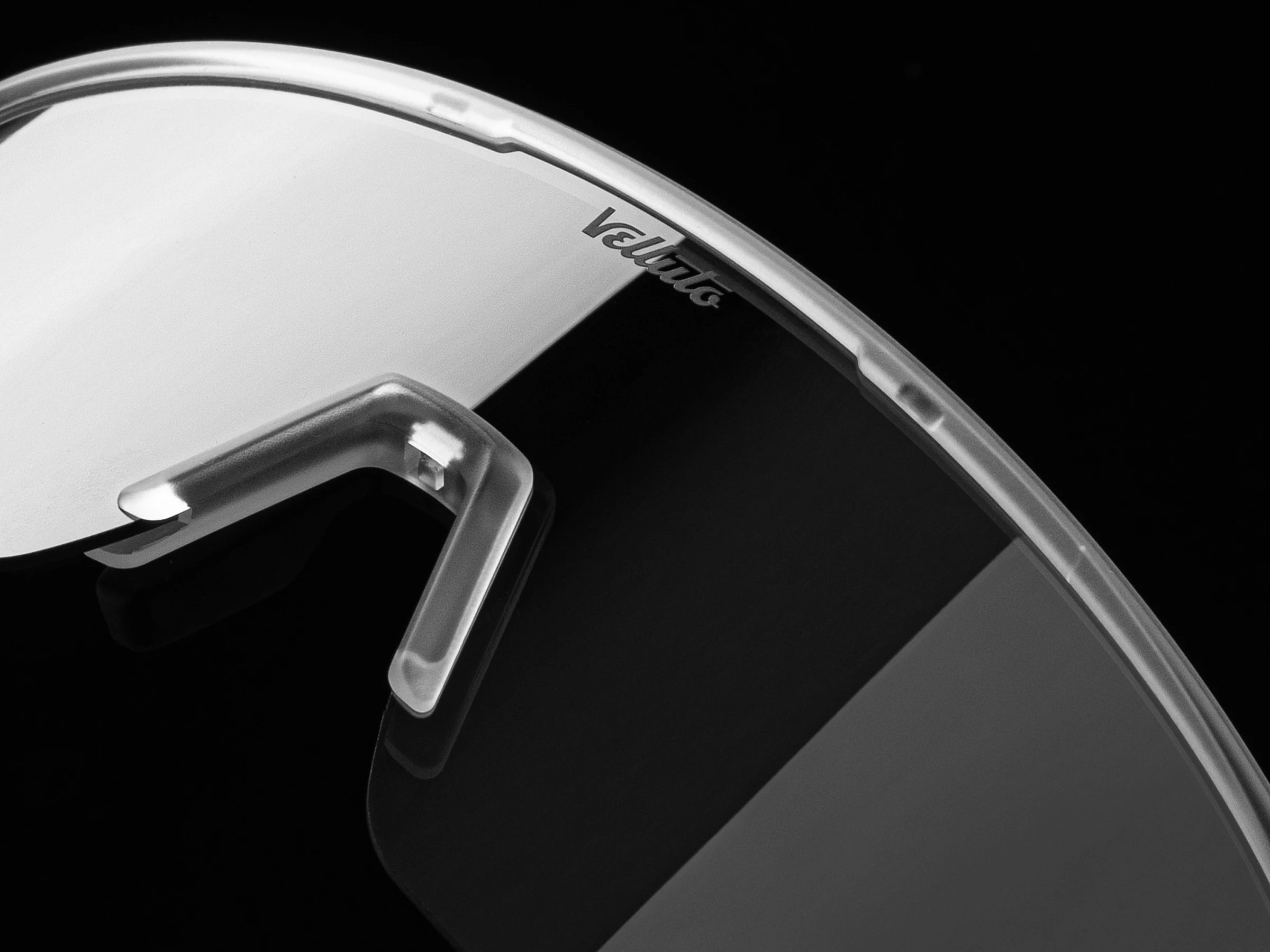
The Italian professional cycling tradition addressed this first through team car support: a rider could pull alongside a vehicle and swap glasses altogether. Recreational riders cannot do that. The interchangeable lens system, developed and refined by Italian manufacturers over several decades, brought the same adaptability to anyone who wanted it. The engineering challenge was making the swap fast, secure, and repeatable without tools. The design challenge was making the mechanism invisible when closed: a lens that looks like it clicks in and out is a frame that looks unfinished. A lens that looks like it belongs there permanently, and happens to be removable, is a different level of design resolution.
The Velluto StradaPro's click-in system reflects this thinking. The VellutoPuro clear lens and the VellutoVisione high-contrast lens both seat into the same frame using the same tool-free mechanism. Press the lens at two anchor points and it releases. Align the replacement and press until it clicks. The swap happens in seconds. More importantly, when either lens is seated, the frame looks complete: no visible gaps, no mechanical intrusion, no sense that something is missing or was added after the fact.
05 · Anti-FogThe Summer Climbing Problem That Italian Design Solved
August. A 15-kilometre climb somewhere in Castile, or in the Dolomites, or on the road to Ronda. The temperature is 32 degrees at the bottom and drops as you ascend. You are producing heat. The air around the lens is cooler than the air inside the frame. Without a designed solution, the lens fogs. You lose vision at the moment the road becomes most demanding.
Anti-fog engineering in cycling eyewear is not simply a coating applied to the lens surface, though coatings play a role. The more durable solution is ventilation geometry: designing the frame and lens together so that airflow moves through the eyewear continuously, preventing the temperature differential that causes fogging in the first place. Italian frame designers, working in close collaboration with riders doing exactly these kinds of climbs in exactly these conditions, refined this geometry over years. The ventilation channels that give many Italian cycling frames their characteristic look serve a real aerothermal function.
The StradaPro includes a built-in anti-fog system that operates on the same principle: airflow managed at the frame level, not dependent solely on a surface treatment. This matters in practice at the Vuelta a España's late-summer conditions, where the gap between ambient temperature and rider body temperature is significant, and at the sportive climbs of August where thousands of amateur riders face the same physics the professionals do. Clear vision on a descent is not optional equipment.

06 · FitAdjustability and the Italian Nose Pad Tradition
One of the less celebrated but most practically important contributions of Italian cycling eyewear is the adjustable nose pad. It sounds like a minor detail. In use, over a three-hour ride, it is not.
The nose pad determines how the frame sits relative to your eyes, how much pressure it places on your bridge, and whether it moves when you accelerate or descend. A fixed, one-size nose pad suits some faces and tolerates others. An adjustable pad can be positioned to your specific bridge geometry: closer or farther from the lens, angled inward or outward, set higher or lower. The result is a frame that stays exactly where you set it without gripping tightly enough to cause pressure or loosely enough to slide.
Italian cycling eyewear took adjustable nose pad engineering seriously because the professional riders demanding performance from these frames were doing so under conditions that reveal every failure of fit. A frame that shifts slightly during a sprint becomes a visible problem on a podium camera. A frame that leaves a red mark on the bridge after four hours is reported back to the manufacturer. These feedback loops, running through the Italian cycling supply chain for decades, produced a culture of fit-precision that now informs how serious road cycling glasses approach adjustability across the market.
The StradaPro's adjustable nose pads reflect this heritage: they can be positioned for your specific bridge shape, eliminating the sliding and pressure that accumulates on long August rides. Combined with the 25-gram frame weight, the net effect is a frame you stop thinking about within the first ten minutes of riding, which is exactly what a well-fitted pair of Italian cycling glasses should feel like.

07 · ColourHow Italian Eyewear Uses Colour as a Design Language
Colour in Italian cycling eyewear is not decoration applied after the fact. It is a considered design decision made in response to the frame's geometry, the material's character, and the cultural context of road cycling.
The Italian approach to colour in performance objects has its roots in the same tradition that made Italian automotive and product design internationally influential: a conviction that colour is a material property, not a finish. The specific orange of a frame is not chosen because orange is popular. It is chosen because that particular orange responds to the frame's surface texture at that specific curvature, reads correctly in the light conditions where the frame will be used, and carries the right associations within road cycling's visual culture. When it works, the result is a colour that feels inevitable: you cannot imagine the frame in any other tone.
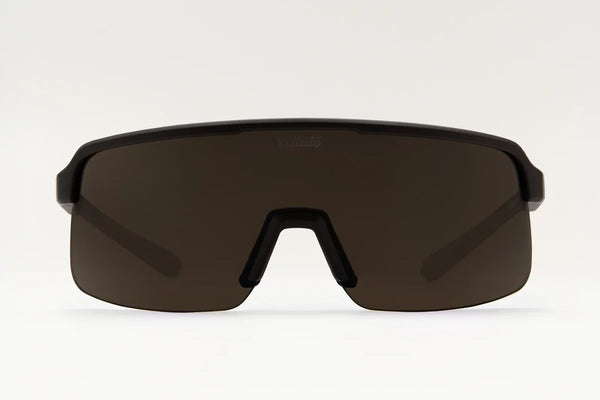
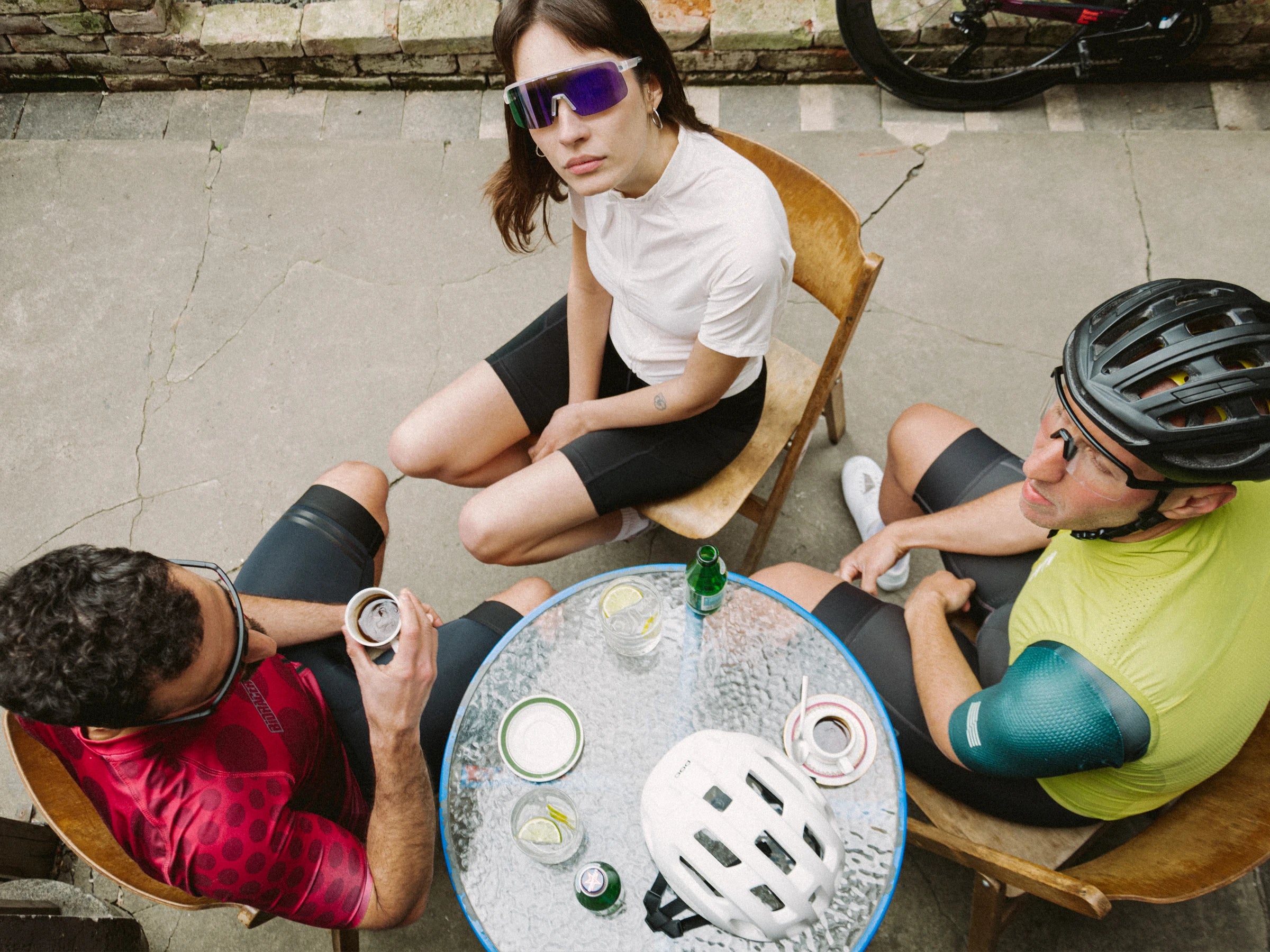
The StradaPro's four colourways reflect this approach. Nero is not simply black: it is a frame where the geometry is legible because colour is not competing with it. Espresso brings the warmth of Italian material culture to a road cycling frame without the self-consciousness of a fashion-led choice. Arancia carries the energy of Italian sports design, a colour that has appeared in Italian cycling culture for decades without feeling dated. Viola is the most adventurous of the four: a purple that works because the frame's proportions are resolved enough to carry it.


08 · The StradaProVelluto's Italian Design Approach in a Road Performance Frame
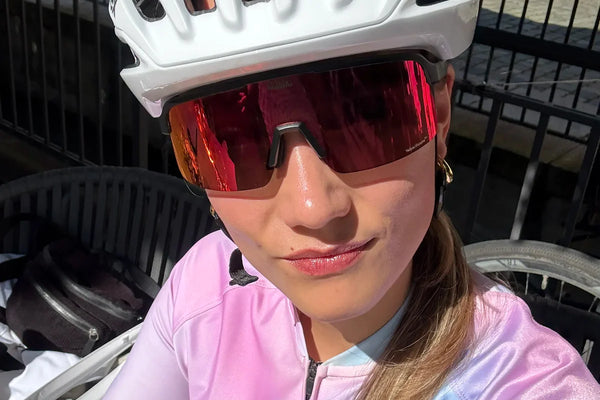
Velluto is a German brand that chose Italian design as the lens through which it would approach road cycling eyewear. That is a deliberate position, not a marketing phrase. It means the StradaPro was conceived within the tradition described in this article: proportional integrity worked out from the first sketch, performance requirements treated as design opportunities, colour applied with the specificity of a considered decision.
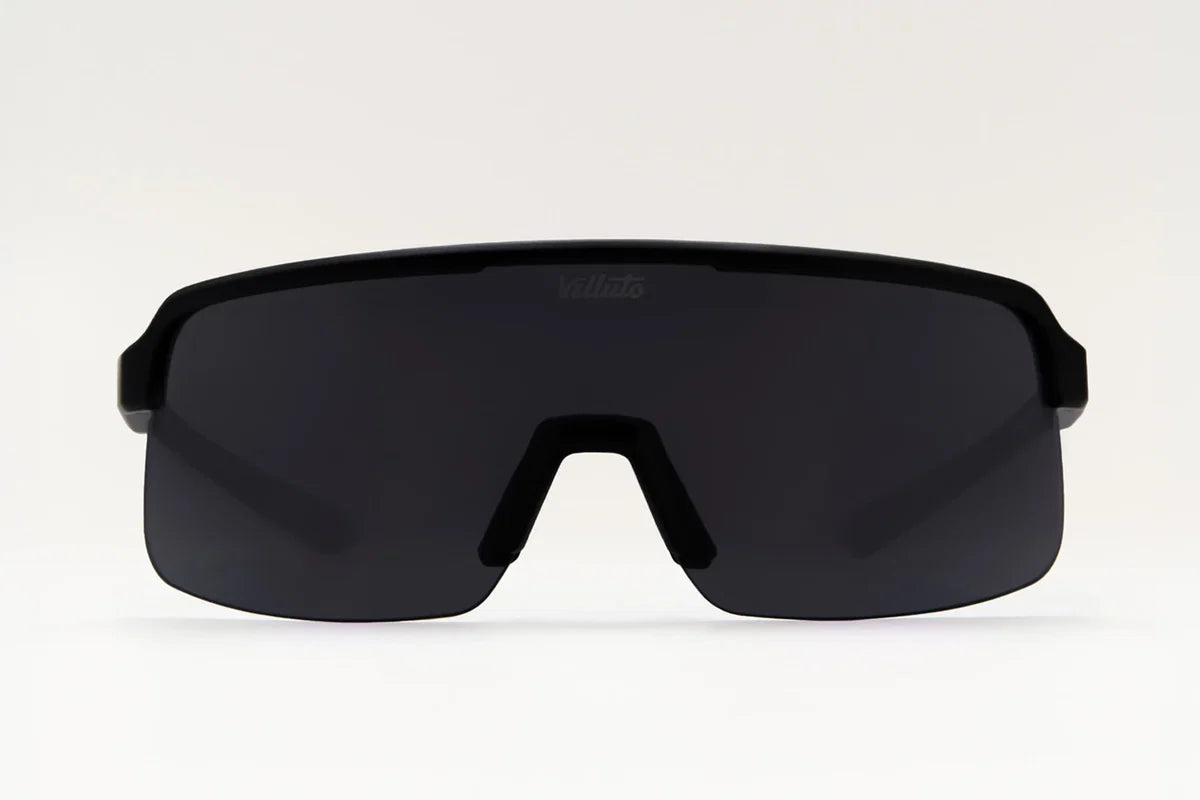
The practical result is a frame that weighs 25 grams, carries UV400 certification on both available lenses, includes a built-in anti-fog system, offers adjustable nose pads for precise fit, and supports tool-free lens swapping between the clear VellutoPuro and the high-contrast VellutoVisione. These are not separate features assembled into a frame. They are the consequence of designing a road cycling frame seriously, in the Italian tradition, from a brief that starts with what a rider actually needs rather than what is easy to manufacture.
For riders preparing for late-season sportives, riding through the variable light and temperature conditions of August in Europe, or simply looking for a frame that performs as consistently on the fifth hour as on the first, the StradaPro represents that tradition made accessible. The 30-day risk-free trial means you can test it on real rides before committing.

09 · Buying GuideHow to Choose Italian Cycling Glasses for Your Riding
The Italian cycling glasses market in 2026 is broader than it has ever been. Brands from across Europe draw on Italian design vocabulary, Italian manufacturing heritage, or both. The following criteria help separate genuine design thinking from surface-level aesthetic borrowing, and match frame characteristics to your specific riding context.
Weight. Every gram of a cycling frame is carried by your nose and ears for the duration of a ride. At 25 grams, the StradaPro sits at the lighter end of the performance road frame category. The practical difference between a 25-gram frame and a 35-gram one is noticeable on rides over two hours: lighter frames fatigue pressure points more slowly and cause less sensory distraction at the moments when your attention is most needed, which is to say, on descents and in sprints. When comparing frames, look for the published weight rather than terms like "ultra-light" unaccompanied by a number.
UV certification. UV400 is the meaningful standard: it means the lens blocks 100% of UVA and UVB radiation up to 400 nanometres. Any serious road cycling lens from any established Italian brand should carry this certification. Be cautious of frames that reference UV protection without the specific UV400 designation.
Lens system. A fixed lens makes sense only if your riding conditions are genuinely consistent. For most European road cyclists, they are not: light changes by season, by time of day and by weather. A two-lens interchangeable system (clear for low-light and overcast; high-contrast for sun and variable conditions) covers the full range of riding contexts without requiring multiple pairs of glasses.
Fit adjustability. An adjustable nose pad is the single most impactful fit feature in a cycling frame. Without it, fit is a binary proposition: either the frame suits your face or it does not. With it, you can position the frame precisely for your bridge geometry, eliminating the slow slide and accumulated pressure that otherwise defines a four-hour ride in August heat.
Anti-fog performance. Anti-fog is most important on climbs (where speed drops and temperature differentials increase) and in transitions between hot and cool conditions. Look for frames where anti-fog is addressed through ventilation geometry rather than solely a surface coating, which can degrade over time. The built-in anti-fog system in the StradaPro is frame-level, not coating-dependent.
Trial period. No amount of in-store testing or specification reading fully replaces real riding. A 30-day risk-free trial period allows you to test a frame across your actual riding conditions before committing. This is particularly valuable for a frame you intend to use through the variable conditions of late summer sportives.

10 · ComparisonsThe StradaPro Alongside Other Road Cycling Eyewear Options
Choosing Italian cycling glasses in 2026 means navigating a category that includes well-established heritage brands, technically strong contemporary options, and newer entrants drawing on Italian design language. The following framing is not a ranking but a map: each option has genuine strengths, and the right choice depends on what you are optimising for.
Briko brings one of the strongest heritage claims in the category. If the history of Italian professional cycling eyewear matters to you specifically, and if Briko's current range offers a frame that fits your riding context, that heritage is real and earned. Briko's design sensibility tends toward restraint, which suits riders who prefer a quieter aesthetic on the bike.
Rudy Project is the strongest Italian option if fit customisation is your primary concern. The brand has invested more in adjustability systems and interchangeable lens variety than almost any other manufacturer in the category. If you have found that standard cycling frames do not suit your face geometry, Rudy Project's fitting options are worth investigating seriously.
Oakley is not an Italian brand, but it is the most widely compared option in the road cycling eyewear category. The Jawbreaker is a technically accomplished frame with strong optics and wide adoption. It is a fair reference point. The StradaPro weighs 25 grams and carries UV400 protection on both lenses. It includes a two-lens click-in system (clear and high-contrast) designed to cover variable European light conditions. The Jawbreaker also carries UV400 protection and offers interchangeable lens options.
POC has built a strong reputation in both road and mountain cycling eyewear, with particular strength in safety engineering. POC's Aspire is a well-regarded road frame with a distinctive aesthetic. If you are drawn to a more angular, Scandinavian design language rather than Italian proportional tradition, POC is a coherent alternative.
The comparison table below uses only publicly available, verifiable specifications. Where a competitor's specific figure is not confirmed from official sources, the cell is left for you to verify directly with that manufacturer.
| Frame | Design origin | Weight | UV protection | Interchangeable lenses | Adjustable nose pad | Anti-fog system |
|---|---|---|---|---|---|---|
| Velluto StradaPro | Italian design, German brand | 25 g | UV400 certified | Yes | Yes | Built-in |
| Oakley Jawbreaker | American | 33 g | UV400 | Yes | See manufacturer | See manufacturer |
| Rudy Project Rydon | Italian | See manufacturer | UV400 | Yes | Yes | See manufacturer |
| Briko (current road range) | Italian | See manufacturer | UV400 | See manufacturer | See manufacturer | See manufacturer |
| POC Aspire | Swedish | See manufacturer | UV400 | See manufacturer | See manufacturer | See manufacturer |
The honest summary: if Italian design heritage is specifically what you are after, Briko and Rudy Project offer the most direct lineage. If you want a frame that applies Italian design principles to a modern road cycling brief, with all the performance specifications that entails, the StradaPro represents that approach at a starting price of from 69 EUR, with a 30-day trial and free shipping on orders over 89 EUR.
11 · The Starter KitTwo Lenses, One Frame, Every Condition
The Velluto Starter Vision Kit is the recommended entry point for riders who want the full Italian cycling glasses experience without making sequential purchasing decisions. The kit includes the StradaPro frame in your chosen colour, the VellutoPuro clear lens, and the VellutoVisione high-contrast lens: a complete two-lens system from the first day.
The logic is straightforward. A clear lens and a high-contrast lens between them cover every riding condition a European road cyclist is likely to encounter in a season. The VellutoPuro handles early morning training, overcast sportives and any conditions where maximum light transmission matters. The VellutoVisione handles direct summer sun, the variable light of late-afternoon rides, and the specific contrast demands of descending fast on a bright day. Both carry UV400 certification and anti-fog performance. Both swap in and out of the StradaPro frame in seconds.
Buying both lenses as a kit rather than purchasing them separately is the more cost-effective approach for riders who know they ride in varying conditions, which is to say, most European road cyclists riding through a full season from spring classics to autumn sportives.
12 · AccessoriesWhat to Pair with Your Italian Road Cycling Glasses
A well-designed pair of road cycling glasses deserves storage and maintenance that match the same standard of thinking. Three accessories are worth noting alongside the StradaPro.
The Velluto Hard Case is built around an anti-crash guarantee and a velvet interior finish. The velvet is not decoration: it prevents the micro-scratches that accumulate when a lens moves against a hard surface in a jersey pocket or kit bag. The hard shell protects the frame against the kind of compression damage that soft pouches cannot. It fits all Velluto road cycling glasses.
The Velluto Cleaning Spray is a 50ml, apple-scented, refillable lens cleaner made in Germany. It is designed for optical surfaces and pairs with the Velluto Microfiber Cleaning Cloth (25x25cm, 80% polyester, 20% polyamide): the material combination that cleans without scratching. Lens care is not a peripheral concern: a scratched or smeared lens degrades the VellutoVisione contrast enhancement and the VellutoPuro's clarity in ways that accumulate ride by ride.

Compare the full lineup in the Velluto StradaPro cycling glasses collection.
13 · FAQFrequently Asked Questions
What makes Italian cycling glasses different from other designs?
Italian cycling eyewear design is rooted in a tradition that treats the frame as both a functional tool and an aesthetic object. Proportions, colour and material are considered together from the first sketch, not layered on after the engineering is finished. The result tends to be frames that feel resolved rather than merely functional. Italian design studios also have deep proximity to professional road cycling culture, which has historically pushed aerodynamic shaping, weight reduction and lens integration further than leisure or lifestyle eyewear.
Do Italian cycling glasses offer UV400 protection?
UV400 is an optical standard, not a geographical one: it means the lens blocks 100% of UVA and UVB radiation up to 400 nanometres. Most serious road cycling glasses, Italian-designed or otherwise, carry UV400 certification. The Velluto StradaPro, designed with Italian aesthetics in mind, carries full UV400 certification on both its clear VellutoPuro and high-contrast VellutoVisione lenses.
Are Italian cycling glasses worth the investment?
It depends on what you prioritise. Italian-designed frames deliver coherence: proportions, colour and material are resolved together rather than layered sequentially. This integrated aesthetic, paired with genuine performance specs (UV400, anti-fog, low weight, secure fit), justifies the investment for riders who value that approach. For riders prioritising basic UV protection and casual use, other options exist across different price points.
What is the difference between VellutoPuro and VellutoVisione lenses?
VellutoPuro is a clear, transparent lens optimised for low-light and night riding, providing full UV400 protection and anti-fog performance while keeping maximum light transmission. VellutoVisione is a high-contrast lens that uses VellutoVisione technology to sharpen visual definition and improve depth perception, making it well-suited for variable summer light, early morning descents and fast-changing weather. Both use the same click-in system for tool-free swaps in seconds.
How does the StradaPro's interchangeable lens system work?
The StradaPro uses a click-in mechanism: press the lens lightly at two anchor points and it releases. Align the replacement lens and press it back until it clicks into place. No tools, no screws. The swap takes seconds at a roadside stop. Both the clear VellutoPuro and the high-contrast VellutoVisione lens are fully compatible.
Will the StradaPro fit my face securely on long climbs?
The StradaPro has adjustable nose pads that allow you to dial in the position for your specific bridge shape, reducing pressure and preventing the frame from sliding forward on long climbs or in heat. At 25 grams the frame exerts very little downward force, which reduces fatigue on multi-hour rides. The built-in anti-fog system maintains clear vision even when your pace drops on a summit finish.
Which colours are available for the Velluto StradaPro?
The StradaPro is available in four colours: Arancia (orange), Espresso (brown), Nero (black) and Viola (purple). All four colourways reflect the same Italian-influenced design language, with proportions and colour choices made to look as considered off the bike as on it.
What Italian cycling glass brands are well known in professional cycling?
Briko and Rudy Project are the two Italian brands most associated with professional road cycling. Briko outfitted some of the most celebrated climbers and sprinters of the 1990s and 2000s and retains strong heritage recognition. Rudy Project built its reputation on adjustability and custom fit, becoming a fixture at gran fondos and professional pelotons alike. Both brands continue to innovate within the Italian design tradition.
What is included in the Velluto Starter Vision Kit?
The Velluto Starter Vision Kit includes the StradaPro frame in your chosen colour plus both the VellutoPuro clear lens and the VellutoVisione high-contrast lens, giving you a complete two-lens system from day one. It is the recommended starting point for riders who face varying light conditions across a season and do not want to buy lenses separately later.
The Italian cycling glasses tradition earned its authority through four decades of proximity to professional road cycling's hardest demands, and through a design culture that refused to treat beauty and performance as separate questions. If you want to bring that tradition to your own riding, the Velluto StradaPro is the place to start: 25 grams, UV400 certified, built-in anti-fog, two interchangeable lenses, 30 days to test it on real roads. The Vuelta riders doing their work in August heat this week would recognise the brief.