How to Choose Cycling Glasses: A Step-by-Step Guide

Contents15 min read
You are two weeks out from your autumn sportive. The Vuelta is on television every evening and the riders' eyewear is, as always, immaculate: clean lines, zero fogging on the col finishes, lenses that read the road surface like a topographic map. You open a browser tab and type three words. What follows is approximately forty minutes of contradictory advice, too many options, and the nagging sense that you are about to spend real money on the wrong thing.
Most cyclists who buy the wrong pair of glasses do not make a mistake on price. They make a mistake on sequence. They start with colour or brand, skip fit entirely, and end up with glasses that fog on the first climb, slide on the descent, or create a pressure point that turns a four-hour ride into an endurance test of a different kind. This guide is structured the other way around: fit first, then lens, then conditions, then budget. By the end, the right choice should feel obvious.
01 · Face shapeWhy face shape is the first filter, not a styling afterthought
Face shape influences three things that actually matter in cycling: frame coverage, temple clearance, and how the glasses interact with your helmet straps. It has very little to do with looking good in a particular silhouette, which is how lifestyle eyewear brands typically frame the conversation. On a bike, the question is whether the frame stays in place, blocks wind from all the right angles, and does not create contact points that become painful after ninety minutes.
A wider face needs a frame with enough horizontal span to reach the outer edge of the eye socket without the temples pressing inward. A narrower face needs the opposite: a frame that does not extend so far that wind channels in from the sides. The critical measurement is the distance between your outer eye corners, roughly your temple width. Most cycling frames are designed around an average, which means they fit most people adequately and fit some people very well. If you find standard frames consistently uncomfortable, adjustable nose pads become particularly important because they allow independent fine-tuning of the bridge fit, which changes the overall sitting position of the frame on your face.
Lens coverage matters too. Road cycling at speed sends air, insects, and road debris toward your eyes from a low angle, not straight on. A lens with generous vertical depth protects the lower eye from this upward-angled stream. Many fashion-oriented sunglasses fail here: the lens looks proportionate when you are standing still but leaves a gap below the eye when you are in the drops and the wind is coming from ahead and below.
Should align with your outer eye socket. Too wide creates wind channels. Too narrow creates temple pressure.
Deeper lenses protect the lower eye from the upward airstream cyclists experience in the drops.
Adjustable pads let you change the frame's sitting position without changing frame size. Essential for fine-fit.
Temples must clear your helmet straps cleanly without creating pressure where the strap passes behind your ear.
02 · FitThe one thing most buyers get wrong
Here is what most cyclists skip: they buy glasses without ever testing whether the glasses stay put on a climb. Fit in a mirror is not the same as fit at 180 watts on a six-percent gradient, sweating, with a helmet compressing slightly over the top of the frame. Glasses that feel fine in a shop can slide two millimetres down your nose within the first twenty minutes of genuine effort, and once they start moving, they keep moving.
The markers of a well-fitting cycling frame are specific. The nose pads should make full, even contact without creating a single pressure point. The temples should pass cleanly alongside, not through, your helmet straps. The lens should not touch your eyelashes when you blink. And the frame should not move when you shake your head side to side at the pace you would use to check traffic at a junction. If any of these fail, no amount of good optics compensates.
Adjustable nose pads are the single most underrated feature in cycling eyewear. They let you set the contact angle for your specific bridge geometry rather than accepting the manufacturer's average. On a long road day, the difference between a nose pad that sits at the right angle and one that sits two degrees off is the difference between forgetting you are wearing glasses and spending the last hour thinking about nothing else.
The glasses that stay put on a four-hour sportive are always the right ones, regardless of what they cost.A principle every experienced road cyclist eventually arrives at
A risk-free trial period solves this problem directly. Testing glasses on an actual ride, over climbs, in variable temperatures, with your specific helmet, is the only reliable way to confirm fit. A 30-day trial window gives you enough rides in enough different conditions to know with certainty.

03 · LensChoosing the right lens for the right light
The lens decision is where most buying guides spend the most words and where most cyclists make the simplest mistake: buying one lens for all conditions. A single tinted lens works well in the scenario it was optimised for. Outside that scenario, it is a compromise at best and a liability at worst. Riding with a dark lens into a tunnel, or starting a pre-dawn sportive with a lens designed for bright midday sun, is genuinely hazardous.
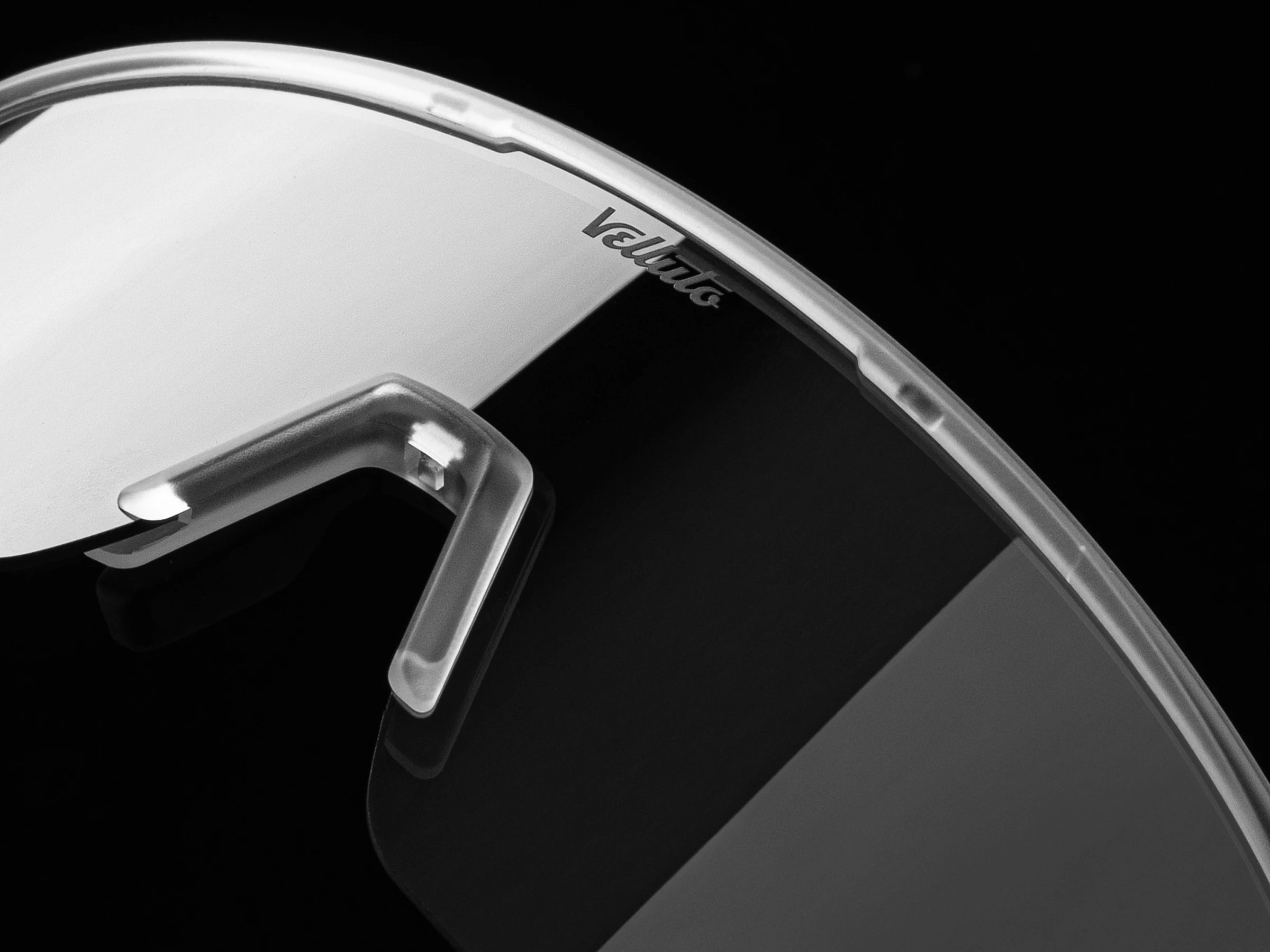
The cleaner solution is interchangeable lenses. One frame, two lenses, every condition covered. The system only works if the swap is fast and tool-free, because conditions change mid-ride and you are not going to stop and fumble with a screwdriver at the bottom of a col.
There are two lens types that cover essentially all road cycling scenarios:
Clear lenses are for low light: pre-dawn starts, tunnels, overcast conditions, early autumn evenings. Their function is not to reduce brightness but to protect against wind and debris while keeping your vision as open as possible. The VellutoPuro lens is built specifically for road cyclists in these conditions, certified to UV400 standard and designed with anti-fog performance for variable weather.
High-contrast lenses are for mixed and bright conditions: the dappled shade of a tree-lined road, the sharp glare off wet tarmac, the low-angle morning sun on a sportive start. They work not by simply darkening the view but by sharpening the distinction between surfaces. The VellutoVisione lens uses this principle to make road texture, kerb lines, and shadows read more clearly at speed. On a descent, that visual definition is the difference between committing early and braking late.
What road cyclists almost never actually need is a single fixed lens that cannot be swapped. If you ride primarily at noon in full sun on the same road every week, a fixed dark lens is fine. If you ride sportives, early training sessions, autumn races, or any event with an uncertain start time, interchangeable lenses are not a luxury. They are the rational choice.
04 · ConditionsMatching your glasses to the rides you actually do
Late August and September in Europe is a specific kind of cycling. The days are still long but the light is lower. Morning starts can be cool and misty. By noon the sun is often strong. Descents into valley shadows shift from bright to dim in seconds. The Vuelta's col finishes illustrate this perfectly: riders who started in full midday glare finish under cloud with the valley lights coming on below them. Their lens choice was made before the start, without knowing exactly what the top of the climb would look like.
Matching your eyewear to conditions means thinking honestly about when and where you ride, not where you wish you rode. A few useful categories:
Full sun, open roads: A high-contrast lens handles this well. The VellutoVisione sharpens visual definition in bright, variable light without going so dark that shaded sections become dangerous.
Mixed or variable light: This is most cycling in central and northern Europe. Interchangeable lenses are the answer. Start with the high-contrast lens, carry the clear one. Swap at the base of a long descent into shade or at the tunnel entrance.
Pre-dawn and low light: Clear lens only. Any tint at this light level is a reduction in safety, not a styling choice.
Sportives and events: Start-to-finish coverage requires both lens types. If your event starts at 6:30 in the morning and finishes six hours later, the light at the end bears no resemblance to the light at the start. Pack both lenses. This is the exact use case interchangeable systems were designed for.
Hot-weather climbs: Anti-fog performance matters here specifically. When your effort level is highest and your airspeed is lowest, the temperature differential between your face and the lens surface is greatest. A frame with a built-in anti-fog system keeps the lens clear at exactly the moment a fogged lens would be most disorienting.

05 · WeightWhy 25 grams matters on a four-hour ride
Weight in cycling glasses is not a marketing number. It is the difference between wearing something and feeling something. At 25 grams, the StradaPro sits in a range where, after the first few minutes, your brain stops registering that the glasses are there. At 35 or 40 grams, the frame is perceptible throughout the ride, and on climbs where you are out of the saddle and your head is moving more, that perceptibility becomes genuine distraction.
The weight argument is most relevant over distance. On a 45-minute commute, 10 extra grams on your face is irrelevant. On a six-hour sportive, the cumulative fatigue of a slightly heavier frame across thousands of head movements is real, if unquantifiable in any useful way. The riders who care most about frame weight are the ones who have done enough distance to notice what happens when it is absent.
06 · BudgetWhat different price points actually get you
Road cycling eyewear sits across a wide price range. At the lower end, you can find frames that provide basic wind protection and a tinted lens. At the upper end, you are paying for a combination of optical quality, frame materials, fit engineering, and the interchangeable lens system. The question is not which number to spend but which features are genuinely worth paying for and which are largely decorative.
The features that translate into ride performance are: UV400 certification on every lens, anti-fog engineering, adjustable nose pads, a tool-free interchangeable lens system, and a frame weight under 30 grams. These are not marketing abstractions. Each of them has a specific, testable effect on the experience of a long ride.
The features that often inflate price without translating into ride performance are: brand heritage marketing, proprietary lens branding built on the same optical principles as generic high-contrast technology, and colourways designed for catalogue photography rather than field performance.
A useful question to ask at any price point: what happens when conditions change mid-ride? A single-lens frame at any price point cannot answer this question well. A frame with a reliable click-in interchangeable system can. That is the functional dividing line more than any specific price number.
For reference, the Velluto StradaPro starts from 69 EUR and includes UV400 certified lenses, a built-in anti-fog system, adjustable nose pads, and full compatibility with the VellutoPuro and VellutoVisione click-in lenses.
07 · ColourFour options, one honest answer on which to choose
Colour is the last decision, not the first. Once you have confirmed fit, lens system, and weight, the colour you choose has zero effect on performance. Choose the one you will actually put on for every ride because you like how it looks on your bike.
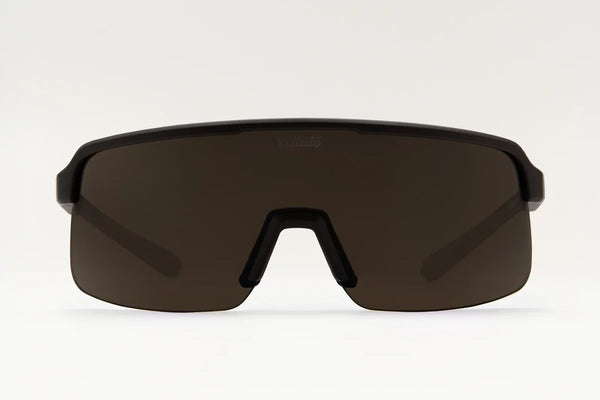
The StradaPro is available in four colours: Nero (black), Espresso (brown), Arancia (orange), and Viola (purple). Each ships with the same frame geometry, the same adjustable nose pads, the same anti-fog system, and the same UV400 certified lenses. The performance is identical across all four.


08 · Our pickThe StradaPro in context
The Velluto StradaPro is a road cycling frame designed with Italian aesthetics and built to handle the specific demands of European road cycling: variable light, long distances, helmet compatibility, and the kind of mixed conditions that define a late-summer sportive. It weighs 25 grams. It carries UV400 certification on every lens. It has a built-in anti-fog system. The nose pads are adjustable. The lenses click in and out without tools.
If you are working through the decision framework in this guide and ticking boxes, the StradaPro ticks them in sequence: coverage for your face shape via adjustable fit, stable on-road performance via lightweight frame and secure nose pads, clear vision across conditions via the two-lens click-in system, and full UV protection via UV400 certification on both the VellutoPuro and VellutoVisione lenses.
The Starter Vision Kit includes the Espresso frame paired with the interchangeable lens system, which is the version we would point most sportive riders toward: one frame, both lenses, the complete solution for variable late-season light.

Compare the full lineup in the Velluto StradaPro cycling glasses collection.
09 · FAQFrequently Asked Questions
How do I know which cycling glasses fit my face shape?
What lens tint is best for road cycling in summer?
Do I need UV400 protection in cycling glasses?
What does anti-fog mean in cycling glasses, and does it matter in summer?
How light should cycling glasses be?
Are interchangeable lenses worth it for road cycling?
What is the difference between a high-contrast lens and a standard tinted lens?
How important is nose pad adjustability in cycling glasses?
What is a risk-free trial and should it influence which cycling glasses I buy?
If this guide has helped clarify what you actually need, the next step is straightforward: choose your frame, pick your lenses, ride for 30 days, and return the glasses if they are not right. That is a lower-stakes decision than most cyclists realise. Find the full StradaPro range and lens options at Velluto cycling eyewear.