Cycling Glasses vs Sunglasses: 5 Key Differences
Contents22 min read
You are 80 kilometres into a late-summer sportive, the kind of August day the Vuelta peloton would recognise: sun hammering the tarmac, a long false-flat ahead, and a tunnel coming up in three kilometres. Your regular sunglasses have already slid twice on the descent. Now, fogging up in the shadow of the tunnel entrance, they are giving you two problems at once and solving none.
That is the moment most cyclists discover, practically rather than theoretically, the difference between a pair of sunglasses and a pair of cycling glasses. The distinction is not cosmetic. It is not about brand names or price brackets. It is about five specific engineering decisions that matter enormously at speed and not at all on a city street. This guide explains each one honestly, so you can decide what you actually need before your next ride, not during it.
01 · The Core QuestionWhy the cycling glasses vs sunglasses debate matters more than you think
The word "sunglasses" describes a product category optimised for one task: reducing solar glare while stationary or moving slowly. Every design decision in a standard sunglass frame, from the flat lens profile to the lightweight open temple design, follows from that brief. There is nothing wrong with that. A classic pair of shades is exactly right for a terrace, a beach, or a drive.
Cycling, especially road cycling, adds a set of demands that did not exist when the sunglass category was invented. You are moving at 30 to 60 kilometres per hour in an aerodynamic position that tilts your head down and forward. Wind hits your face from the front and channels around the frame edges. Sweat builds on your nose bridge over hours. Your body temperature rises and falls with gradient. Lighting shifts from open road to tunnel to dappled tree cover in seconds. Insects and road grit travel at the same speed as you do.
A sunglass designed for a beach handles none of those conditions particularly well. A cycling glass is designed for all of them. The gap between the two, in practical terms, is the subject of this guide.
02 · Difference OnePeripheral coverage: the gap that becomes a wind scoop
Pick up a standard pair of sunglasses and look at the lens profile from above. The lens is approximately flat, running more or less parallel to your face. There is a visible gap between the lens edge and your temple, and another gap below the lens where it meets the cheekbone. At walking speed those gaps do not matter. At 45 kilometres per hour they become a problem.
Wind does not hit a moving object uniformly. It separates and channels around edges. On a bicycle, the airflow that reaches the sides of your face is moving at close to your full travel speed relative to your skin. Any gap in your eyewear acts like a channel, concentrating that airflow and directing it across the eye surface. Cyclists who regularly ride at sportive pace (30 to 50 km/h) report significantly more eye irritation, dryness, and "wind tear" than those using wrap-around frames, even on identical routes.
Insects are the more dramatic illustration of the same physics. A small fly or bee at 40 km/h carries enough kinetic energy to cause genuine injury. The gap between a flat sunglass lens and the temple is wide enough for an insect that size to pass through at full speed. Wrap-around cycling glasses eliminate that gap. The curved lens profile follows the contour of the face closely enough that wind channelling is minimised and insects are deflected before they reach the eye.
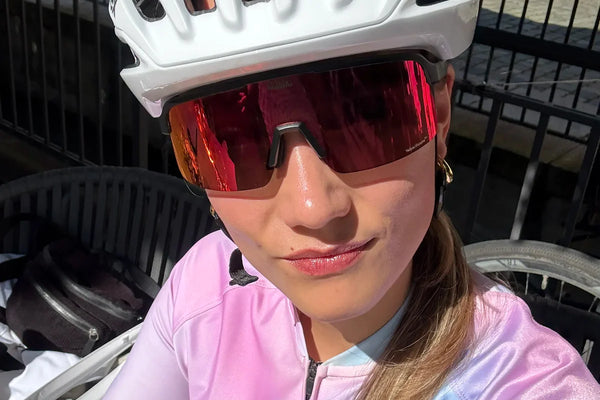
The shape is not arbitrary design. It is an aerodynamic decision. The wrap creates a micro-climate around the eye, a small zone of relatively still air inside the coverage of the lens, rather than exposing the eye directly to the oncoming airstream. That difference is imperceptible on a walk to the coffee shop. It is highly noticeable in the first ten minutes of a fast group ride.

03 · Difference TwoVentilation and anti-fog: the problem that only appears on climbs
Fogging is almost entirely a cycling problem. It rarely affects sunglasses wearers because the conditions that create it, a significant temperature differential between the lens and the air trapped between lens and face, almost never occur in the activities sunglasses are designed for. On a bicycle, those conditions occur reliably.
When you climb, your effort level rises, your face produces more heat and moisture, and your speed drops. The moving air that kept the inside of your lenses cool and dry during the flat section is now slower or absent. Warm, humid air from your breath and face pools behind the lens. If the lens surface is even slightly cooler than that air, moisture condenses. The lens fogs. It does not happen gradually. It tends to happen quickly and completely, which is why cyclists who experience it mid-descent describe it as a sudden white-out rather than a gradual dimming.
Standard sunglasses are typically not designed with anti-fog lens coatings, which are a specific feature of purpose-built cycling eyewear. Those coatings work by making the lens surface hydrophilic, meaning water spreads into a thin, clear film rather than forming the tiny droplets that scatter light and appear opaque. Second, standard sunglass frames are not designed to ventilate the space behind the lens. The frame sits close to the face as a fashion decision, and there is no deliberate airflow path through the frame.
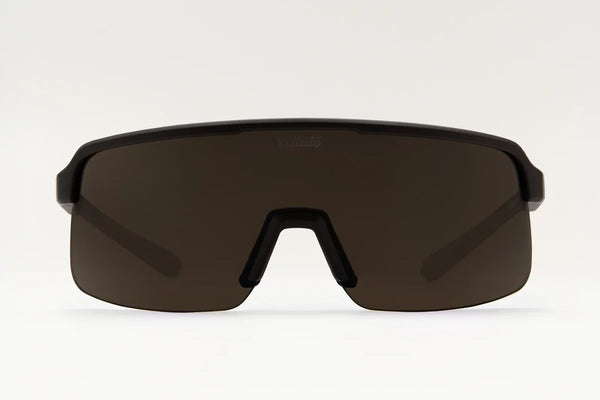
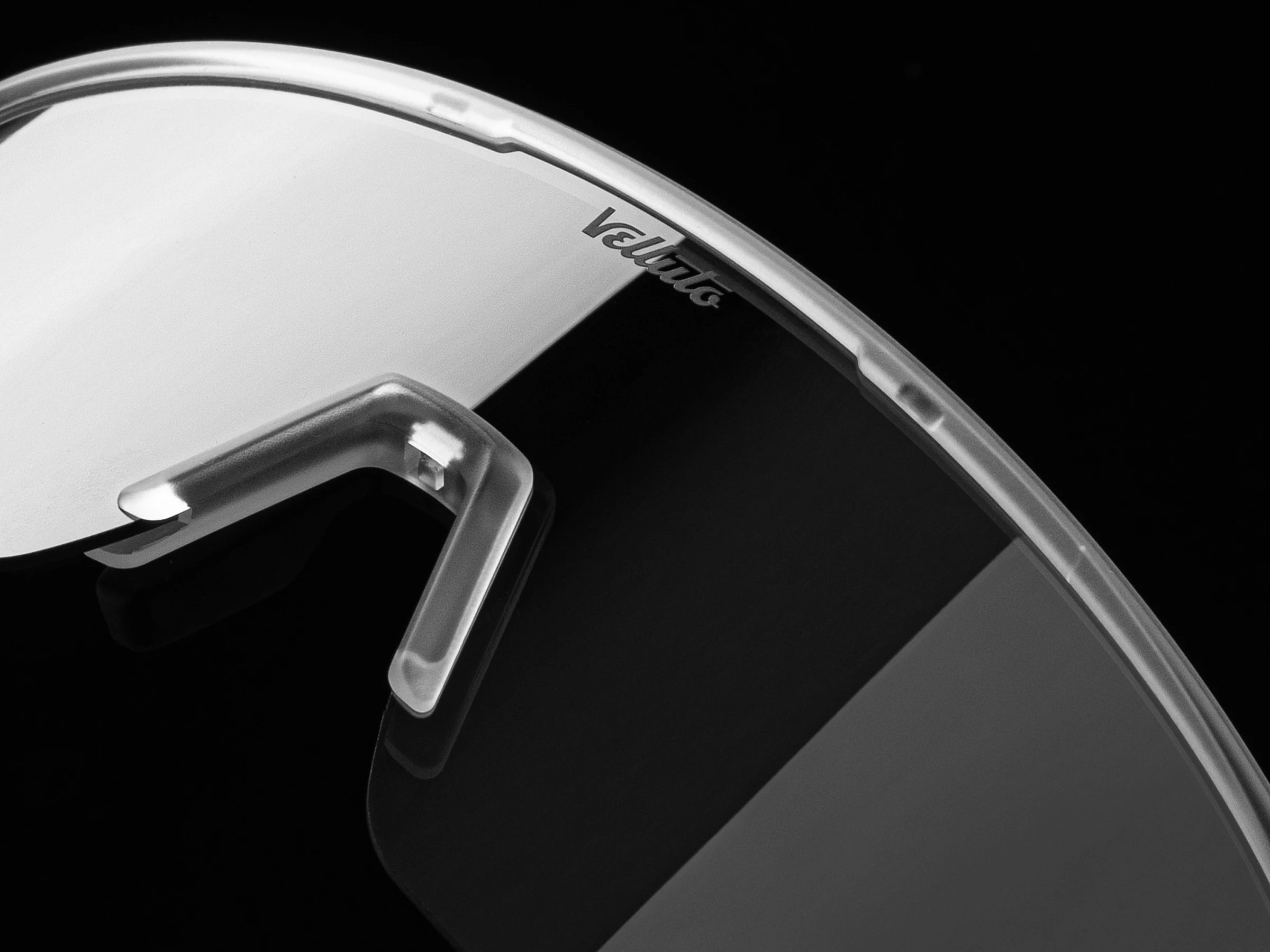
Purpose-built cycling glasses address both. The VellutoStradaPro uses a built-in anti-fog system that combines coating technology with a frame geometry designed to allow airflow across the inner lens surface. That airflow replaces warm, humid air with cooler, drier air before condensation can form. On climbs, in tunnels, and in the variable weather of a late-summer sportive, the difference between a fogged lens and a clear one is not a minor comfort issue. It is a visibility and safety issue.
Fogging does not happen gradually. It tends to happen quickly and completely. That is why it is a safety issue, not just a comfort one.Velluto Cycling Eyewear
The Vuelta peloton uses stage racing glasses for exactly this reason. Late August in Spain means temperature swings of 20 degrees Celsius between valley starts and mountain finishes. The condensation physics are identical whether you are racing at 1,800 metres or completing a Gran Fondo with an alpine finish. If your lens fogs at 60 km/h on a descent, you cannot see. The anti-fog system is not a feature you need until the moment you desperately need it, at which point it is the only thing that matters.
04 · Difference ThreeGrip and stability: why sunglasses slip and cycling glasses do not
Sweating is part of cycling. After the first hour of a summer ride, your face is wet. After two hours in 28-degree heat, the nose bridge and temples of your eyewear are coated in a layer of salt water. Standard sunglasses, which are designed for faces that are mostly dry, deal with this poorly.
Most sunglass frames use smooth plastic or metal nose bridges and temple tips. These materials have low friction against dry skin. Against wet, sweaty skin, they have almost none. The result is that the glasses slide down the nose. This is an inconvenience on a beach. On a bicycle, reaching up to push your glasses back into position means taking a hand off the bars, usually during a moment when both hands are most useful: a technical descent, a sharp corner, the final sprint of a group ride.
The grip problem is compounded by the aerodynamic position. When your head is down and forward in a road cycling position, gravity is working to pull your glasses forward and down the nose. Standard frames with smooth bridges have nothing to counteract this force except the friction of skin contact, which disappears under sweat. The glasses start to drift. In the final kilometres of a hard ride, they are often sitting at a noticeably different position than they started, which shifts the optical axis and makes the lens geometry work against rather than for you.
Cycling-specific frames address this with rubberised or silicone nose pads and temple tips. These materials are engineered to increase their grip under moisture rather than lose it. The physics are the same as wet-grip tyres versus slick tyres: the material deforms slightly under load to increase contact area, and it does not become slippery when wet. The Velluto StradaPro uses adjustable nose pads that allow precise positioning for different face shapes, ensuring the grip point is correct for each rider rather than relying on a one-size-fits-all geometry that may or may not make contact where it should.
Adjustability matters here in a second way. A nose pad that is adjusted correctly distributes the weight of the frame evenly across the nose bridge. One that is misaligned creates a pressure point on one side, which becomes genuinely uncomfortable after three or four hours. A well-adjusted cycling frame should create zero perceptible pressure at any point on a long ride. That is a specific design target. It is not achievable with a fixed-geometry sunglass bridge.

05 · Difference FourHelmet compatibility: the geometry problem most cyclists never think about
A road cycling helmet has a specific internal strap geometry. The straps split below the ear and converge in front of it, creating a Y-shape that cradles the lower part of the skull. The temples of your glasses run along the side of the head, and they have to pass through or around the front section of that strap geometry every time you put on and take off your eyewear.
Standard sunglass temples are designed for use without a helmet. Their arms are often wider at the hinge, thicker in cross-section, or angled in ways that work perfectly in everyday life but create interference with helmet straps. The practical result is that putting on or removing sunglasses while wearing a helmet becomes a two-handed operation that requires removing the helmet, or produces a situation where the glasses arms are pressing the helmet straps against your face.
More significantly, a sunglass temple that presses against a helmet strap will often be levered slightly outward by that pressure. This lifts the lens away from the face on one or both sides, reopening the peripheral gap that the lens profile was supposed to close. The protection you thought you had from a wider lens is partially negated by the fit distortion caused by helmet contact.
Cycling-specific frame geometry accounts for this. The temple arms are designed to run cleanly inside the helmet strap, not pressing against it or being deflected by it. The arm cross-section is thin enough to avoid strap interference. On some frames, including the StradaPro, the temple angles are calibrated so that putting the glasses on before pulling the helmet down over them is the natural sequence, and the result is a frame that sits correctly inside the helmet without adjustment.
There is also a helmet ventilation consideration. Many road cycling helmets use wide front vents that direct airflow over the scalp. A sunglass frame with a tall, opaque bridge or thick upper rim can partially obstruct those vents. Cycling glasses tend to use rimless or semi-rimless upper edges specifically to keep the helmet-to-scalp airflow path clear.
Closes peripheral gaps that allow wind, insects, and road grit to reach the eye at cycling speeds.
Prevents condensation on climbs, in tunnels, and in variable weather through coating and ventilation design.
Rubber or silicone nose pads and temple tips that hold position as moisture builds over a long ride.
Temple geometry designed to sit cleanly inside helmet straps without creating pressure or opening lens gaps.
06 · Difference FiveInterchangeable lenses: one pair, every light condition
Standard sunglasses have one lens. That lens has one tint. That tint is designed for one light level, usually bright sun. In most non-cycling contexts this is perfectly adequate because you simply take the glasses off when the light drops. On a bicycle, taking your glasses off is not always convenient or safe, and in many conditions, particularly dusty roads, high-speed descents, or sections with insects, riding without eye protection at all is worse than riding with an imperfect lens tint.
A summer cycling season in Europe does not deliver uniform light. A Gran Fondo might start at 6:30 in the morning in grey light, cross into bright alpine sun by 10:00, pass through a series of tunnels at noon, and finish in the golden-hour light of late afternoon. A single fixed-tint sunglass forces you to choose one compromise for that entire range, or to carry multiple pairs.
Interchangeable lens systems solve this with a single frame that accepts multiple lenses. The key performance variable is the swap mechanism. A system that requires tools, case access, or significant time and finger dexterity to change is unlikely to be used mid-ride. A system where the lens clicks in and out securely with a single motion, tool-free, can be changed in a feed zone or at the side of the road in seconds.
The Velluto StradaPro uses a click-in system compatible with both the VellutoPuro clear lens and the VellutoVisione high-contrast lens. The VellutoPuro is optimised for low-light conditions and provides the wind and insect protection of a full cycling frame without reducing available light. The VellutoVisione uses contrast-enhancement technology to sharpen the visual definition of road surfaces, shadows, and edge lines, which is particularly useful on descents and in variable late-summer light. Both lenses carry UV400 certification.
The practical scenario that makes interchangeable lenses most useful is not the extreme case but the ordinary one. You leave for your Sunday ride with a tinted lens installed. By kilometre 30, cloud cover has built and you are riding in flat, grey light where the tint is working against you. With a fixed sunglass you continue squinting into reduced contrast. With an interchangeable system you swap to clear at the next junction in fifteen seconds and the ride becomes immediately more enjoyable. That is not a feature you will use every ride. It is a feature you will appreciate significantly the first time conditions change unexpectedly, which in northern European and alpine cycling happens with some regularity.

07 · In PracticeWhat these five differences mean on real rides
It is worth being direct about one thing: if you ride occasionally, at modest speeds, on short routes in good weather, standard sunglasses will do most of the job most of the time. The five differences above become progressively more relevant the faster, longer, and more variably you ride. A 45-minute commute at 20 km/h on flat roads is not the context where anti-fog systems and wrap-around coverage change your experience materially.
A 120-kilometre summer sportive, a club ride with sections over 45 km/h, a mountain stage with temperature differentials of 15 degrees and a descent after a long climb, these are the contexts where the engineering decisions in a purpose-built cycling frame produce a measurable, ride-altering difference. The late August Vuelta stages that professional teams use as a reference point for equipment design are an extreme version of the same physics. The condensation on a pro rider's lens at 1,900 metres obeys the same rules as the condensation on your lens at a local col.
The weight factor is also relevant in practice. At 25 grams, the Velluto StradaPro sits at the lighter end of purpose-built cycling frames. Weight on eyewear is felt differently from weight elsewhere on the bike. A frame that is too heavy slides faster on sweat, creates more pressure on the nose bridge over a long ride, and fatigue the temple muscles subtly over hours. At 25 grams, the Velluto StradaPro is engineered for the specific demands of long road rides, where minimising nose-bridge load across four hours directly affects comfort and performance.
The UV protection question is also worth stating clearly. UV400 certification means the lens blocks 100 percent of UVA and UVB radiation up to 400 nanometres. This is the full spectrum of ultraviolet light capable of causing eye damage, including the UVA wavelengths that penetrate more deeply into the eye structure and contribute to long-term cataract and macular degeneration risk. Cyclists accumulate UV exposure in long, uninterrupted doses, often at altitude where UV intensity is meaningfully higher than at sea level. Every lens in the Velluto range, the StradaPro frame with both the VellutoPuro and VellutoVisione options, carries UV400 certification. This should be a baseline requirement for any cycling eyewear you consider, not a premium feature.

08 · The Full KitWhat else belongs in your cycling eyewear setup
The glasses themselves are the centre of a cycling eyewear setup, but the rest of the kit matters more than most riders realise until they get it wrong.
Storage is the first consideration. Cycling glasses, with their curved wrap-around lenses, do not fit well in standard soft cases. A lens that is pressed slightly flat by a case that is too small develops micro-scratches and, eventually, distortion in the optical centre. A hard case designed for cycling frame geometry protects the lens from both pressure and impact. The Velluto hard case carries an anti-crash guarantee and uses a velvet interior that will not scratch coated lens surfaces, while fitting the StradaPro frame geometry precisely.
Lens cleaning is the second consideration. The anti-fog coating on a cycling lens is a functional surface treatment, not just a glass layer. Cleaning it with the wrong material, a paper tissue, a jersey hem, or a coarse cloth, degrades the coating progressively. A dedicated microfibre cleaning cloth uses a fine-filament fabric that lifts particles off the surface without pressing them into the coating. The Velluto microfibre cloth uses an 80 percent polyester, 20 percent polyamide construction, which is the standard specification for optical-grade cleaning applications.
Lens cleaning spray completes the kit. A dry wipe on a lens coated in dried sweat, sunscreen residue, or insect material does not clean the surface. It smears it and risks grinding particles across the coating under friction. A dedicated cleaning spray dissolves and lifts surface contamination before wiping, which both cleans more effectively and extends coating life. The Velluto cleaning spray is produced in Germany, comes in a 50ml refillable format, and uses an apple fragrance. Small detail, but worth noting for riders who have experienced the unpleasantness of alcohol-heavy sprays close to the face.

09 · The Colour QuestionWhich StradaPro colourway suits which rider
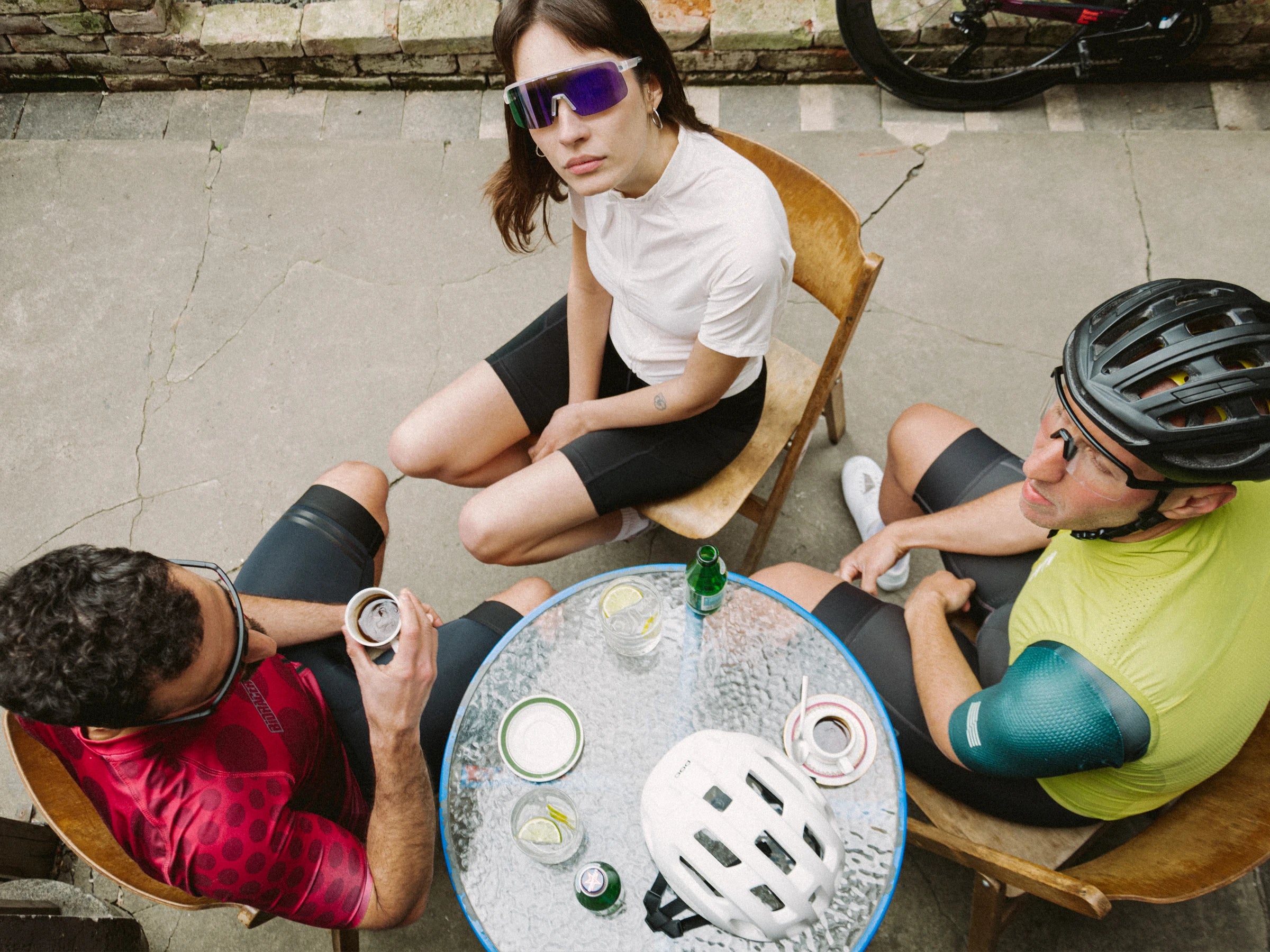
The Velluto StradaPro is available in four colourways: Arancia (orange), Espresso (brown), Nero (black), and Viola (purple). The lens optical performance is identical across all four. The choice is entirely personal, with one practical note: the frame colour affects how visible the glasses are in a dropped jersey pocket or on a cafe table. Arancia is the most visually distinctive and therefore the least likely to be left behind at a feed station. Nero is the most versatile against different kit colours.


10 · Keeping Them CleanThe right way to maintain your lens coatings
Anti-fog and UV coatings on cycling glasses are durable by design, but they are not indestructible. The coating is a molecular-level treatment applied to the lens surface, and it can be degraded by abrasion, by certain chemical solvents, and by being allowed to dry with surface contamination on the lens (sweat, sunscreen, and insect material are all mildly acidic and will etch a coating if left in contact over time).
The care routine that extends coating life is simple. After each ride, remove surface dust with a gentle blow (or compressed air if available) before touching the lens. Apply a small amount of appropriate lens cleaning spray and wipe with a clean microfibre cloth using circular motions from the centre outward. Store the glasses in a hard case between rides. Do not leave them face-down on any surface. Do not wipe with jersey fabric, paper tissues, or tap water alone (the mineral content in tap water can leave deposits on the lens surface that act as abrasives under subsequent wiping).
That routine adds approximately ninety seconds to the post-ride process. It extends the functional life of the anti-fog coating by a meaningful margin and keeps the optical clarity of the lens at the level it was when new.

Compare the full lineup in the Velluto StradaPro cycling glasses collection.
11 · FAQFrequently Asked Questions
Can I wear regular sunglasses for road cycling?
You can, but regular sunglasses were not designed for the aerodynamic position, speed, or ventilation demands of road cycling. Most standard frames leave gaps at the temples and below the lens that allow wind, insects, and road grit to reach your eyes at speed. They also tend to slide on a sweaty nose bridge and lack the anti-fog performance needed when your body heat rises on climbs. For occasional, low-speed riding they may suffice, but for sportives, longer road rides, or any riding above 30 km/h, purpose-built cycling glasses offer meaningfully better protection and comfort.
What is the main difference between cycling glasses and sunglasses?
The five most practical differences are: wrap-around coverage that closes peripheral gaps, built-in ventilation or anti-fog systems that prevent lens fogging on climbs, frame geometry optimised for a helmet and aerodynamic head position, secure grip systems that prevent slipping under sweat, and interchangeable lens systems that let you adapt to changing light without carrying multiple pairs. Standard sunglasses typically offer none of these features as standard.
Do cycling glasses need to be UV400?
Yes. UV400 means the lens blocks 100 percent of UVA and UVB rays up to 400 nanometres, covering the full spectrum of ultraviolet radiation that causes eye damage. Cyclists are exposed to UV for long, uninterrupted stretches, often at altitude where UV intensity is higher. Any cycling glass worth considering should carry UV400 certification. The Velluto StradaPro and both its interchangeable lenses (VellutoPuro and VellutoVisione) are UV400 certified.
Why do cycling glasses have a wrap-around shape?
The wrap-around shape closes the gap between the lens edge and the side of the face. At cycling speeds, even a small gap acts like a wind scoop, channelling air, dust, insects, and road debris directly toward the eye. Flat-lens sunglasses leave open corridors at the temples and below the frame that are harmless at walking pace but become genuine hazards above 25 km/h. The curved lens profile of a cycling-specific frame keeps the eye protected across the full field of vision.
What does anti-fog mean on cycling glasses, and why does it matter?
Anti-fog refers to a combination of lens coating technology and frame ventilation design that prevents condensation forming on the inside of the lens. Fogging happens when warm, humid air from your face meets a cooler lens surface, which occurs reliably on climbs, in tunnels, and in variable late-summer weather. A standard sunglass lens has no anti-fog treatment and often sits flush enough to trap warm air. The Velluto StradaPro uses a built-in anti-fog system that keeps vision clear through tempo climbs, Gran Fondo finishes, and sudden weather changes.
Are interchangeable lenses worth it for cyclists?
Yes, particularly for riders who go out in variable conditions. A single fixed-tint sunglass commits you to one light level. Interchangeable cycling glasses let you swap to a clear or high-contrast lens for early starts, overcast rides, or tunnel sections without buying a second pair. The Velluto StradaPro is compatible with both the VellutoPuro (clear, wind and insect protection) and VellutoVisione (high-contrast, sharpens road surface definition) lenses, both swapped tool-free in seconds using the click-in system.
How should cycling glasses fit with a helmet?
The temples of the glasses should sit cleanly inside the helmet straps without the arms pressing outward or lifting the lens away from the face. A frame that is too wide will be pushed in by the straps and create pressure points; one that is too narrow will be forced outward, opening gaps. Adjustable nose pads allow vertical positioning so the lens sits at the right height relative to the brow pad of the helmet. The Velluto StradaPro has adjustable nose pads and a temple geometry designed to slot cleanly between helmet strap and skull.
Do cycling glasses slip when you sweat?
Standard sunglasses with smooth plastic or metal nose bridges slip significantly on sweaty skin, which becomes a safety issue on descents where you cannot reach up to adjust them. Purpose-built cycling frames use grippy rubber or silicone nose pads and temple tips that increase grip as moisture builds. The Velluto StradaPro uses adjustable nose pads designed for long rides, maintaining a secure, pressure-free hold even after hours in the saddle.
What lens tint should I use for summer cycling?
For bright summer riding, a darker or high-contrast lens reduces glare and improves definition of road surface texture and depth. The VellutoVisione lens uses high-contrast technology to sharpen visual definition, making it well suited for intense sunlight and variable terrain. For early morning starts, overcast days, or tunnel sections, the VellutoPuro clear lens provides wind and insect protection without reducing available light. Carrying both and using the click-in swap system means you are covered across the full range of summer light conditions.
If you are heading into late-summer sportives or planning your autumn riding kit and still running standard sunglasses, the five differences above are worth taking seriously before the next ride rather than after it. The Velluto StradaPro comes with a 30-day risk-free trial. You can test it on real rides, in real conditions, including climbs, descents, variable light, and sweat, and return it if it does not perform as described. That is a practical way to experience the difference between cycling glasses and sunglasses on your own roads, rather than taking anyone's word for it. Find the full range at velluto-shop.com.