Cycling Glasses Interchangeable Lenses: One Frame, All Conditions
Contents25 min read
It is 5:48 in the morning on a stage day in the Alps. The valley road is still dark, the first col is two hours away, and by the time you reach the summit the sun will be directly overhead. You have one pair of cycling glasses in your jersey pocket. The question is: which lens is already in the frame?
That question matters more than most cyclists realise until they are squinting into full sun through a clear lens at noon, or feeling their way down a shaded descent through a heavily tinted lens at dusk. Light conditions on a typical road ride change three or four times. A single fixed lens cannot be optimised for all of them simultaneously. That is the practical argument behind cycling glasses with interchangeable lenses: adapt the optics to the conditions rather than adapt your riding to whatever your glasses happen to allow.
This guide covers the full case for interchangeable lens systems. When to use each lens type, the light thresholds that should trigger a swap, exactly how to change a lens without scratching the surface, how the Velluto StradaPro click-in system works with the VellutoPuro and VellutoVisione lenses, and how to decide whether a swappable system is worth it for your specific riding. At the end, you will know precisely what to look for and why.
01 · The optical caseWhy lenses matter more than frames
When cyclists think about upgrading their eyewear, the frame gets most of the attention. The shape, the colour, whether it sits on the nose correctly, whether it looks right. Those things matter for comfort and fit. But the lens is where the actual performance happens. A lightweight frame with a poor optical lens gives you visual fatigue, edge distortion, and inadequate UV filtering. A heavier frame with a precision-ground, UV400-certified lens gives you hours of clear, protected riding.
The reason interchangeable systems exist is that no single lens can be genuinely optimised for all light conditions. Optical physics does not permit it without a compromise. A clear lens transmits the maximum amount of available light, which is exactly right in low-light conditions and exactly wrong in direct high-altitude sun. A tinted lens attenuates light transmission to a level appropriate for bright conditions, which becomes a liability the moment you enter a tunnel or start a climb into deep shade.
Fixed-lens glasses lock you into one position on that spectrum. Interchangeable-lens glasses let you move along it by swapping the optic itself. That is a genuine functional advantage, not a marketing one.
The secondary benefit is economic. Owning two pairs of single-lens cycling glasses costs at minimum the price of two frames plus two lenses, plus the inconvenience of carrying two pairs on every ride long enough to cross light conditions. An interchangeable system gives you one lightweight frame, two precision lenses, and the ability to carry the full system in a single hard case.
StradaPro frame weight
UVA and UVB blocked (UV400)
Clear and high-contrast, one frame
Risk-free trial on real rides
02 · Light across a rideThe light conditions of a real ride
Most cycling content on lenses discusses light as if it were fixed for the day: "wear tinted on sunny days, clear on overcast days." That framing works for a 45-minute commute. It does not work for a four-hour stage that starts in a valley at 6 a.m., climbs through forests, exits onto an exposed col at 2,000 metres by 10 a.m., descends a north-facing slope, and finishes on a flat road at noon.
That is a single ride. It will expose you to pre-dawn darkness in a valley, variable tree-filtered morning light on the lower slopes, sharp high-altitude sun above the treeline, cold shadow on a technical descent, and full midday exposure on the flat. You are looking at a 15-fold range in ambient luminance across those conditions. No single lens handles all of them well.
The same logic applies at a smaller scale. A sportive from your club on a partially overcast summer morning will still include shaded road sections, moments of direct sun cutting through cloud, and one long tunnel on the descent. Each of those moments will feel wrong through the wrong lens.
Understanding the specific trigger points for each lens type makes the swap decision straightforward. You do not need to guess. You need to know the thresholds, and then apply them.

03 · Clear lensesWhen and why to ride clear
A clear lens is not a compromise lens. It is not what you put in when you cannot find your tinted one. A clear optical lens, properly manufactured to UV400 standard, is a precision piece of equipment that blocks all UVA and UVB radiation while transmitting the full visible light spectrum. For a significant portion of road riding, it is the correct tool.
The conditions that call for a clear lens are more common than most cyclists expect:
Pre-dawn starts. Any ride that begins before roughly 45 minutes after sunrise needs a clear lens. A tinted lens in pre-dawn light reduces your ability to read road surfaces, see road furniture, and react to changes in the road ahead. This is not a subjective preference. It is a reaction-time and safety issue at a fundamental level.
Forest climbs and long shaded sections. A road that passes through mature woodland can reduce ambient light to the equivalent of late-evening conditions even at 10 a.m. If your route includes a significant shaded climb, a clear lens will give you better surface detail and improved depth perception through the changing patches of light and dark that characterise forest roads.
Tunnel sections. This one is non-negotiable. Entering a tunnel at speed on a tinted lens is a genuine hazard. The light differential between the bright approach road and the dark interior is handled poorly by a tinted lens, which attenuates the light you need most precisely when you need it. A clear lens manages the transition much more safely, particularly if the tunnel has no internal lighting.
Overcast days with variable light. A consistently overcast sky is often borderline for a light tint, but as soon as cloud cover becomes patchy with intermittent sun, you are dealing with rapid luminance variation that a fixed tinted lens handles poorly in both directions. Clear is often the more practical choice for genuinely variable weather.
Wind, insects, and road debris protection. This is a use case that has nothing to do with solar light. Even on a calm day, a clear lens provides essential mechanical protection against insects, grit, and debris thrown up from road surfaces. If you have ever had a wasp hit your bare eye at 50 km/h on a descent, this point needs no further argument.
A clear lens that is UV400 certified gives you full solar radiation protection with zero compromise on visible light. It is the correct choice for more conditions than most cyclists realise.Velluto Lens Guide
The practical trigger point for switching to a clear lens: when you are about to enter a tunnel, when the sun drops below the horizon or behind a long ridgeline, when your route enters a significant stretch of mature forest, or when the ambient light would make you reach for sunglasses indoors.
04 · High-contrast lensesWhen and why to ride high-contrast
A high-contrast lens does two things simultaneously. It reduces the total amount of light reaching your eyes to a level appropriate for bright conditions, and it selectively filters certain wavelengths to sharpen contrast and visual definition at the road surface. The result is that tarmac imperfections, gravel scattering, painted road markings, and changes in surface texture become easier to read at the speeds where these details matter most.
This is particularly relevant during the Tour de France summer window, when the major Alpine and Pyrenean stages are ridden in full summer sun at altitude. UV index values above 2,000 metres in July regularly exceed 10, significantly higher than sea-level conditions. At those UV intensities, UV400-certified protection is not optional and a high-contrast lens that both attenuates total light and sharpens road-surface contrast is doing real optical work, not cosmetic work.
The conditions that call for a high-contrast lens:
Mid-morning to mid-afternoon riding on open roads. From roughly two hours after sunrise to two hours before sunset on a clear summer day, exposed road riding generates a level of incident light and surface glare that benefits from lens attenuation. Visual fatigue from unfiltered high-luminance exposure accumulates over hours, even when individual moments do not feel uncomfortable.
High-altitude exposed stages. Above 1,500 metres, UV intensity increases significantly relative to sea-level conditions. The combination of thinner atmosphere and often-reflective road surfaces means that UV400 protection is doing more work, and you feel the difference in eye fatigue by the end of a long stage.
Fast descents on open roads. A high-contrast lens that sharpens surface detail gives you more information per second at high speed. When you are reading road surface 50 metres ahead at 70 km/h, the additional contrast definition from a quality high-contrast lens is a real safety input, not a comfort preference.
Sportives and group rides in full summer conditions. Any event that puts you on open roads between 9 a.m. and 4 p.m. in July or August benefits from the light management a tinted or contrast lens provides. Eye fatigue at the end of a long sportive is not exclusively muscular. Visual fatigue from hours of bright-light exposure is a real contributor to the feeling of being done.

05 · The swap techniqueHow to change a lens without scratching
Lens swapping anxiety is real. If you have ever watched a fellow rider spend three minutes wrestling with their interchangeable system by the side of the road, or seen a lens bounce off tarmac at the worst possible moment, you understand why some cyclists default to a fixed lens and accept the visual compromise.
The anxiety comes from using the wrong technique. A click-in lens system that is properly designed should swap in under 15 seconds with the correct method. Here is the complete process, step by step.
Before you start. Find a moment of stillness: a café stop, a natural regrouping point, the base of a major climb. Do not attempt a lens swap while moving. Make sure your hands are clean and reasonably dry. Lens surfaces pick up oil from fingertips and even a small amount of skin oil creates a smear that requires cleaning before you ride again.
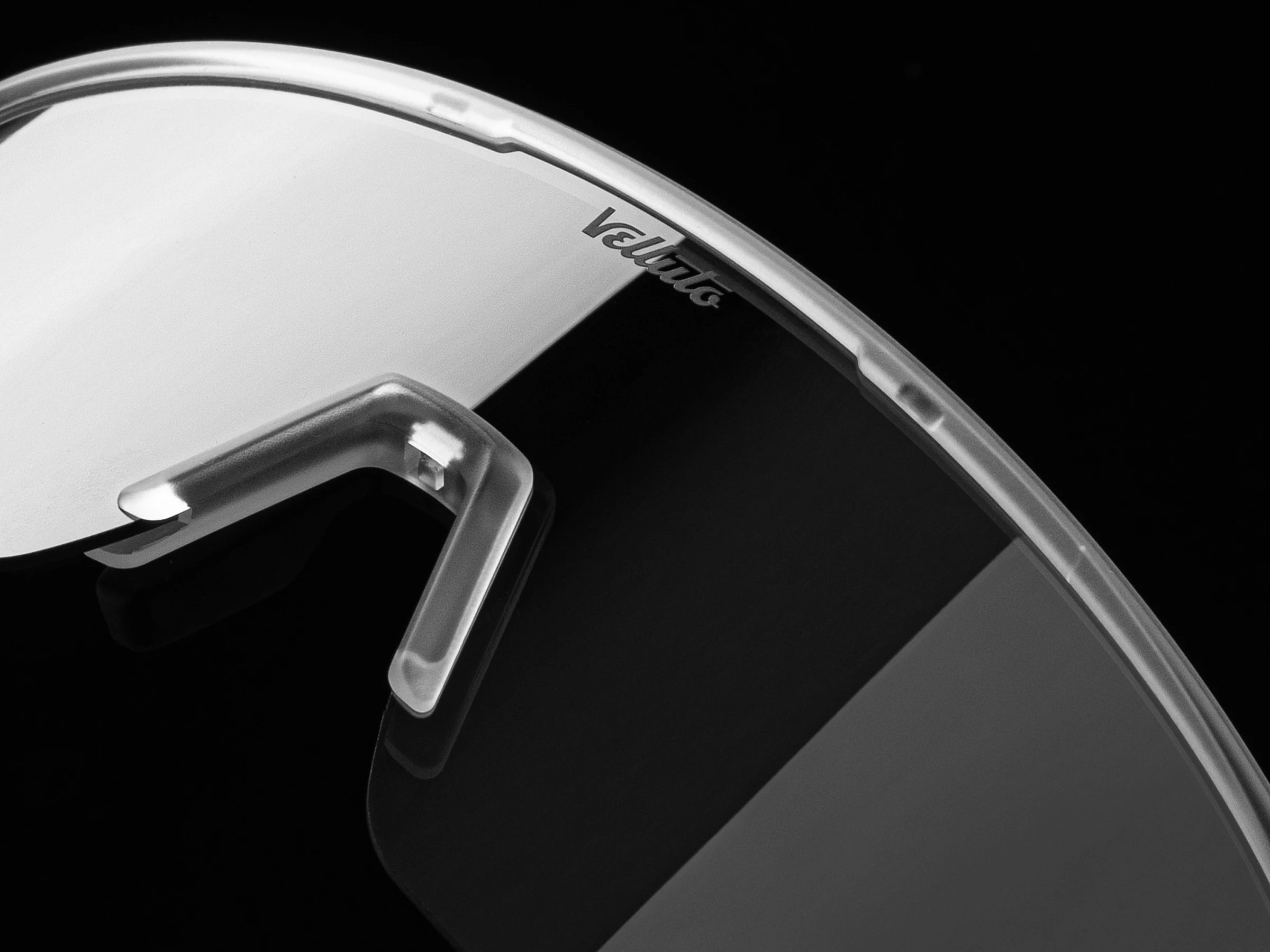
Removing the existing lens. Hold the frame with both hands, thumbs positioned on the inner (concave) surface of the lens near the centre, index fingers on the outer rim for stabilisation. Apply gentle, even inward pressure with both thumbs simultaneously at the lens centre. You are not trying to force the lens out: you are reducing the curve of the lens slightly so the retention tabs at the upper and lower edge of the frame release their grip. Once you feel or hear the tabs release, peel the lens out from one corner, working progressively around the edge. Never grab the centre of the lens with fingertips or pinch the optical surface between thumbnail and forefinger: this is where scratches happen.
Storing the removed lens. Immediately place the removed lens into a soft protective sleeve or the hard case you carried it in. Do not set it down on the road surface, on a jersey, or in an open jersey pocket. Grit on any surface will damage the lens coating in seconds. The five seconds it takes to properly store a lens are the five seconds between a lens that lasts two seasons and one that needs replacing after six rides.
Inserting the new lens. Align the top edge of the new lens with the upper retention channel of the frame first. This is the key to a reliable insertion: top edge seated first, then work down. With the top edge correctly located, apply even inward pressure across the lower half of the lens until each retention tab clicks into place. You will hear or feel a distinct click at each retention point. If the lens sits proud of the frame at any edge, it has not fully engaged: press again at that specific point. A properly seated lens sits flush with the frame rim on all edges.
After the swap. Hold the frame up briefly and sight along the lens edge to confirm it is uniformly seated. Give the lens a gentle press across its full width. If it shifts or feels loose, remove it and repeat the insertion. A lens that is 95 percent seated will feel secure until the moment it matters most, which is typically at speed on a technical descent.
Cleaning during the swap. If you are doing a planned swap at a café or stage village, use this moment to clean the lens you just removed. A quality microfibre cloth and a small bottle of lens cleaning spray takes under 30 seconds and means both lenses are ready when you need them next.
06 · The Velluto systemVellutoPuro and VellutoVisione explained
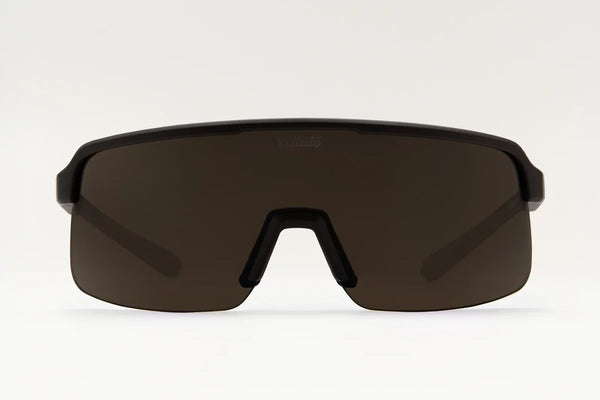
The Velluto StradaPro uses a click-in interchangeable lens system that accepts two dedicated lenses: the VellutoPuro and the VellutoVisione. Both are UV400 certified, meaning they block 100 percent of UVA and UVB radiation. Both are designed with anti-fog performance built into the lens geometry and coating rather than as a separate add-on. Both swap tool-free in seconds using the technique described above.
The frame itself weighs 25 grams. That number matters for interchangeable lens riding specifically because you may be carrying both lenses on longer rides, and the total kit weight of frame plus two lenses in a protective sleeve is still significantly lighter than two separate pairs of cycling glasses. The adjustable nose pads mean the frame sits consistently regardless of which lens is installed, without pressure shifting or fit variation between swaps.
VellutoPuro: the clear lens. The VellutoPuro is designed for low-light and variable conditions. It blocks wind, insects, and road debris while transmitting the full visible spectrum. UV400 certified, it provides complete solar radiation protection in the ultraviolet range even when its visible-light transmission is effectively total. This is a point that surprises some riders: a clear optical lens can simultaneously transmit visible light fully and block ultraviolet radiation entirely. Those are different parts of the electromagnetic spectrum, and they are handled by different components of the lens construction.
The VellutoPuro is the lens for pre-dawn starts, shaded climbs, tunnel roads, and any ride where you do not want to sacrifice visible light. It is also the correct lens for group training rides on overcast autumn or spring mornings where the wind-and-debris protection of any lens is needed but light restriction is not.
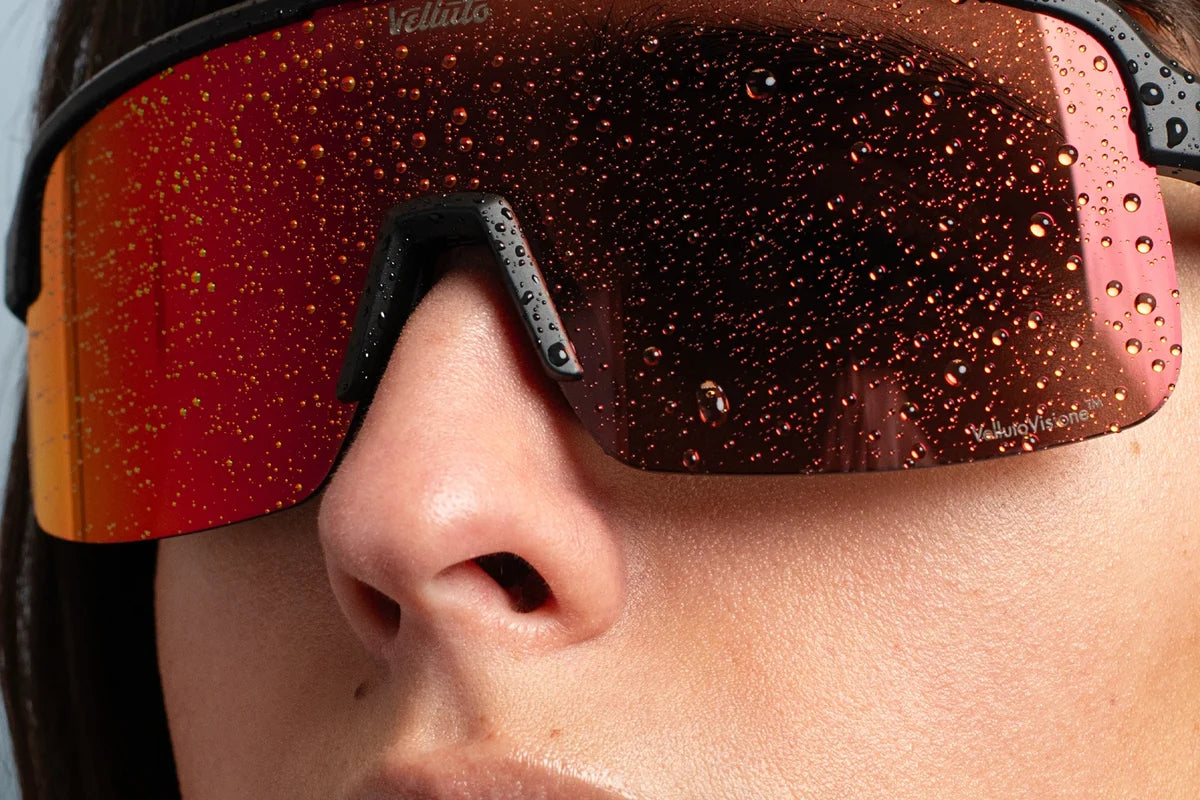
VellutoVisione: the high-contrast lens. The VellutoVisione uses specific wavelength filtering to sharpen contrast and visual definition at road surfaces. In practical terms, this means changes in road surface texture, painted markings, gravel scatter at the edge of a descent, and imperfections in tarmac become more visually distinct at speed. Combined with UV400 protection and the same anti-fog performance as the VellutoPuro, the VellutoVisione is built for the conditions that appear most frequently in mid-season Alpine and Pyrenean riding: full summer sun, exposed mountain roads, fast descents where surface-reading matters.
The click-in mechanism is identical for both lenses. Once you have the technique, swapping between VellutoPuro and VellutoVisione takes the same time regardless of which direction you are going. That consistency is a practical detail that matters on the road: you do not need to remember a different procedure for each lens.

The anti-fog performance of both lenses deserves specific attention in the context of interchangeable lens riding, because this is where swappable systems from lower-quality manufacturers often fail. A lens that fogs on the inside during a climb is not just uncomfortable: it is a visibility hazard on the descent that follows. The StradaPro's built-in anti-fog system is designed around the conditions Alpine and Pyrenean cyclists actually encounter: the rapid transition from hard climbing effort at low altitude to cooler, faster airflow at higher elevations, where body heat, humidity from exertion, and cold mountain air create the peak conditions for lens fogging. You can read more about how the system performs across conditions at the StradaPro product page.
07 · Buying criteriaWhat to look for in any interchangeable lens system
If you are evaluating any cycling glasses with interchangeable lenses, the following criteria separate systems that perform on the road from those that work only in the shop.
Retention security. The lens must stay in place on a long descent at speed in vibration from road surfaces. The only way to assess this with confidence before buying is to find real rider accounts from people who have used the system on technical road descents, not just on flat training roads. A lens that pops out at 70 km/h on a hairpin is not an interchangeable lens system: it is a liability. Look for a mechanism with multiple retention points distributed across the top and bottom of the lens, not a single-point clip.
Swap speed and mechanism simplicity. A good interchangeable system should be swappable in under 30 seconds by a rider who has done it five times before. If the mechanism requires a tool, a specific grip position that is difficult to replicate with cold hands, or more than light pressure to seat the lens, it will not be used consistently on the road. Riders who find swapping too complicated default to one lens and accept the visual compromise. The mechanism should work with clean dry hands, lightly gloved hands in cooler weather, and without requiring you to remove the frame from your face to complete the swap.
UV400 certification. This is not negotiable. UV400 means the lens blocks 100 percent of UVA (315-400nm) and UVB (280-315nm) radiation. Some lower-cost interchangeable systems use lenses that filter visible light without providing full UV protection. A dark lens that does not filter UV is actually worse than no lens at all, because the pupil dilates in the apparent darkness while UV radiation passes through unchecked. Verify that UV400 certification applies to both lenses in the system, not just the tinted one.
Optical quality at the lens edge. The edge of a cycling lens is where distortion appears most commonly in lower-quality optics. On a road bike in an aggressive position, your peripheral vision covers the road shoulder and approaching traffic through the lower-outer edge of the lens. If that zone has prismatic distortion or visible colour fringing, it creates visual discomfort across a long ride and reduces peripheral vision reliability. Look for lenses with consistent optical quality across the full lens area, not just the central optical zone.
Anti-fog performance of both lenses. Evaluate the anti-fog claim for both lenses in the system, not just the clear one. Tinted lenses fog too, particularly on climbs where internal body heat is high and external air temperature drops with altitude. A high-contrast lens that fogs on every long climb is not doing the job it was designed to do. Look for systems where the anti-fog feature is built into the frame ventilation design as well as the lens coating, rather than relying entirely on a surface treatment that degrades with cleaning over time.
Frame weight with both lenses considered. The weight advantage of a lightweight frame is partially offset if the lenses themselves are heavy. Evaluate the complete system weight: frame plus the heavier of the two lenses. For road cycling specifically, frame weight matters across long rides because a heavier frame sits less naturally on the nose and creates pressure points over several hours. The StradaPro weighs 25 grams, a number that is meaningful across a four-hour Alpine stage.
Lens storage on the bike. Consider where the second lens lives during a ride. Most riders carry it in a jersey back pocket. A lens that is stored without a protective sleeve is exposed to keys, a phone, energy bar wrappers, and grit. The lens you carry is only useful if it is scratch-free when you need it. A hard case or fitted sleeve that fits easily in a jersey pocket is part of the functional interchangeable lens system, not an optional extra.

08 · Who should buyIs an interchangeable lens system worth it for you
The honest answer is: it depends on how you ride. Here is a practical breakdown by rider type.
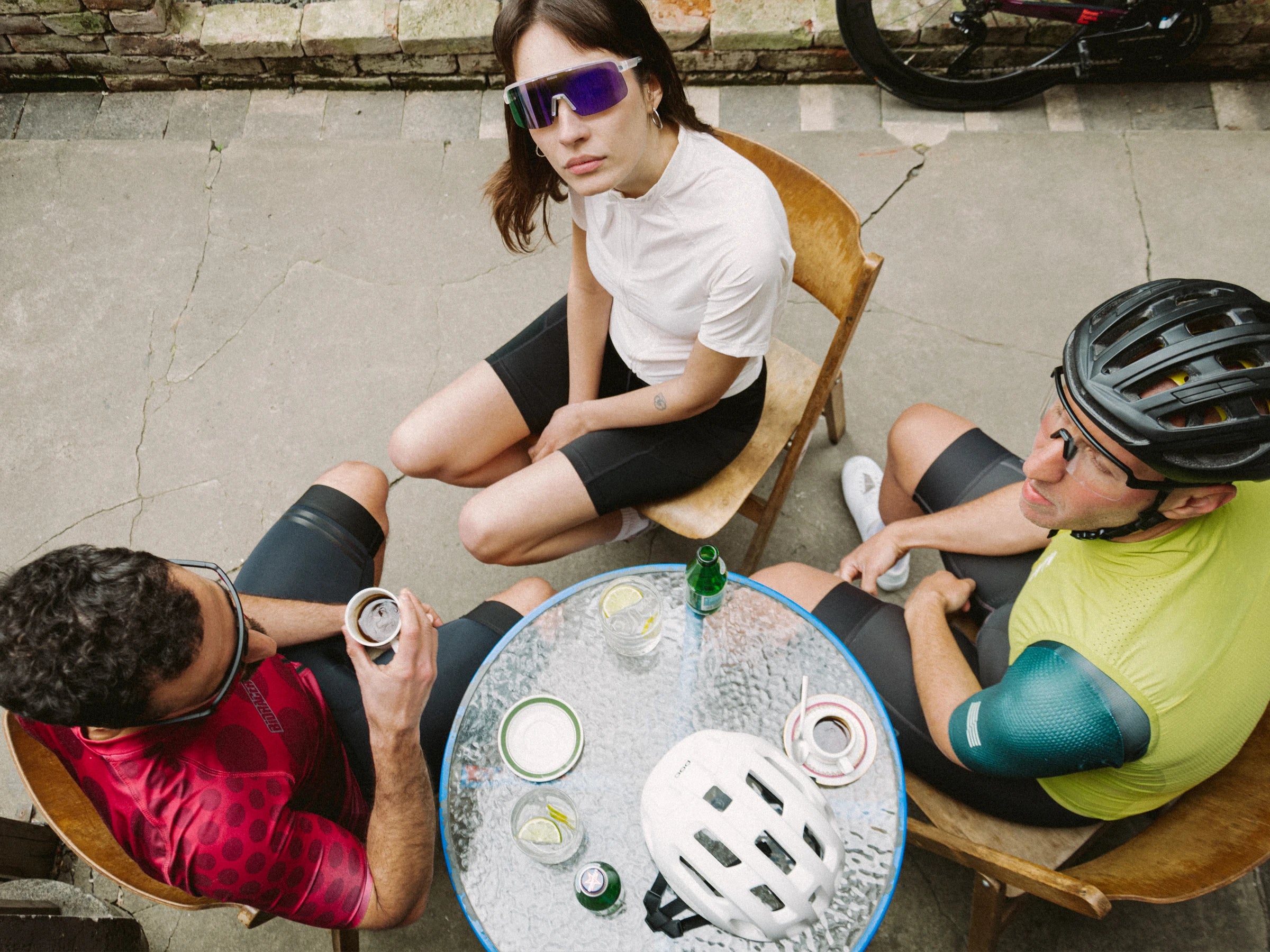
The early-morning club rider. If your regular training rides start before 7 a.m. and finish after 9 a.m., you are routinely crossing the threshold between pre-dawn low-light conditions and mid-morning direct sun in a single ride. An interchangeable system is not a luxury for this rider. It is the difference between riding the first hour with adequate vision and the last two hours with adequate vision, in a single pair of glasses. A clear lens for the departure, a VellutoVisione swap at the first café stop: that is the practical cycle.
The Alpine or Pyrenean camp rider. This is the use case the system was designed for. Long mountain stages with valley starts and high-altitude cols expose you to the widest possible light range in a single day. The tunnel roads on major Alpine passes, the deep-shadow sections of north-facing descents, the full summer sun above 2,000 metres: these are the conditions that make a fixed-lens system feel genuinely inadequate by stage three of a week-long camp. Alpine and Pyrenean cycling camps, which peak in summer and often align with Tour de France routes, are exactly the environment where this system earns its place.
The all-weather commuter-turned-weekend-racer. If your riding spans weekday training rides that start early and weekend rides that run into midday summer conditions, you are in a different light environment on Tuesday morning than on Saturday afternoon. Owning two single-lens pairs and switching between them at home is an option, but carrying both lenses in one 25-gram frame and swapping when conditions require is more practical and more likely to happen.
The cyclist who does long sportives. A 150-km sportive in July that starts at 7 a.m. will expose you to at least three distinct light phases. Starting clear, swapping to VellutoVisione at the first control, and finishing with the high-contrast lens in full summer light is a more comfortable experience than squinting through an inappropriate lens for a third of the event. The swap takes 15 seconds at a control stop.
Who might not need it. A rider who does exclusively lunch rides in consistent summer sunshine, on roads without tunnels, starting and finishing in full daylight, will get most of the benefit from a quality tinted-only or high-contrast-only lens. But even for this rider, the clear lens provides insurance for the ride home when the sun is lower, the spring or autumn ride where a planned-sunny day turns overcast, or the gravel deviation that goes through forest.
The 30-day risk-free trial that comes with the StradaPro matters specifically here. You can commit to the system for a full month of real riding, across whatever conditions July and August throw at you on your specific routes, and assess whether it works for how you actually ride. That is a more reliable evaluation than a shop test or a 20-minute group ride at a launch event.


There is one further consideration that the marketing rarely discusses: consistency. The best interchangeable lens system is the one you actually use. If the swap mechanism is difficult, you will stop carrying the second lens after a few rides. If the lenses are stored loose in your pocket and arrive scratched at every swap point, you will stop swapping. The practical discipline of lens swapping, clean storage, and carrying both lenses on rides long enough to warrant it, determines whether an interchangeable system delivers its theoretical benefit on real roads.
The technique described in section five, combined with a hard case that lives in your jersey pocket on long rides, is the practical system that makes interchangeable lens cycling glasses actually work rather than just theoretically work. The system is only as reliable as the habits around it.

Compare the full lineup in the Velluto StradaPro cycling glasses collection.
09 · FAQFrequently Asked Questions
What are cycling glasses with interchangeable lenses?
How do I swap lenses on cycling glasses without scratching them?
When should I use a clear lens versus a tinted lens on a ride?
Are interchangeable lens cycling glasses worth it?
What is the VellutoVisione lens and what conditions is it for?
What is the VellutoPuro lens and when do I use it?
How much do cycling glasses with interchangeable lenses cost?
Do cycling glasses with interchangeable lenses fog up on climbs?
Can I use any lens with any cycling glasses frame?
If you are ready to ride with a lens system that adapts to your conditions rather than the other way around, the StradaPro with both VellutoPuro and VellutoVisione lenses is the place to start. The 30-day risk-free trial means you can test it across a full month of real riding before committing. Find the full range, all four colours, and both lens options at velluto-shop.com.