Cycling Glasses Buying Guide 2026: Optics, Fit and Value
Contents23 min read
You are forty minutes into a wet November ride, the kind where the sky cannot decide between drizzle and genuine rain, and somewhere past the second climb your vision starts going soft at the edges. Your lenses are fogged. Your eyes are watering from wind. You can feel exactly where the nose pad is digging in. This is the problem that purpose-built cycling glasses exist to solve, and it is also the reason choosing the wrong pair costs you more than money.
The cycling eyewear market has become genuinely complicated. Serious road cyclists face a shelf of options ranging from mass-market sports sunglasses dressed up with a cycling brand sticker, to technically sophisticated frames that cost as much as a wheelset. In between sits a wide band of products that look similar in product photos, make similar promises in marketing copy, and perform very differently once you are out the door at six in the morning in October.
This guide cuts through that. It is written from one clear position: you are a serious rider who cares about optics quality, fit, UV protection, and value. You are not willing to pay a brand-tax premium for a name stitched into sports culture. And you want to understand what the specifications actually mean before you spend your money.
What follows covers the criteria that genuinely distinguish good cycling glasses from expensive ones, the riding scenarios that expose those differences, and where Velluto cycling eyewear fits into that picture honestly. No invented tests. No manufactured comparisons. Just the specs, the reasoning, and the real-world context.
01 · Short answerTL;DR: What You Actually Need to Know
If you are in a hurry, here is the honest summary. Good cycling glasses in 2026 need to do five things well: protect your eyes from UV radiation (UV400 certified, not just "UV resistant"), control fogging on variable-effort rides, fit securely without pressure under a helmet, give you at least one optical solution for low-light and one for bright conditions, and not fall apart or slip after three months of regular use.
Beyond those five criteria, you are paying for brand heritage, aesthetic choices, or marginal differences that most riders will not notice in practice. That does not mean premium options are overpriced relative to their quality. It means you should know exactly which of these five criteria you are buying when you spend more.
The Velluto StradaPro addresses all five criteria at a starting price of from 69 EUR, with an adjustable nose pad system, a built-in anti-fog system, two interchangeable lenses (clear VellutoPuro and high-contrast VellutoVisione), and UV400 certification. That is what this guide will unpack, alongside the broader criteria any competitive option should meet.
02 · CriteriaWhat Actually Matters in Cycling Glasses
Performance cycling glasses differ from general sports sunglasses in ways that matter most when conditions are worst. The following criteria are the ones that separate frames built specifically for road riding from frames that borrow the aesthetic.
Not UV protection, not UV resistant: UV400 certified. This designation confirms that lenses block 100% of ultraviolet radiation at wavelengths up to 400 nanometres, covering both UVA and UVB bands. UV exposure accumulates on every ride, year-round, regardless of cloud cover. A UV400-certified lens is a standardised, verifiable threshold. Everything below it is a gradient with no guaranteed upper limit.
Fogging is the most common complaint among cyclists who buy otherwise decent glasses. It happens when warm, humid air from your face contacts a cooler lens surface during low-intensity sections or at the top of a climb. Some frames rely purely on ventilation geometry. Others add a coating or system to the inner lens surface. Both approaches can work. What you need to know before buying is which approach the frame uses, and whether the manufacturer describes it honestly.
A cycling frame that fits in front of a mirror may not fit under a helmet, on a long drop bar section, or during a head-down effort on the turbo. The key factors are frame width relative to your face, the nose pad system (fixed vs adjustable), and temple arm profile. Adjustable nose pads are the single most practical feature for getting the vertical position right across different face shapes. Without them, you are dependent on the frame's fixed geometry matching yours.
Two distinct optical approaches exist for handling variable light conditions. First: interchangeable lenses, where you physically swap between a clear lens and a tinted or high-contrast lens depending on conditions. Second: photochromic lenses, which adapt their tint automatically. Each has genuine advantages. Interchangeable systems give you the clearest possible optics for each condition, because each lens is optimised for a fixed light environment. Photochromic lenses remove the need to decide or swap. Neither is objectively superior; they solve the same problem differently. Know which approach a frame uses before you buy.
Frame weight matters more over long distances than over short ones. A 30-gram difference between frames is not perceptible on a 20-minute commute. On a five-hour ride it accumulates as nose bridge pressure and temple fatigue. The StradaPro weighs 25 grams. That specific number is worth benchmarking when you compare options.
Wind and debris protection matters more in autumn and winter than in summer, and more in cyclocross conditions than on clean road surfaces. A larger lens coverage area and a close-fitting frame geometry reduce the debris ingress that happens on wet, gritty descents. Cycling glasses designed specifically for road use tend to get this right; general sports sunglasses often trade coverage for a broader aesthetic.
The cycling glasses that perform best on race day are the ones you stopped thinking about by kilometre fifteen.The measure of a good fit
03 · ComparisonVelluto Positioning vs Alternatives
It is worth being direct about what this section is and what it is not. This is brand content published by Velluto. The comparison that follows is built on verifiable specs and genuine category observations. Where competitor figures are cited, they come from information those manufacturers publish themselves. Where figures are not available or cannot be independently confirmed, they are omitted. No invented data, no selectively quoted specs, no policy comparisons that could change without notice.
The road cycling glasses market at the serious end includes well-established names. Oakley's Sutro and Jawbreaker remain the most visible in the peloton. Rudy Project and POC make technically rigorous frames used at WorldTour level. SunGod offers strong customisation. Tifosi and Bollé serve the value segment. Each of these brands makes frames that work. The question is not whether they work. The question is what you are paying for in each case, and whether that maps to your actual priorities.
The table below is built on verified, publicly available figures. Where a competitor figure is not confirmed, the cell is left empty rather than estimated. This is intentional: an incomplete comparison is more honest than an invented one.
| Product | Frame Weight | UV Rating | Lens System | Anti-Fog | Nose Pad | Trial Period |
|---|---|---|---|---|---|---|
| Velluto StradaPro | 25 g | UV400 certified | Interchangeable click-in (clear + high-contrast) | Built-in anti-fog system | Adjustable | 30-day risk-free |
| Oakley Jawbreaker | 26 g (published) | UV400 | Interchangeable (Prizm lens range) | Vented lens | Fixed | See manufacturer |
| POC Aspire | UV400 | Single lens standard; interchangeable variants available | Vented frame | Adjustable | See manufacturer | |
| Rudy Project Rydon | 28 g (published) | UV400 | Interchangeable (Impactx lens range) | Vented frame | Adjustable | See manufacturer |
| Tifosi Podium | 28 g (published) | UV400 | Interchangeable (3 lenses included) | Vented frame | Adjustable | See manufacturer |
| SunGod Velans | UV400 | Single lens standard; multiple tint options | Vented frame | Fixed | See manufacturer |
A few observations worth spelling out clearly. Frame weight differences of a few grams are real but their effect is primarily felt over long efforts, not short ones. UV400 is now a category standard at this price tier; any frame without it should be excluded from consideration regardless of other attributes. Anti-fog approach is worth interrogating specifically: "vented lens" and "built-in anti-fog system" are different engineering choices. Ventilation manages airflow to reduce condensation; a dedicated anti-fog system addresses the lens surface directly. Both can work in the right conditions; for high-humidity, variable-effort riding, the distinction matters.
The 30-day risk-free trial is specific to Velluto. It is not a comparison point against other brands' policies, which vary and change. It is simply worth knowing when you are deciding whether to commit.

04 · LensesHigh-Contrast Optics: What the Specification Actually Means
The term "high-contrast lens" appears in cycling eyewear marketing frequently enough to have lost precision. It is worth recovering that precision before discussing what the VellutoVisione lens does and does not claim to do.
Optical contrast in this context refers to the visual differentiation between adjacent surfaces or objects in your field of view. On a road ride, relevant contrast includes: the edge between the tarmac surface and the gutter, the difference between a dry road and a wet patch, a pothole in shade on a sunlit road, and road markings under low-angle morning or afternoon light. High-contrast lenses use tint and coating combinations to sharpen these differences relative to what you see with either no lens or a neutral grey tint.
What Velluto does not claim: specific percentage improvements in contrast, lab-measured vision enhancement figures, or comparative performance against named competitors' lens technologies. Those claims require independent laboratory testing, and without that documentation, they are marketing assertions rather than verified specifications. The VellutoVisione lens is built around the high-contrast principle. Its optical performance on the road is what it is. The 30-day trial exists precisely so you can verify that for yourself in real conditions rather than taking marketing language at face value.
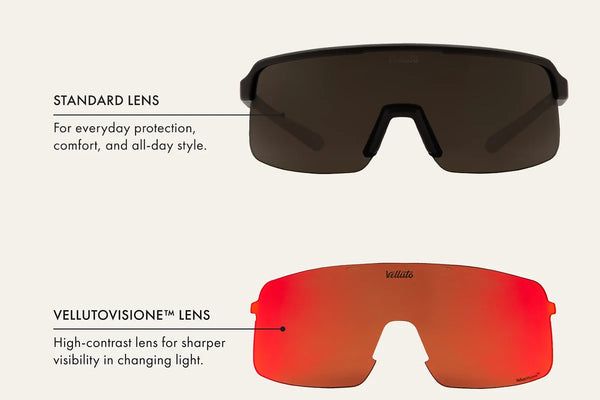
What matters in practice: a high-contrast lens is not the same as a photochromic lens. The VellutoVisione has a fixed tint optimised for contrast in variable road light. If you need a lens that adapts its tint automatically as conditions change from overcast to bright sun, that is a different product category. Velluto's answer for photochromic performance is the Velluto Chromo, a separate model launched in October 2026, with a self-tinting lens that darkens and becomes mirrored in bright conditions.
The two-lens approach of the StradaPro (clear VellutoPuro for dawn, low-light, and tunnel sections; high-contrast VellutoVisione for road riding in variable light) is a different engineering philosophy from the photochromic single-lens approach of the Chromo. Neither is objectively better. They suit different rider preferences. Some cyclists prefer to decide the right lens for the ride ahead and have that lens be fully optimised for those conditions. Others prefer the automatic adaptation of a photochromic lens across a single ride with changing light. Both are legitimate choices.
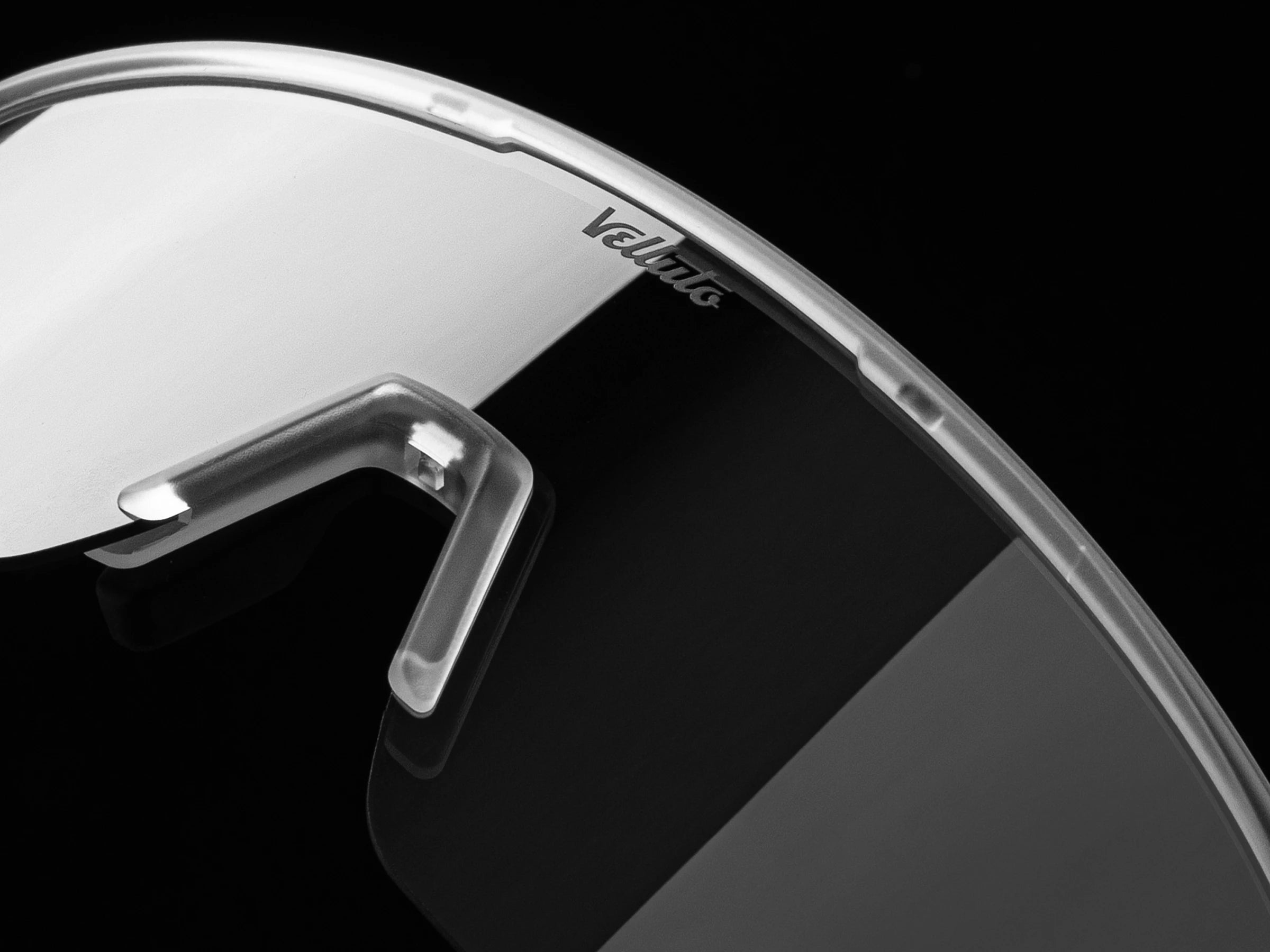
The VellutoPuro gives you clean, unfiltered vision in low light. The VellutoVisione sharpens road contrast when it matters most. Swapping between them takes seconds.Velluto StradaPro lens system
05 · FitFrame Fit, Weight and the Helmet Problem
The most common buying mistake with cycling glasses is evaluating fit without a helmet on. Stand in front of a mirror at a bike shop, try on a frame, it feels comfortable. Put your helmet on, clip the strap, and suddenly the temple arms are creating pressure points, the frame is sitting at a different angle on your nose, and the top of the lens is in your sightline when you drop into an aero position. This happens because a road helmet's retention system and pad layout actively change how eyewear sits on your face.
The practical implication: always test cycling glasses with your actual helmet on your actual head, not in isolation. If you are buying online, a 30-day trial period is the equivalent of that test. You need to ride in them, under a helmet, in the positions you actually ride in.
Frame weight becomes a fit variable on long rides in a way that is easy to underestimate before you have experienced it. At 25 grams, the StradaPro is light enough that the weight itself does not become a factor. Heavier frames create cumulative pressure on the nose bridge and behind the ears over three, four, five hours. It is not dramatic, but it accumulates as a low-level irritation that affects focus and comfort in the final hours of a long ride.
Nose pad adjustability is the other factor that is hard to evaluate from a product photo. Fixed nose pads mean the frame either fits your nose bridge or it does not, full stop. Adjustable nose pads allow you to fine-tune the vertical position and the standoff distance from your face, which affects both comfort and anti-fog performance. A frame sitting too close channels warm air across the inner lens surface and increases fogging risk. A frame with the right standoff for your face creates a natural ventilation gap that helps manage moisture.

The StradaPro fits a wide range of face shapes and comes with interchangeable clear and high-contrast lenses for varying light conditions. The adjustable nose pad system is not a minor accessory feature. It is the mechanism that makes the frame adaptable across the full range of face widths and bridge heights that a single fixed geometry cannot serve.
06 · ScenariosReal-World Riding Scenarios
Performance specifications make more sense in context. The following scenarios map the StradaPro's key features to the specific riding situations where they matter most. These are not invented test conditions. They are the situations that cycling glasses exist to handle.
Scenario 1: Cyclocross, November morning, mixed light and mud. You start in grey light before nine, the sky shifts from overcast to thin autumn sun twice inside an hour, and the course sends you into a tree section where visibility drops sharply. For this scenario, lens clarity and protection from mud spray are the primary concerns. The VellutoPuro clear lens gives you clean, undistorted vision in low to medium light without darkening. UV400 protection remains relevant even under overcast skies, where UV transmission is still significant. The anti-fog system matters on the low-effort sections between efforts, where your body temperature drops and fogging risk rises.
Scenario 2: Road ride, dawn start, climbing to coffee stop. You leave home in the dark, ride through changing light as the sun rises, and face the classic climber's fog problem: you work hard enough on the ascent to generate significant heat and humidity, then the intensity drops and the lens temperature equalises with the cooler air. Without a proper anti-fog system, this is when lenses go soft on you. The StradaPro's built-in anti-fog system addresses this directly. After coffee, you switch to the VellutoVisione for the return in full morning light, with sharpened contrast for reading road surfaces.
Scenario 3: Winter preparation, long base miles, variable conditions. Base training in November and December means long hours in conditions that shift between dry, damp, cold and occasionally wet. The 25-gram frame weight becomes genuinely important over four to five hours. The adjustable nose pads allow you to set up the frame correctly for the temperature, since cold air affects how much standoff you want. The VellutoPuro lens means you are not riding in a tinted lens in the grey low-light of a winter afternoon, which would darken your vision unnecessarily.
Scenario 4: Group ride with tunnels or tree-covered roads. Any route with significant sections of shade or tunnel time creates the problem of a tinted lens in suddenly low light. The interchangeable system solves this for planned routes: start with VellutoVisione for the exposed sections, swap to VellutoPuro before the tunnel section, swap back. Practically, the more realistic approach is to know your route and pick the right lens before you roll. The click-in swap takes seconds if you need to change mid-ride.

Scenario 5: Changing light that you cannot plan for, the photochromic argument. Some riders genuinely prefer not to decide in advance. If you want one lens that handles whatever the sky does on a given ride without manual intervention, the StradaPro's interchangeable system is not what you are looking for. The Velluto Chromo is. It has a photochromic lens that self-tints as light intensity changes, becoming dark and mirrored in bright sun and clear in low light. That is a different product solving the same problem a different way. If the interchangeable system suits your riding style, the StradaPro is the choice. If you prefer automatic adaptation, the Chromo is worth looking at.
07 · ProductVelluto StradaPro: Specifications and Options
The StradaPro is available in four colours: Arancia (orange), Espresso (brown), Nero (black) and Viola (purple). All four share the same frame geometry, lens system and specification. The choice between them is purely aesthetic. Each comes with the VellutoPuro transparent lens and is compatible with the VellutoVisione high-contrast lens (sold separately or in kit combinations).

The four colourways are shown below. All share identical technical specifications.


Accessories worth considering alongside the StradaPro: the Velluto Cleaning Spray is a 50ml apple-scented solution, refillable and made in Germany, designed for lens surfaces. It pairs with the included microfiber cleaning cloth (25x25cm, 80% polyester / 20% polyamide). The hard case carries all road cycling glasses with an anti-crash guarantee and a velvet interior that does not scratch lenses.

08 · ValueWhat You Are Actually Paying For
Price in cycling eyewear is worth interrogating specifically, because the range is wide and the relationship between price and performance is not linear. At the entry level, below roughly 30 to 50 EUR, frames typically use injection-moulded plastic with no optical-grade lens coating, fixed nose pads, and no meaningful anti-fog provision. UV protection may or may not be certified. These are not cycling glasses in any performance sense. They are sunglasses that will not break immediately.
Between roughly 50 and 150 EUR, you enter the range where most of the genuinely useful performance features appear: UV400 certification, interchangeable lens systems, adjustable nose pads, and proper anti-fog provision. The StradaPro sits in this band. At this price point, the meaningful differentiators are lens optical quality, build material and durability, fit system adaptability, and the confidence that comes from a trial period.
Above 150 EUR, you are in the territory of well-established WorldTour-associated brands, premium lens technologies with proprietary names, and the marketing infrastructure that surrounds them. Frames in this range are genuinely well-made. They are also priced to reflect brand position, heritage, and the cost of sponsoring the professional peloton, which is not a reason not to buy them, but it is a reason to know exactly what you are paying for.
The honest Velluto position: this is a German brand with Italian design. The StradaPro is built to perform at a price that reflects the product, not a brand's race programme. If that trade-off suits your priorities, the 30-day trial period means you can verify it without financial risk.
What Italian design means in context: it means the aesthetic language, proportions, and finishing of the StradaPro are informed by Italian design principles. It does not mean that Italian design alone guarantees better fit, superior anti-fog performance, or more durable materials. Those outcomes depend on engineering and manufacturing choices, not geographic design heritage. Velluto makes this claim precisely and no further.

09 · Autumn and WinterCycling Glasses for the Cyclocross Season
Cyclocross and winter road preparation change the demands on cycling eyewear in specific ways. The conditions are wetter, the light is lower and more variable, the temperatures are colder, and the terrain is more likely to throw mud and grit at your face. Generic cycling glasses that perform well in June often reveal their limitations between October and February.
Low and variable light is the central challenge. Autumn mornings produce a specific quality of flat, directionless light that makes road surfaces and obstacles harder to read than bright summer sun. A tinted lens that is appropriate for summer becomes a liability on a November morning. The VellutoPuro clear lens is the right choice for genuinely low light. The VellutoVisione high-contrast lens helps in variable conditions where contrast between the road surface and debris matters more than reducing overall light transmission. Having both available via click-in swap addresses the full range without needing two separate frames.
Cold and moisture create a fogging problem that is more acute than in summer. The temperature differential between your face and the ambient air is larger in cold conditions, and damp air is more likely to condense on a cold lens surface. The StradaPro's built-in anti-fog system is relevant specifically in these conditions. No anti-fog system eliminates fogging in all conditions, and Velluto does not claim otherwise. What a purpose-built system does is significantly reduce the frequency and severity compared to frames that rely on ventilation geometry alone.
Coverage and debris protection matter more in cyclocross conditions. A larger lens with a close-fitting frame geometry reduces the amount of grit, mud, and cold air that reaches your eyes from the sides and below. If you are riding cyclocross specifically, the debris protection function of cycling glasses is as important as the optical one.
Frame durability in cold weather is worth checking. Some plastics become brittle at low temperatures and are more susceptible to impact damage. The StradaPro's material holds up in cycling-typical cold conditions. What it is not: a photochromic lens that adapts across the full range of autumn light automatically. If that is what you need, the Chromo is the right product. If you prefer the two-lens interchangeable approach, the StradaPro handles winter riding well.

Compare the full lineup in the Velluto StradaPro cycling glasses collection.
10 · FAQFrequently Asked Questions
Are cycling glasses actually worth buying for road riding?
Yes, for several specific reasons that go beyond aesthetics. UV400-certified lenses block 100% of UVA and UVB radiation, which accumulates on every ride regardless of cloud cover. Wind protection reduces eye fatigue on fast descents and long intervals. And a well-fitted frame with an anti-fog system prevents the blurred vision that plain sports sunglasses cause on climbs. If you ride more than three hours a week, purpose-built cycling glasses address real performance problems, not just style preferences.
What does UV400 mean and why does it matter for cyclists?
UV400 is a certification confirming that lenses block 100% of ultraviolet light at wavelengths up to 400 nanometres, covering both UVA and UVB bands. Cyclists accumulate significant UV exposure over a season, often more than they realise because overcast days still transmit UV. A UV400-certified lens is not a marketing label but a measurable, standardised protection threshold. When choosing cycling glasses, look for "UV400 certified" rather than "UV protection" or "UV resistant", which are looser, non-standardised terms.
What is a high-contrast lens and when is it useful on the bike?
A high-contrast lens is tinted and coated to sharpen the visual difference between surfaces and objects in your field of view. On the road, this is most useful for reading tarmac texture, spotting loose gravel, distinguishing road markings from shadows, and picking up obstacles in variable autumn or early-morning light. The VellutoVisione lens is built around this principle. It is not the same as a photochromic lens, which changes tint in response to light intensity. The Visione has a fixed tint optimised for contrast; for a self-tinting option, Velluto's separate Chromo model is photochromic.
What is an interchangeable lens system and why does it matter?
An interchangeable lens system lets you swap the lenses in your cycling glasses without tools. For road cyclists, this means using a clear lens in dawn rides or tunnel-heavy routes and switching to a tinted or high-contrast lens for bright midday conditions. The Velluto StradaPro uses a click-in system compatible with both the VellutoPuro transparent lens and the VellutoVisione high-contrast lens. The swap takes seconds. This is different from a photochromic lens, which adapts automatically but cannot be physically removed and replaced with a different optical character.
How do I stop my cycling glasses from fogging up on climbs?
Fogging occurs when warm, humid air from your face meets a cooler lens surface. Purpose-built cycling glasses address this in two ways: frame geometry that channels airflow across the inner lens surface, and anti-fog coatings or systems applied to the lens itself. The Velluto StradaPro includes a built-in anti-fog system designed for the variable conditions common on climbs. Fit also plays a role: a frame sitting too close to your face traps warm air. Adjustable nose pads, like those on the StradaPro, let you optimise the standoff distance for your face shape.
What should I look for in cycling glasses if I have a narrower or smaller face?
The key fitting factors are frame width, nose pad adjustability, and temple arm length. Many performance cycling frames are sized for a broad average and can sit loose or low on narrower faces, causing the frame to slide on climbs or block the lower field of view. Adjustable nose pads are the single most practical feature for smaller or narrower faces because they let you fine-tune the vertical position and standoff without bending the frame. The Velluto StradaPro weighs 25 grams and includes adjustable nose pads, making it adaptable across a range of face shapes.
How does a 30-day risk-free trial work for cycling glasses?
Velluto offers a 30-day risk-free trial on the StradaPro. This means you can order, ride in them on real routes in real conditions, and return them within 30 days if they do not work for you. For cycling glasses specifically, this matters because fit on the bike is different from fit in front of a mirror: you need to feel how the frame behaves under a helmet, on a long climb, in wind, and when you look down at your computer. A trial period removes the financial risk of discovering a poor fit after the return window has closed.
What is the difference between the Velluto StradaPro and the Velluto Chromo?
The StradaPro is an interchangeable-lens cycling frame. It comes with two click-in lenses: the VellutoPuro (clear, for low light and wind protection) and the VellutoVisione (high-contrast tint for road clarity). You swap lenses manually in seconds based on the conditions. The Velluto Chromo is a separate, photochromic model: its single lens adapts its tint automatically as light intensity changes, darkening and becoming mirrored in bright sun. The Chromo suits riders who prefer one lens that handles changing light automatically. The StradaPro suits riders who want maximum flexibility with two distinct optical characters. Both offer UV400 protection.
Do cycling glasses work with all road helmets?
Most performance road cycling glasses, including the Velluto StradaPro, are designed with temple arms that sit inside a helmet's retention system without creating pressure points. The 25-gram weight of the StradaPro means minimal added load, and the adjustable nose pads allow you to position the frame correctly even if your helmet sits lower at the forehead than average. The best check is simply to put your helmet on first, then the glasses: the arms should clear the interior padding and the frame should not shift when you look down toward your stem.
The StradaPro is a 25-gram, UV400-certified, Italian-designed frame with an anti-fog system, adjustable nose pads, and a two-lens click-in system built for the full range of road riding conditions. Try it on real rides with a 30-day risk-free trial at velluto-shop.com.