Best Glasses for Cycling in Sun: Smoke, Brown or Orange?
Contents23 min read
The Vuelta peloton is grinding through Andalusia in 38-degree heat, and the riders are not all wearing the same lens tint. Watch closely and you will see smoke, amber, and the occasional near-clear lens, each chosen for a specific reason. The same decision faces every road cyclist who has ever reached for their glasses at 6am and wondered whether they grabbed the right pair.
Choosing the best glasses for cycling in sun is not about picking the darkest lens available. It is about understanding what different tints actually do to the light entering your eyes, and matching that to the conditions you are riding in. This guide covers the three tints that matter most for summer road cycling: smoke, brown, and orange. It explains what each one does optically, when it excels, when it fails, and how to build a practical lens setup that covers the whole riding day without carrying three separate frames.
The context is August 2026, late-season sportives, and the kind of long rides that start before sunrise and finish well into the afternoon. The light you encounter across those hours is not uniform. Getting the lens right for each phase of the day is one of the simplest performance gains most riders never bother to make.
01 · Lens science basicsWhat Lens Tint Actually Does to Your Vision
Before reaching for a specific colour, it helps to understand what a tinted cycling lens is actually solving. Sunlight is not flat. It contains ultraviolet radiation (blocked by UV400 certification), visible light across the full colour spectrum, and infrared radiation. The human eye adapts to overall brightness reasonably well, but it struggles with glare, which is visible light reflected off high-contrast surfaces like wet tarmac, white road markings, and pale gravel. Glare causes squinting, reduces contrast, and over a long ride, produces eye fatigue that shows up as a dull headache by hour four.
A tinted lens addresses two distinct problems. The first is overall light reduction, measured as visible light transmission, or VLT. A lens with 15% VLT lets through 15% of the visible light spectrum and blocks 85%. The second is selective filtering: some tints absorb or transmit specific wavelengths more than others, which shifts the perceived colour of the scene and can either enhance or flatten contrast depending on the conditions.
UV400 certification sits above this entirely. It is not a function of tint at all. A UV400 lens blocks 100% of ultraviolet radiation up to 400 nanometres regardless of whether the lens is smoke, brown, orange, or completely clear. UV protection is a material property, not a visual one. This matters because cyclists sometimes assume a dark lens is automatically safer for their eyes. A very dark lens without UV certification would be worse than a clear UV400 lens: the pupil dilates behind the dark tint and admits more unfiltered ultraviolet light than it would in full daylight. UV400 on the spec sheet is the baseline, not a bonus.
With that foundation in place, the tint conversation becomes practical rather than abstract. Smoke is about reducing overall brightness neutrally. Brown adds mild contrast enhancement. Orange pushes contrast aggressively and trades brightness reduction for depth perception. Each lens is solving a different version of the same problem: helping your eyes read the road clearly without strain.
02 · Smoke lensesSmoke Lenses: The Default for Bright Sun
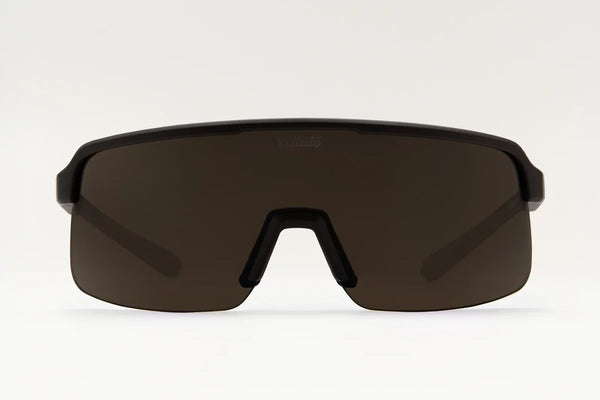
Smoke lenses, also described as dark grey by some manufacturers, are the safest general choice for riding in direct, intense sunlight. Their defining characteristic is colour neutrality. A smoke lens reduces the total volume of visible light entering your eye without meaningfully shifting how colours appear. The road is still the same colour. The sky is still the same shade. The white line at the edge of the road is still white. Everything is simply dimmer, in the same way that turning down the brightness on a monitor dims the image without changing its hue.
This colour neutrality is more important than it might seem. When you are descending at 60 kilometres per hour, any artificial colour shift in the scene introduces a subtle processing load. Your brain is already managing speed, line choice, traffic, and surface feedback from the bike. A neutral lens removes the brightness problem without adding a new visual interpretation task. For fast riding in consistent, bright conditions, this is exactly what you want.
The practical sweet spot for smoke lenses is mid-morning to mid-afternoon riding: roughly the window between 9am and 4pm on a clear summer day, when the sun is high enough to produce flat, intense light with minimal shadow variation. The Vuelta stage finishes that tick over in the heat of a Spanish afternoon are ridden almost universally in this kind of lens. The light is not complex, it is just overwhelming, and the job of the lens is to reduce it to a manageable level.
Where smoke lenses underperform is at the edges of the day and in variable conditions. In early morning or late evening light, smoke is simply too dark. The VLT is too low for the ambient light level, and the result is visual underexposure: you can see, but you are straining to pick out detail. On a route with tunnels, tree cover, or sudden cloud-shade, switching in and out of shadow becomes uncomfortable and potentially dangerous. Smoke is a specialist, not a generalist. Use it when the sun is high and the light is consistent.

03 · Brown lensesBrown Lenses: Contrast and Depth for Transitional Light
Brown lenses occupy the middle ground between the colour-neutral dimming of smoke and the aggressive contrast boost of orange. They filter light in a way that selectively reduces blue wavelengths while transmitting more red and green. The perceptual result is a warmer scene with slightly enhanced edge contrast: the road surface appears to have more texture, camber changes become easier to read, and distance objects appear slightly sharper against the sky.
For road cyclists, this contrast enhancement has practical value in two specific situations. The first is morning riding, roughly between 6am and 9am, when the sun is still low and the quality of light is soft and directional rather than flat and overhead. In this kind of light, smoke would be too dark relative to the ambient brightness, but brown sits at a VLT that admits enough light while adding just enough contrast to compensate for the lower luminance of the scene. The second situation is the softening light of late afternoon, typically from 4pm onward, when shadows become long and the road alternates between patches of direct sun and deep shade. Brown handles these transitions more gracefully than smoke because it maintains better visibility in the shaded sections while still providing adequate protection in the lit ones.
Brown lenses are also well-suited to roads with complex surfaces: urban riding with varying road quality, gravel paths, and routes through forests where the surface changes frequently. The contrast enhancement helps you identify loose gravel versus packed surface, puddles versus shadow, and edge drop-offs more reliably than a colour-neutral lens at the same VLT.

One common question is whether brown lenses distort traffic light colours. At a moderate VLT, the colour shift introduced by a brown lens is not significant enough to impair colour recognition for most riders. Red is still clearly red, green is still clearly green. The shift is in texture and edge definition, not in hue identification. That said, if you are riding in heavy urban traffic at dusk, switching to a clearer lens removes any theoretical concern entirely.
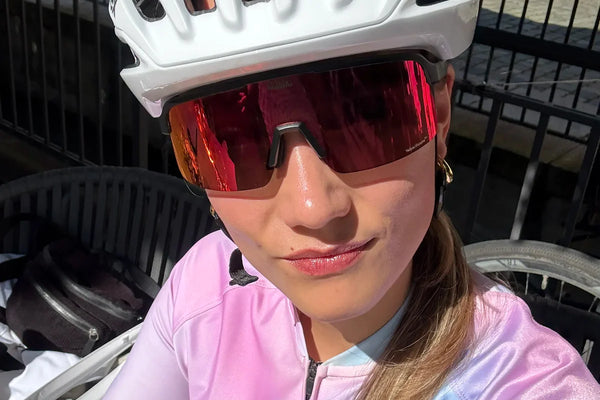
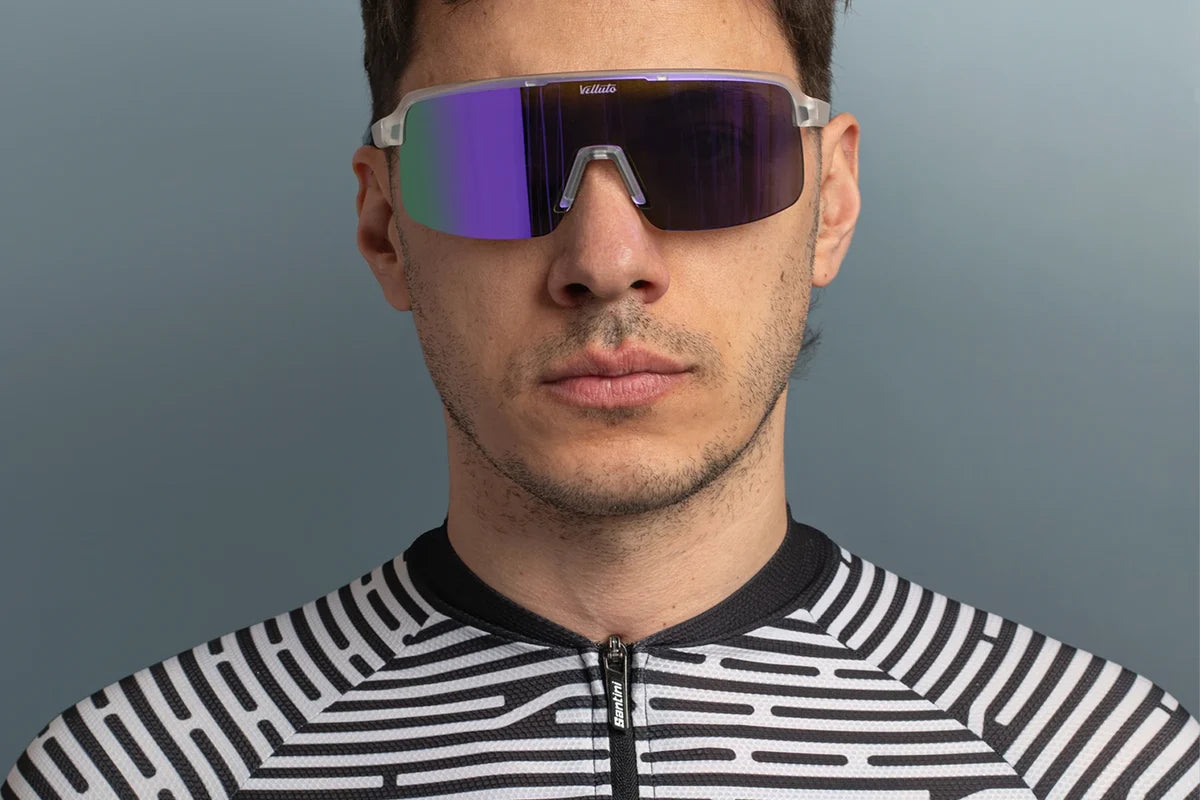
The Velluto StradaPro in Espresso pairs visually with the warm, amber-adjacent palette of a brown lens in a way that many riders find more visually coherent than mixing a brown tint with a silver or black frame. This is a minor consideration, but for riders who spend time thinking about kit aesthetics, it is worth noting. More importantly, the Espresso frame is the same 25-gram build with the same adjustable nose pads and the same click-in lens system as every other StradaPro colour, so the choice between frame colours is genuinely about aesthetics without any technical trade-off.
04 · Orange lensesOrange Lenses: Maximum Contrast for Low Light
Orange lenses are the most misunderstood tint in road cycling. They are frequently described as good for overcast conditions or variable weather, which is accurate, but they are almost never described with equal clarity for what they are not suitable for: direct, intense sunlight. An orange lens has a high VLT, typically in the 40-75% range depending on the specific product, which means it admits far more visible light than a smoke lens and provides minimal brightness reduction in full sun. Wearing orange in Vuelta-stage midday conditions is the optical equivalent of squinting into the sun through a slightly amber-tinted window.
Where orange is genuinely excellent is in low-light road cycling: pre-dawn intervals, evening club rides, and overcast days where a dark lens would make the road feel underlit and increase the risk of missing surface hazards. The wavelength filtering in an orange lens boosts perceived contrast dramatically, particularly between similar shades, which is why depth perception and surface detail feel sharper on a grey morning than they would through a clear lens. This is why many track cyclists and time trialists use amber or orange lenses for indoor or low-ambient-light conditions.

A point of clarification that matters here: the Velluto StradaPro Arancia is a frame colour, orange in the physical frame material, not a lens tint specification. The lens you ride in is chosen separately through the click-in system. The Arancia frame is vibrant and visible, which makes it a reasonable choice for riders who want to be seen in low-light conditions or who simply prefer a bolder kit colour. The lens performance is the same regardless of which frame colour you choose. Do not conflate the two when thinking about what tint you are riding in.
For a rider whose schedule includes early morning training followed by a long afternoon sportive, orange (or the VellutoVisione high-contrast lens, which operates in a comparable light range) is the right choice for the dawn portion of the ride. By mid-morning, switching to a darker tint becomes necessary. This is precisely the argument for an interchangeable lens system rather than a fixed tint.
05 · ComparisonSmoke vs Brown vs Orange: A Practical Decision Framework
The three tints cover overlapping but distinct windows of the day and the weather. Here is how to think about them in combination rather than competition.
The practical implication of this framework is that no single fixed tint covers a full riding day in late summer. A rider who leaves at 6am for a six-hour sportive will start in near-dark, climb through variable morning light, hit midday sun on the exposed sections, and descend in the heat before returning in the cooler, lower light of the late afternoon. A smoke lens chosen at 6am will be dangerously dark in the first hour. An orange lens chosen for the dawn will be inadequate by 10am. Brown is the most versatile of the three, but it is a compromise, not an optimum, for either end of the day.
The solution is not to carry three frames. It is to ride with a frame that allows a lens swap in seconds and to make a deliberate choice at the start of the ride about which lens covers the majority of the planned conditions. For a predominantly daytime ride in August sun, start with a high-contrast lens for the first hour and swap to something darker once the sun is up. For an evening sportive that starts in daylight and finishes at dusk, start with brown and be ready to swap to clear before the light fails entirely.

06 · What the market offersHow Major Brands Approach Lens Tint Systems
Understanding how other brands structure their lens offerings helps clarify what you are choosing between when you make your own decision. This section treats all named brands fairly and objectively, based on information they publish publicly.
Oakley built much of its cycling lens reputation on the Prizm lens technology, a contrast-enhancement system that filters specific wavelengths to make road surface detail more visible. Prizm Road is broadly comparable in purpose to a brown-tinted lens with additional wavelength tuning, and Prizm Road Black is comparable to a smoke lens with Prizm treatment. Oakley offers a wide range of lens options, and their frames are well-regarded in the peloton. Lens swapping is possible on models like the Jawbreaker, though the mechanism differs from a simple click-in system.
Rudy Project builds frames designed for athletes and includes the Rydon as a long-standing road cycling option. Their ImpactX photochromic lenses automatically adjust to light conditions, which solves the multi-condition problem differently from the interchangeable lens approach: rather than swapping lenses, the lens itself adapts. Rudy Project also offers fixed tints at various VLT levels for riders who prefer a static lens.
SunGod allows riders to configure custom tint options during the ordering process, which is useful for riders who have a very specific tint preference or who ride primarily in one type of condition. Their RXS lens claims full UV protection and the brand has a strong following among cyclists who value colour customisation.
The VellutoVisione high-contrast lens, paired with the StradaPro frame, sits closest to the brown/amber category in its functional intent: sharpening contrast and visual definition in variable and transitional light. The VellutoPuro clear lens covers the zero-tint end of the spectrum for dusk, rain, and tunnels. What the Velluto system does not include is a fixed dark smoke lens, which means that for riders whose primary use case is noon-to-mid-afternoon bright sun riding, the VellutoVisione will provide less brightness reduction than a dedicated smoke lens. This is an honest trade-off worth acknowledging.
Where the StradaPro's interchangeable system adds genuine practical value is in the transition between conditions. The click-in swap is tool-free and takes seconds, which means it can be done at a rest stop, at the base of a climb, or at a sportive feed station without carrying additional tools. For a rider whose riding spans multiple daily light conditions, this is more useful than a single optimised lens with no swap option.
No single lens tint covers a six-hour August ride from first light to mid-afternoon. The question is not which lens is best in the sun, but which system lets you adapt when the conditions change.Velluto Lens Guide 2026
07 · Fit and comfortWhy Frame Weight and Fit Matter as Much as Lens Tint
Lens tint selection is only one part of what makes the best glasses for cycling in sun. A lens chosen with precision but mounted in a frame that digs into the bridge of your nose by kilometre 80 is not performing well regardless of its optical properties. Frame fit and weight deserve the same deliberate attention as lens selection.
The StradaPro weighs 25 grams. To put that number in physical context: a standard AA battery weighs approximately 24 grams. The StradaPro is a full road cycling frame with temples, lens mount, nose pads, and anti-fog system, and it weighs roughly the same as an AA battery. For a rider who has experienced the slow accumulation of pressure from a heavier frame over a long sportive, 25 grams is not a marketing number, it is a physical relief.
The adjustable nose pads on the StradaPro are worth specific attention for riders with narrow or low nose bridges, which is a common fit problem with cycling frames designed primarily around a single bridge geometry. The ability to position the nose pads to suit your specific anatomy means the glasses sit at the correct distance from the lens to the eye, which affects optical clarity as well as comfort. A frame that sits too low on the nose creates a gap through which wind and debris enter from below. A frame that sits too high creates unwanted magnification effects at the edge of the lens. Correct adjustment resolves both.

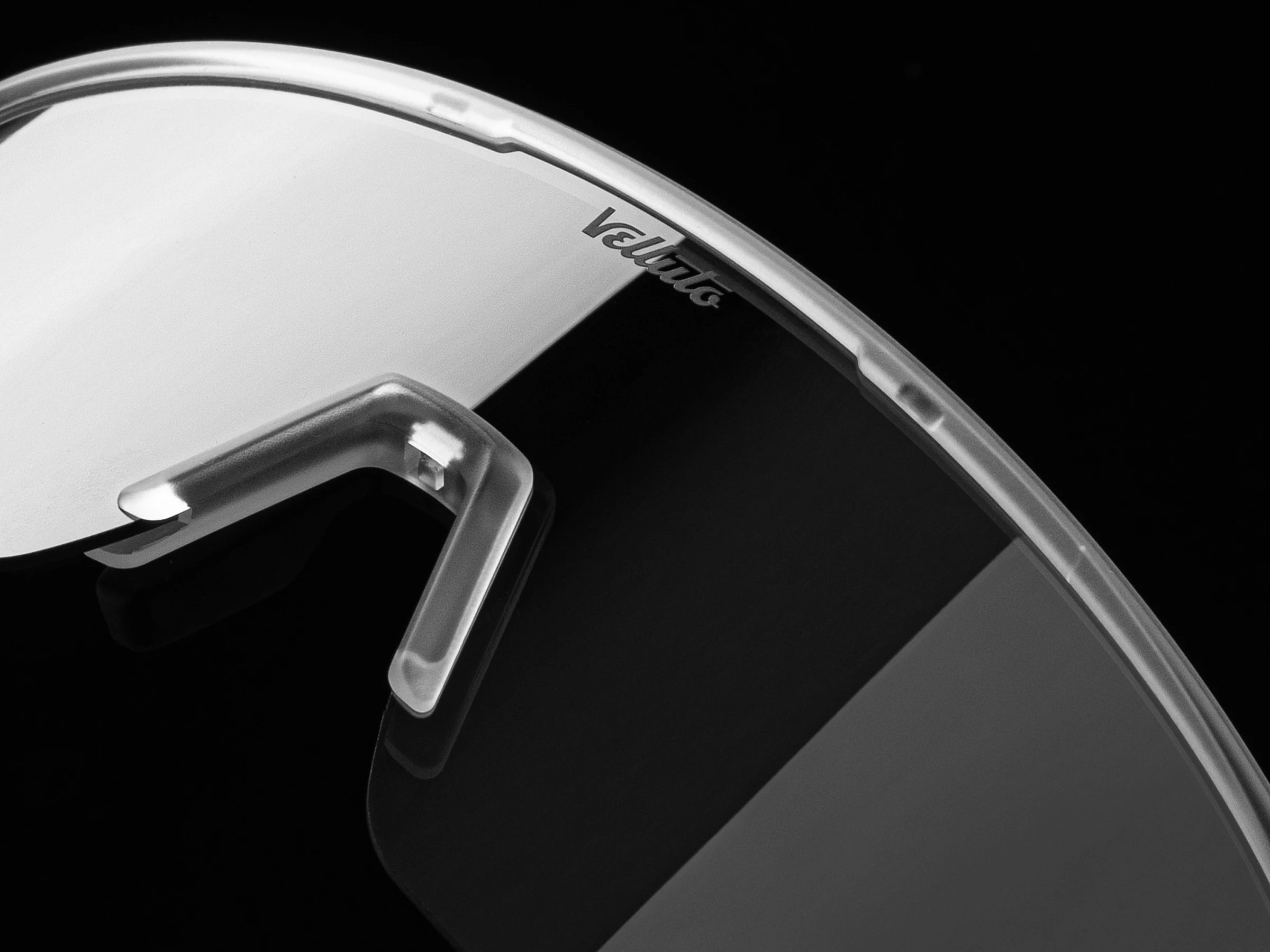
Anti-fog performance is the third variable in this framework. In bright sun conditions, fog is not typically the primary concern. But for riders who include climbs in their August routes, the transition from a fast, cooling descent to a grinding climb at low speed produces exactly the temperature and moisture differential that causes fogging. A frame without an anti-fog system will fog on a steep climb in any warm, humid condition, regardless of how well it performs on the flat. The StradaPro's built-in anti-fog system addresses this through a combination of ventilation geometry and lens treatment, which means it continues to provide clear vision through the effort phases of a ride as well as the easier sections.
For summer riding specifically, anti-fog is more relevant than many riders realise. August heat produces more rider perspiration, which raises the humidity level inside the frame. The Vuelta stages finish with riders who have been sweating for four or more hours. If their frames do not manage that moisture at low speeds, their vision on the final climb approach is compromised. Anti-fog is not a winter-only problem.
08 · Building a practical kitThe Two-Lens Setup for All-Day Summer Riding
The most practical approach for a cyclist who rides in varied light conditions is a two-lens setup: one lens optimised for bright conditions and one for low light, both housed in the same frame. This covers the full riding day without requiring multiple frames, a separate case for each, or a decision at 5:30am about which pair to take based on a weather forecast that may not hold.
For the StradaPro, this setup is built into the product design. The VellutoVisione high-contrast lens handles the variable and transitional light phases: dawn, dusk, cloud cover, and the shifting light of a forested descent. The VellutoPuro clear lens covers the zero-light-reduction end: night riding, rain, and tunnels. Both click in and out without tools and without loosening or adjusting anything else on the frame.
What this setup does not include is a dedicated dark smoke lens for peak midday sun. Riders whose primary use case is noon riding in southern European heat on fully exposed roads will find the VellutoVisione lens provides more visible light transmission than a category 3 or 4 smoke lens would. For those riders, the VellutoVisione's contrast enhancement is still useful, but it functions more like a light brown lens than a dark smoke lens in terms of overall brightness reduction.
The honest recommendation is therefore contextual. If you ride primarily in the 9am to 4pm window in full summer sun, and that is the condition you are buying glasses to solve, you should also consider whether a fixed dark tint frame fits your needs better than an interchangeable system. The interchangeable system wins on versatility. The fixed tint wins if your conditions are genuinely uniform and you want the deepest possible glare reduction without ever needing to swap. Most riders' conditions are not uniform enough for the fixed tint to be the clearly better option, but the trade-off is real and worth naming.
For the typical August sportive rider whose day starts early and finishes late, the two-lens approach with a frame that accommodates both is the more functional choice. Start with VellutoVisione for the first two hours. Swap to your darker option as the sun rises. Swap back to VellutoPuro if the weather changes or if the finish line arrives in low light. Three different optical environments, one frame, no extra weight in the jersey pocket.
09 · Colour variantsStradaPro Frame Colours: Four Options, One Build Standard
The StradaPro is available in four frame colours. Each shares the same 25-gram build, UV400 lens system, adjustable nose pads, built-in anti-fog, and click-in lens compatibility. The colour choice is aesthetic, not technical. Here is a brief orientation for riders choosing between them.


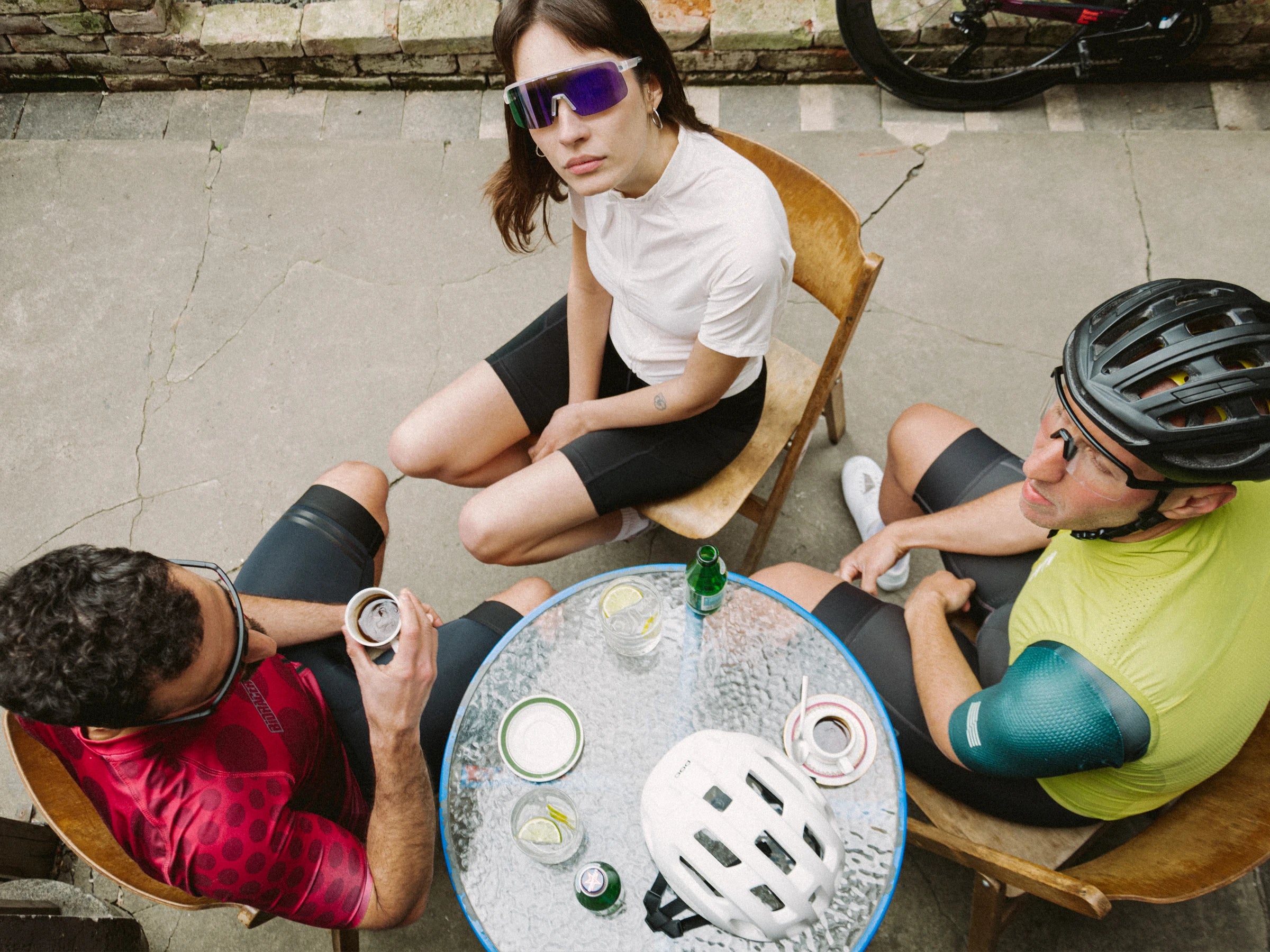
Nero in black is the most visually neutral choice: it works with any kit colour and disappears into a black helmet without drawing attention. Espresso in brown has a warmer, more distinctive look and pairs well with earth-tone kit or a tan saddle. Arancia in orange is the visibility-focused option: high contrast against dark helmets and memorable in a group. Viola in purple sits somewhere between Arancia and Nero in terms of conspicuity, offering a colour that is uncommon in cycling eyewear and stands out without being loud.
For riders who are undecided, the Espresso frame is a useful starting point. The warm brown palette reads as performance-specific without being aggressive, and the colour has visual coherence with a brown or amber lens tint if that is your primary lens choice for the kind of morning and variable-light riding described in this guide.

Compare the full lineup in the Velluto StradaPro cycling glasses collection.
10 · FAQFrequently Asked Questions
What is the best lens tint for cycling in bright sunlight?
What does UV400 protection mean for cycling glasses?
Are brown lenses good for cycling?
When should I use an orange lens for road cycling?
How much do cycling glasses weigh, and does it matter?
Can I use one frame with different lenses for different light conditions?
Do cycling glasses need to be anti-fog?
What is the difference between smoke and grey cycling lenses?
Is a 30-day trial enough time to evaluate cycling glasses?
If you are building a practical kit for summer road cycling and want to understand which frame and lens combination fits your specific riding pattern, the full range is at velluto-shop.com, with a 30-day risk-free trial on every order and free shipping on orders over 89 EUR. The Velluto StradaPro in Espresso is a practical starting point for riders whose riding covers the full light spectrum from early morning to late afternoon sun.