Why Wear Cycling Glasses: The Real Reasons That Matter
Contents18 min read
You are descending at 52 km/h when a hoverfly enters your right eye. In the fraction of a second it takes to react, both hands have come off the drops and the bike has crossed into the oncoming lane. That is not a hypothetical: it is the most common reason experienced club riders finally commit to proper cycling glasses, usually after one close call too many.
Most riders who skip cycling glasses think of them as sun protection, which means they think of them as optional on cloudy days, on morning rides, or on routes that never leave the city. That framing misses almost everything that actually matters. UV accumulation, the wind tear reflex, gravel spray, and mid-ride fogging are not edge cases. They are ordinary conditions on ordinary rides, and each one affects how well you can see at the moment when seeing well is most important.
This guide covers the real case for cycling glasses, built around the specific hazards that every road cyclist encounters, autumn or spring, flat or hilly, road or gravel. The season matters here: the Vuelta concludes in September on roads that shimmer with late-summer UV, the Dutch gravel season peaks with loose surface debris, and autumn sportives across Europe run into exactly the dusk-light and wet-tarmac conditions where eye protection earns its place most clearly. By the end, the question will not be whether to wear glasses. It will be which lens for today.
01 · The physical hazardInsects at 35 km/h are not a minor irritation
At 35 km/h, which is a moderate group-ride tempo rather than a fast one, a flying insect strikes with roughly the same kinetic energy as a small stone chip from a passing car. The cornea is one of the most sensitive surfaces in the human body. Contact from a particle at that speed causes immediate tearing, reflex eye closure, and, in worse cases, corneal abrasion that needs medical attention and days off the bike.
The reflex reaction is the more immediate danger. When something touches the eye unexpectedly, the body's response is total: hands come up, posture changes, and conscious control of the bike drops out for a full second or more. At 50 km/h on a descent, one second without active steering is 14 metres of uncertain trajectory. This is why insect impact is categorically different from ordinary discomfort. It is a bike-handling event, not just an eye event.
Insects are not the only airborne hazard. Grit from the road surface, dust on dry climbs, pollen in late summer and early autumn, and water droplets from spray in wet conditions all travel at similar speeds and all carry enough energy to cause momentary loss of vision. A full-wrap cycling lens intercepts all of these before they reach the eye zone. There is no equivalent protection from ordinary sunglasses, which sit away from the face and leave a gap at the top and sides that debris exploits precisely when you are moving fastest.

02 · The slow damageUV is cumulative, and cyclists accumulate a lot of it
Cyclists spend more time outdoors, at speed, facing forward, than almost any other group of regular exercisers. A committed road cyclist might accumulate 300 to 600 hours per year in direct outdoor exposure. The eyes receive UV radiation throughout that time, and unlike sunburn on skin, there is no obvious signal that damage is happening.
UV damage to the eye is dose-dependent and cumulative across a lifetime. The conditions most associated with elevated risk are exactly those that characterise road cycling: extended duration, midday hours, reflective surfaces (tarmac and water both reflect UV upward toward the face), and altitude, where UV intensity increases by approximately 10% for every 1000 metres gained. An autumn sportive in the Alps or the Pyrenees is not a low-UV event simply because the air feels cool.
The specific risks are well documented in ophthalmic literature. Photokeratitis is essentially a sunburn of the cornea, causing pain, light sensitivity, and temporary vision loss. Cataracts, the leading cause of preventable blindness globally, have a well-established association with cumulative UV exposure. Pterygium, a growth across the surface of the eye, is significantly more common in people with long-term outdoor UV exposure. None of these develops from a single ride, but all of them are preventable through consistent use of UV400-certified eye protection.
UV400 certification means the lens blocks 100% of UV radiation up to 400 nanometres, covering the full UVA and UVB spectrum. It is not a marketing designation: it requires the lens to meet a specific optical standard. A lens that carries the mark prevents essentially all UV from reaching the cornea and lens of the eye. One that does not, regardless of how dark its tint, may allow significant UV transmission.
That last figure deserves emphasis. On an overcast day, approximately 80% of UV radiation still reaches ground level. Riders who leave their glasses at home when the sky is grey are receiving a significant UV dose through what feels like an absence of sun. The cumulative effect of dozens of cloudy rides per season, unprotected, adds meaningfully to a lifetime total. A clear lens with UV400 certification, such as the VellutoPuro, provides full UV blocking with no visible tint, making it the correct choice for grey-sky conditions where a dark lens would reduce visibility unnecessarily.
03 · The hidden impairmentThe wind tear reflex and what it does to your vision
The wind tear reflex is the least discussed of the physical arguments for cycling glasses and possibly the most operationally significant. Here is what happens: when moving air contacts the surface of the eye, the eye responds by producing excess tear fluid. This is not allergy or irritation. It is an involuntary protective reflex, no different from the reflex that makes your hand pull back from a hot surface. You cannot override it through concentration or experience.
On a descent where speed is 50 to 70 km/h, the airstream across an unprotected eye is enough to trigger persistent watering within 30 to 60 seconds. The excess tear fluid blurs the corneal surface in exactly the way a smeared lens would. You are not seeing through clear optics. You are looking through a moving film of saline that distorts fine detail and, critically, reduces contrast. Road surface texture, the gap between riders in a bunch, the painted line marking a corner apex: all of these require contrast to read accurately and quickly.
The reflex also causes instinctive partial eye closure. Squinting while descending narrows the visual field and adds a small but real distraction. On technical descents with hairpin corners, where you need to be reading the road 4 to 6 seconds ahead of your current position, any narrowing of the field or reduction in contrast has a direct effect on how safely and how fast you can descend.
A well-fitted cycling lens solves this completely. It creates a still-air environment in front of the cornea. The eye never registers the airstream, the reflex never fires, and vision remains as sharp on a 70 km/h descent as it was at the top of the climb. Riders who have made this transition consistently describe it not as comfort but as information: they simply see more, and see it faster.

04 · Surface hazardsGravel spray and wet tarmac: what your tyres throw at your face
Gravel riding has grown enormously as a discipline, and with it, the exposure of road cyclists to a hazard that tarmac minimises but never eliminates: surface spray. On gravel, the rear tyre of the rider in front throws a constant stream of small stones, grit, and dust rearward and upward in a low arc. The trajectory is almost perfectly aimed at the face of the following rider. At typical gravel sportive speeds of 25 to 35 km/h, particles in this stream are large enough to sting exposed skin and fast enough to cause real eye injury.
Road surfaces are not neutral either. Wet tarmac generates significant spray from both your own tyres and those of riders around you. This spray carries road detritus: fine grit, oil residue, and small particles of debris that accumulate on European roads through the autumn riding season. The water component causes its own visual disruption, coating the lens rather than the eye, but the solid particles it carries are the real concern.
Autumn specifically compounds this. Fallen leaves decompose on road surfaces and break into small particles that tyres aerosolise into the air behind the wheel. Sandy grit that was fixed in dry summer road coatings becomes loose and mobile when autumn rain first arrives. The debris loading on a wet October road is meaningfully higher than on a dry August road.
On gravel, your rear tyre is essentially a slingshot aimed at the face of whoever is riding behind you. A cycling lens intercepts that stream before the first particle arrives.Velluto cycling eyewear
The practical answer is a full-wrap lens that covers from the brow to the cheekbone and from the nose to well beyond the temple. This geometry catches the low-angle particle stream that straight-bar sunglasses miss entirely. It also handles the overhead angle from road surface reflections and the side angle from spray thrown laterally in crosswind conditions on wet roads.
05 · The fog problemWhy cycling glasses fog, and how a built-in system stops it
Fogging is the friction point that leads riders who have tried cycling glasses to abandon them, usually after one ride where a heavy climb left the lens opaque at exactly the moment they needed to see the descent. It is a real problem, not a fringe case, and it is worth understanding what causes it before explaining the solution.
Fogging occurs when warm, moist air from your breath and your radiating body heat meets a lens surface that is cooler than the dew point of that air. The moisture condenses on the inner lens surface in tiny droplets, and you see a white or grey haze. The conditions that produce this most reliably are: high effort (heavy breathing), slow speed (less airflow to carry moisture away), cool ambient temperature, and a lens that sits close to the face. In other words, the conditions of a steep road climb in autumn.
Passive ventilation alone is not sufficient in those conditions. Moving air through slots in the frame helps at moderate speeds, but at the low speeds of a hard climb, there is not enough throughput to prevent condensation on the inner surface. An effective anti-fog system requires either a hydrophilic coating that causes moisture to spread into a transparent film rather than bead into opaque droplets, or a ventilation design that maintains adequate airflow at low speeds, or both.
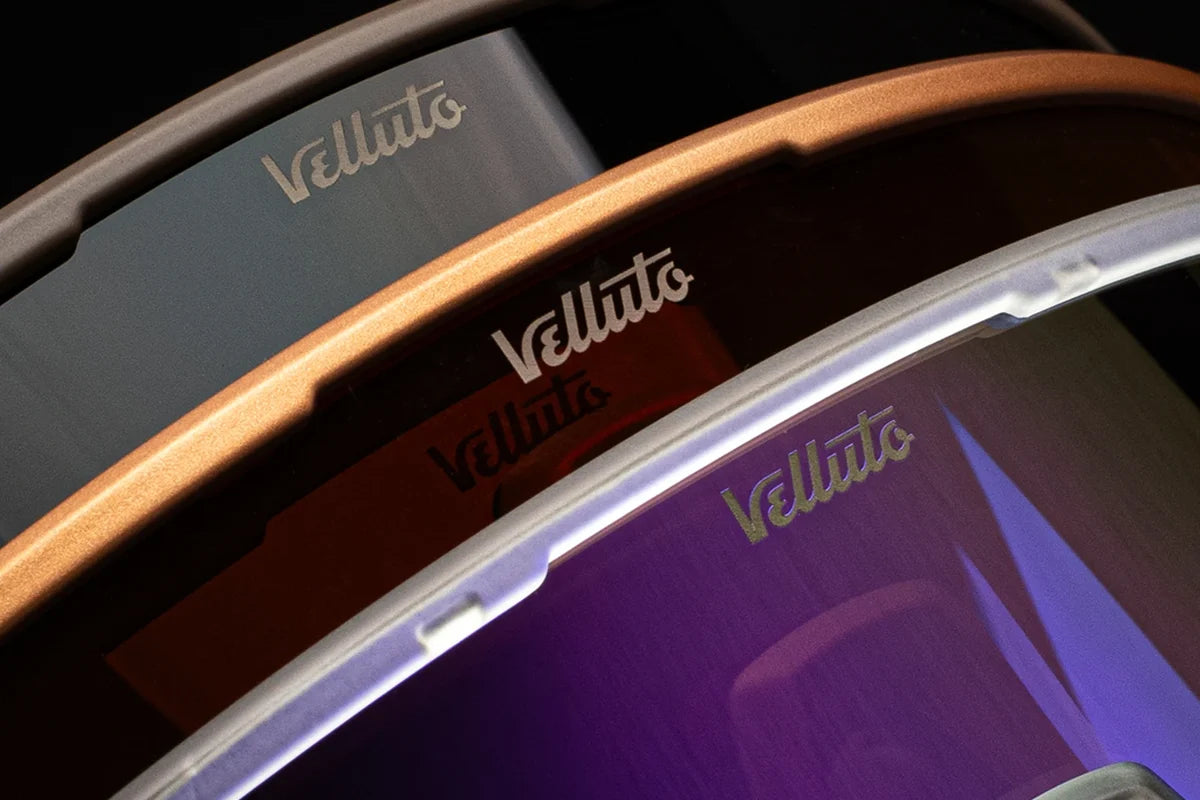
The StradaPro uses a built-in anti-fog system that addresses this directly. It maintains clear vision on climbs and in variable weather, which is the condition that matters most. Equally relevant is the interchangeable lens system: on a long ride where conditions shift from cool morning shadow to bright midday sun to damp afternoon descent, you are not locked into a single lens. The VellutoPuro and VellutoVisione click in and out without tools, letting you match the lens to the light rather than the reverse.

06 · Light conditionsChoosing the right lens for the ride: clear, tinted, or high-contrast
One of the most common reasons riders leave their glasses at home is that their only lens is a dark tint that makes a grey autumn morning feel like wearing a blindfold. This is a lens-choice problem, not a glasses problem. The solution is interchangeable lenses designed for different light conditions, which changes the decision from "do I need glasses today" to "which lens does today's light call for."
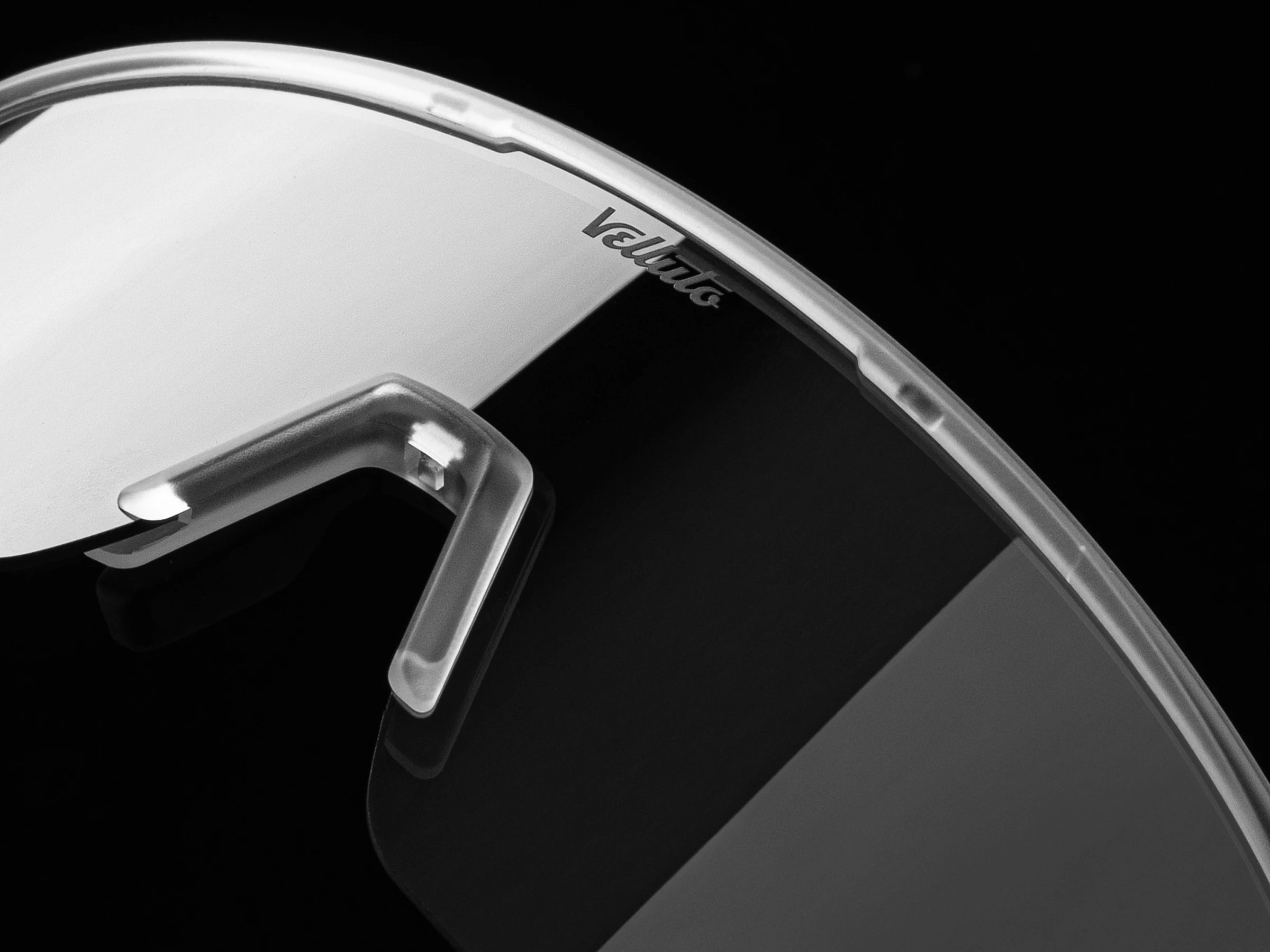
The VellutoPuro transparent lens is optimised for exactly this scenario. It provides UV400 protection, wind shielding, insect protection, and anti-fog performance with no visible tint. For early morning rides before the sun rises, for overcast autumn sportives, for evening training sessions that extend into dusk: the clear lens gives you every protective benefit of cycling glasses while adding zero reduction in ambient light. It also protects from the wind tear reflex just as effectively as any tinted lens, because the reflex is triggered by airflow, not by light.
The VellutoVisione high-contrast lens serves a different purpose. In variable light, which describes most European cycling conditions for eight months of the year, contrast matters more than raw tint depth. A high-contrast lens sharpens the visual definition of road texture, shadow patterns, the edge of a pothole, the line of a corner. It does not simply darken the image: it restructures it to make fine detail easier to read quickly. This is the lens for mixed-cloud days, for forest roads with light gaps, for the late afternoon rides where the sun is low and strobing through trees at 40 km/h.
07 · Fit and comfortWhy a 25g frame matters over four hours on the bike
The argument for wearing cycling glasses collapses immediately if the glasses are uncomfortable. Glasses that press on the nose bridge after 45 minutes, that slide down on sweaty skin, that create hot spots on the temples: riders take those off and put them in a jersey pocket, where they protect nothing. Fit and weight are therefore not secondary questions. They are part of the core case for why wear cycling glasses in the first place.
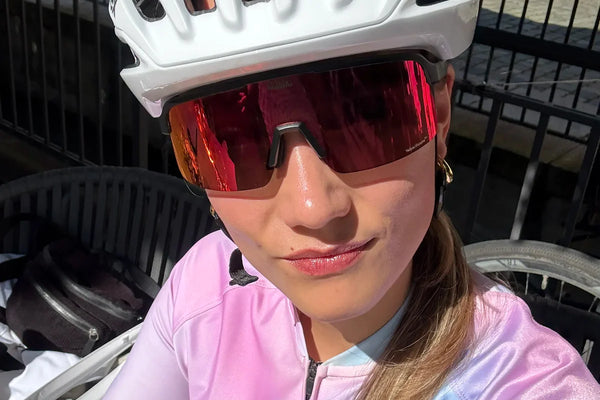
Frame weight has a direct effect on fit stability. Heavier frames move on the face when you look into the drops, shake your head in a sprint, or sweat through a long climb. The StradaPro weighs 25 grams. At that weight, inertia is low enough that the frame tracks your head movement without shifting position. You do not need to push them back up. You do not feel them on your nose. Over four hours of riding, the cumulative irritation of adjusting glasses that move adds up to real distraction.
Adjustable nose pads address the other dimension of fit: face shape variation. The distance between the lens and the eye, and the angle at which the frame sits on the nose, both vary significantly across riders. A fixed nose pad fits some faces well and others poorly. Adjustable pads let you dial in the exact position that places the lens close enough to provide wind protection without touching the eyelashes, and distributes the frame's weight across the nose bridge without creating a pressure point at any single spot.
The 30-day risk-free trial period matters here. Fit is something you cannot fully evaluate in a shop or from a product page. You need to wear the glasses on three or four real rides, in the positions you actually ride, at the efforts you actually make. If the fit is not right after honest testing on real roads, you can return them. That removes the primary purchasing risk for an item where individual fit variation is high.

08 · The StradaProHow Velluto addresses each hazard
Understanding why wear cycling glasses makes the specification of any glasses you choose legible. You are no longer selecting from a list of features: you are matching specific design decisions to the hazards each one addresses. The Velluto StradaPro was designed around exactly the conditions described in this guide.
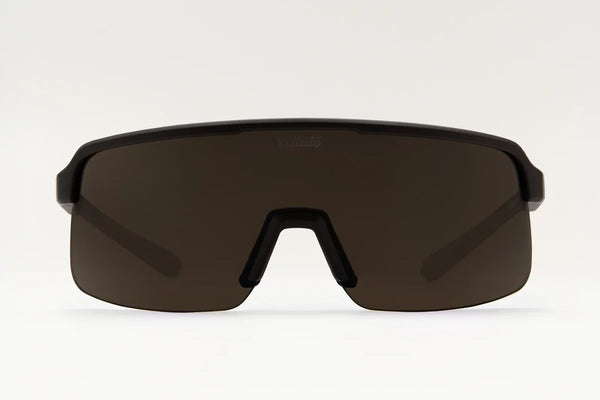
The UV400 certification handles the cumulative UV argument directly: 100% of UVA and UVB radiation is blocked on every ride, including overcast days, without requiring a dark tint. The full-wrap Italian-design geometry addresses insect impact, gravel spray, and road debris, creating a physical barrier across the entire eye zone. The built-in anti-fog system handles the climb-to-descent transition where fogging is most likely. The 25g frame weight and adjustable nose pads address the fit stability that determines whether glasses stay on the face or end up in a jersey pocket after the first hour.
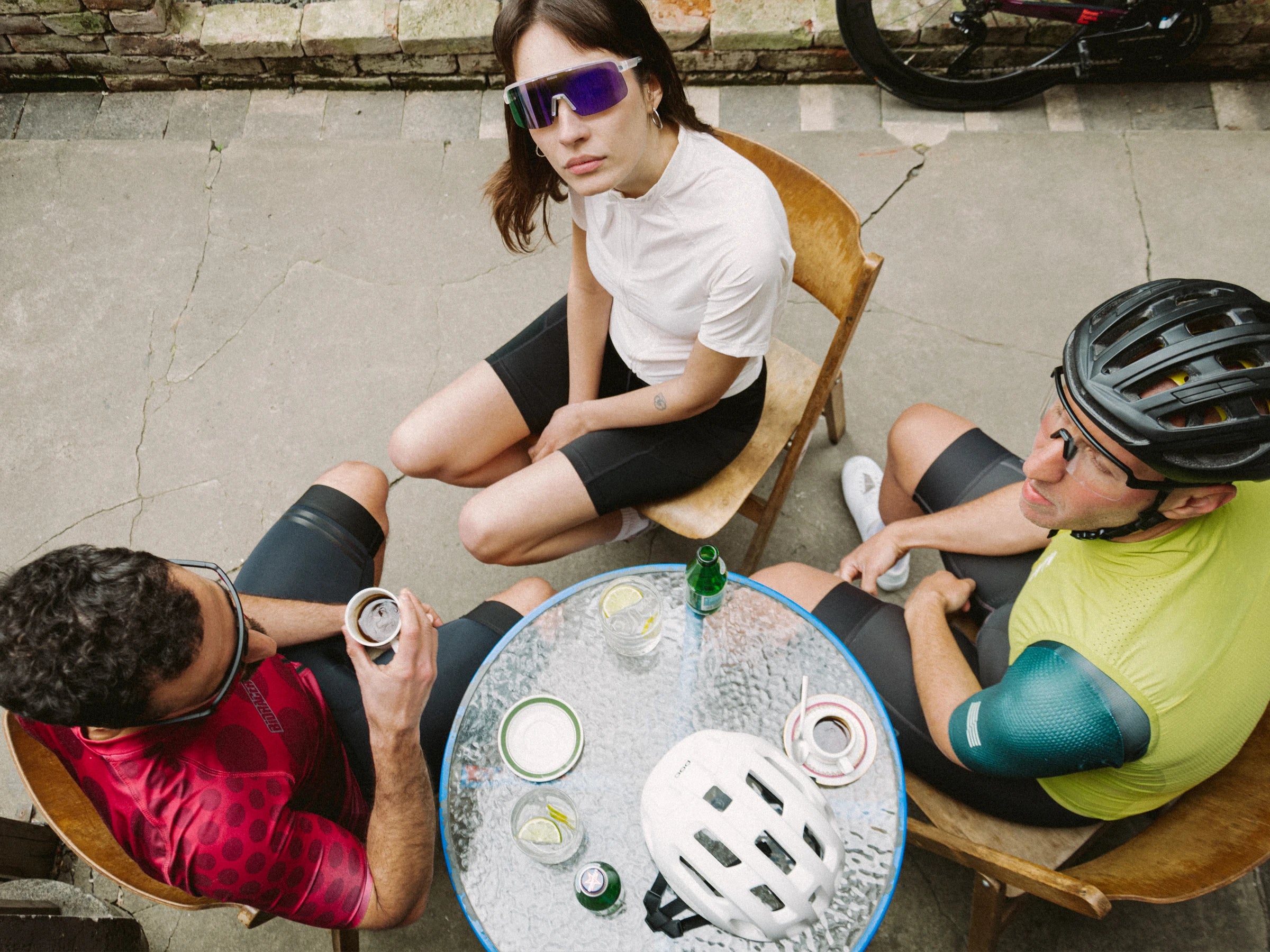
The interchangeable VellutoPuro and VellutoVisione lenses address the light-condition problem that makes riders leave glasses at home on grey days. Two lenses cover the full range of European riding conditions without compromise in either direction. The click-in, tool-free swap takes seconds and can be done at a café stop or a sportive checkpoint. And the 30-day risk-free trial removes the purchase risk from an item where fit matters more than any spec on a page.

Keeping lenses clean is part of making the investment work. Smeared or scratched lenses undo the optical clarity that anti-fog and UV400 certification provide. The Velluto Cleaning Spray is a 50ml apple-fragrance formula, made in Germany, refillable, and designed specifically for optical surfaces. Paired with a microfibre cloth, it keeps both the VellutoPuro and VellutoVisione lenses performing as intended ride after ride.


Compare the full lineup in the Velluto StradaPro cycling glasses collection.
09 · FAQFrequently Asked Questions
Why wear cycling glasses if I already have sunglasses?
Can an insect seriously injure a cyclist's eye at speed?
How does UV light damage eyes during cycling?
What is the wind tear reflex and why does it affect my vision?
Do cycling glasses help with gravel and road spray?
Should I wear cycling glasses on overcast or cloudy days?
What is anti-fog in cycling glasses and why does it matter on climbs?
Are interchangeable lenses necessary or just a nice feature?
How heavy should cycling glasses be?
Every hazard covered in this guide is present on every ride, including yours this weekend. The insects, the UV, the wind tear reflex, the gravel spray: none of them announce themselves. They arrive at speed and resolve in fractions of a second. Cycling glasses do not make you faster, but they keep you seeing clearly at the moments when seeing clearly is most consequential. The full StradaPro range, with both interchangeable lenses and a 30-day risk-free trial, is at velluto-shop.com.