Road Cycling Sunglasses 2026: What You Actually Need
Contents11 min read
You're forty kilometres into a road ride, the sun has shifted, and the lens you chose at 7 a.m. is now working against you. A gust catches you at 48 km/h and your eyes are streaming. These are not equipment failures, they are the predictable consequences of wearing the wrong glasses for road cycling. The right pair changes every ride.
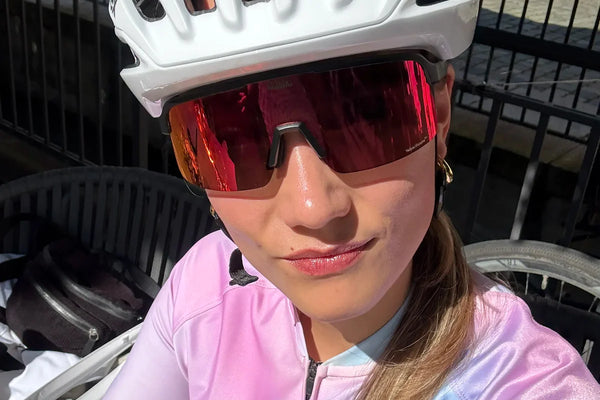
Road cycling asks more of your eyewear than almost any other sport. You are moving fast, facing directly into wind and debris, generating significant heat on climbs, and spending hours in direct sun, often at altitude, where UV intensity is measurably higher than at sea level. The glasses that work at a garden barbecue, on a ski slope, or even at a running event are not optimised for this specific combination of demands. Understanding what road-specific design actually means makes choosing much simpler.
01 · The FundamentalsWhat road cycling actually requires from your eyewear
Start with the physics of riding at speed. At 40 km/h, the wind pressure on your face is continuous and significant. Any gap between your glasses and your face, at the temples, along the top of the frame, or at the sides, becomes an entry point for wind, dust, insects, and road spray. Casual sports sunglasses are typically designed with ventilation in mind; that ventilation becomes a liability at road cycling speeds.
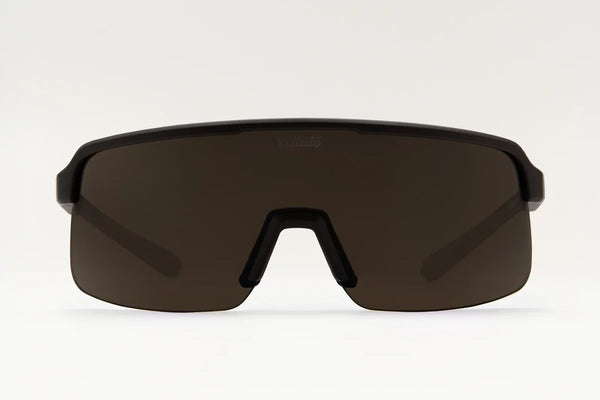
Wide lens coverage is the first road-specific requirement. You want a lens that wraps far enough around your face to eliminate lateral exposure, sits close enough to your brow to block overhead sun, and extends low enough to shield against spray thrown up by your front wheel when you're in an aero position. The geometry of a road cyclist, head down, chin slightly forward, is completely different from a pedestrian or a runner, and the optimal lens geometry reflects that.
The second requirement is weight. Over a three-hour road ride, a pair of 40-gram glasses creates a meaningfully different experience at the nose than a 25-gram pair. Adjustable nose pads are not a luxury feature, they are the difference between a frame that stays secure across varying nose shapes and one that migrates continuously upward as you sweat, requiring constant adjustment at exactly the moment you least want to take a hand off the bars.

02 · The NumbersSpecifications that actually move the needle
Frame weight: 25g, a specification optimised for multi-hour road riding
100% UVA and UVB protection, certified, not approximate
Risk-free trial, test on real rides, not just the car park
Interchangeable lenses, clear and high-contrast, click-in tool-free
These numbers matter because road cycling is a specificity sport. The difference between 25 grams and 33 grams sounds abstract until hour three of a ride with a 1,200-metre climb. The difference between UV400 and no certification is invisible until cumulative UV exposure becomes a medical issue. Specificity builds trust, and in eyewear, the specifications you can verify are the ones that protect you.
03 · The Anti-Fog ProblemWhy fogging happens on road rides, and how to stop it
Anti-fog performance is undervalued until the moment you need it, and on road rides, that moment comes reliably. The physics are straightforward: when you're grinding up a long climb at low speed, your body generates significant heat and moisture. The lens surface is cooler than the air between your face and the glass. Condensation forms. Your vision disappears at precisely the point when you're most focused on your breathing and least able to deal with a distraction.
A built-in anti-fog system addresses this through a combination of lens coating and frame ventilation that manages the airflow across the lens surface without creating the open gaps that cause problems at speed. The goal is not to eliminate the temperature differential, that is impossible, but to manage the moisture exchange so condensation never accumulates enough to obstruct your vision. This is an engineering problem, not a marketing claim, and the solutions that work are specific and verifiable.
The Giro d'Italia stages through the Dolomites this spring illustrated the problem vividly for anyone watching from the roadside: riders descending in cold air after high-altitude climbs in warm sun were constantly managing their eyewear. The glasses that stayed clear were the ones with genuine anti-fog engineering, not just a ventilation gap cut into a fashion frame.
The glasses that stayed clear on the descent weren't the most expensive ones, they were the ones with genuine anti-fog engineering built in from the start., Velluto Ride Journal, Dolomites Test Ride, April 2026
04 · Lens SystemsWhy interchangeable lenses are a road-specific advantage
A single-lens road cycling glass is a compromise. You choose a tint that works reasonably well in the conditions you expect and accept that it will be suboptimal for anything else. Experienced road cyclists know that conditions rarely match expectations: a 6 a.m. start in shade, a 10 a.m. climb in bright sun, an afternoon descent through tree cover. Each scenario has a different optimal lens.
Interchangeable lens systems solve this without requiring you to carry multiple pairs of glasses. The key variables in any interchangeable system are how quickly the swap happens, whether it requires tools, and whether the second lens is genuinely optimised or just a tinted afterthought.
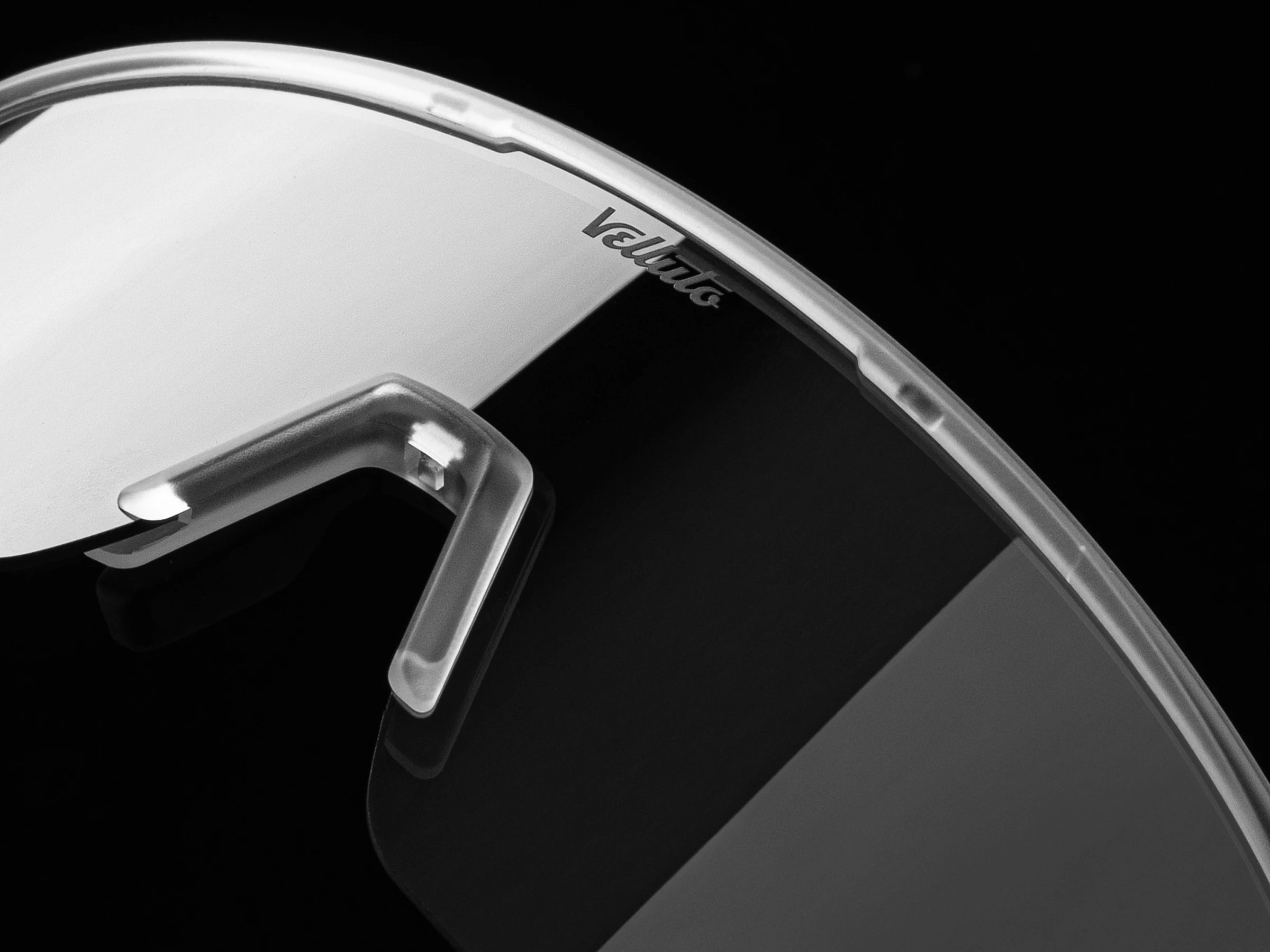
The Velluto StradaPro uses a click-in system compatible with two purpose-built lenses: the VellutoPuro transparent lens, optimised for wind and insect protection in low-light conditions, and the VellutoVisione high-contrast lens, which sharpens terrain definition and visual acuity in bright, variable light. Both are UV400 certified. Both swap in seconds without tools.
Ideal for dawn rides, tree cover, tunnels, and overcast conditions. Maximum wind and debris protection with full UV400 certification.
Sharpens contrast and terrain definition in bright sun and variable cloud. The lens for climbs, descents, and open road.
Tool-free swap in seconds. No loose parts to lose mid-ride. Secure engagement confirmed before you roll.
Not just the primary lens, full UVA/UVB certification applies to every lens in the system.
05 · Road vs CasualWhere sports sunglasses fall short on the bike
The casual sports sunglasses market is large and well-served. For the gym, running, or general outdoor activity, a decent pair of UV-rated sunglasses does the job. Road cycling introduces a specific set of conditions that most of those glasses are not designed for.
Frame weight becomes critical over multi-hour efforts. Nose bridge design matters because you spend hours in a forward-leaning position, not upright. Anti-fog is irrelevant when you're walking but essential at climb pace. Lens geometry needs to account for your head position on drop bars. Wind sealing becomes important at speeds a runner never reaches. These are not incremental improvements, they are different design requirements entirely.
The other factor is durability under road-specific conditions: sweat, sunscreen, road spray, and the mechanical stress of being removed and replaced dozens of times during a season. A frame that flexes over the ears to stay put is an advantage. A nose pad that adjusts to your anatomy rather than requiring your anatomy to adjust to it is a meaningful difference across a long season.

06 · The StradaProBuilt specifically for road cycling

Italian design discipline is visible in every dimension of the StradaPro. The 25-gram frame is not the result of removing material arbitrarily, it is the outcome of designing specifically for road cycling's requirements: a frame that holds its shape under sweat and heat, maintains lens alignment at speed, and distributes its minimal weight so evenly that you stop noticing it is there. The adjustable nose pads are the kind of detail that sounds minor until you've spent three hours on a climb where a slipping frame has been your only frustration.
The 30-day risk-free trial is the StradaPro's clearest statement of confidence. You cannot properly evaluate road cycling glasses in a shop. You need the glasses on a climb, in variable weather, at speed, in real sun. Thirty days is enough to know whether they work for you. If they don't, the process of returning them is straightforward. That offer is not common in this category, and it reflects what Velluto believes about the product's performance under real conditions.
07 · Colour & VariantsFour colourways, one specification
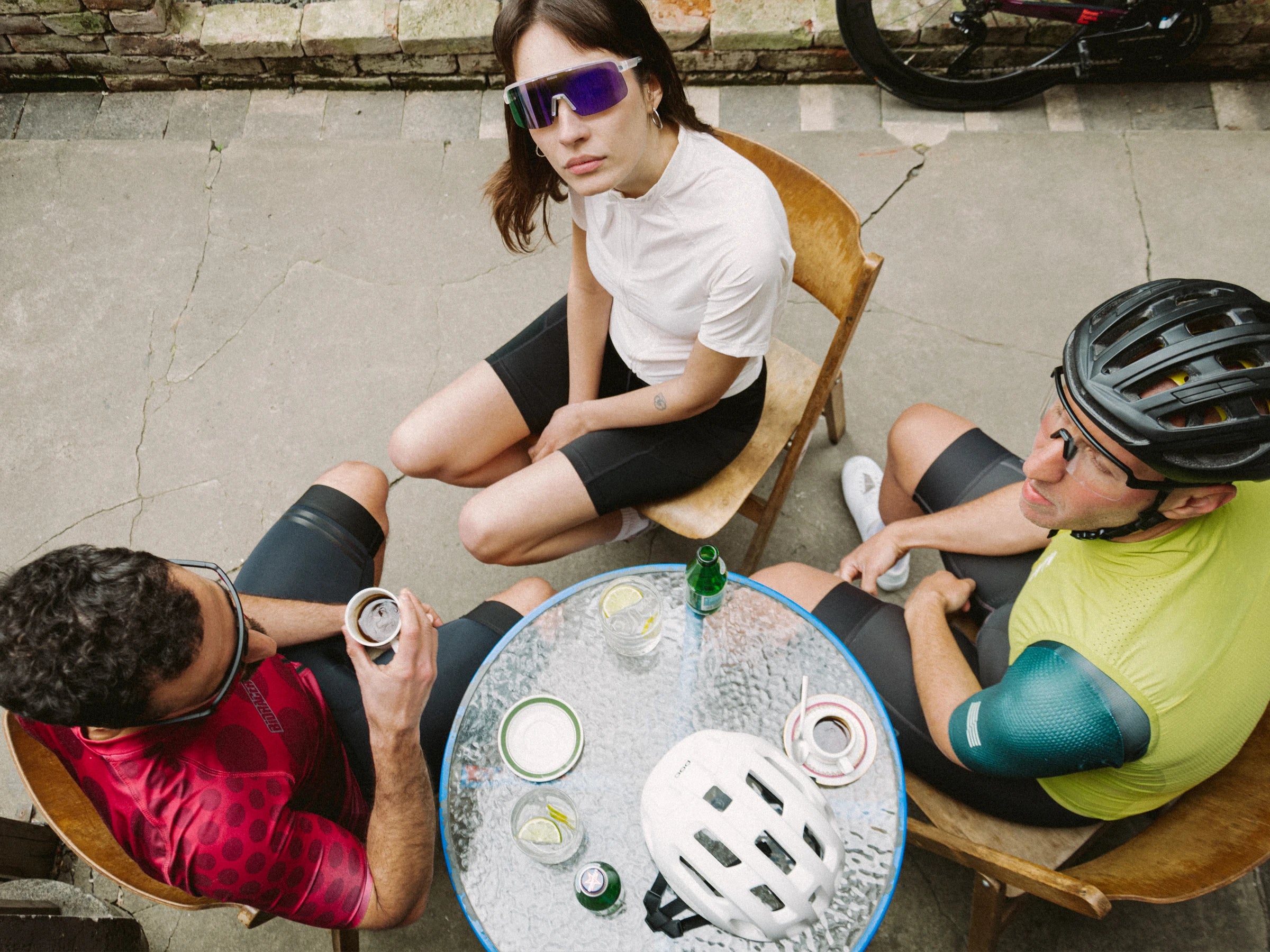
The StradaPro is available in four colourways. The specification is identical across all four, 25 grams, UV400, adjustable nose pads, built-in anti-fog, click-in interchangeable lenses. The choice is entirely aesthetic, which is as it should be. Your eyewear should reflect your taste without asking you to trade performance for colour.


08 · Lens CareKeeping your lenses performing all season
Road cycling glasses face a specific set of abuse conditions: sunscreen transferred from your hands, road grit kicked up from the tarmac, salt from sweat, and the occasional rain shower. Each of these degrades lens coatings if not properly managed. The cleaning protocol is simple but must be followed consistently.
Rinse with clean water before any wiping, dry-wiping a lens covered in road grit is the fastest way to introduce micro-scratches that permanently compromise anti-fog and optical clarity. Use a dedicated microfiber cloth and a lens cleaning spray formulated for optical surfaces. Velluto's cleaning spray is a 50 ml refillable bottle, made in Germany, apple-scented, and formulated specifically for coated cycling lenses. When you're not riding, the hard case with its velvet interior is not optional storage, it is the difference between lenses that last a season and lenses that last several years.
09 · FAQFrequently Asked Questions
What makes road cycling sunglasses different from regular sports sunglasses?
Do road cycling glasses need UV400 protection?
How much should road cycling sunglasses weigh?
Are interchangeable lenses worth it for road cycling?
What is anti-fog technology in cycling glasses, and does it work?
Can I use road cycling glasses for gravel riding too?
What does VellutoVisione high-contrast lens technology do?
What is the Velluto 30-day risk-free trial?
How do I clean road cycling sunglasses properly?
Road cycling sunglasses are not a premium accessory, they are functional kit that directly affects your vision, comfort, and safety across every ride you do. If you're riding seriously, the glasses you wear on the road deserve the same consideration as the tyres you choose or the position you've dialled in. The Velluto StradaPro was designed from the ground up for exactly this context: road riding, at speed, in real conditions. Try them for thirty days and decide for yourself, full details and all four colourways at velluto-shop.com.