Best Road Cycling Glasses 2026 Criteria & Top Picks

Contents13 min read
It is 6:47 am in the Pyrenees and a cycling camp group rolls out of Luz-Saint-Sauveur with the road still shaded and the sky already white-bright above the treeline. Within ninety minutes they will be above 2,000 metres with full sun, wind, and another four hours in the saddle. The glasses on their faces will either earn their place or quietly become a problem.
Every July, with the Tour de France lighting up the same roads, that question gets asked again by serious cyclists across Europe: which road cycling glasses actually hold up across the full range of conditions, and which ones just look good in a product photo? This guide answers that question with honest criteria, a clear comparison framework, and a recommendation built on verifiable specs rather than marketing language.
Quick answer: The best road cycling glasses in 2026 are those that combine UV400 certified protection, a frame under 30 grams, reliable anti-fog performance and an interchangeable lens system that lets you adapt to changing light without stopping. The Velluto StradaPro delivers all four at 25g, with a 30-day risk-free trial so you can test it on real rides before committing.
01 · Short answerThe best road cycling glasses in 2026, summarised
If you want a fast answer before reading the full breakdown: look for UV400 certification (not just "UV protection"), a frame weight below 30 grams, adjustable nose pads for long-ride stability, and a lens system that handles both low-light starts and bright alpine descents. A meaningful trial period matters too, because no amount of product photography tells you how a frame sits after three hours in the drops.
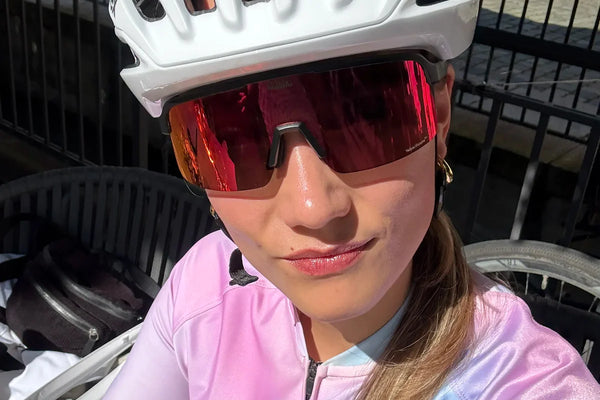
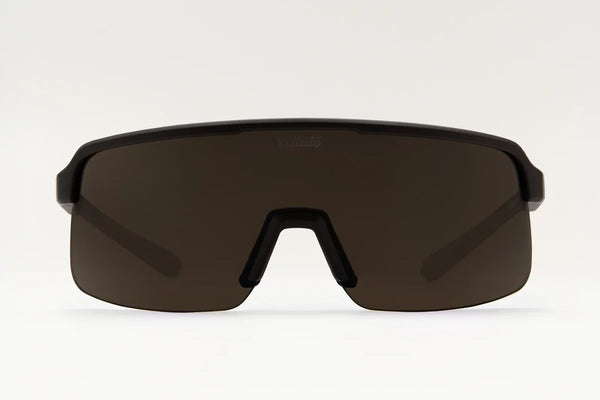
The Velluto StradaPro hits every one of those criteria. Italian-designed, 25 grams, UV400 certified, anti-fog system built in, and a click-in interchangeable lens system compatible with the clear VellutoPuro and the high-contrast VellutoVisione. It is not the only option worth considering in 2026, but it is the one that resolves the most common complaints riders bring up about their current glasses: too heavy, fogs on climbs, slips during efforts, and looks like a sponsorship obligation rather than a choice.
02 · Selection criteriaWhat actually matters in road cycling sunglasses
Before comparing any specific glasses, it helps to agree on what the criteria are. "Best" cycling sunglasses is a marketing phrase. What serious riders actually need is a ranked set of requirements, and the priority order matters.
Not optional. UV400 blocks 100% of UVA and UVB radiation up to 400nm. At elevation, UV intensity increases by approximately 10% per 1,000 metres. Alpine and Pyrenean riding without proper UV protection is a cumulative eye health risk, not a style debate.
Heavy glasses shift during sprints and feel worse over long rides. Under 30 grams is the meaningful threshold for road cycling. At 25 grams, the StradaPro sits at the low end of performance frames without sacrificing structural stability.
Road conditions change across a single ride. A fixed tint that is ideal for a sunny summit is wrong for a shaded valley or a long tunnel. Interchangeable lenses or a genuinely fast-response photochromic system are the two solutions. Both have trade-offs (covered below).
Fogging happens at the worst moments: the top of a hard climb before a technical descent. A built-in anti-fog system is a functional requirement for road cyclists, not a premium add-on. Ventilation design and lens coating both contribute.
Two secondary criteria worth noting: adjustable nose pads (critical for long-ride comfort and preventing the forward slide that happens when you sweat heavily), and fit across a range of face shapes. Generic one-size frames often cause pressure pain on shorter faces or slip on narrower bridges. Adjustability resolves both.
What does not belong in the primary criteria list: tint darkness as a quality signal (darker is not better, it is just a different tool), brand logo size, and anything described only in relative terms ("enhanced clarity", "improved grip") without a spec or mechanism behind it.
03 · ComparisonVelluto StradaPro vs the alternatives: how it stacks up
The premium road cycling sunglasses market in 2026 sits between roughly $100 and $350 at the upper performance tier. The brands most riders are cross-shopping in that range include established names known for sponsored-team optics and proprietary lens technology. Here is how the key specs compare across that landscape.
| Feature | Velluto StradaPro | Oakley Radar EV | Rudy Project Cutline | 100% Speedcraft SL |
|---|---|---|---|---|
| Frame weight | 25g | ~33g | ~28g | ~28g |
| UV protection | UV400 certified | UV400 | UV400 | UV400 |
| Interchangeable lenses | Yes (click-in, tool-free) | Yes (proprietary) | Yes (proprietary) | Yes (proprietary) |
| Anti-fog system | Built-in | Ventilation design | Ventilation design | Ventilation design |
| Adjustable nose pads | Yes | No (fixed) | Yes | No (fixed) |
| Risk-free trial | 30 days | Standard returns only | Standard returns only | Standard returns only |
| Price tier | from 69 EUR | $200 to $280 | $180 to $250 | $180 to $250 |
| Lens ecosystem | VellutoPuro + VellutoVisione | Prizm (multiple tints) | Multiple tints | Multiple tints |
| Design origin | Italian | American | Italian | American |
A few things stand out in that table. The StradaPro is the lightest frame in the comparison by a meaningful margin. The adjustable nose pad is a genuine differentiator against the two fixed-nose options. And the 30-day risk-free trial is, as far as this guide can verify, unique to Velluto in this price tier. Standard retail returns typically require unworn, undamaged goods, which limits real-world testing before final purchase.
Larger established brands offer a wider range of lens tints and multiple colour options across their proprietary ecosystems. If your riding requires a specific tint for a specific purpose beyond the clear VellutoPuro and high-contrast VellutoVisione, those broader ecosystems provide additional choices.

04 · Lens systemInterchangeable vs photochromic: the honest comparison
This is the decision most road cyclists spend the most time on, and it deserves a direct answer rather than a hedge.
Photochromic lenses react to UV light and darken automatically. In ideal conditions, they are genuinely convenient: one lens handles a range from overcast to moderate sun without any action on your part. In practice, photochromic performance varies by temperature (cold slows the reaction significantly), and the transition takes time, which matters during fast tunnel exits on mountain stages. They also carry a cost premium, and when the reactive coating degrades over time, the whole lens needs replacing.
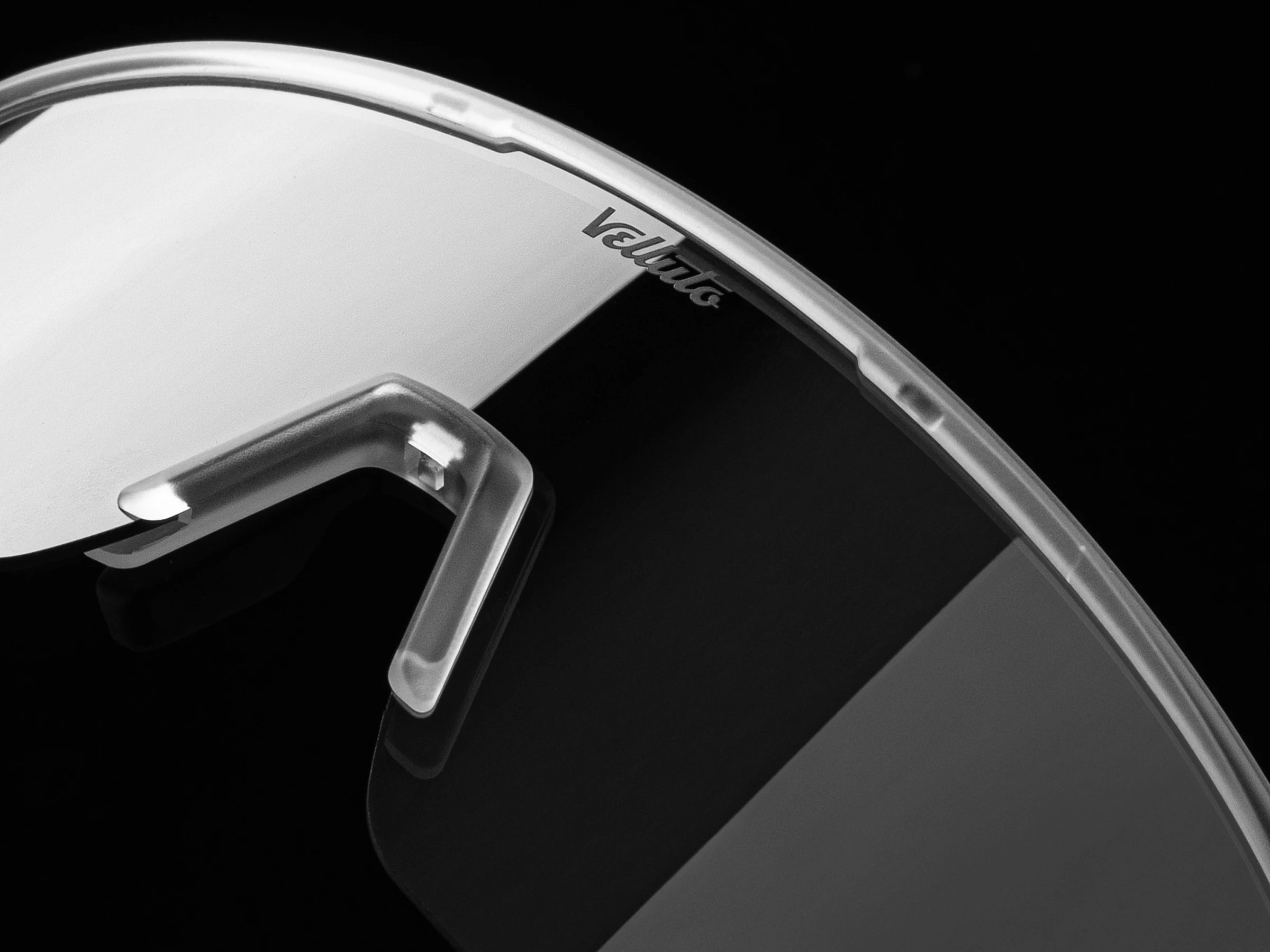
Interchangeable lenses require a deliberate swap. The VellutoPuro clear lens clicks out, the VellutoVisione high-contrast lens clicks in, in seconds, without tools. That is a minor action before a ride rather than a compromise during one. For a rider doing an early morning start in low light followed by a bright alpine summit, swapping at the car before departure solves the problem cleanly. For spontaneous mid-ride light changes, photochromic has an advantage. For everything else, the interchangeable system gives you full control at a lower price point.
The best lens for a mountain stage is the one you chose deliberately for the conditions, not the one trying to keep up with them.Velluto editorial
VellutoPuro is optimised for wind and insect protection as well as UV400 safety, making it the correct choice for tunnel-heavy routes, forest stages and early low-light kilometres. VellutoVisione uses contrast-enhancement technology to sharpen visual definition on bright roads, helping you read road surface and distance more accurately on open descents. Neither is a tinted fashion choice: both serve a specific optical function for road cycling.
05 · Real-world ridingFour scenarios where lens choice and fit define performance
Abstract specs are useful. Concrete situations are more useful. Here are four scenarios that road cyclists are navigating this summer, and how glasses specification maps to each one.
Scenario 1: Dutch cycling camp, Col du Tourmalet, July morning start. The group leaves the valley at 7am with the road in shadow. Air temperature is cool and the lens fogging risk is real on the first effort. A VellutoPuro transparent lens with anti-fog performance handles this start cleanly. By the time the sun clears the ridge at the halfway point, conditions have shifted but the clear lens still functions: UV400 protection holds, and the anti-fog system keeps vision unobstructed through the effort-induced humidity spikes. At the top, the descent demands confidence. A well-fitted 25g frame that has not shifted once on the 90-minute climb means the rider is not adjusting their glasses mid-corner.
Scenario 2: Two-hour evening training ride, variable cloud cover. This is the scenario photochromic advocates cite most often. But variable cloud in European summer typically moves between categories a fixed tint handles fine. A high-contrast lens like VellutoVisione improves visual definition in both direct sun and diffuse cloud conditions. The contrast enhancement serves both states without a tint change.
Scenario 3: Hot criterium, fast corners, heavy sweat. Frame stability becomes critical here. Fixed nose pads are a liability when sweat breaks the friction seal and the frame starts riding down the nose. Adjustable nose pads on the StradaPro allow a snug but pressure-free fit configured before the start. The 25g weight means there is less mass moving with each acceleration, reducing the tendency to bounce or drift during hard efforts.
Scenario 4: Buying online without the ability to try first. This is the scenario that drives most cycling eyewear purchasing regret. A frame that looks right in photos sits wrong on your face, or the lens performs differently than the brand's language suggested. The 30-day risk-free trial from Velluto resolves this directly: test it on real rides, in real conditions, and return it if the performance does not match the spec sheet. No other brand in this comparison tier currently offers that guarantee.

06 · ProductVelluto StradaPro: full specification
The StradaPro is available in four colourways, all sharing the same frame construction, UV400 certification and lens compatibility. The Nero colourway is the most versatile across kit combinations. Espresso suits riders who want a warmer tone. Arancia is the most distinctive on the road. Viola works particularly well against dark kit.


07 · AccessoriesWhat to pair with your road cycling glasses
A premium frame deserves protection between rides. The Velluto hard case carries an anti-crash guarantee and fits all road cycling glasses in the range, with a velvet interior finish that prevents lens scratching during transport. It is the kind of case that fits in a jersey pocket without bulk and actually protects the glasses when your kit bag gets packed roughly after a long ride.
The Velluto Cleaning Spray (50ml, apple fragrance, refillable, made in Germany) pairs with the 25x25cm microfiber cloth (80% polyester, 20% polyamide) for lens maintenance on the road. Mountain dust, sunscreen residue and insect debris are constant problems on summer rides: clean optics are not a luxury, they are a visibility requirement. The spray is compact enough to carry in a saddle bag on multi-day trips.

08 · Buying decisionHow to choose: a simple decision framework
Use this framework to reach a decision rather than circling the options indefinitely.
Step one: confirm UV400 on anything you are considering. This is not negotiable for road cycling. Any lens that only lists "UV protection" without the 400nm specification is a lower standard. Do not accept vague phrasing.
Step two: weigh the frame if you can, or find the published spec. Above 35 grams, you will feel it on long climbs. Below 30 grams is the target range. 25 grams is excellent.
Step three: decide on your lens philosophy. If you want maximum convenience with one lens across conditions, evaluate photochromic options with an honest assessment of their temperature limitations and replacement costs. If you prefer deliberate choice and the ability to carry the exact right lens for the day's conditions, an interchangeable system like the StradaPro gives you full control with zero tools required.
Step four: check the nose pad arrangement. Fixed nose pads are acceptable for shorter rides and riders with specific bridge dimensions who happen to match the default. For everyone else, especially on rides over two hours, adjustable nose pads resolve fit problems before they develop into comfort issues.
Step five: verify the trial policy before purchasing online. If a brand's return policy requires unworn goods, you cannot test the glasses under the conditions you are buying them for. A 30-day trial on real rides is the meaningful standard.

Compare the full lineup in the Velluto StradaPro cycling glasses collection.
09 · FAQFrequently Asked Questions
What are the best road cycling glasses in 2026?
How heavy should cycling sunglasses be?
Are interchangeable lenses worth it for road cyclists?
What is UV400 protection and why does it matter for cyclists?
Do the Velluto StradaPro glasses fog up on climbs?
Can I get the Velluto StradaPro in different colours?
Does Velluto offer a trial period?
Which Velluto lens should I choose for road cycling?
Is free shipping available on Velluto orders?
If the criteria in this guide match what you are looking for, the Velluto StradaPro is worth testing on your next ride. With the 30-day trial and free shipping over 99 euros, the decision is low-risk by design. Find the full range at velluto-shop.com.