Rudy Project Alternative Cycling Glasses: StradaPro vs Rydon
Contents22 min read
The Vuelta a España is in full swing, and every climb you tackle this late-summer season is a reminder that the glasses on your face matter more than you thought they would. Fog rolling in from a valley at kilometre 80, sweat on the bridge of your nose at kilometre 100, and a low sun hitting the road at a flat angle on the descent: your eyewear earns its keep on every one of those moments, or it lets you down quietly. If you have been wearing Rudy Project frames for years and wondering whether anything else holds up, or if you are shopping for the first time and Rudy Project keeps appearing at the top of every list, this guide is for you.
Rudy Project has genuinely earned its reputation. The Italian brand has been making performance eyewear for road cyclists since the 1980s, and frames like the Rydon and the Keyblade carry decades of refinement. They are not on this page to be knocked down. They are here because they are the honest reference point that most road cyclists reach for when they start comparing options, and any alternative worth considering needs to stand next to them on the specs that actually matter on the road: weight, UV protection, lens flexibility, anti-fog performance and fit over long hours.
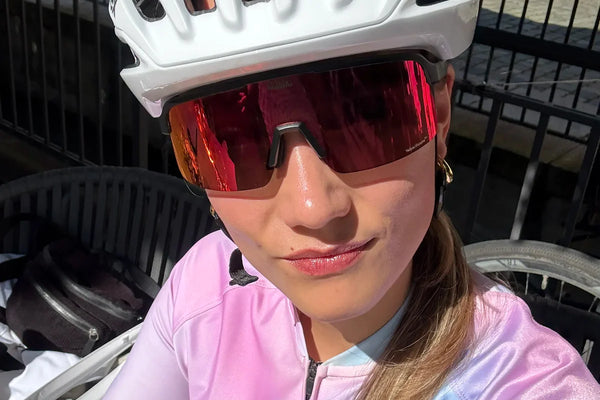
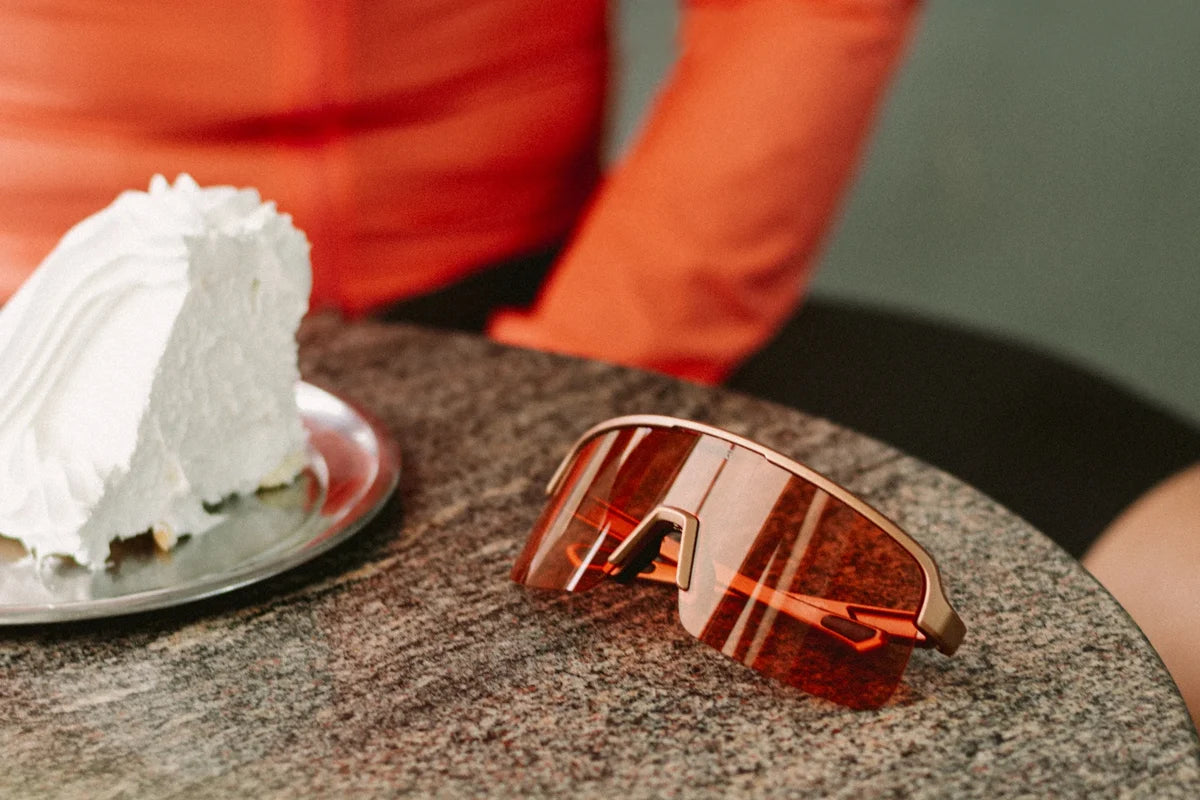
The Velluto StradaPro is the frame this guide places alongside the Rydon and Keyblade. It weighs 25 g, carries UV400-certified interchangeable lenses, a built-in anti-fog system and adjustable nose pads, and it comes with a 30-day risk-free trial. Those are the facts this comparison is built on. No invented lab scores, no borrowed editorial stars: just the specs both brands publish and the riding conditions that separate good eyewear from great.
01 · Why LookWhy Look for a Rudy Project Alternative at All?
Searching for a Rudy Project alternative does not mean Rudy Project has done something wrong. It usually means one of three things: the price point of the Rydon or Keyblade sits above your current budget; you want a specific combination of weight, lens system and fit that differs from what Rudy Project prioritises; or you simply want to know what else exists before committing. All three are reasonable starting points for a serious cyclist.
The performance cycling eyewear market in 2026 is more competitive than it has ever been. Brands that did not exist a decade ago are producing frames with UV400 certification, sub-30-gram weights and click-in lens systems that would have seemed premium-tier five years ago. The question is no longer whether alternatives can perform. The question is which ones perform on the combination of features you personally care about.
For road cycling specifically, those features tend to cluster around a short list. Optical clarity under UV400 certification. Frame weight, because anything that sits on your face for four or five hours needs to disappear after the first twenty minutes. Lens adaptability, because late-summer rides in Europe move through four or five distinct light conditions in a single day. Anti-fog performance on climbs. Fit security when your heart rate is up and your head is down in an aero position. And, increasingly, the ability to try before you fully commit.
Rudy Project addresses these with their ErgoIV temple adjustment system, Impactx photochromic lens technology (on selected models) and RX-ready inserts for riders who need corrective lenses. These are genuine advantages worth naming. Any comparison that does not acknowledge them is not a fair one, and an unfair comparison helps no cyclist make a better decision.
The best cycling glasses are the ones you forget are there after the first climb. Everything else is a bonus.Road cycling principle, backed by every long-distance sportive rider who has stopped mid-descent to adjust a slipping frame
02 · Rudy ProjectWhat Rudy Project Does Genuinely Well
The Rydon is Rudy Project's most recognised road frame. It has been a staple in the peloton and on gran fondo start lines for long enough that its silhouette is almost shorthand for performance cycling eyewear. The ErgoIV temple adjustment system is a real feature: the temples can be bent to match individual head shapes without heat tools, which is meaningful for riders with non-standard head widths or who have struggled with conventional temple fit. The nose piece is also adjustable, giving a second axis of fit customisation.
The Keyblade is the more contemporary sibling: a wider lens, a more aerodynamic profile and a shield-style aesthetic that suits riders who want maximum coverage. Rudy Project makes both frames RX-ready, meaning they can be configured with an optical insert for riders who need corrective lenses. This is a specific and valuable feature for a segment of cyclists who otherwise face limited options.
Rudy Project offers photochromic lens options on selected models, allowing automatic lens darkening as light conditions change. For riders who want a single-lens solution rather than a manual swap, this is a genuine convenience. The brand's history in pro cycling means their frames have been refined across real racing environments, and the Rydon in particular benefits from that long feedback loop.
None of these things are contested here. The Rydon and Keyblade are excellent frames with real, documented advantages. The more useful question is: which of those advantages matter most to you, and are there other ways to get the ones you care about?

03 · StradaProThe Velluto StradaPro: Specs That Stand on Their Own
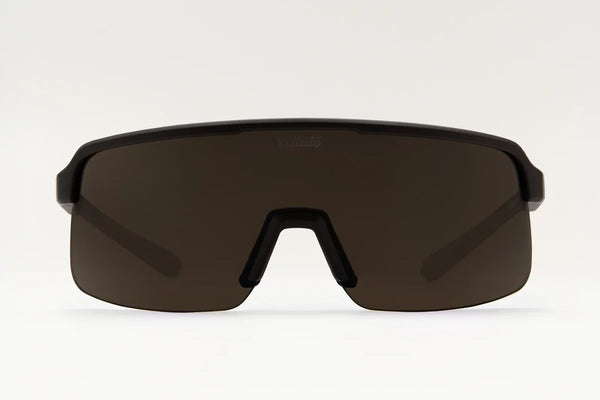
The Velluto StradaPro is a German brand with Italian design. That combination is not accidental: the Italian design language gives the frame its proportions and colour palette (Arancia, Espresso, Nero, Viola), and the German engineering discipline pushes the frame weight down to 25 g and keeps the lens system precise enough to click in and out without tools or wobble.
The 25 g figure is worth pausing on. Most road cycling frames sit in the 25 to 35 gram range; the lighter end of that range is where you stop feeling the frame on descents and start feeling only the wind. At 25 g, the StradaPro sits at the lighter end of that window without sacrificing structural integrity for the claim. The adjustable nose pads and the geometric fit of the temples mean the frame can sit correctly on a range of face shapes without needing manual bending or heat shaping.
UV400 certification means the lenses block 100% of UVA and UVB radiation. This is not a marketing claim: it is a measurable standard that the lenses either meet or do not. The StradaPro's lenses meet it, across both available options.
The built-in anti-fog system is relevant for late-summer riding in particular. When you drop from a sun-baked plateau into a shaded valley, or when you push into a long climb and your core temperature rises faster than the air temperature around you, single-lens systems with no active ventilation management can fog. The StradaPro's anti-fog system keeps the optical surface clear through those transitions.
04 · Lens SystemInterchangeable Lenses: How the Click-In System Works
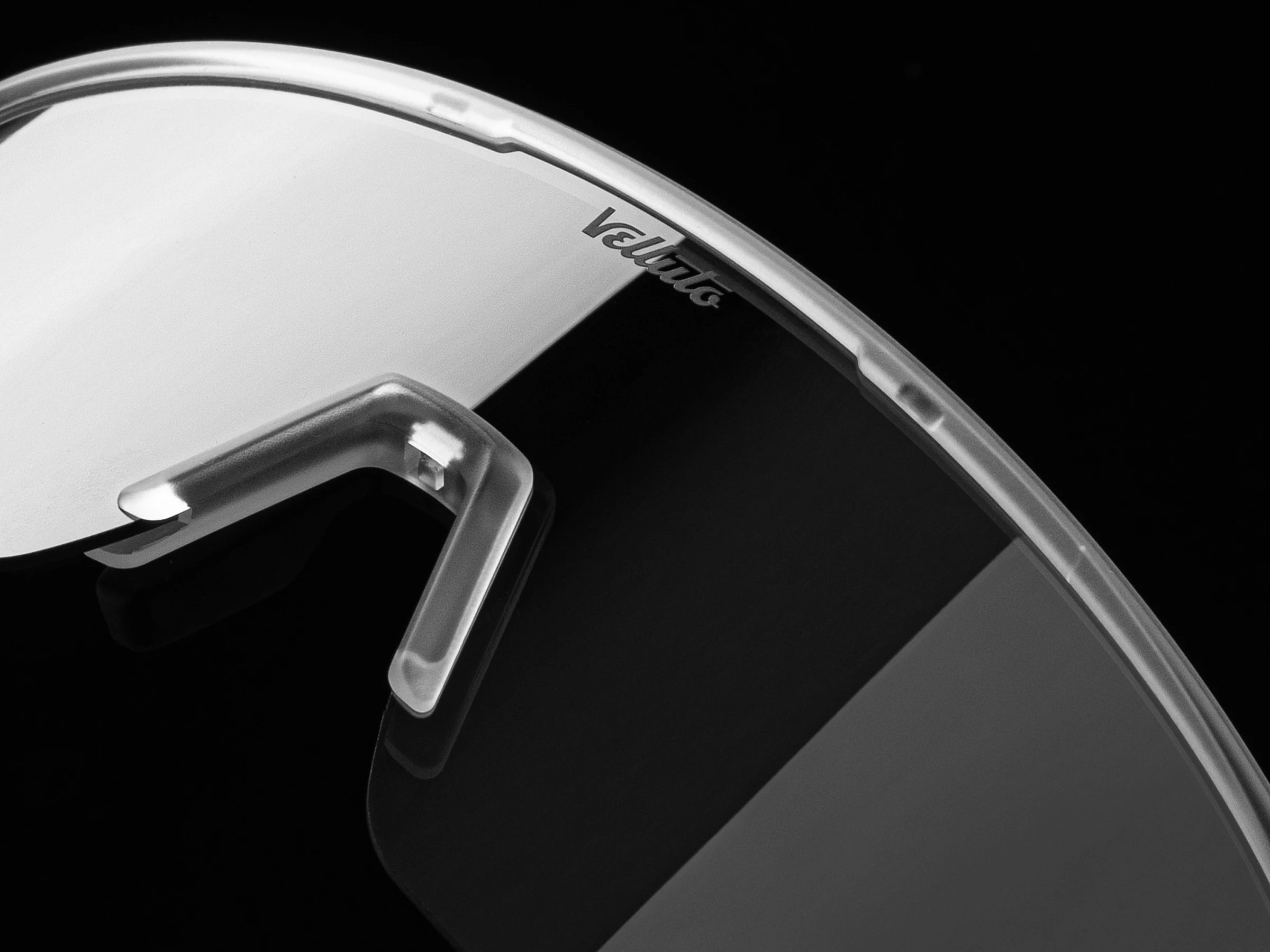
The StradaPro is compatible with two lenses: VellutoPuro and VellutoVisione. Both use the same click-in system, and both are UV400 certified. The swap is tool-free and takes seconds, which makes it practical at a cafe stop or at the bottom of a climb rather than a decision you make before leaving the house and then regret by mid-afternoon.
VellutoPuro is the clear lens. It is optimised for road cycling, designed primarily to defend against wind and insects, and UV400 certified despite its transparency. Clear lenses often look like a compromise, but for low-light starts, overcast days and tunnel sections on alpine routes, they are the right optical choice rather than a fallback. Fog resistance is built into this lens as well.
VellutoVisione is the high-contrast lens. The VellutoVisione technology sharpens contrast and visual definition, which is specifically useful for reading road surface texture on fast descents and picking out gravel lines on mixed-surface sportive routes. Where a standard tinted lens reduces light uniformly, a high-contrast lens redistributes visual information in a way that makes the road ahead feel more three-dimensional.
Rudy Project's approach to lens variety is different: they offer multiple tint options and, on selected models, photochromic lenses that adapt automatically. If you want a single lens that handles a full range of light without any manual intervention, Rudy Project's photochromic option is genuinely convenient. If you prefer to choose your lens based on the day's forecast and swap in seconds at the trailhead or car park, the StradaPro's click-in system gives you that control directly.

05 · Head-to-HeadRudy Project Rydon vs Velluto StradaPro: Spec Comparison
The table below compares published specs across the features that matter most for road cycling. Every figure in the Rudy Project column comes from Rudy Project's own published product information; check their current spec pages before purchasing, as product ranges evolve. Every figure in the Velluto column is documented and verified.
| Feature | Rudy Project Rydon | Velluto StradaPro |
|---|---|---|
| Frame design origin | Italian design | Italian design |
| UV protection | UV400 | UV400 certified |
| Lens system | Interchangeable (multiple tints, photochromic options) | Click-in interchangeable (VellutoPuro clear, VellutoVisione high-contrast) |
| Anti-fog | Ventilation-based | Built-in anti-fog system |
| Nose pad | Adjustable | Adjustable |
| Temple adjustment | ErgoIV adjustable temples | Geometric fit, adjustable nose pad |
| RX-ready option | Yes (optical insert) | Not available |
| Trial period | See manufacturer | 30-day risk-free trial |
| Brand origin | Italian brand | German brand, Italian design |
A few notes on reading this table honestly. The RX-ready row is the clearest structural difference: Rudy Project offers it, Velluto does not. If corrective-lens compatibility is a requirement for you, that row resolves the comparison quickly. The lens system row reflects a genuine philosophical difference: Rudy Project's photochromic option automates light adaptation, while Velluto's click-in system gives you manual, deliberate control over which optical profile you are riding with. Neither approach is objectively superior; they suit different rider preferences and habits.
The anti-fog row uses different vocabulary because the underlying approaches differ: ventilation manages airflow through the frame, and the StradaPro's built-in anti-fog system adds a coating-and-design layer on top of that. In practice, both can produce clear lenses on climbs; the relevant question is how each performs in the specific conditions you ride most often.

06 · FitFit Over Long Rides: Nose Pads, Temple Pressure and the Hours That Test Glasses
Fit is the feature that most buyers underestimate in the first kilometre and most riders overestimate the importance of in a shop. In a shop, any frame feels fine. At kilometre 120 of a late-summer sportive, with a temperature inversion keeping the summit 12 degrees cooler than the valley, a frame that was "fine" earlier in the day has revealed itself one way or the other.
The points of contact that matter on a long ride are the nose bridge and the temples. Nose pads that are too high create pressure on the nose bone over several hours; nose pads that are too low allow the frame to slide down during climbs, which is both annoying and potentially dangerous on a descent that immediately follows. Temple pressure behind the ears is less acute but equally cumulative: a frame that presses against the mastoid bone or the cartilage at the top of the ear becomes genuinely uncomfortable after the third hour.
The StradaPro addresses both with adjustable nose pads, which let you move the contact point to match your nose bridge geometry, and a temple design calibrated for the geometry of a road cyclist's head position: chin down, eyes forward, not the upright position a shop mirror tends to flatter. Rudy Project's ErgoIV system takes a different but equally considered approach, allowing the temple itself to be physically adjusted to match head width and the angle of the ear. Both systems are genuine attempts to solve the same problem; they differ in which axis of adjustment they prioritise.
The StradaPro weighs 25 g. The direct practical consequence of that number is that the frame exerts less downward force on the nose bridge over a long ride. This is not a small thing if you have spent an afternoon riding with a 35 g frame. The difference is not dramatic at kilometre 10. It is noticeable at kilometre 100.
You need an RX-ready optical insert for corrective lenses, you prefer photochromic lenses for automatic light adaptation, or you have a non-standard head width that benefits from ErgoIV temple bending.
You want a 25 g frame with UV400-certified click-in lenses, a built-in anti-fog system and a 30-day risk-free trial that lets you test on real rides before fully committing.
Italian design heritage, UV400 protection, interchangeable lens systems, adjustable nose pads and a clear performance-cycling focus rather than a lifestyle or casual-wear positioning.
Do you need corrective-lens compatibility or automated photochromic adaptation? If yes, Rudy Project's architecture serves that need directly. If not, compare the two on weight, anti-fog and trial policy.
07 · Anti-FogAnti-Fog Performance on Vuelta-Style Climbs and Late-Summer Sportives
August and September in Europe are the months that reveal whether an anti-fog claim is genuine or aspirational. The Vuelta a España runs through this window for a reason: the Spanish summer produces exactly the conditions that stress eyewear most. Valley temperatures in the high thirties, summit temperatures that can drop to single digits, humidity that changes with altitude faster than a rider's exertion level does. An eyewear frame that fogs on the Angliru or the Lagos de Covadonga is not just uncomfortable; it is a safety issue.
The StradaPro's built-in anti-fog system is designed for this specific problem: not fogging in a controlled environment, but staying clear when temperature and humidity differentials shift quickly. The anti-fog treatment works in combination with the frame's ventilation geometry to keep air moving across the inner lens surface. The result is that the lens stays optically clear through the temperature drop that happens when a ride transitions from exposed col to shaded descent.
This matters for sportive riders as much as for racers. A gran fondo in Andalusia, the Pyrenees or the Alps in late summer will put your glasses through the same sequence of conditions a Vuelta stage does, at a somewhat lower speed. The difference is that a professional rider has a mechanic and a spare set of glasses in the team car; you have what is on your face and what is in your jersey pocket. A frame with a reliable built-in anti-fog system reduces the number of times you have to stop and wipe.
Rudy Project addresses fogging through ventilation design in the Rydon and Keyblade frames. Ventilation-based anti-fog is effective in motion; it relies on airflow across the lens surface to prevent condensation. In high-humidity, low-speed conditions (the early kilometres of a long climb, for instance), airflow-only systems can occasionally struggle. The StradaPro's built-in system adds a layer of active fog management beyond airflow alone.

08 · ColoursColour, Design Language and the Italian Connection
Both Velluto and Rudy Project draw on Italian design as a reference point, and it shows in the frame aesthetics of both brands. Italian cycling design has a specific visual grammar: proportions that are refined without being minimal, colour names that gesture toward materials and landscapes rather than colour-chart codes, a sense that the frame should look at home on a road bike and nothing else.
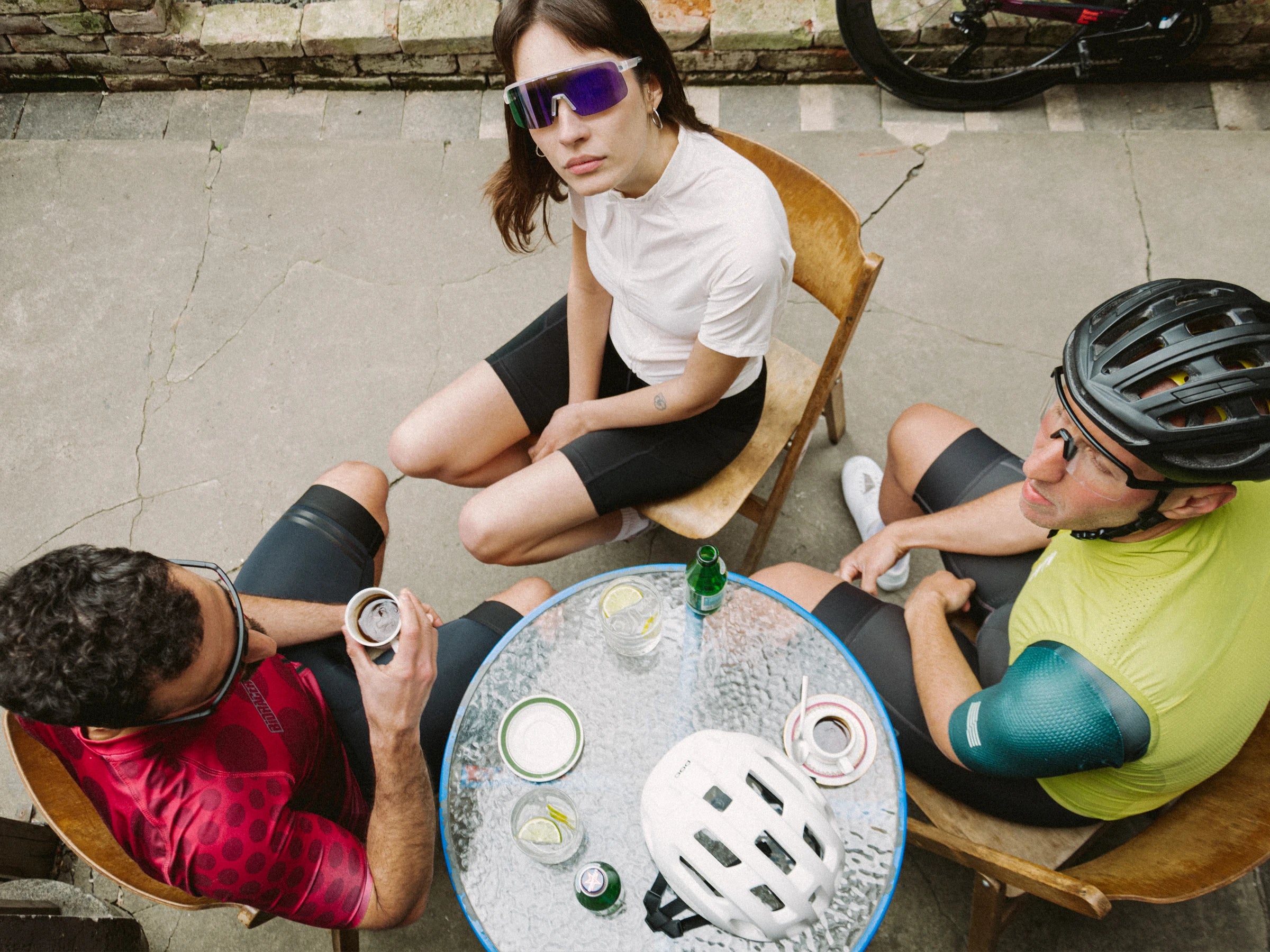
The StradaPro comes in four colours. Arancia is the orange variant: warm, visible and the colour closest to a classic Italian cycling aesthetic, the shade of certain team kit that has won races in the mountains for decades. Espresso is the brown variant: understated, compatible with a wide range of bike finishes, the colour that looks better in person than any photograph captures. Nero is the black variant: versatile, serious, the one that disappears into a frame without drawing attention to itself. Viola is the purple variant: distinctive, less common in the road cycling market and, for riders who want their eyewear to be a deliberate choice rather than a default, the most interesting option in the range.
All four colours share the same 25 g frame, the same UV400-certified lens system, the same click-in compatibility for VellutoPuro and VellutoVisione, and the same adjustable nose pads. The colour decision is genuinely stylistic rather than a compromise on any performance specification.


09 · AccessoriesWhat Comes With the Frame and What You Can Add
A cycling glasses purchase rarely ends at the frame. The things you use to store, clean and transport your glasses over months and years of riding are as relevant to the long-term experience as the frame specs themselves.
Velluto offers a hard case with an anti-crash guarantee and a velvet finish. For cyclists who transport their glasses in a jersey pocket, a handlebar bag or a kit bag that shares space with shoes and a helmet, a hard case is not optional; it is the difference between glasses that last three seasons and glasses that last one. The velvet interior is a detail that matters when the case is closed: it keeps the lens surface free of the micro-abrasions that accumulate from a case interior that moves against the optical surface during transport.
The Velluto Cleaning Spray is a 50 ml, apple-fragranced, refillable spray made in Germany. The 25 x 25 cm microfiber cloth that accompanies the range (80% polyester, 20% polyamide) is the correct tool for the lens surface rather than a jersey hem, which is where most riders clean their lenses mid-ride because no better option was immediately available. Having the right cloth in a pocket is a small thing that changes how you interact with your glasses over the course of a long day.

10 · RiskThe 30-Day Trial: Why It Changes the Decision
Most cycling glasses are bought and kept regardless of whether they turn out to be the right fit, because returning them is inconvenient and the alternative is admitting the purchase was wrong. The result is that a significant percentage of cyclists are riding with glasses that are slightly too heavy, slightly too tight or slightly too foggy for their actual riding style, because the friction of the return process was greater than the discomfort of the glasses.
Velluto's 30-day risk-free trial eliminates that friction. You receive the glasses, you ride with them on actual routes in actual conditions, and if after 30 days they are not the right frame for your face and your riding, you return them. This is not a policy that costs Velluto nothing; it is a policy that reflects confidence in the frame performing as advertised on real rides rather than on the stand in a shop.
For a frame you are considering as an alternative to Rudy Project, which you may have ridden with for years and which fits your face in a specific way that a new frame needs to match or improve on, a trial period is precisely the right mechanism. You cannot know whether 25 g feels like the right weight on your nose until you have ridden 80 kilometres with it. You cannot know whether the anti-fog system handles your specific micro-climate until you have descended a col with it. The 30-day trial is how you find out those things with no permanent commitment.
Orders qualify for free shipping from 89 EUR onwards, which covers purchase bundles that include the frame and both lens options together.

11 · Market ContextWhere the StradaPro Sits in the 2026 Road Cycling Eyewear Market
The premium road cycling eyewear market in 2026 covers a wide range of price points and positioning. At one end, brands with decades of professional race sponsorship and global distribution networks carry their heritage as part of the price. At the other end, newer brands have entered with specific technical claims and lower price points, with varying degrees of substance behind them.
The StradaPro sits in a specific position within this range: a frame that leads with verifiable specs (25 g, UV400 certified, built-in anti-fog, click-in dual-lens system) and a starting price of from 69 EUR, backed by a 30-day trial rather than a marketing promise. That combination is where the value proposition is clearest: you are buying a frame with documented performance specs and a genuine mechanism to verify that they work for your riding.
Rudy Project's Rydon and Keyblade sit at a higher price point and carry the weight of their professional racing history and their broader lens ecosystem. For riders for whom that context matters, and for whom the RX-ready option or Impactx photochromic lens is a specific requirement, Rudy Project's pricing reflects capabilities the StradaPro does not replicate.
For riders who do not need those specific features and are looking for a frame that performs on the metrics of pure road cycling use, the StradaPro's combination of weight, UV certification, anti-fog performance and trial period makes it a compelling alternative rather than a compromise. Those are different things, and the distinction is worth holding clearly.
Other brands in the 2026 market worth being aware of in this comparison context include Oakley (particularly the Sutro Lite and Radar EV Path, which are well-distributed and widely reviewed), SunGod (known for strong colour customisation and a direct-to-consumer model), Tifosi (competitive at the more accessible price point) and 100% (strong in the gravel and cross-country cycling segment). Each of these occupies a distinct position, and none of them maps exactly onto either Rudy Project or Velluto in their combination of features, price and trial policy.
Compare the full lineup in the Velluto StradaPro cycling glasses collection.
12 · FAQFrequently Asked Questions
Is the Velluto StradaPro a good Rudy Project alternative for road cycling?
How does the StradaPro weight compare to Rudy Project frames?
Does the Velluto StradaPro have interchangeable lenses?
Can I use the StradaPro in low-light or early-morning rides?
Does the Velluto StradaPro have anti-fog protection?
What colours does the StradaPro come in?
What lens options does Velluto offer?
Is there a risk-free way to try the StradaPro before committing?
Are the StradaPro nose pads adjustable?
If you are at the point in the comparison where the specs make sense and you want to know how the StradaPro actually feels on your face over a real route in real conditions, the 30-day trial is the next step. Explore the full range and both lens options at velluto-shop.com.