MTB Cycling Glasses: What to Look for in 2026
Contents23 min read
You drop into the first steep section of trail, momentum building fast, tree canopy closing overhead. Within thirty seconds your glasses have fogged from the climb you just finished, a root catches your front wheel, and the light shifts from bright to dark in less than a bike length. This is the environment that exposes the difference between cycling glasses designed around real-world demands and those built to look good in a product photo.
The conversation around MTB cycling glasses has become more complicated in recent years. Dedicated trail riders want wraparound coverage, impact resistance, and fog-free optics. Gravel riders crossing between tarmac and singletrack want something lighter and more versatile. Cross-country racers want a frame that sits cleanly under a helmet without adding grams or shifting under vibration. The result is a category that is not one thing at all, but three or four different use cases wearing the same label.
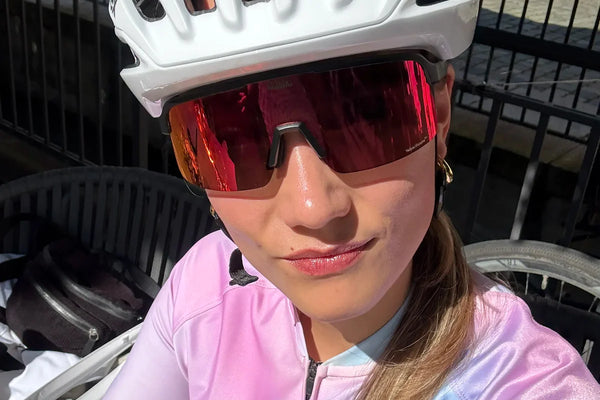
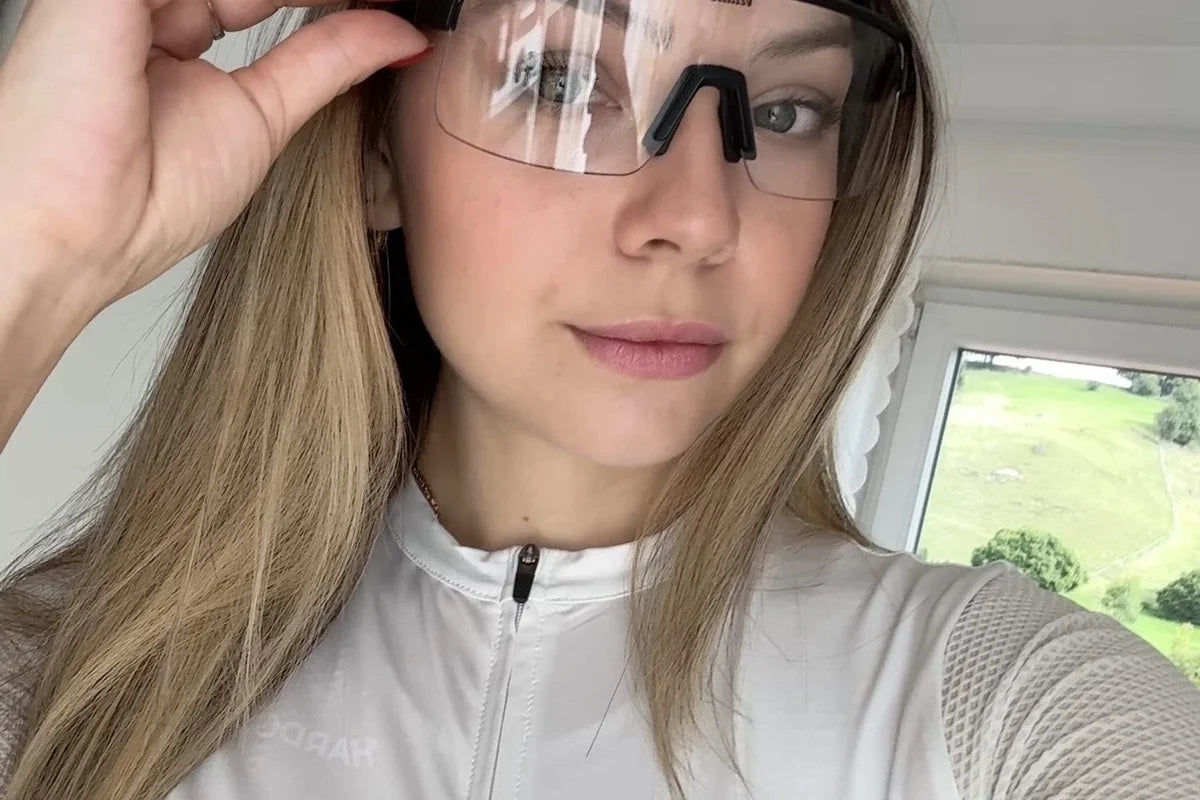
This guide is built around the specific demands of mountain biking and gravel riding: what those demands actually are, which specifications matter, which are marketing noise, and where a performance road frame like the Velluto StradaPro sits within that picture. The StradaPro was designed for road cycling, but its 25-gram weight, built-in anti-fog system, and tool-free interchangeable lens system make it a legitimate option for any rider who moves between surfaces. We will be specific about where it excels off-road, and honest about the context in which a purpose-built trail goggle makes more sense.
01 · The MTB EnvironmentWhat Trail Riding Actually Demands from Your Eyewear
Road cycling glasses are optimised around one set of conditions: sustained speed, consistent airflow, bright to overcast light, and a relatively predictable debris environment. The threats are wind, UV radiation, and the occasional insect. The design response is a large, ventilated lens that maximises forward vision while keeping air moving across the face to prevent fogging.
Mountain biking changes almost every one of those variables. Average speeds on singletrack are lower than on road, which means less airflow across the lens, which means the anti-fog equation becomes harder to solve. Exertion levels spike sharply on short climbs before dropping just as fast on technical descents, creating rapid temperature swings that produce condensation on cold lens surfaces. The debris environment is richer and more varied: dust, fine grit, trail spray, low branches, and insects that the slower speed does not help you avoid. And the light environment is more dynamic: open hillside to deep forest canopy in seconds, with the eye needing to adapt quickly at precisely the moment that concentration on trail features is highest.
The wide field of view that matters on the road matters even more off it. Peripheral awareness on a technical descent, catching movement at the edge of vision, seeing the drop-off that is just outside where your eyes are focused: these are not abstract performance gains. They are the difference between a clean run and a crash. A lens that cuts off vision at 30 degrees either side is genuinely limiting in a way that most road riders never notice.
Fit security is a third variable that road riding underweights. On smooth tarmac, a lightly fitted frame is comfortable and causes no problems. Hit a rocky section at 15 km/h and the vibration transmitted through the bike and into every contact point on your body, including your face, will shift a poorly fitted frame in ways that require you to adjust it mid-descent. A nose pad system that locks the frame in place regardless of vibration is not a nice-to-have for trail riding. It is a functional requirement.
02 · Anti-FogThe Feature That Separates Trail Glasses from Road Glasses
Ask any mountain biker what their single biggest frustration with cycling glasses is and the answer is almost always the same: fogging. It is a problem that road cyclists encounter occasionally, typically on long climbs in cold or humid weather. For trail riders it is endemic. Every steep climb produces it. Every transition from sun to shade can trigger it. Every stop to check a trail map or reset after a technical section creates the conditions for it.
The mechanics are simple. Warm, humid air from exertion meets a lens surface that has been cooled by airflow, or more commonly on trails, by the absence of airflow. Condensation forms. Vision degrades. At 40 km/h on road you might push through it. At 12 km/h on a rooted descent it is dangerous.
There are two main engineering responses to this problem. The first is ventilation geometry: designing the frame so that warm air has a clear exit path rather than accumulating behind the lens. The second is lens treatment: applying an anti-fog coating that prevents condensation from beading and obscuring vision even when some moisture is present. The StradaPro uses both. The built-in anti-fog system combines frame ventilation design with lens treatment to address the problem structurally rather than hoping that airflow alone will be sufficient.
This matters more at trail speeds than at road speeds. At 35 km/h on a long climb, airflow across the lens is usually enough to prevent fogging in all but the most extreme humidity. At 8 km/h on a switchback climb through dense forest, there is no such airflow. The anti-fog system has to work independently of speed, and the StradaPro's dual approach is built for exactly that condition.

03 · Lens ChoiceVellutoPuro vs VellutoVisione for Off-Road Riding
The lens decision for mountain biking is more consequential than on the road, because the light environment is more variable and the consequences of visual errors are more immediate. A road cyclist who misjudges a patch of road surface at speed has tarmac to deal with. A trail rider who fails to read a root or a loose rock in time has significantly worse options.
The Velluto StradaPro is compatible with two interchangeable lenses, both available through the click-in system: VellutoPuro and VellutoVisione.
VellutoPuro is the clear lens. Its primary value for mountain biking is in low-light conditions: pre-dawn trail starts, heavily wooded singletrack where the canopy reduces ambient light significantly, and overcast late-summer days where a tinted lens would leave you underlit. It provides full UV400 protection and anti-fog performance in a completely clear optic, meaning you get the physical protection from debris and wind without any light attenuation. For riders whose trails run through deep forest or who ride early and late in the day, VellutoPuro is the right choice.
VellutoVisione is the high-contrast lens. The VellutoVisione technology sharpens contrast and visual definition, which translates directly into better trail reading at lower speeds. The texture of a loose surface, the shadow that indicates a drop, the subtle change in colour that signals wet rock rather than dry: these are the visual cues that experienced trail riders process in fractions of a second, and a lens that enhances contrast makes those cues more legible. For open terrain, mixed light, and the kind of late-summer riding that the Vuelta season brings, VellutoVisione is the stronger MTB choice.
The click-in system is tool-free and takes seconds. This means you can match the lens to the trail rather than compromising. A morning ride that starts before dawn and finishes in full sun does not require a choice between VellutoPuro and VellutoVisione. It requires both, with a lens swap at the trailhead when the light changes. The StradaPro is built to make that swap so fast it is not a consideration.
You are riding in wooded or shaded terrain, starting before full daylight, or in conditions where maximum light transmission is the priority. Clear optics, full debris and wind protection, UV400 certified.
You are riding open terrain, mixed light conditions, or any trail where surface contrast matters for line choice. The high-contrast technology sharpens the visual detail that trail reading depends on.
The click-in lens swap takes seconds without tools. A late-summer trail ride that starts in shade and finishes on exposed moorland benefits from both lenses. One frame, two lenses, one small jersey pocket.
Both VellutoPuro and VellutoVisione carry UV400 certification, blocking 100% of UVA and UVB radiation. At altitude or on exposed ridgelines, this baseline protection applies regardless of which lens is fitted.
04 · Weight and FitWhy 25 Grams Matters More on Trail Than on Road
The weight conversation in cycling equipment tends to focus on the bike. Frames, wheels, groupsets: these are where grams command significant attention and significant price premiums. Eyewear weight is discussed less, but for trail riders it matters in a specific way that road riders rarely encounter.
On smooth tarmac, a heavier frame sits on the nose and stays there. Gravity acts on it predictably and the absence of vibration means it does not move. The discomfort of a heavier frame on a long road ride is real but manageable: it is a persistent low-level pressure rather than an active performance problem.
On trail, the equation changes. Vibration transmitted through the bike reaches the rider's face and interacts with the mass of the glasses in a way that produces movement. A heavier frame shifts more, requires more grip to stay in place, and eventually requires the rider to use a hand to adjust it at the least convenient moment. A lighter frame, particularly one with an effective nose pad system, has less tendency to shift because there is simply less mass for the vibration to act on.
At 25 grams, the StradaPro sits at the lightweight end of the performance cycling glasses spectrum. That number is not incidental. It is the result of the frame geometry and material choices that define the design brief. Paired with the adjustable nose pad system that allows a precise, personalised fit, the result is a frame that stays where it is placed regardless of what the trail is doing beneath you.
The adjustable nose pad also matters for the interface with an MTB helmet. Trail helmets differ from road helmets in their coverage and strap routing. A nose pad that can be precisely positioned allows the frame to sit close to the face and flat to the cheeks in a way that works with the helmet geometry rather than against it. There is no temple pressure from straps, and the frame does not ride up the nose when you look down at the trail.
At 25 grams, the frame has less mass for trail vibration to act on. It stays where you put it, from the first switchback to the last descent.Velluto Product Brief, StradaPro
05 · Road vs MTB GlassesWhat the Category Difference Actually Means for Buying Decisions
The cycling eyewear market broadly divides into three segments: road performance glasses, dedicated trail goggles, and hybrid or multi-sport glasses. Each has a genuine use case, and the honest answer about which one is right for a given rider depends on the specifics of their riding.
Dedicated trail goggles, of the kind used in enduro and downhill disciplines, offer the maximum in impact protection and debris coverage. Full-face coverage, foam gaskets for dusty conditions, and impact-rated polycarbonate lenses designed to absorb rather than deflect significant strikes. These are the right tool for high-speed descending on gnarly terrain, particularly in race or race-adjacent contexts where the speed and consequence of a fall are both elevated. They are not, however, lightweight or particularly comfortable for multi-hour rides that involve significant climbing.
Road performance glasses, of which the StradaPro is a premium example, prioritise weight, optics, and ventilation. They are designed around the physiological reality of sustained aerobic effort: the face gets warm, airflow is important, and the rider's head is relatively stable. The field of view is optimised for looking ahead and into corners at speed. The UV400 certification is non-negotiable. The lens system is built around changing light conditions on rides that can last four to six hours.
The hybrid space is where most cross-country mountain bikers, gravel riders, and trail cyclists who also ride road actually live. They want something lighter and more breathable than a goggle, more protective than a minimal road lens, and adaptable enough to work across the range of conditions their riding covers. The StradaPro is genuinely positioned here. Its anti-fog system, interchangeable lenses, 25-gram weight, and adjustable fit address the core requirements of trail riding without the bulk of a goggle and without sacrificing the optical quality and UV protection that long road rides require.
The honest caveat is this: if your mountain biking involves steep technical descending at significant speed, regular exposure to flying rocks or heavy vegetation, or the kind of conditions where eye impact protection is the primary concern, a purpose-built goggle is the safer choice. The StradaPro is built for performance, not impact absorption. For cross-country, gravel, sportive, and trail riding where the conditions are challenging but not extreme, it is an excellent option. For enduro or downhill racing, look at a full goggle.

06 · The Interchangeable Lens SystemOne Frame for Every Trail Condition
The interchangeable lens system is one of the most practically useful features in modern cycling eyewear, and it is more useful off-road than on it. The reason is simple: the light environment on trail is more variable, changes faster, and has more direct consequences for riding quality than on the road.
A road cyclist riding a six-hour sportive in August can generally select one lens in the morning and trust that the conditions will not deviate so far from the original choice that the lens becomes a liability. Overcast becomes partly cloudy. The light shifts, but slowly and predictably. The worst outcome of the wrong lens choice is some minor visual discomfort.
A trail rider doing a four-hour loop that starts on exposed moorland, drops into a forested river valley, climbs back out through mixed woodland, and finishes on open hillside is riding through four essentially different optical environments in a single session. The lens that works perfectly on the exposed climb becomes inadequate in the forest section. The lens that gives maximum clarity in the trees leaves you slightly squinting on the ridgeline.
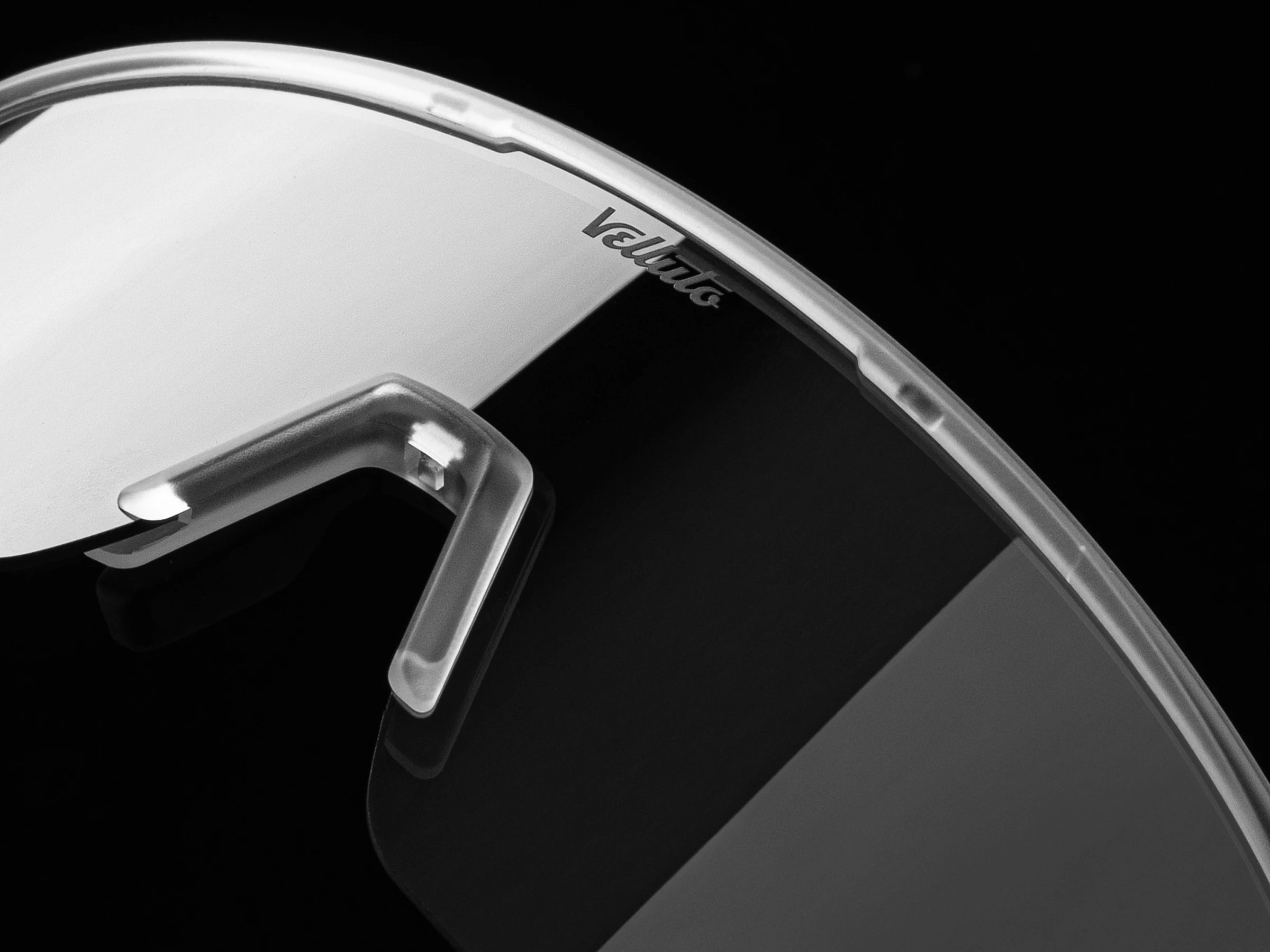
The StradaPro's click-in system addresses this by making the lens swap genuinely fast and genuinely tool-free. There is no fumbling with magnets that weaken over time, no screwdriver required, no instruction manual needed on the trail. The VellutoVisione and VellutoPuro lenses click in and out in seconds. The practical result is that you can carry both lenses, swap at the point where the light environment changes significantly, and always be working with the right optic for the conditions.
The system also extends the useful life of the frame. Rather than buying a second pair of glasses optimised for a different light condition, you buy the additional lens. One frame works across all conditions. For riders who move between road and trail, between early morning and midday, between summer and autumn riding, this is a significant practical and financial advantage.
Both lenses carry the same UV400 certification. There is no trade-off on protection when you choose between them. The difference is purely optical: contrast enhancement versus full transparency. The protection is always there, regardless of which lens is fitted.
07 · Late Summer MTB RidingThe Specific Demands of Vuelta Season Trail Riding
August on the trails in Central Europe, Scandinavia, or the mountain stages that shadow the Vuelta a España route presents a specific set of conditions that are worth addressing directly. Late summer trail riding has its own character, and it has implications for eyewear choice that are different from spring or autumn riding.
The UV index in August is at or near its annual peak in most of Northern and Central Europe. At altitude, which is where many of the best MTB trails are concentrated, UV intensity is meaningfully higher than at sea level, increasing by approximately 10 to 12 percent for every 1,000 metres of elevation. A long day in the mountains during Vuelta season is a high-UV environment that demands certified protection, not just tinting. UV400 certification means 100% of UVA and UVB radiation is blocked. It is the non-negotiable baseline for summer mountain riding.
Late summer trails also bring specific debris conditions. Dried vegetation, dust on unsurfaced trails, insects at their late-summer peak. The physical barrier function of the lens, which cyclists sometimes undervalue relative to the optical properties, matters more in these conditions. A lens that provides full eye coverage protects not only against UV but against all of the physical debris that late-summer trail riding generates.
The light conditions in August also shift noticeably toward the end of the month. Rides that earlier in summer would have been comfortably within daylight are now ending in lower light. The versatility of carrying VellutoPuro alongside VellutoVisione becomes more valuable as the season progresses and the window of high-quality trail light narrows. Starting a late-afternoon ride with VellutoVisione for the exposed sections and having VellutoPuro available for the forest sections in fading light is not an unusual scenario by late August.
Temperature variation is another late-summer factor. August mornings in the mountains can be cold enough that anti-fog performance matters on the first descent of the day, even if the afternoon ride is warm. A built-in anti-fog system that works independently of ambient temperature provides consistent performance across the full arc of a late-summer ride, from cold start to warm finish.

08 · Buying CriteriaHow to Choose MTB Cycling Glasses That Actually Work
The eyewear market for cyclists is large, and the claims made within it are often imprecise. Weight figures appear without context. "Anti-fog" appears as a label without any explanation of the mechanism. "High contrast" is used to describe lenses with meaningfully different optical technologies. The following criteria are the ones that actually determine performance for mountain biking and trail riding. Apply them to any glasses you are considering, including the StradaPro.
UV400 certification. This is the baseline and it should be non-negotiable. UV400 means the lens blocks 100% of ultraviolet radiation up to 400 nanometres, covering both UVA and UVB. Some glasses in the market offer UV380 protection, which leaves a gap in coverage for the wavelengths between 380 and 400 nm. For mountain riding where altitude amplifies UV intensity, the certified UV400 standard is the one to require. Both VellutoPuro and VellutoVisione are UV400 certified.
Anti-fog mechanism. The word "anti-fog" on packaging tells you nothing on its own. Ask what the mechanism is. A ventilation channel that relies entirely on airflow is less effective at trail speeds than a combined system that also uses lens treatment. The StradaPro uses both. This distinction matters practically on slow climbs and in humid forest conditions.
Field of view. Road glasses optimised for aerodynamics sometimes sacrifice peripheral vision. Trail riding requires peripheral awareness for obstacles, for other trail users, and for technical features at the edge of the rider's forward focus. Choose a frame geometry that does not cut off peripheral vision.
Fit security. Test the fit under vibration, not just static. A nose pad system with genuine adjustability allows a fit that is customised to face shape and maintains position through rough terrain. The StradaPro's adjustable nose pad system is not decorative. It is the mechanism by which the 25-gram frame stays in place on technical singletrack.
Lens interchangeability. For any rider who rides more than one type of trail or at more than one time of day, an interchangeable lens system extends the versatility of a single frame investment significantly. Evaluate the swap mechanism: tool-free is meaningfully more convenient than systems requiring tools or techniques that degrade over time.
Frame weight. Less mass means less tendency to shift under vibration and less cumulative fatigue on multi-hour rides. 25 grams is a specific, verifiable number. It is worth asking for the equivalent figure from any glasses you are comparing against.
Durability and storage. Trail riding is harder on equipment than road riding. A hard case that can absorb knocks in a pack or jersey pocket protects the lens from scratches that reduce optical quality. Velluto's hard case carries an anti-crash guarantee and fits the StradaPro with the lens fitted, which means you are not trading optical quality for transport convenience.

09 · The Full RangeStradaPro Colour Variants and What Each Brings to Trail Riding
The StradaPro is available in four colours, each sharing the same 25-gram frame, UV400 lens compatibility, anti-fog system, and adjustable nose pad. The choice between them is primarily aesthetic, but there are contextual reasons why certain colourways suit certain riders and riding conditions.
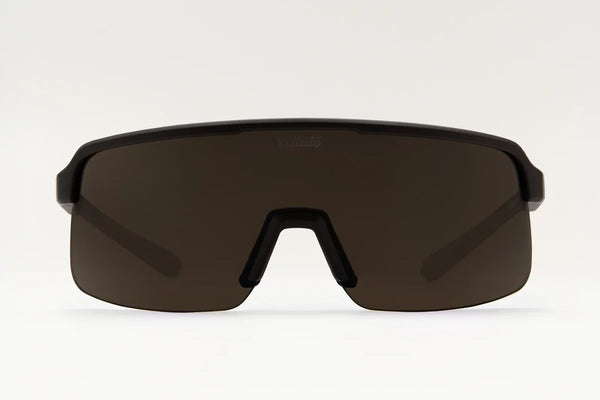
Nero is the clean, versatile option. The black colourway works across all light conditions visually and photographs well on the bike, which matters to riders who document their trail sessions. It is the least visually distinctive of the four but the most universally applicable.
Espresso is the warm-toned option, pairing well with natural trail environments and late-summer light. The brown frame suits the earthy palette of woodland trails and is a popular choice among riders who want something distinct from the standard black frame without committing to a brighter colour.
Arancia brings the strongest visual energy of the range. The orange colourway is visible in low light and in group riding situations, and it carries the warmth of late-summer riding. For riders who use their glasses as a colour accent in their kit, Arancia is the choice.
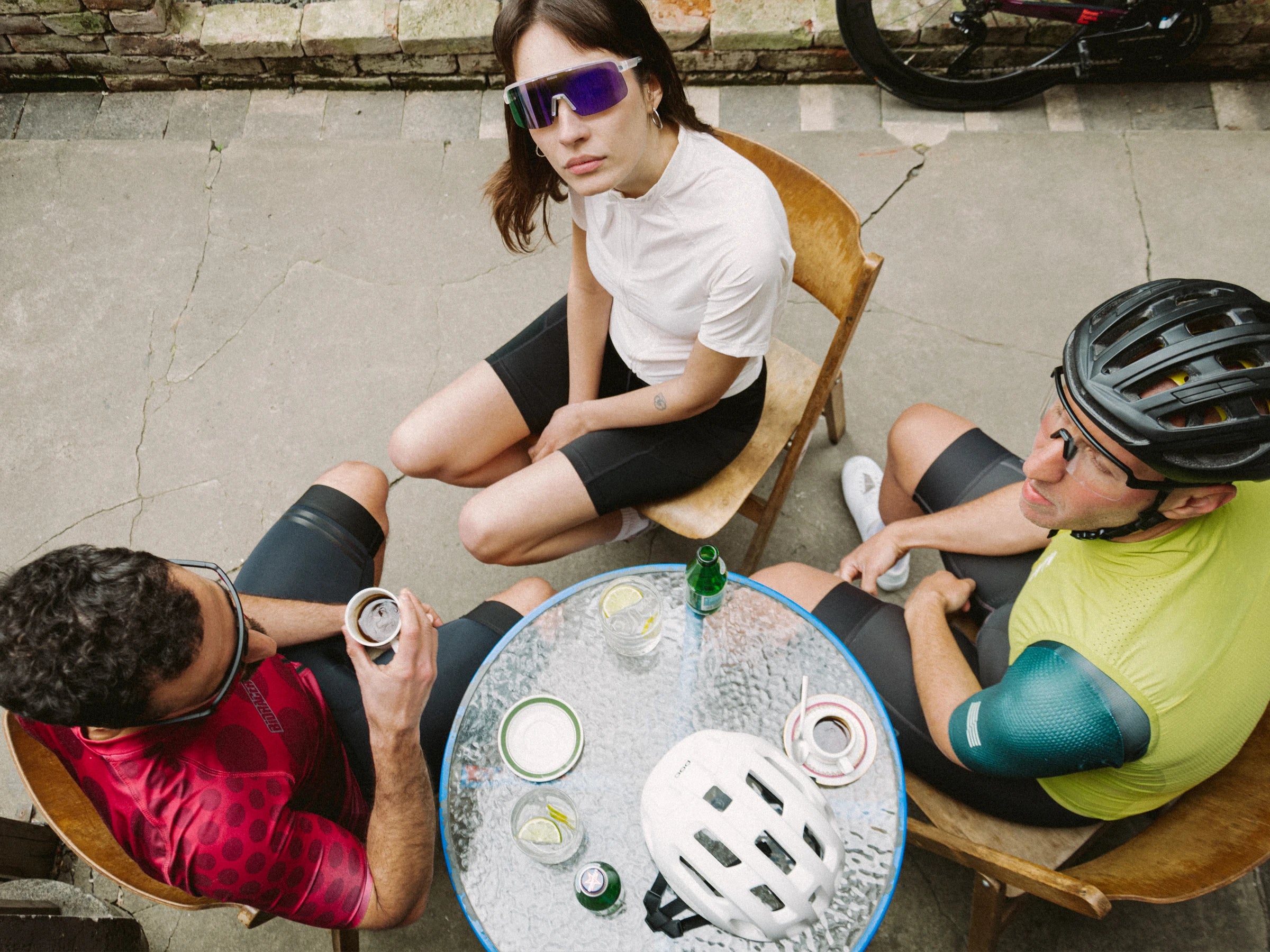
Viola is the most distinctive option in the range. Purple sits at the opposite end of the visual spectrum from the warm tones of trail environments and creates a strong contrast that suits riders who want their eyewear to be a deliberate design statement. The Viola colourway has particular resonance in a season when road cycling's most watched race is crossing the Castilian plateau in late-summer light.


10 · AccessoriesWhat Completes the MTB Eyewear Setup
The glasses are the primary investment, but the accessories that accompany them determine how well that investment holds up over time. On trail, the risk of lens scratches, frame impacts, and optical quality degradation from incorrect cleaning is higher than on road. Three accessories address these specifically.
The Velluto hard case carries an anti-crash guarantee and is sized to fit all road cycling glasses. On trail, glasses spend time in jersey pockets, in pack pockets alongside tools and food, and in transition zones where they are set down on whatever surface is available. A soft pouch absorbs light impacts. A hard case absorbs falls. For the StradaPro, which represents a genuine optical investment, the hard case is the correct storage choice.
The cleaning routine matters more on trail than on road because trail debris is coarser. Fine grit from unpaved surfaces can scratch a lens if wiped dry with a rough cloth. The Velluto microfibre cleaning cloth, 25 by 25 centimetres, 80% polyester and 20% polyamide, is the correct tool for removing trail debris from the lens surface. The Velluto cleaning spray, 50 millilitres, apple fragrance, refillable, and made in Germany, dissolves oily residue and insect debris without requiring the kind of dry-wiping pressure that causes microscopic scratches over time. Used together after every trail session, they maintain the optical quality of both lenses across months of regular riding.
The lens quality that makes the VellutoVisione contrast enhancement genuinely useful is a function of a clean, unscratched lens surface. Every scratch from improper cleaning or unprotected storage is a permanent reduction in the optical performance you paid for. The accessory investment is small relative to the glasses investment. The case and cloth are the insurance policy on the primary purchase.

Compare the full lineup in the Velluto StradaPro cycling glasses collection.
11 · FAQFrequently Asked Questions
Are road cycling glasses suitable for mountain biking?
What makes MTB cycling glasses different from road glasses?
Do the Velluto StradaPro glasses fit under an MTB helmet?
Which Velluto lens is better for mountain biking: VellutoPuro or VellutoVisione?
How does the anti-fog system work on singletrack?
Can I use one pair of glasses for both road and MTB rides?
How secure is the fit on rough terrain?
What UV protection do the Velluto StradaPro lenses provide?
What is the 30-day trial and how does it apply to MTB riders?
The StradaPro is not a goggle, and it does not claim to be. For the cross-country rider, the gravel adventurer, and the cyclist who wants one frame that works from road to trail without compromise, it is a considered, specific answer to a real set of demands. Thirty days of rides across every trail and light condition you can find is how you find out whether it is the right answer for you. Explore the full range and the interchangeable lens options at velluto-shop.com.